Alasitas – Bolivia

January 24

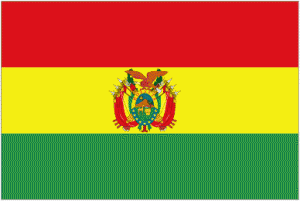
Today is the annual Alasitas festival in Bolivia’s capital city of La Paz.

Alasitas isn’t a Spanish word but an Aymara one. It means something akin to “Buy me.” And if you thought El Norte held a monopoly on consumerism, don’t put your money on it.

Alasitas is all about prosperity in the coming year. People buy miniatures of whatever it is they hope to achieve. Actually it’s better luck if someone else buys it for you. And you can buy just about anything for what your heart desires: miniature houses, miniature cars, miniature diplomas. Even miniature barber shops for aspiring hair stylists.

It’s not all about materialism though. There are miniature symbols of love for those seeking their soulmate. And miniature divorce certificates for those on the other end of the spectrum.

But the most omnipresent celebrant of the festivities is a little chubby guy named Ekeko. Imagine a cross between a cherub and your cigar-chomping great uncle Luigi. (I don’t have a great uncle Luigi but if I did, I imagine that’s what he’d look like.)

Photo by ctln, Creative Commons license
Photo by Cltn, Creative Commons license

Ekeko is the Aymara god of abundance. Ekeko, like Alasitas itself, is one of those pagan traditions the Spanish never fully wiped out. Small Ekeko idols can be found at every shop and vendor’s stand.

They did manage to change the date of Alasitas however. It was originally a harvest festival celebrated in September. It was changed to January 25 in the early 19th century to commemorate the victory of a famous battle.

Your good luck wish isn’t complete until you have your miniatures blessed by one of the many priests wandering through the streets just for the occasion.

This year Alasitas precedes a momentous event in Bolivian history. Tomorrow Bolivians will vote on a new constitution. President Evo Morales calls it a milestone for indigenous peoples:

This fine land belongs to us: Aymaras, Quechuas, Guaranies, Chiquitanos … The rights of those that were born in this land are recognized in the new constitution. — Reuters

An Aymara Indian, Morales is the country’s first indigenous President, even though indigenous descendants make up over half Bolivia’s population. He’s also a controversial left-wing leader, whose nationalization policies have received criticism from the previously right-wing government. Politics is personal in Bolivia; clashes have led to violence over the past couple of years.

The Catholic Church has not taken an official stance in the political debate, but one group calling itself “Iglesias Re Unidas (Reunited Churches) opposes the new constitution with the slogan, “Choose God. Vote No.”

Either way, as the vote falls one day after the start of Alasitas, you can bet Ekeko will have his say.

Chinese New Year 2009: Year of the Ox

[published January 26, 2009]

fireworks

Year of the Ox:

Ox: You are a born leader, and you inspire confidence in those around you. You speak little, but are quite eloquent.  You are steadfast, solid, hard-working, goal-oriented, mentally and physically alert and generally easy-going, but remarkably stubborn. Be careful about being too demanding. You are also methodical and good with your hands. You will make a good surgeon, general or hairdresser.

— ancient Chinese Fortune Cookie

Actually they don’t have Chinese fortune cookies in China. Fortune cookies are an American thing.  Although the Chinese did hide secret messages in Moon Cakes way back in the 14th century, the closest cookie you’ll find to the modern incarnation date from 1800’s Japan.

Makin' fortune cookies, Japan, 1878
Makin' fortune cookies, Japanese etching, 1878

The legend is that fortune cookies were brought to North America by Chinese laborers around the time of the 1849 Gold Rush, but there’s no evidence of this.

They were probably were introduced in the U.S. by a Japanese immigrant in San Francisco in the 1910’s. Another claim is that they were made by a Chinese restaurant owner in L.A. So the question isn’t are they Japanese or Chinese, but are they Northern Californian or Southern Californian?

Fortune cookies became a staple at Chinese restaurants in the U.S. after World War II.

Chinese Zodiac

The Chinese Lunar Calendar is one of the oldest calendars in the world, and probably the oldest known horoscope.

The Rat is the first year of the 12-year cycle. An ancient legend explains the order of the animals. The twelve animals of the zodiac quarreled with each over who would be first, and the gods were asked to decide. A race was held, in which the 12 animals of the zodiac had to cross a river.

Ox was the first across the river. Little did he know Rat had hitched a ride on his back, and Rat darted across the finish line when they reached the other side. For this reason Ox is second.

Perhaps because of Rat’s savvy, “Years of the Rat” always coincide with a U.S. Presidential election. Since 1900, “Year of the Rat” elections have re-elected the sitting President, with the exceptions of 1912 (Wilson), 1960 (Kennedy), and 2008 (Obama).

Today marks the beginning of the year of the Ox.

Barack Obama is one of two “Oxes” to be elected President. [Gerald Ford and Chester Arthur were also “Oxes” but took over for resigning and assassinated Presidents.] The other was Warren G. Harding, who died in office, and whom until recently, many historians considered to be the country’s worst President.

15 Presidents (5 each) have been Rats (including George Washington), Snakes (FDR & JFK),  and Pigs (Jefferson, Jackson, Reagan).

Rats, Snakes, Pigs & other Presidents by Chinese Zodiac

“The ancient Chinese attributed the origin of all life to the balance between heaven and Earth, and the yin and the yang.”

Shelly Wu, Chinese Astrology

Chinese New Year is one of the most widely celebrated holidays in the world.

Chinese New Year

Feb. 7, 2008
Jan. 26, 2009
Feb. 14, 2010
Feb. 3, 2011
Jan. 23, 2012

The Chinese Calendar is one of the oldest calendars in the world, dating back thousands of years, though it has undergone many changes in that time.

The Chinese calendar is a lunisolar calendar. New Year usually begins on the second new moon following the winter solstice, or the first new moon after lichun.

(Lichun is one of 24 markers that chart the solar year. It falls on or around February 4 in the Gregorian calendar.)

There are 12 months in the Chinese calendar, each lasts 29 to 30 days. The months track the course of the waxing and waning moon. This results in a calendar shorter than the solar year by about 10 days. To keep consistent with the solar year and the changing of the seasons, an intercalary month is inserted every three years. (The Chinese calendar is much, much, much more complicated than that. For a better explanation see:

Calculating the Chinese New Year

or in pdf format:
http://www.math.nus.edu.sg/aslaksen/calendar/cal.pdf

Countries that celebrate the lunar New Year include:
Malaysia, Singapore, Taiwan, Mauritania, Viet Nam (Tet), Indonesia, Mongolia (Tsagaan Sar) Thailand (not an official holiday), Laos, and Brunei. Also cities across AustraliaCanada, and the United States have large Chinese New Year celebrations, making it one of the most widely celebrated holidays in the world.

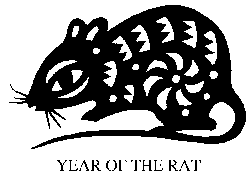
Year of the Rat

2008 (or 4706 in the Chinese calendar) was the Year of the Rat. Rat is the first symbol of the Chinese Zodiac. There are two stories regarding how Rat came to be first:

Many years ago, according to an Ancient Chinese legend, Buddha decided to choose animals as the signs of 12 year cycle. He summoned all the animals to be present at a meeting next morning and he would secretly select the first 12 animals arriving to be the signs of a year respectively. The rat and cat, who were good friends, agreed to wake each other up. Next morning Rat, who woke up first, broke his promise and left cat sound asleep as he quietly left alone to arrive at the meeting.

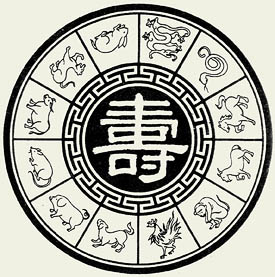
Buddha selected the first 12 animals as they arrived to be the signs for the years. They came in this order: the rat, ox, tiger, rabbit, dragon, snake, horse, goat, monkey, rooster, dog, and the pig. By the time the cat arrived everyone was celebrating their good fortune and that is why there is no cat in the zodiac. Needless to say, Cat and Rat became enemies from then on. Chinese Zodiac Symbols

Chinese Zodiac

Another legend is that Rat tricked Ox into carrying across the river on his back, then dashed to the finish before ox had time to get out of the water. Thus Rat is before Ox.

Either way, the important thing to remember is that Rat is tricky, full of promises and good words, but in the end just wants to win the race.

Coincidentally, the Year of the Rat always falls on election year. [Hmmm…
Fox News Hires Karl Rove]

[published Feb. 7, 2008]

2009 was the Year of the Ox. 2010 was the Year of the Tiger [the sexiest of all zodiac symbols –Ed.], 2011 was the Year of the Rabbit, and 2012 is the Year of the Dragon!

Chinese Zodiac

World Religion Day – Bahá’í

January 20

Today is World Religion Day in the Bahá’í Faith.

Bahai symbol

For two years I drove by the Baha’i Faith Center just a few blocks from my apartment without bothering to stop in.

It wasn’t until after I moved away that I finally decided to come back and sit in on a Sunday service to find out more about the Baha’i Faith first hand.

To my surprise, the center was mostly empty, despite it being a Baha’i holiday: World Religion Day. Members taught me two things about the Baha’i Faith that helped explain why to attendance on a Baha’i holiday was less than packed.

Most Baha’i services are not held in formal places of worship at all. Bahais usually meet at the homes of the congregation’s members.

Baha’u’llah, the religion’s founder, believed that the people’s scarce resources shouldn’t be spent on lavish buildings. The Baha’i world headquarters in Haifa, Israel, is the exception to this.

Shrine of the Bab, Haifa, Israel

The community center in Los Angeles on the other hand is a plain, underwhelming box that’s easy to miss amid the grid of traffic and mini-malls known as La Cienaga Boulevard.

I was surprised the meeting didn’t mention anything about World Religion Day. The Baha’i Faith combines the philosophies of the world’s major religions — Judaism, Christianity, Islam, Buddhism, Hinduism, Jainism, and Zoroastrianism — with the writings of its founder and final prophet Baha’u’llah. The people at the service came from all different religious backgrounds, and they said members were encouraged to continue attending the services of their original faiths.

World Religion Day was not an invention of Baha’u’llah it turns out, but was promoted by the American chapter of the Baha’i Faith beginning in the 1950’s. I don’t want to call it a publicity stunt, but it may have be more for those outside the Faith than within.

As one member of the small congregation explained to me, for Bahais, “every day is World Religion Day.”

[Originally written March 2008]

More about the Baha’i Faith

Bahai Community in Iran Under Attack

Baha’i Library Discussion Group

Why Baha’i?

Timkat

January 19 (January 20 in Leap Years)

If you’ve just had an epiphany, you’re not alone.

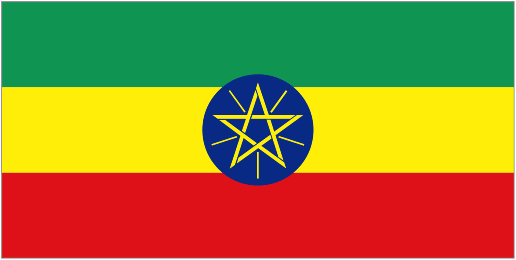
The Ethiopian Orthodox Church celebrates Epiphany on January 19. (January 20 in Leap Year.) It’s called Timkat, or Timket.

In parts of Europe and the Americas Epiphany is also known as Three Kings Day, (though no number or rank is specified in the Bible) and celebrates the visit of the Magi who bestow gifts on the baby Jesus.

In the Eastern and Oriental Orthodox Churches however, the day commemorates Jesus’s baptism by St. John in the River Jordan.

As Jesus was coming up out of the water, he saw heaven being torn open and the Spirit descending on him like a dove. 11And a voice came from heaven: “You are my Son, whom I love; with you I am well pleased.” — Mark 1:10

Traditionally Christians celebrate the event twelve to fourteen days after Christmas. (Once Epiphany was the twelfth day of Christmas.) In the Ethiopian Calendar Christmas falls on December 28, or January 7 Gregorian.

door_arch

Timkat/Epiphany falls on January 11th in the Ethiopian Calendar, or January 19th Gregorian.

The night before, priests take the Tabot (which symbolizes the Ark of the Covenant) containing the Ten Commandments from each Church. Concealed by an ornamental cloth, it is taken to a tent, close to a consecrated pool or stream, accompanied by much ringing of bells, blowing of trumpets and the burning of incense. — http://www.selamta.net/Festivals.htm

In Timket, Tella and Tej are brewed, special bread is baked called “Himbash” (in Tigrigna) “Ambasha” (in Amharic), and sheep are slaughtered to mark the three-day celebration. — www.ethiopiantreasures.toucansurf.com

While most African churches south of Egypt date only to the colonial era, Hebraic traditions and Semitic language were practiced by some Ethiopian tribes before the birth of Christ.

ethiopian_orthodoxy

In fact, the Ethiopian Cathedral of Our Lady Mary of Zion, claims to hold the original Ark of the Covenant, said to have been brought to Ethiopia by Minelik, son of Solomon and the Queen of Sheba, around the 9th century B.C.

The Ark’s authenticity has been impossible to verify, as only one person has access to the Ark at a time: a sacred guardian, chosen for a lifetime term by the previous guardian.

The Ethiopian Orthodox Church has the most extended Biblical Canon of any major church, numbering 81 sacred books. Among those writings not included by Jewish, Protestant, and Catholic churches are the books of Enoch, Esdras, and Jubilee.

peace-on-earth.org – photos/celebration of Timket

Timket 2008: Epiphany & Stardom – a Peace Corps blog

Christian Unity Week of Prayer

January 18-25

January 18, 2008 marked 100 years since the first Christian Unity Week of Prayer was first held on January 18, 1908.

Over a century ago an American Episcopalian priest and an English Anglican vicar exchanged correspondence regarding a day of prayer for Christian Unity. Reverend Jones, the Anglican vicar, proposed June 29th, the Feast of Saints Peter and Paul. Friar Paul Wattson, the Episcopalian, suggested a week of prayer between the Feast of the Chair of St. Peter (then celebrated on January 18th) and the Feast of the Conversion of St. Paul on January 25th.

And I tell you that you are Peter, and on this rock I will build my church, and the gates of Hades will not overcome it. I will give you the keys of the kingdom of heaven; whatever you bind on earth will be bound in heaven.

Matthew 16:18

The Feast of the Chair, now celebrated on February 22, is not in honor of the grand Basilica in St. Peter’s Cathedral, designed by Bernini during the 17th century. Nor is it meant to pay homage to the remains of the chair behind it–once thought to have been St. Peter’s own chair–which is now believed to have been built around the 9th century.

The word “chair” in Latin is cathedra, from which we get the word “cathedral.” Specifically, cathedra referred to a chair with armrests, or a throne. But the word signified the power that went along with the throne of the Roman Emperor. Today we still say “the seat of power” to refer to an abstract position of power, not as a four-legged furniture piece. (Likewise, “chairman of the board” does not mean upholsterer.)

Thus the Feast of the Chair of St. Peter is in effect in honor of the creation of the Papacy by Jesus and St. Peter.

Records of the Feast date all the way back to the 4th century, and were adapted from an ancient Roman tradition honoring the memory of the original patriarch of a dynasty, family or clan.

In 1908 Friar Paul Wattson felt this would be an appropriate date on which to start an Ecumenical week of prayer. The term Ecumenical Movement refers to “the initiatives and activities planned and undertaken…to promote Christian unity.” (Unitatis Regintegratio, Vatican II)

The Society of the Atonement was founded by Wattson and Mother Lurana White in Garrsion, New York in 1898, one of its main missions being greater unification between the differing sects of Christianity. Wattson decided upon the name “Atonement” while reading Romans 5:11. The word atonementseemed to stand out from that sacred page with a distinctness all it own…”  When divided the word read ‘at one’ -ment.

Friar James Gardiner describes the first observance of Christian Unity Prayer Week:

“Ten inches of snow blanketed the Hudson River Valley and temperatures hovered in the low 30s. There couldn’t have been more than a handful of people–probably just the Friars and Sisters–who gathered each night in the Chapel of Our Lady of the Angels at Greymoor.”

Through Wattson’s correspondence with religious leader thousands of others joined in prayer at other locations.

The following year Wattson was told, “You cannot serve either the Papal Church or the Protestant Episcopal Church well if you try to serve both at the same time.

Friar Paul along with Mother Lurana and other members of the Society of the Atonement made the choice of submitting to the Catholic Church as a distinct religious community. The Friars and Sisters of the Atonement were recognized as corporate body, “the first such occurrence since the Reformation.” (http://www.prounione.urbe.it/fra-fri/e_friars.html)

The Christian Unity Octave was blessed by Pope Pius X. During World War I Pope Benedict XV encouraged the annual celebration throughout the Catholic Church. For its Golden Jubilee Pope John XXIII announced:

Encouraging you and your community to ever more strenuous efforts in the propagation of the Chair of Unity Octave, we urgently invite the faithful of every race and clime to join in this period of prayer.

Five years later the Second Vatican Council recognized that prayer was “the soul of ecumenical movement” and “welcomed ecumenical dialogue with non-Catholic Christians and with Orthodox Churches.”

The decree announced revolutionary changes that encouraged cooperation between separate churches, including:

“All who have been justified by faith in Baptism are members of the Body of Christ, and have a right to be called Christian, and so are correctly accepted as brothers by the children of the Catholic Church…

“The Sacred Council exhorts all the Catholic faithful to recognize the signs of the times and to take an active and intelligent part in the work of ecumenism.

“Catholics are encouraged to join in ecumincal activity, and to meet non-Catholic Christians in truth and love…

“All Christians have a common purpose–to confess Christ before men. Practical expression must be given to this, by relieving the distress which afflicts so many of the human race: famine, illiteracy, shortage of housing and the unequal distribution of wealth.”

[posted January 18, 2008]

Greymoor Friary
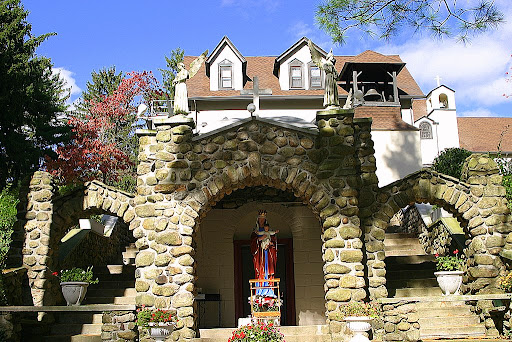
Graymoor Friary today

Ad Te Levavi Animam Meam

Graymoor Ecumenical & Interreglious Institute

Blog by the Sea

fratres.wordpress

Christian worship & spirituality

St. Anthony: Blessing of the Animals

January 17

St. Anthony the Hermit

And God maketh the beast of the earth after its kind, and the cattle after their kind, and every creeping thing of the ground after its kind, and God seeth that it was good.

— Genesis 1:25

Before there was Doctor Dolittle, there was St. Anthony Abad, patron saint of the animal kingdom.

St. Anthony the Hermit, or St. Anthony the Great, was born in Egypt in 251 AD and lived to be 105. At age 34, he relinquished all his wealth and headed into the desert to be alone with God and meditate on Christ. He spent twenty years in isolation living in an abandoned Roman fort on a mountain by the Nile. The devil tormented him with images of animals attacking him, but Anthony never gave in.

Later in life, according to legend, various animals helped guide Anthony on his travels, including a wolf and a raven.  Once a dog attacked his enemy. Once he cured a pig from illness. He’s often pictured wandering the wilderness with a pig by his side.

Anthony’s other claim to fame was his fight against the followers of Arian Christianity in the late 3rd and early 4th centuries. Arias was an Egyptian Christian who taught that, while Jesus was divine, he was not the same as God. The Council of Nicea declared Arian Christianity heretical in 325 AD.

Blessings of pets and livestock are common, but not limited to Latin and Hispanic cultures. The biggest ceremonies occur on the Sundays nearest the feast days of St. Francis of Assisi (October 4) and St. Anthony the Hermit (January 17).

St. Anthony died on January 17, celebrated as his spiritual birth in Heaven.

Even now I remember being caught up in the moment, feeling inexplicably happy when my doggie received her very own blessing from the priest. When all is said and done, it was a remarkable experience, a chance to share our love for our beloved pets, and to renew our commitment to protecting and respecting all of God’s creatures.

Rose Lee Hayden, Goin’ to the Chapel, The Blessing of the Animals a la Romana

Pongal – Day 3 – Mattu Pongal

January 16

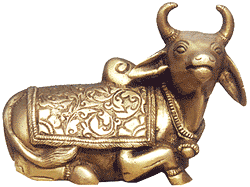
Mattu Pongal, the third day of the Pongal festival of southern India, is dedicated to the animals of the world, particularly cattle.

The legend goes, Shiva told his bull Basava, or Nandi, to inform the people of the world that they should eat once a month and bathe daily with an oil massage.

Evidently, Bull was not the best messenger. He told the people to eat daily and bathe once a month.

When Shiva heard this he was furious, so he forced Bull to return to earth and help the people plow, where he’s been ever since. That way they’d have food enough to eat each day.

There’s a belief in western society that Indians “worship” the cow. This is a misconception, perhaps propagated by the activities on Mattu Pongal. On this day cows do get the royal treatment: they’re bowed down to, painted, decorated with care, and they are offered Pongal, the rice dish for which the festival gets its name. The cows are symbolic of all animals on earth.

But they are not worshipped in the English sense of the word. Cows are considered special in the sense that they cannot be slaughtered. Part of the reason for this is that the cows already give so much back to the people through their milk. Another historical, practical reason may have been that the killing of the best cows for their meat reduced the genetic diversity of the herd.

A third, more controversial theory is that in the Sanskrit of the Vedas the word Go, meant “light” or “sense” as well as “cow.” Thus, the phrase “Protector of the Brahmanas and the Light” was interpreted as “Protector of the Cow.” [But this sounds to me like the story of the Catholic priest who, after a life of being celibate (no sex), goes to up heaven and gets to read Jesus’s original instructions on how to live the life a priest. He’s furious when he reads the original translation: “A priest should be pure and celebrate.”]

At any rate, Holy Cow is misleading. More like “Venerated Cow.” As Gandhi put it:

“One can measure the greatness of a nation and its moral progress by the way it treats its animals. Cow protection to me is not mere protection of the cow. It means protection of all that lives and is helpless and weak in the world.

http://www.puja.net

http://www.kamat.com/indica/culture/holy-cow.htm

Why is the cow sacred?

http://www.dnaindia.com/report.asp?newsid=1144839

http://www.tamilnadu-tourism.com/tamilnadu-festivals/pongal-festival.html

http://sirensongs.blogspot.com/search/label/pongal

http://nitawriter.wordpress.com/