October 28, 2010 marks the 1698th anniversary of the Battle of Milvian Bridge, a battle of two Emperors that changed the course of history.
Maxentius and Constantine were brothers-in-law, both had valid claims to the throne thanks to Diocletian’s division of the Empire in 306, and both their fathers had been previous Emperors. In fact, Maxentius’s father had committed suicide after a failed rebellion against Constantine.
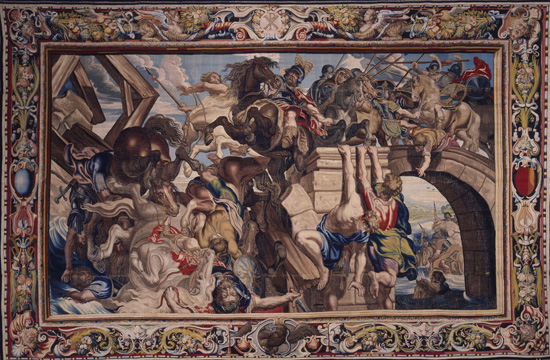
In 312 A.D. Maxentius held Rome; Constantine held the north. Hearing of Maxentius’s claim, Constantine gathered his army and headed south, encountering Maxentius’s troops at the Milvian Bridge just outside Rome. The actual Milvian bridge was not functional, perhaps purposefully destroyed by Maxentius in preparation for the expected attack. But Maxentius made a grave tactical error. He used a makeshift pontoon bridge to transport his troops to the other side of the Tiber, and placed them too close to the riverbank.
Battle of the Milvian Bridge
Constantine, a 40 year-old veteran of campaigns against the Franks and Gauls, forced Maxentius’s army against the river, allowing them only one means of escape: the bridge. During the retreat, the bridge collapsed, and the portion of Maxentius’s troops stranded on the north side were slaughtered or taken prisoner.
Maxentius supposedly drown in the river. His body was found, decapitated, and paraded through Rome the following day.
It is said Constantine had a vision the night before of the sign of the cross, and the words “In this sign, you shall conquer.”
Constantine’s victory over Maxentius was later seen as a victory of the Christian god over the Roman pagan deities. Constantine became the first Christian Emperor, reversed the ruthless persecution of Christians that had dominated the reign of Diocletian, and implemented a policy of religious tolerance throughout the Empire.
Though not an official holiday, many Christian sects observe the anniversary of Milvian Bridge on October 28 in memory of the historic turning point of early Christianity.
…I do not want much of a present, anyway, this year.
After all I am alive only by accident.
I would have killed myself gladly that time any possible way…
There’s nothing like the poetry of Sylvia Plath to brighten up a birthday celebration. Today, October 27, is Sylvia Plath Day in Northampton, Massachusetts, where Plath attended Smith College. She was born on this day in 1932, and died thirty years later, on February 11, 1963.
Plath lost her father at an early age. She suffered from depression and mental illness, which she described in her semi-autobiographical work, The Bell Jar. The Bell Jar details the mental and emotional journey of college student Esther Greenwood, who interns at a New York fashion magazine. (Think “The Devil Wears Prada” without the catchy soundtrack and more electroshock therapy.)
At age 23, Plath married English poet Ted Hughes. Plath taught at her alma mater Smith before moving to England with Hughes. Her first poetry collection was published in 1960.
Smith suffered a miscarriage, but the couple later had two children, Nicholas and Frieda. Plath and Hughes separated in late 1962.
The following February, a month after the publication of The Bell Jar, Plath placed her head in the oven as her two young children lay sleeping in the next room.
…Sweetly, sweetly I breathe in,
Filling my veins with invisibles, with the million
Probable motes that tick the years off my life…
from A Birthday Present
Nearly two decades after her death, Plath became the first poet to win a posthumous Pulitzer Prize, for “The Collected Poems” published in 1981.
“I think that in today’s Prozac world and with depression often being glamorized as an intrinsic sign of artistic greatness, the real tragic dimensions of the disease get lost in the fervor. Sylvia may have thought her children would be better without her, who knows? From her poems and her journals, her writing indicates that she certainly loved her children and to say that her act was reprehensible belies an understanding of depression, which is not merely a case of the blues. It is a disease that overwhelms even the immeasurable love bonding a parent to a child…
“I assume that Sylvia Plath day is intended to celebrate her life and her talent. As a poet and an academic achiever, she is worthy of admiration. Her suicide is not to be admired but to be lamented.”
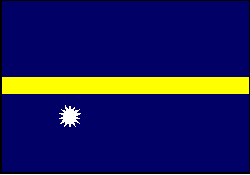
Today the small island nation of Nauru celebrates Angam Day.
Angam means “jubilation” or “homecoming”. The jubilation doesn’t refer to any election, battle, revolution, legislation, or victory. It celebrates a birthday. It’s the birthday of a woman named Eidaruwo, who was born on October 26, 1932. But Angam Day doesn’t celebrate anything she did. In fact, it was first celebrated on the very day she was born.
For nearly all of its 3000 year history, Nauru’s remote location ensured its isolation, ever since Polynesian and Micronesian travelers first settled there. Contact with the West in the 19th century could not have come at a worse time. Not only was the country ripe for exploitation, the importation of guns and ammo exacerbated deadly tribal wars that devastated the island’s population.
The population of the island fell from 1,400 to 900 and didn’t recover. After World War I, an Australian study determined that the island’s population was so low that the race was in danger of dying out. Nauru would have to reach 1,500 in order to ensure healthy survival.
The mission to achieve 1,500 people united the island. It took many years, but on October 26, 1932 a baby girl named Eidaruwo was born. The whole island celebrated her birth, and they have celebrated the date as Angam Day ever since, except during World War II.
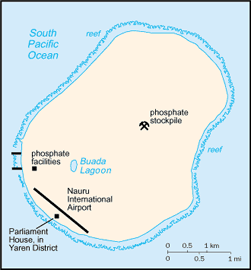
Today Nauru’s population is over 13,000, making it one of the most densely populated countries in the world. But during the 20th century, phosphate mining depleted the island’s natural resources.
“Since the light of intelligence (Varhamana Mahavira) is gone,
let us make an illumination of the material matter.”
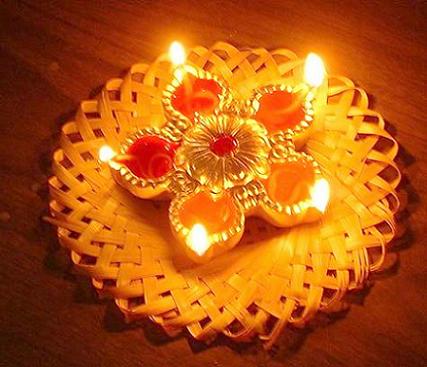
On the darkest evening in the month of Ashvin (October/November), Hindus around the world fill the night with candles, lamps and firecrackers to celebrate the Festival of Lights known as Diwali.
Diwali, or Deepavali, means literally, a row of lamps. Deep meaning lamp or light, avali meaning array.)
These lights are ubiquitous during Diwali, symbolizing the victory of Inner Light over Darkness.
The third and most auspicious day of the five-day celebration falls on the new moon of the month of Ashvin.
The legends that different regions cite as the origin of Diwali are too various to recount them all.
In the north of India, Hindus celebrate Diwali as the return of the ancient King Rama to his home in Ayodhya after 14 years in exile. The Prince Rama had been forced into exile by his stepmother, Queen Keykayee, who wanted her own son to inherit the throne.
In exile, Rama’s wife Sita was abducted by the ten-headed demon Ravana, who took her back to his kingdom in Sri Lanka. Rama built a bridge from the tip of India to Sri Lanka, slayed Ravana, and returned with his wife to their homeland. The people of Ayodhya were so anxious for his return, lamps were lit all across the nation to welcome him home.
In the South, Hindus recall the defeat of the powerful Narakasura by Lord Krishna and his wife Sathyabhama, as recorded in the Puranas.
Diwali is associated with the rice harvest. One of the most popular Diwali treats is a pounded semi-cooked rice dish known as Poha.
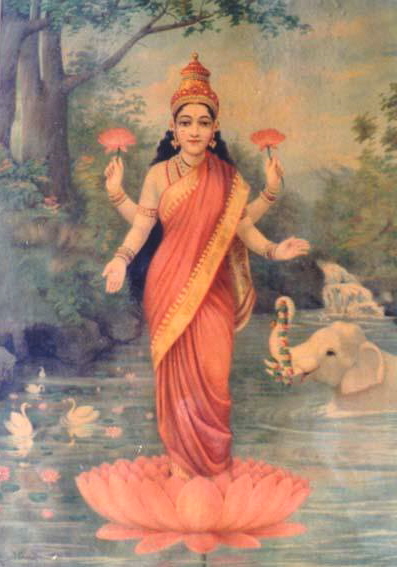
The second and third days are traditional times to invoke the goddess Lakshmi, Vishnu’s consort and the goddess of light, beauty, and prosperity. Women sweep and clean the house to allow Lakshmi a clear path of access. One staple of Diwali is the lighting of firecrackers, but Hindus are careful not to do so during aarti, (ie. invoking the goddess). For Lakshmi prefers tranquility and peace, so a small bell works better than the a loud clap preferred by other gods.
Lakshmi, Goddess of Good Fortune
Diwali is considered the New Year and one of the holiest days in the Jain religion. It’s known as Maharvira Nirvana, in honor of the moment the great Mahavira reached Nirvana at age 71.
Celebrants take ritual oil-baths during the festival, symbolic of the cleansing of the soul, in the hopes of a prosperous new year.
“…On this day of Dipavali we worship the Supreme God who is the source of all conceivable virtues, goodness and prosperity, which is symbolised in illumination, lighting and worship in the form of Arati and gay joyous attitude and feeling in every respect.”
“Over the centuries you will be remembered and praised, you, the officers and soldiers who have freed Transylvania.”
–General Gheorghe Avramescu, October 29, 1944
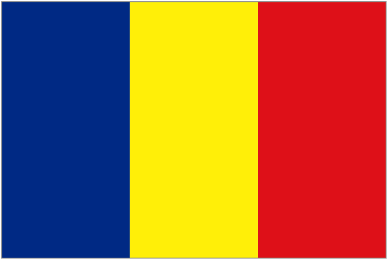
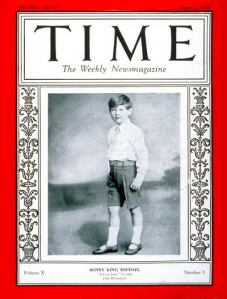
On this day in 1944 Romanian troops liberated Carei, the last German-occupied city in Romania. It is also the birthday of Romania’s last king, Michael I. (Pre-emptive answer: No, I don’t know why the there is a “I” if there won’t be a second.)
King Michael, or Mihai, became heir apparent of Romania at age 4 after his father Crown Prince Carol II abandoned his claim to the throne to elope with his mistress. When his grandfather, King Ferdinand died, the 6 year-old boy became king.
However in 1930, Carol II returned to the throne, becoming perhaps the only European king to have succeeded his own son.
In 1940, Carol II refused to go along with pro-Nazi Romanian leaders. He was forced to abdicate the throne for his son, 18 year-old Michael, who was expected to rule as a puppet monarch for a fascist Romanian government allied with Hitler.
There are conflicting stories of Michael’s motivations for turning against Germany in 1944. Some portray him as a hero whose daring fight against fascist leaders hastened the Nazi defeat, thus saving tens of thousands of lives. Others claim he was a pragmatist who had no choice but to switch once it became clear the Soviets were winning.
According to future Soviet leader Nikita Khurshchev…
In 1944, as we approached Bessarabia and fighting broke out on its territory, and then as we approached the borders of Romania itself, it became evident that the pointer on the scale had tipped strongly in the direction of victory for our side…Then a coup occurred in Romania. The young King Michael took part it it…In Romania a situation took shape in which the sympathies of the people moved to the left, the authority of the Communist Party rose, and the king decided the Communists should participate in the new government that was being formed…The question of whether Romania would take the socialist path did not come up at the time.”
–Memoirs of Nikita Khruschchev
The U.S. awarded King Michael the Legion of Merit for his bravery, and the Soviets awarded him the Order of Victory. But proof that no good deed goes unpunished, the Romanian Communist government abolished the monarchy in January 1948 and forced Michael to leave the country. According to Khrushchev, Michael was told, “he could take everything with him that he considered necessary, but he had to leave his kingdom.”
In exile, he married Princess Anne of Bourbon-Parma with whom he raised 5 daughters in Switzerland. The former king worked for an aircraft company training European pilots to fly with American instruments.
The former king once said:
“Though many people think that not to be allowed back into your country is easier to bear than not to be allowed out of it, this is not true. The feeling of powerlessness and loss of liberty is associated with both.
“Millions of tongues record thee, and anew
Their children’s lips shall echo them, and say—
‘Here where the sword united nations drew,
Our countrymen were warring on that day!”
–Lord George Gordon Byron, Childe Harold’s Pilgrimage
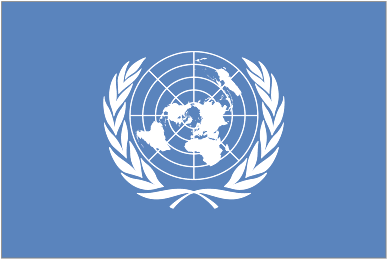
In 2009 the UN turned 63, the same age its leading proponent was when he died in April 1945, a month shy of Germany’s surrender.
Franklin Delano Roosevelt had spent his 63rd birthday (January 30, 1945) aboard the USS Quincy on route to meet Churchill and Stalin in the Crimea. Stalin had refused to travel far “on doctor’s orders”, so FDR, stricken with polio and two months from death, trekked halfway across the world. Churchill once said of Yalta, “We could not have found a worse place if we had spent ten years on research.”
At Yalta, Churchill and Roosevelt lost on the issue of future democratic elections in Soviet-controlled Poland. But they got one thing from Stalin. They settled the “veto issue” that had halted the negotiations of the formation of the “United Nations”, an international organization that would curb future territorial aggression.
[Previous to this, the term “United Nations” referred to an alliance of countries fighting against the Axis Powers in World War II. The January 1, 1942 Declaration by United Nations had stated that “Each Government pledges itself to employ its full resources, military or economic, against those members of the Tripartite Pact and its adherents with which such government is at war.“]
On April 12, 1945, hours after FDR’s death, the new VP Harry Truman was sworn in as President of the United States, inheriting a World War and an atomic bomb project so secret that the Soviets had known of its existence before he did. Truman’s first decision as President, immediately after taking the oath, was to carry on with the scheduled UN conference in San Francisco. “It was what Roosevelt wanted,” he said.
Two weeks later, representatives of 50 countries met in San Francisco to forge the Charter of the United Nations, based on negotiations between the US, UK, USSR and China.
Twenty five years earlier a similar organization, the League of Nations, had stumbled in its infancy when Woodrow Wilson, who had pushed the idea of the League of Nations to the rest of the world, failed to gain enough support from his own Congress to join it.
This time, with the hindsight of WWII, the U.S. Senate approved the charter, 89 to 2. On August 8, two days after Truman dropped an atomic bomb on Hiroshima and one day before Nagasaki, the U.S. became the first country to submit its formal documents to the United Nations.
It was an ominous moment of gestation for a world peace organization, and a foretelling one. The power of all the countries of the world would be eclipsed by the atomic weapons of the two most powerful. And thus for most of its life, the UN’s influence was secondary to the Cold War tug-of-war between the U.S.-led NATO and the Soviet Union’s Warsaw Pact.
Founding of the U.N.
The UN first convened on October 24, now observed as United Nations Day.
Today, if there is one thing that unites all the contradictory and warring countries of the earth, it may be universal disappointment at the United Nations, seen as a tool of the U.S. by much of the West, and as a tool of the West by the rest of the world. While in the U.S., as conservative commentator Bill O’Reilly once told War Crimes Ambassador David Scheffer, “I’m not going to make an excuse for the U.S. government. Our intelligence agencies obviously have been troubled. But you are making an excuse for the United Nations, which I think is so impotent there isn’t enough Viagra in the world.”
Still, for all its faults, this year the United Nations is technically older than most governments on earth. That means over 100 nations have gained their independence since its formation, and most of these were subjugated colonies and satellites of the Big Five in charge. Even if the UN isn’t directly responsible for all these births, it has created a forum in which the countries of the earth are forced, for a brief moment, to see themselves through their neighbors’ eyes. And in a world this small, that may prove to be the most powerful negotiation tool of all.
For three decades Hungarians were forbidden to mention the events that occurred on October 23, 1956.
After World War II, Hungary found itself increasingly under the thumb of the Soviet occupiers that had liberated the country from the Nazis. The Communist Party slowly replaced the democratically elected Hungarian government, and the Hungarian State Security Police “purged” thousands of political dissidents through relocation, imprisonment, and execution.
In 1955 Hungarians hoped their country might go the way of Austria, becoming a demilitarized, independent country. However, the Warsaw Pact of that year bound Hungary to the USSR and formed part of “the Iron Curtain”.
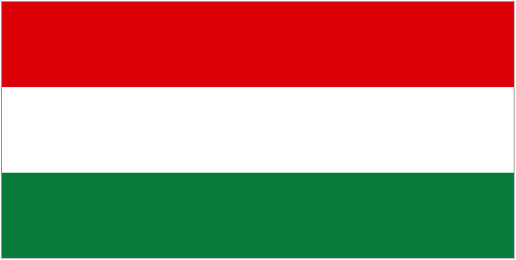
In Poland, public outcry at Soviet quashing of an uprising had led the Soviets to make concessions to Poland in October 1956. Hungarian students expressing solidarity with the Poles by holding a demonstration in Budapest at statue of Polish-Hungarian General Józef Bern. Students cut the Soviet coat of arms from the Hungarian flag and sang the old national song, Nemzeti dal, “We vow we will no longer remain slaves.”
According to reports, the crowd swelled from 20,000 people to as many as 200,000. By evening, the crowd had toppled the 10 meter tall statue of the recently-deceased Soviet leader Joseph Stalin and placed Hungarian flags in his boot. As the demonstrations multiplied and crowds grew unruly, Soviet tanks rolled into Budapest. But it was the much reviled Security Police that fired the first shots into the crowd.
News of the clashes in Budapest spread throughout the country. Protests and demonstrations broke across Hungary, followed by mob violence against the Security Police and full-scale revolution.
On the 28th of October, Soviets called for a ceasefire and Soviet forces withdrew from Budapest. A new national Hungarian government was proclaimed, led by Imre Nagy, with the intention of becoming a neutral multi-party democracy.
The joy was brief. On November 3, the infant government was invited to negotiate the withdrawal of Soviet forces. Arriving at the meeting point, the delegation was arrested. Soviet tanks attacked Budapest in “Operation Whirlwind”. By November 10, when the last rebels conceded defeat, 2,500 Hungarians and 722 Soviet troops were dead.
It would be a long road to freedom for the Hungarians. On October 23, 1989, just before the collapse of the Berlin Wall, the Republic of Hungary was proclaimed, and October 23 was declared a national holiday in memory of the short-lived government and the revolution that refused to be forgotten.
“The was no way to predict or prepare for Rwanda.”
Not exactly true. In 1993, a year prior to the Rwanda genocide, a nearly identical scenario occurred in Burundi.
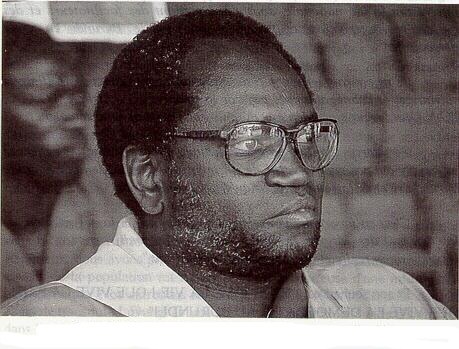
After years of Tutsi rule, Hutu political parties united in their support to elect Melchior Ndadaye, a Hutu, as President of Burundi. The Hutu parties succeeded, ousting the incumbent President Pierre Buyoya, a Tutsi, in the country’s first democratic election.
Ndadaye was 40 years old. He had grown up during the intense ethnic wars of 1972. He studied at the University of Rwanda and at the National Academy of Arts and Trades in France. He sought to bridge the ethnic divide in Burundi by appointing Tutsis to top governments posts, including that of Prime Minister. But less than three months from taking office a coup erupted to removed the ruling Hutu government. On October 21, 1993, under the guise of protection, Tutsi security forces escorted Ndadaye and top government officials to a secret location, and murdered them.
The coup ultimately failed, but the President’s death sparked passion and anger across the country, fueled by radio and other mass media. Hutus attacked Tutsis in mass, neighbor against neighbor. The weapon of choice, the machete. The Tutsi-led army retaliated by killing tens of thousands of Hutu men, women, and children. Before long, an estimated 100,000 Hutu and Tutsi Burundians lay dead.
And the world was none the wiser.
Despite the lessons learned from Burundi, the United Nations remained ill-equipped to combat the ethnic massacres in Rwanda the following year. In July 1994, a plane carrying both the Rwandan President and the new President of Burundi crashed, igniting the bloodiest massacre in modern times. In a matter of months, a million men, women, and children were slaughtered by their own neighbors.
The Burundi Civil War continued until 2005, taking the lives of over a quarter million Hutus and Tutsis.
The wounds are slow to heal. Burundi is one of the ten poorest countries in the world. Today its people remember the horrors of 1993 and the assassination of President Molchior Ndadaye.