Kenyatta

October 20

When the Missionaries arrived, the Africans had the Land and the Missionaries had the Bible. They taught us how to pray with our eyes closed. When we opened them, they had the land and we had the Bible.

Jomo Kenyatta
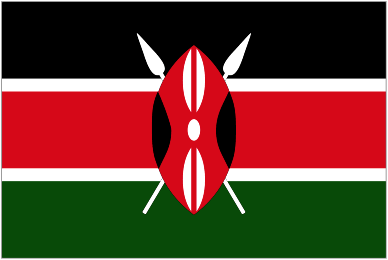
Jomo Kenyatta was a controversial figure, difficult to categorize, impossible to stop. He straddled the world of traditional Kenyan tribalism and European imperialism during the country’s most revolutionary years, and is considered Kenya’s founding father.

Kenyatta was born Kamau wa Negengi, a member of the Kikuyu people, on this day in 1894. His first contact with the West was at age 10, when a leg infection caused his family to seek help at the Church of Scotland mission. Kamau studied English and the Bible at the mission school and was baptized “John Peter.”

He found work at the Nairobi Public Works Department, and earned the nickname “Kenytta”, Kikuyu for the type of fancy belt he always wore. Kenyatta took an interest in local politics, joined the Kikuyu Central Association and edited a small newspaper.

In 1929, Kenyatta traveled to London to argue for Kenyan land interests.  He met with little success, but published an editorial in The Times.

Kenyatta studied at the London School and Economics and the Soviet Union’s Moscow State University, briefly joining the Communist Party. Despite his involvement in the Communist Party, later as leader of Kenya, he fought against nationalization of industry and agriculture, encouraging instead European investment in Kenya.
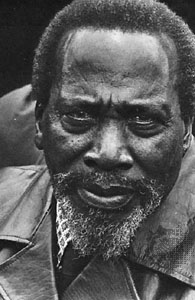
Jomo Kenyatta
Jomo Kenyatta

In 1952, the violent Mau Mau rebellion broke out against British rule. Kenyatta denied involvement in the Mau Mau attacks, but he was arrested and convicted by a British court in a highly publicized trial and sentenced to 7 years hard labor.

When Kenyans won the right to vote in 1960, Kenyatta was elected President while still in detention. He negotiated Kenya’s terms for independence from Britain, and became the independent nation’s first Prime Minister and President in 1963 and 1964, respectively. He died in 1978.

Kenyatta is controversial in Kenya even today. He pioneered a one-party political system, and though he greatly increased Kenya’s wealth during his presidential years, much of that wealth went directly to his family and cronies.

According to one blogger:

“If parliament sees it necessary that Kenyatta Day be retained because of historical significance, then I can only suggest that it be renamed Heroes Day or Wazalendo Day or whatever, but just not to name it to one individual who caused Kenya more harm than good in their life time.”
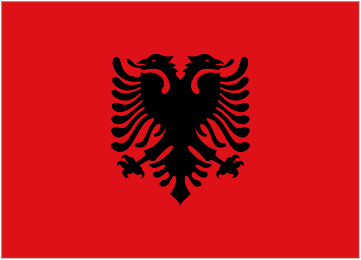

Mother Teresa Day – Albania

October 19

“If in coming face to face with God we accept Him in our lives, then we are converting. We become a better Hindu, a better Muslim, a better Catholic, a better whatever we are…

“What approach would I use? For me, naturally, it would be a Catholic one…What God is in your mind you must accept. But I cannot prevent myself from trying to give you what I have…”

Mother Teresa

Agnes Gonxha Bojaxhiu was born in Skopje, Albania (now Macedonia) between the Ilinden anti-Ottoman Uprising and the outbreak of the First World War.

At age 8, her father died. At 18, she moved to Ireland to join the Sisters of Loreto, with whom she began her monastic training in India the following year. Agnes chose the name Teresa, after Teresa of France, the patron saint of missionaries who died in 1897 at age 24.

Sister Teresa taught students at the Loreto convent school in Calcutta for several years. On September 10, 1946, on her annual retreat to Darjeeling, she felt the call of God, telling her to work not within the confines of the school, but among the sick and poor of the streets.

She exchanged her convent habit for a simple cotton chira, became an Indian citizen, and continued to help the poorest of the poor for nearly 50 years. She established the Missionaries of Charity in 1950 to help “the hungry, the naked, the homeless, the crippled, the blind, the lepers, all those people who feel unwanted, unloved, uncared for throughout society…”

The Missionaries currently operate over 600 missions in 123 countries.

I don’t think there is anyone else who needs God’s help and grace more than I do…I need His help twenty-four hours a day. And if days were longer, I would need even more of it.

Mother Teresa

Today, Mother Teresa’s homeland of Albania honors her with a national holiday. October 19 is the anniversary of the day in 2003 that she was beatified by the Vatican.

“Christ will not ask how much we did but how much love we put into what we did.”

Mother Teresa

“Do not imagine that love to be true must be extraordinary. No, what we need in our love is the continuity to love the One we love.”

Alaska Day

October 18

“Some return from Alaska. Not all die there. They return blind and rheumatic for the rest of their lives, with hands useless, shriveled as if in a gesture of perpetual anguish. Hands that long hours with the fishnets went numb from cold and chests that, worn-out from coughing lost all strength… Adventures! Fortunes! All a lie! Alaska is the hell that extinguishes faith and quickens curses to the lips.”

Alfonso Fabila, “The Horrible Hell of Alaska,” 1929

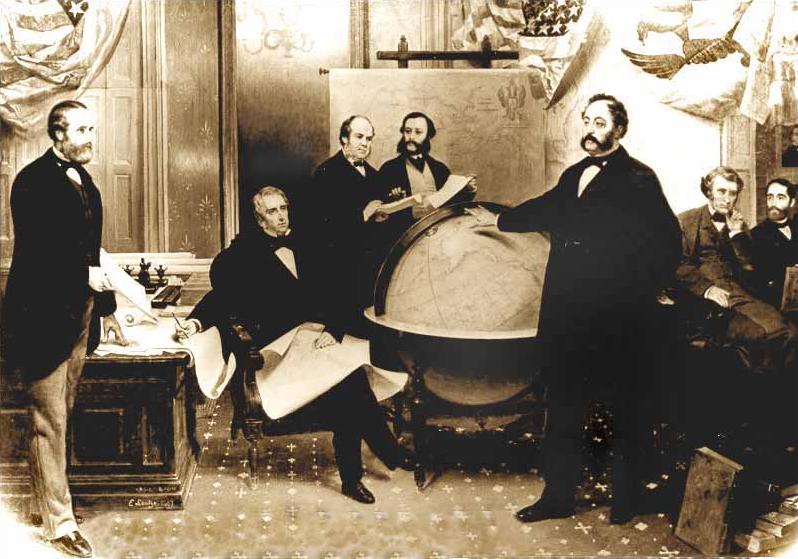
Well things have gotten a little better since Alfonso wrote his memoir, and today the state is home to over 700,000 Americans. October 18 is Alaska Day, celebrating the day in 1867 that Russia transfered 1.7 million square kilometers to the United States.

Signing of Treaty of Cessation of Russian Alaska to U.S.
Signing of Treaty of Cessation of Russian Alaska to US

Recently my optometrist moved there. Now he’s an optical Aleutian. (Rim shot)

+ + +

Alaska is the largest state.

How big is it?

Alaska is so big, if it were a country, it would be the 18th largest in the world.

It’s bigger than France, Germany, the United Kingdom, Ireland, Italy, Switzerland, Portugal, Austria, and Greece combined.

According the Alaska Science Forum, Alaska has more coastline than all other states combined, and its lake areas alone are larger than the Hawaiian Islands.

17 of the 20 highest mountains in the United States are in Alaska.

Its former governor could see Russia from her house. (This has been disputed.)

+ + +

Secretary of State William Seward purchased Alaska from Russia in 1867 for 2 cents an acre. The deal, known as “Seward’s Folly”, paid for itself within 30 years. In 1896, gold was discovered near the Yukon, thus beginning the great Klondike Gold Rush.

After World War II, Seward was further vindicated when Alaska became one of the U.S.’s most prized possessions in terms of strategic defense. At its western-most point, Alaska is only 55 miles from Eastern Siberia.

These days residents of the lower 48 cherish Alaska for its wildlife and environmental diversity, as well for its large reserves of untapped oil. Because of this dichotomy, the state is the frontline in the battle between environmental groups and proponents of cost-efficient energy.

Alaska comes from an Aleut word meaning “the mainland.” The state’s motto is “North To the Future!”

Sukkot

15th of Tishri (October 12-19, 2011)

In the month of Tishri, Jewish holidays go from one extreme to the other. The month begins with the spirited Rosh Hashanah (Jewish New Year) to Yom Kippur (Day of Atonement), the most solemn fasting day in the Hebrew calendar. But on the 15th of the Tishri, celebrants are encouraged to eat, drink and be merry for Sukkot, the Feast of the Tabernacles.

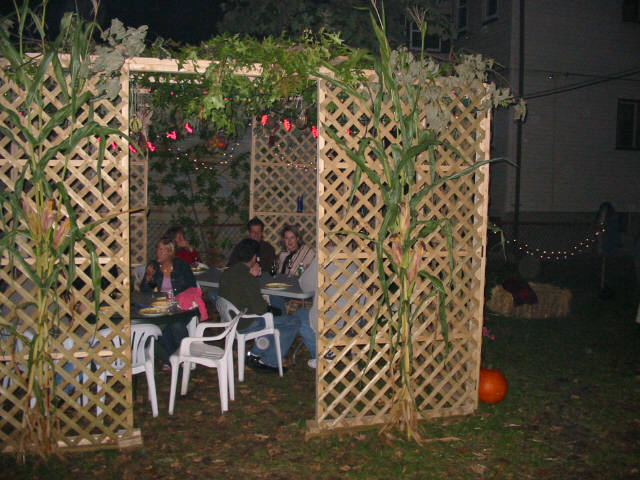
Sukkah means ‘booth’ or ‘hut’. It refers to a temporary shelter like the kind the ancient Hebrews built during their 40 years wandering the desert. The festival of Sukkot lasts for seven days.

“Beginning with the fifteenth day of the seventh month, after you have gathered the crops of the land, celebrate the festival to the Lord for seven days…On the first day you are to take choice fruit from the trees, and palm fronds, leafy branches and poplars, and rejoice before the Lord your God…This is to be a lasting ordinance for the generations to come…Live in booths for seven days…so your descendants will know that I had the Israelites live in booths when I brought them out of Egypt.”

Leviticus 23

There are all sorts of rules describing how to make one. For instance, you need to be able to see the stars from inside. We tried finding a Sukkah on Shopzilla, but all we got was this.

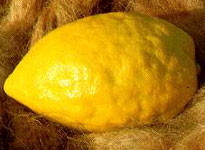
One of the main traditions of Sukkot is the waving of the ‘Four Species’; two branches (myrtle and willow), a palm frond, and an etrog (a type of lemon). The four elements of nature are bundled together and waved as shown here.

According to Judaism 101:

Many Americans, upon seeing a decorated sukkah for the first time, remark on how much the sukkah (and the holiday generally) reminds them of Thanksgiving. This may not be entirely coincidental…The pilgrims were deeply religious people. When they were trying to find a way to express their thanks for their survival and for the harvest, they looked to the Bible for an appropriate way of celebrating and found Sukkot.

My 1st Canadian Thanksgiving

2nd Monday in October

This weekend I shared something with my one year-old niece: our first Canadian Thanksgiving. She was born just after Thanksgiving last year.

The most glaring difference I’ve noticed between Thanksgiving in the U.S. and in Canada is that Canadian Thanksgiving is on a Monday. Other than that, it’s pretty much the same.

In the process of celebrating Canadian Thanksgiving, I have learned a few other things about our Canuck brethren and sisteren.

1. Conservatives are blue and liberals are red, which when you think about it, makes more sense.

2. Election season in Canada is only SIX WEEKS LONG! Two years less than what we’ve had to endure south of the border.

3. It’s traditional for the Finance Minister to wear brand-new shoes when presenting the new budget.

4. Saskatchewan, despite its reputation as a barren wasteland, is the sunniest province in Canada. (Which is like being the rainiest place in the Sahara.)

5. Ottawa is the second or third coldest capital in the world, tied with Moscow, and right behind Ulan Batar, Mongolia.

6. Terrence & Philip is not a real TV show.

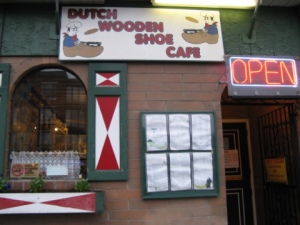
No Thanksgiving would be complete without breakfast at the Dutch Wooden Shoe Pannekoek House

We celebrated like true Canucks, enjoying breakfast at the Dutch Wooden Shoe Pannekoek House. In the afternoon we followed the age old wisdom of Canadian superstar Robin Sparkles…

[published October 13, 2008]

Chongyang – China’s Double 9th

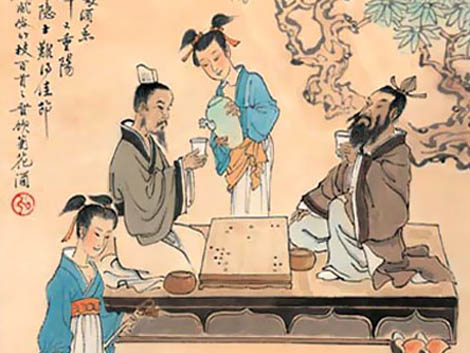
As the days grow shorter and colder, the Chinese celebrate Chongyang, an old festival honoring ancient people. Wait, no—an ancient festival honoring old people.

Chongyang is also known as Double Ninth. As the highest odd single number, 9 is considered especially lucky in Chinese culture. Chongyang falls on the 9th day of the 9th month of the Chinese calendar.
The tradition is so old that no one really knows how it began.

One story of the festival’s origin tells of a boy named Heng (or Huan) Jing who studied under a Taoist teacher. The old man warned Heng Jing how to avoid the plague that was killing the villagers of the Ruhe River region. He told the boy the devil would rise up from the water on the 9th day of the 9th month. He instructed Heng Jing to tell his townspeople to pin Cornus leaves (or tie Dogwood twigs) to their clothes, soak chrysanthemums in liquor, and climb up a nearby mountain.

Now, these days a student like Heng would do the socially responsible thing and commit his master to a hospital for the mentally unstable, but Heng Jing did as he was told. Sure enough, on the 9th day of the 9th month the devil rose from the waters. But as the devil pursued Heng Jing and his people up the mountain, the overpowering scent of the Cornus and chrysanthemum made the devil dizzy, and he fell back into the water.

Ever since, the Chinese have celebrated Double Ninth by drinking chrysanthemum wine and pinning Cornus leaves to their clothes.

One of the most popular activities of Chongyang is “Deng Gao”, which means going to a high place. Chinese families and groups trek up to the hills or mountains with dogwood twigs. Those who can’t make the trip, eat cake instead. (Gao is a homonym for both ‘high’ and ‘cake’.)

Culturally, Chongyang is enjoyed as the last time of year people can hike the mountains and enjoy the great outdoors before the onset of winter. Chongyang has a special place in Taoism. In the philosophy of yin and yang, even numbers are associated with yin while odd numbers are associated with yang. The double of the highest odd single digit represents a benevolent combo of yin and yang.

www.huawei.com – the Chongyang Festival

www.chinavoc.com – Double Ninth

www.radio86.co.uk – Chongyang: The Double Ninth Festival

Navami & Dashami

October 5-6, 2011

Maha Navami

According to an 1815 French text…

“Maha-navami, known also under the name of Dasara, [is] specially dedicated to the memory of ancestors. This feast is considered to be so obligatory that it has become a proverb that anybody who has not the means of celebrating it should sell one of his children in order to do so.”

Okay—celebrants don’t actually sell off the kids to honor to celebrate, but the holiday is a big deal in India (especially Bengal) as well as parts of Nepal, Bhutan, and other countries with Bengal populations.

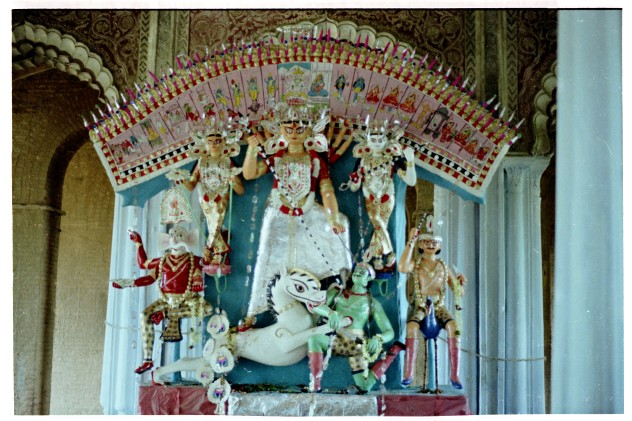
Also, Maha-navami isn’t the name of the whole celebration. Navami means ninth day, and refers to the ninth and penultimate day of the Durga Puja festival. It’s observed in different ways throughout the subcontinent.

Maha-navami falls right after Maha-ashtami (eighth day) and opens with Sandhi Puja, the ritual that recalls Durga’s defeat over Mahishasura’s two generals, Mundo and Chando.

Dashami

The following day, Dashami, is a sadder occasion, as worshippers of Durga try to postpone the inevitable.

Dashami is the day when Goddess Durga accompaning her children sets for Kailash, her husband’s abode. With a heavy heart the Bengalis immerse the clay idol of Durga in the sacred Ganges bidding her goodbye and earnestly waiting to see her again the next year…

http://www.durgapujagreetings.com/nirghonto.html

Durga Puja – the Morning After (The Ecological Impact)

Cinnamon Bun Day – Sweden

October 4

Not a good holiday for those on a diet.

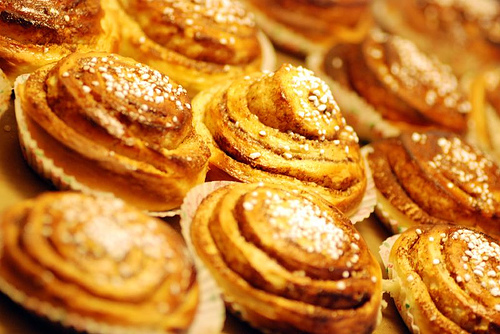
It’s worth wondering how a people noted for their healthy physique could be gastronomically symbolized by a cinnamon bun. The thing is a black hole of caloric intake.

Cinnamon buns, or kanelbullar, have been a Swedish staple since at least the 1920s. According to Birgit Nilsson Bergström of Sweden’s Home Baking Council:

“We found that the cinnamon bun was the best symbol for Swedish home baking. I don’t think there are any Swedes who don’t like them.”

These angelic looking, yet devilishly tasty swirls of dough and sugar made their way across Northern Europe during the 20th century, and finally got their big Hollywood break in the hit 1977 film Star Wars.

I decided to celebrate today by finding the world’s best cinnamon bun, and came across a National Cinnamon Bun Day blog by baking aficionado Anne of Sweden. The Swedish cinnamon expert has sampled some of the finest buns in the world and proclaims she found the perfect bun, not in Scandinavia, but in a distant land…

“My favorite cinnamon bun is not a bun, but a roll, from Sweet Jill’s. That’s a small pastry shop on Second Street (Belmont Shore) in Long Beach, California. Needless to say, I don’t eat them very often. But on my California trips…The rolls are huge – incredibly large, I bet they weigh a pound. And so incredibly delicious.

So at great expense and hazard to my own person, I undertook the perilous journey to this quaint and mystical seaside town of Belmont Shore.

I was surprised to find the workers at Sweet Jill’s unaware of Cinnamon Bun Day. When I asked for a world-famous cinnamon bun, my server replied, “Walnut or low-fat?” He may have noticed the disappointment in my face, or the tears welling up in my eyes. (I don’t like walnuts and don’t believe in low-fat.) For, moments later, he pulled from the oven a fresh batch of beautiful, nut-free, fat-full cinnamon swirls.

I did not weigh it, but I would agree with Anne, you could feed a family of four for a week.

Okay, truth be told, I grew up near Sweet Jill’s, a classmate of mine even worked there in high school, and I set foot in there maybe once all the time I lived there. It goes to show the old axiom is true: You don’t know the treasure in your own backyard, until you start researching National Cinnamon Bun Day in Sweden.

The bun/roll/swirl was delicious as its legacy warranted, and I can honestly say, I end this holiday, if not wiser, heavier.

http://annesfood.blogspot.com/2008/10/national-cinnamon-bun-day.html (Warning: You may absorb calories just by looking at this website.)