Niger Republic Day

December 18

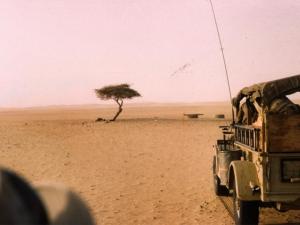
The Tree of Ténére, 1961, by Michael Mazeau

Standly quietly in the desert, L’Abre du Ténére was the only tree for 400 kilometers in any direction, earning the reputation as the most isolated tree in the world. It served as a natural lighthouse for travelers and traders crossing the Sahara.

In 1939 a team dug a neaby well to find out where the tree got its water. It determined the trees roots had to descend 35 meters to reach the source.

The Tree of Ténére was the sole survivor of a forest than once dominated the region. In fact this part of the Sahara was a fertile grassland, which ancient artworks depict supporting a multitude of animals. Ten thousand years of “global warming” entirely dried up the grassland.

Giraffes of the Sahara, (c) 2006 Marc Faucher

Today 80% of Niger is covered by the Sahara desert. Most Nigeriens live in the southwest corner of the country, where a small stretch of the Niger River flows in from Mali on the west and out through Nigeria to the south.

For centuries the unusual path of the Niger River baffled European explorers, who assumed its source was an unchartered snow-topped mountain rather than from storm run-off.


“Age after age the lordly stream hath run,
From secret source which mortal ne’er hath seen,
Deep-hidd’n perchance, where never sound hath been
Or sign of life–where tropic summers glow
On silent peaks of everlasting snow;”

William Allan Russell, The Niger

Because of its remoteness, the Niger region–ancient domain of the Songhai–was one of the last casualties of colonization. The French, intent on linking their holdings from the Niger River to the Nile, subdued Tuareg resistance and confiscated tribal lands in 1922.

During WWII, the French found themselves similarly occupied, and the Vichy government gave Nigeriens the right to vote. On December 18, 1958, Nigeriens voted to become an autonomous nation within the French commonwealth. Full independence came two years later. December 18 is celebrated as Niger’s National Day.
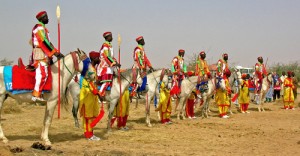
Niger National Day (c) 2006 Esther Garvi
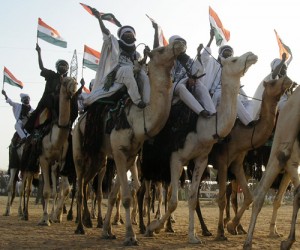
Niger National Day (c) 2008 Esther Garvi

Watching Nigeriens celebrate National Day, you’d hardly believe the title that the UN Human Development Index bestowed upon the nation in 2006: “Least Livable Country in the World.” Nigeriens are among the most resourceful and spirited people in the world. The nation has navigated for centuries though colonialism, coups, drought, famine and war for centuries.

It has few precious natural resources. No oil like its neighbor to the south, Nigeria. No diamonds like Sierra Leone. No ocean access. A new gold mine started production in 2007, which may help raise Niger’s GDP. The land-locked nation gained notoriety in 2003 for something it didn’t do with its most highly-safe-guarded natural resource: it didn’t sell yellow-caked uranium to Iraq, as U.S. intelligence once suspected.

As for the Tree of Ténéré, it stands no more. According to Henri Lhote, who observed the tree in 1934 and again in 1959:

“Before, this tree was green and with flowers; now it is a colourless thorn tree and naked. I cannot recognise it—it had two very distinct trunks. Now there is only one, with a stump on the side, slashed, rather than cut a metre from the soil. What has happened to this unhappy tree? Simply, a lorry going to Bilma has struck it… but it has enough space to avoid it… the taboo, sacred tree, the one which no nomad here would have dared to have hurt with his hand… this tree has been the victim of a mechanic…’

After hundreds of years of surviving the harshest desert conditions, the lone survivor of the Ténéré forest succumbed 14 years later, not to nature, but to the bumper of a reportedly drunk driver.
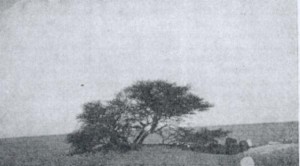
Tenere Tree, 1939

L’Arbre du Ténéré

Niger 2006 Solar Eclipse

Peace Corps Volunteer in rural Niger (God is BIG!)

Esther Garvi’s Niger Blog


Zamenhof Tago!

December 15

Originally celebrated as Zamenhof Day, Esperanto Day is the birthday of Esperanto founder L.L. Zamenhof. He would be 149 today.

The son of a German teacher, Zamenhof was born in Bialystok, Russia, in what is now Poland. He spoke all three of those languages as a child, and studied Greek, Latin, Hebrew and French. He grew up to be a doctor, but had an incredible ability to pick up languages. During his formative years in Poland, conflicts in Eastern Europe led Zamenhof to believe that much of the world’s violence could be stemmed by a common language. Zamenhof set out to create an international language, easy to learn, simple to use, that could unite the world’s speakers for the first time since the Tower of Babel.

In 1887 he published a booklet of the rules of “An International Language” using the pseudonym Dr. Esperanto (one who hopes).

Ludoviki Lazaro "Dr. Esperanto" Zamenhof

The pseudonym became synonymous with the language, and Esperanto was born. It was an uphill battle promoting his language. At the first Esperanto congress in 1905 in Boulogne-sur-Mer, France, Zamenhof stated:

And now for the first time the dream of thousands of years begins to be realized. In this small French seaside town I have met men from the most varied countries and nations, and they meet each other not as deaf-mutes, but they understand one another and speak to one another as brothers, as members of one nation.

One common criticism of Esperanto is that English has become the default “international language”. However, we forget how many languages have attained that position during the peak of their mother country, only to ebb away. The Romans, the Spanish and Portuguese, and the French empires once could say the same.

After the First World War delegates from Europe, South America, Africa, and Asia submitted a proposal that the League of Nations: to make Esperanto the working language of the league. Ten voted for the proposal, one against…

The French delegate, Gabriel Hanotaux, argued that French was and should continue to be the language of international affairs. It didn’t work out that way. Because of Hanotaux’s objection, the League of Nations failed, and the world plunged into the Second World War.

Okay, maybe the chain of cause-and-effect wasn’t that drastic, but the twentieth century proved that the ability to communicate was of paramount importance to international peace and stability.

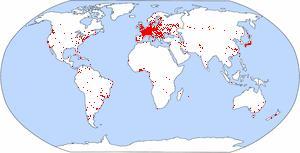
Today France is the leading host country of Esperanto’s Pasporta Servo, where Esperanto speakers can travel the globe practically for free, lodging at the homes of Esperanto hosts in 92 countries. The Pasporta Servo is actually a major incentive for young people to learn Esperanto, which can be learned in a fraction of the time of other languages.

Pasporta Servo host map
Pasporta Servo hosts

Of course with the growing popularity of sites like Babelfish, and increasingly accurate voice-recognition software, it may be that one day everything we say will be instantly translated into whatever language the listener desires.

But until that day…mi provas lerni Esperanton.

Esperanto FAQs

Birthday of His Highness the Aga Khan

December 13

His Highness the Aga Khan has been the Imam of the Shia Ismaili for over fifty years. The Ismaili are the second largest group of Shia in the world. At age 20 he was chosen by his grandfather to succeed him rather than his father or uncle. Wrote his grandfather, Sultan Muhammed Shah Aga Khan:

“In view of the fundamentally altered conditions in the world in very recent years due to the great changes that have taken place, including the discoveries of atomic science, I am convinced that it is in the best interests of the Shia Muslim Ismaili community that I should be succeeded by a young man who has been brought up and developed during recent years and in the midst of the new age, and who brings a new outlook on life to his office.”

Five years before 9/11 the Aga Khan gave a foretelling speech to a group of young people, mostly Americans, about to enter “the real world.” Excerpts are below.

“Today in the occident, the Muslim world is deeply misunderstood by most.

“The Muslim world is noted in the West, North America and Europe, more for the violence of certain minorities than for the peacefulness of its faith and the vast majority of its people…And the Muslim world has, consequently, become something that the West may not want to think about, does not understand, and will associate with only when it is inevitable…

“…the historical process of secularisation which occurred in the West, never took place in Muslim societies. What we are witnessing today, in certain Islamic countries, is exactly the opposite evolution…

“The news-capturing power of this trend contributes to the Western tendency to perceive all Muslims or their societies as a homogeneous mass of people living in some undefined theocratic space, a single “other” evolving elsewhere. And yet with a Muslim majority in some 44 countries and nearly a quarter of the globe’s population, it should be evident that our world cannot be made up of identical people, sharing identical goals, motivations, or interpretations of the faith…

“…Concepts such as meritocracy, free-world economics, or multi-party democracy, honed and tested in the West may generally have proven their worth. But valid though they may be, responsible leadership in the Islamic world must ask if they can be adapted to their cultures which may not have the traditions or infra-structure to assimilate them: There is a real risk that political pluralism could harden latent ethnic or religious divisions into existing or new political structures…

“Although the modern page of human history was written in the West, you should not expect or desire for that page to be photocopied by the Muslim world.”

Full speech at http://www.brown.edu/Administration/News_Bureau/195-96/95-147t.html

I was in the large church room when the Aga Khan delivered this address. Like others of my young age I did not understand the importance of his words, every one of which came true in the years that followed.

More words of the Aga Khan at:http://spiritandlife.wordpress.com/2008/01/16/quotes-of-aga-khan/

Aga Khan’s 70th Birthday Today

Lucia Day

December 13

You know you’ve been in Sweden too long when seeing a young woman with lit candles stuck to her head no longer disturbs you. — You Know You’ve Been In Sweden Too Long When…

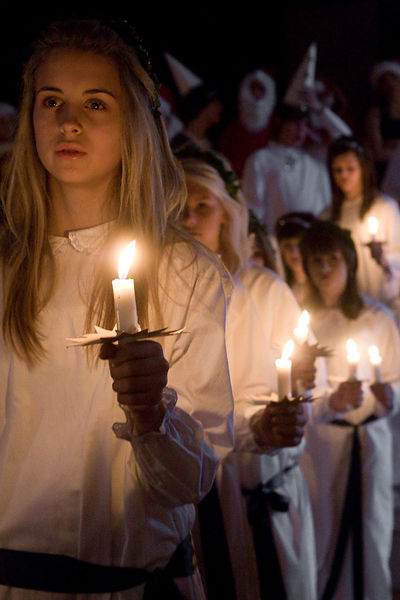
In Sweden and in Swedish communities in North America, thousands of girls will don the traditional white dress and red sash to take part in Lucia Day. Atop the heads of many girls will burn candles in a special crown worn for the holiday–although in Sweden most candles used these days are the battery-powered kind, due to–as the Swedes have discovered–the highly flammable nature of girls’ hair.

The crown of candles shines a light of hope during the darkest nights of the year, which in Sweden can be about 23 hours long.

(c) 2007 Fredrik Magnusson

Saint Lucia was a young Christian who lived in Syracuse, Italy during the time of Diocletian–the infamous persecutor of early Christians–in the late 3rd century. When her mother became ill, Lucia prayed for her. Upon her mother’s recovery Lucia took a vow of chastity and gave her dowry to the poor, thus earning the rancor of a particularly vindictive suitor.

Some stories say the angry suitor outed her as a Christian in court, which then ordered her execution. Other stories say the suitor tried to kill her himself. Either way, they tried to kill her by fire, but she would not burn. Her eyes were poked out (some say she poked out her own eyes and gave them to the suitor) but new eyes grew back in their place. Men and oxen tried to drag her from the town, but she could not be budged.

Finally, on December 13, 304 A.D., the angry suitor stabbed Lucia with a sword in the neck and killed her. She was 20 years old.

Another legend tells of St. Lucia helping the ancient Christians in the catacombs, where torches were needed to navigate the dark tunnels. To keep her hands free to bring more food and drink, Lucia attached candles to a wreath she wore on her head.

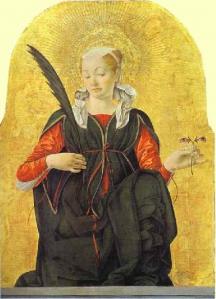
Saint Lucy (Those ain't flowers)

So how did this Catholic saint from Italy become the heroine of a Protestant country in Scandinavia?

It may have to do with the date. Back when Sweden was Catholic and used the Julian calendar, Lucia’s feast day, December 13, was the longest night of the year. In pagan times the winter solstice was considered an ominous night to be out, when trolls and supernatural spirits wandered the earth. Lucia, whose name means light, became a symbol of the victory of light over darkness. Today, Swedish towns hold pageants to pick the “Lucia Bride”. Rituals similar to Luciatagen have taken place in Sweden in one form or another for over a thousand years, but it wasn’t until the 1927 Lucia procession in Stockholm, organized by a local newspaper, that the tradition as we know it spread throughout Sweden and Swedish-speaking Finland.

Lussekatter, or saffron buns, are a staple of the holiday. Made with one of the world’s most expensive spices, saffron dough is filled with cinnamon, sugar, raisins and chopped nuts. The oldest (or youngest) girl in the family serves these goodies.

A more recent Lucia Day tradition is to wake up unsuspecting Nobel Prize winners sleeping at the Grand Hotel in Stockholm. The Nobel Prize is awarded three days earlier on December 10.

Story of Saint Lucy of Syracuse

“You Know You’ve Been in the U.S. When…” and “You Know You’ve Been in Sweden Too Long When…”

Linnea in Lund

The Truth about Santa – St Nick’s Eve

December 5

About this time of year parents deliberately wait in long lines in overcrowded shopping malls so their kids can sit on the lap of a fat red stranger.

Some cultures might call this odd. We call it Christmas.

Though the Christmas season begins commercially on Black Friday, and religiously on Advent, tonight kicks off the season for children in Europe, including the Netherlands, Germany, Belgium, the Czech Republic, and Austria.

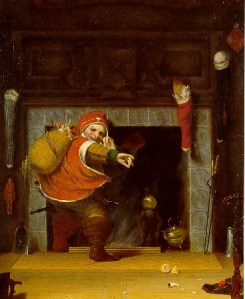
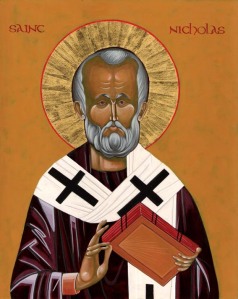
Saint Nicholas, 1838 - by Robert Weir

It’s St. Nicholas’ Eve, and though the date and the figure go by many names, the themes remain the same: kids and candy.

The jolly bearded guy known as Santa Claus in the United States is actually is an amalgamation of numerous folk figures.

The United States imported “Santa Claus” mainly from the Dutch Sinterklaas. Long before that, the Dutch learned of the saint, Saint Nicholas, from Spanish sailors, who believed Saint Nicholas had the power to save sailors by stemming storms at sea. Even today Sinterklaas arrives in Holland on or around November 17 each year, not on a sleigh from the North Pole, but on a ship from Spain.

No one would be more surprised at the role Santa plays in modern society than Saint Nicholas himself, who was actually a bishop in the ancient town of Myra, Turkey (then Asia Minor) around 300 AD.

Saint Nick, old skool

Saint Nicholas was imprisoned for 5 years for refusing to recognize the Roman Emperor Diocletian as a god. He was released after the Christian Emperor Constantine took the throne and removed Christianity from the Roman “terrorist watchlist.”

Today Saint Nicholas is remembered less for his role in destroying pagan temples than for his acts of kindness toward children. Like secretly giving poor families of young girls money for a dowry, so they could marry rather than become prostitutes.

Legends of Saint Nicholas’s devotion to the poor spread throughout the centuries. As his posthumous fame grew, children would leave their boots outside on St. Nicholas Eve in the hopes that St. Nick would fill them with goodies.

In Protestant Germany, Martin Luther replaced the Catholic gift-giving Saint Nicholas with the Christkindl, or “Christ Child.” Over time Christkindl’s name morphed to Krist Kindel. You may know him however as Kris Kringle.

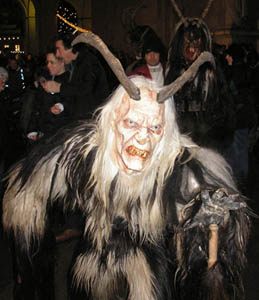
In North America Santa Claus travels by reindeer-guided sleigh, while in Europe the gift-giver is accompanied by figures such as Zwarte Piet (Black Piet) or Krampus (The Claw), the latter being a goat-headed demonish entity who whips bad children with a switch. The Bad Cop to Santa’s Good Cop.

Whether you call him Santa, Kris Kindl, or Father Christmas, you better watch out, you better not cry, you better not pout, I’m telling you why: Christmas is still 20 days out and believe me, you don’t want to end up on Krampus’s naughty list!

Krampus
Krampus

There Really is a Santa Claus – William Federer

Sankt Nikolaus und der Weihnachtsmann

Saint Nicholas Customs Around the World

Sinterklaas

St. Nicholas Day in Germany

Saint Barbara’s Day

December 4

Kids, if you thought your folks are hard on you, be glad you didn’t have Saint Barbara’s dad.

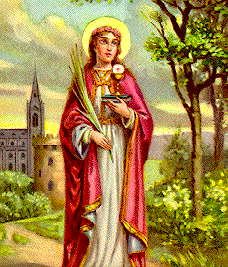
Barbara’s claim to fame was being kept in isolation in a tower by her father Dioscorus, a prominent pagan in Asia Minor, around 300 AD.

barbara
Saint Barbara

Dioscorus grew upset at his daughter’s refusal of several marriage proposals by eligible suitor-princes. Before leaving on a business trip, Dioscorus ordered his workers to construct a bathhouse for Barbara. The bathhouse had two windows. But in her father’s absence, Barbara asked the workmen to put in a third window. When Dioscorus returned he was infuriated by the deviation from his plan. Barbara confessed she did it in honor of the Holy Trinity, and that she was a Christian, having been secretly tutored by a priest.

As any concerned father would do, Dioscorus took her to the Roman prefect, Marcian, who ordered Barbara to be tortured until she renounced her faith. Young Barbara withstood heinous tortures, but did not renounce Christ. When Marcian ordered her execution, Dioscorus offered to do it himself. Barbara was beheaded by her own father around 303 AD. Dioscorus was then struck by a bolt of lightning and died.

Because of the method of her father’s demise, Barbara became the patron saint of those threatened by thunderstorms and fire. And later became the patron saint of miners and artillerymen.

Rome had the last laugh on Barbara though. In 1969, after over a thousand years, the Catholic Church officially removed her Feast Day–like Saint Brigid–for lack of any evidence that she ever existed.

Barbara’s legend is still strong in Germany and northern Europe, where Barbara is celebrated on December 4, the assumed date of her martyrdom. It’s customary to place a twig from a cherry branch (Barbarazweig) in water on this day, to bloom by Christmas. While imprisoned Barbara had found a cherry branch in her cell and moistened it with her drinking water. Before her death, it bloomed, and brought her joy.

cherrybranch

The U.S. Field Artillery has two military orders in her name, the Ancient Order of Saint Barbara and the Honorable Order of Saint Barbara.

St. Barbara’s Day in Germany

National Day – United Arab Emirates

December 2

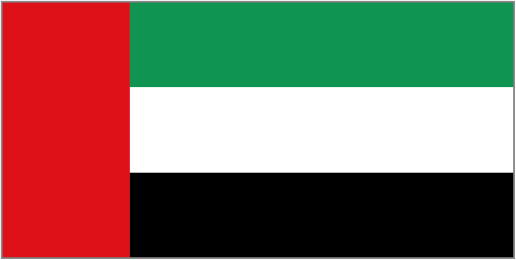
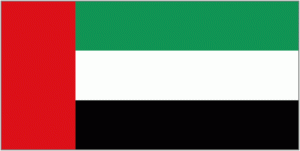
flag_uae

You’ve heard all about the city on its way to becoming the 8th wonder of the modern world, Dubai, but what do you know about the country in which it lies: the United Arab Emirates, or UAE?

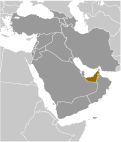
According to the World Factbook, the UAE is one of the wealthiest nations on Earth, with the 12th highest GDP per capita. The UAE has come a long way from the collection of sheikdoms striving to recover from the collapse of the pearl diving industry. Today, this tiny stretch of land between the Arabian desert and the Persian Gulf is the 4th largest oil exporter in the world, and has more oil reserves than Russia, China, and the United States combined. [And at this rate will have more Starbucks too! (-: ]

UAE (brown) & Arabian peninsula

The UAE’s robust economy stems partly from its leaders decision to reinvest oil and gas revenues in the country’s infrastructure, to diversify the economy, and to attract foreign capital and workers.

Dubai boasts the tallest building in the world, the Burj Dubai. At over 800 meters, it’s nearly twice the height of the Empire State Building.

Burj Dubai ©2009 Imre Solt

But the capital of the UAE is not Dubai. It’s Abu Dhabi. Abu Dhabi is the largest of the UAE’s seven sheikdoms, comprising 80% of the country’s land. Combined with Dubai, the two sheikdoms make up the vast majority of the country’s population.

Abu Dhabi holds the Sheikh Zayed Mosque, named after the country’s first President. The mosque can accommodate 40,000 worshippers, and is one of the largest mosques in the world.

The UAE has eight public holidays, of which six are Muslim holidays. The other two are New Year’s Day (January 1) and today, December 2. (ameinfo.com) National Day marks the anniversary of the union of the seven sheikdoms to form the UAE after British withdrawal in 1971.

UAE has the world’s highest net migration rate. Only about a fifth of the country’s residents are citizens. Most of the remainder are expatriates from all over the globe.

Though the UAE is one of the Middle East’s great economic success stories, there has been concern during the financial downturn. Recently, the corporation Dubai World — the company famous for its unprecedented housing projects — made headlines for defaulting on half its $60 billion debt. Ironically, for the average UAE resident, there’s no such thing as bankruptcy. If you can’t pay your debt, you go to jail. (The Dark Side of Dubai – Johann Hari, The Independent) Though the UAE government refused to cover Dubai World’s losses, Asian banks have stepped in with a pledge of support. Evidently Dubai World has learned from its Western counterparts. Lose millions = jail. Lose billions = bailout.

Palm Island Resort seen from space

St. Andrew’s Day – Scotland

November 30

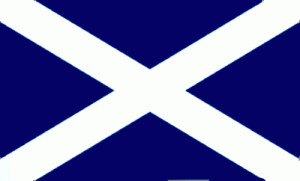
flag_scotland

November 30, St. Andrew’s Day, is the national day of Scotland.

St. Andrew is said to be the first disciple of Christ, though he’s got some competition from his brother Simon Peter.

As Jesus was walking beside the Sea of Galilee, he saw two brothers, Simon called Peter and his brother Andrew. They were casting a net into the lake, for they were fishermen. “Come, follow me,” Jesus said, “and I will make you fishers of men.”

— Matthew 4:18-19

The Book of John, however, proclaims Andrew and an unnamed disciple of John the Baptist as the first two, and Simon Peter as the third. When John the Baptist calls Jesus “the Lamb of God”, Andrew and the unnamed disciple choose to follow Jesus. Only after spending the day with Jesus, does Andrew get his brother Simon Peter to tell him they’ve found the Messiah.

Andrew is also present with Peter, James, and John on the Mount of Olives opposite the temple when Jesus tells them of false prophets and prophesies to be fulfilled:

“Nation will rise against nation, and kingdom against kingdom…

“…You will be handed over to the local councils and flogged in synogogues…Whenever you are arrested and brought to trial, do not worry beforehand about what to say. Just say whatever is given you at the time, for it is not you speaking, but the Holy Spirit.”

— Mark 13

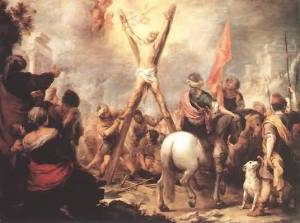
We don’t know Andrew’s last words. According to the Acts of St. Andrew, a third century text, he preached in Asia Minor, the Black Sea area, and Greece, and was crucified around 60 A.D. Tradition has it he was tied (not nailed) to an x-shaped cross, now known as St. Andrew’s Cross, or Saltire. Today the diagonal cross forms the banner of Scotland, of which St. Andrew is the patron saint. (Andrew the Apostle: Profile & Biography – About.com)

Martyrdom of St. Andrew

Saint Andrew is also the patron saint of Russia, the Ukraine, Greece, and Romania. But why Scotland? A country he never came a thousand miles from? The answer may lie with some of the Saint’s relics.

“…the monastery of Kilrymont (later St Andrews) in Fife claimed to have three fingers of the saint’s right hand, a part of one of his arms, one kneecap, and one of his teeth. It is possible that these were brought to Fife (which was at that time part of the kingdom of the Picts) from the neighbouring kingdom of Northumberland, where veneration of St Andrew was particularly strong. St Andrews became a popular pilgrimage destination after miracles were attributed to the saint.”

Saint Andrew seals Scotland’s Independence

St. Andrew’s Day didn’t become an official Bank Holiday in Scotland until 2006, a move that met with some controversy.

“There will always be someone to argue against something as unambiguously positive and celebratory as Saint Andrew’s Day. They’ll say it’s all a load of patriotic nonsense; they’ll say that Saint Andrew never set foot in Scotland, they’ll question why we have to share a saint with the Ukraine, Russia, Greece and so on. Maybe they’ll whinge that it’s too Christian, too partial, or not multicultural enough, and ask why it has to be that particular saint in the first place. But it all misses the point. Let’s face it, nobody thinks Saint Patrick’s Day is really about Saint Patrick; everybody knows it’s all about Ireland. And so it should be with Saint Andrew’s Day. It’s not really about celebrating Saint Andrew, it’s about celebrating Scotland.”

Azeem Ibrahim, Is Saint Andrew’s Day Worth Celebrating?

Historically, the night before St. Andrew’s Day served as a divination night for unmarried girls, who could discern information about their future mate through age-old rituals:

“Throw a shoe at a door. If the toe of the shoe pointed in the direction of the exit, then she would marry and leave her parents’ house within a year…

“Peel a whole apple without breaking the peel and throw the peel over the shoulder. If the peel formed a letter of the alphabet, then this suggested the name of her future groom.”

— http://www.woodlands-junior.kent.sch.uk/months/andrew.html

St. Andrew’s Eve Divination and Rituals