China National Day

October 1

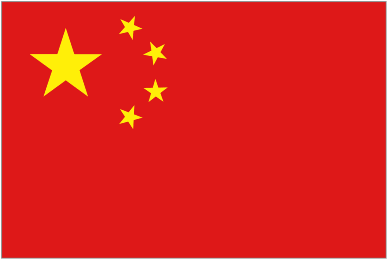
flag_china

By population, it’s the biggest National Day in the world. On this day (October 1) in 1949 Mao Zedong and the Communist Party of China declared victory against the National army of Chiang Kai Shek and announced the birth of a new nation. A grand ceremony was held in Tiananmen Square celebrating the new People’s Republic of China.

Over sixty years later the Chinese continue to celebrate the country’s National Day with three full days of festivities. The holiday runs from October 1 to October 3 each year, but the whole week is referred to as a “Golden Week”. The other “Golden Week” is during Chinese New Year.

Parades, fireworks, and music concerts are some of the key features of the holiday, especially in larger cities like Shanghai. In the past, approximately 800,000 volunteers have helped out around the country to ensure the festivities go smoothly. (Guardian 9/30/09)

The main parade in Beijing can involve hundreds of thousands of people. The parade is an opportunity to show national spirit, and also for the government to strut its military stuff in peacetime.

Of course not all spectators are equally enthralled.

“This is basically a live action Powerpoint presentation, except more painful because the slides actually have to slowly walk by.”

Chen Xi, 10/1/09

But most see a great deal of symbolism and take pride in the ceremonies:

” Amid 60 gun salutes, 200 national flag guards in olive green uniforms walked down the platform of the Monument to the People’s Heroes in the center of Tian’anmen Square, marching northward on ared carpet toward the national flag post.

“The guards walked a total of 169 steps, which symbolized 169 years since 1840, a watershed in China’s history when the country lost the Opium War with Britain. That eventually led to the scramble of Western powers in China.

“The founding of the People’s Republic ended China’s history of being humiliated by outside forces. The country now is emerging as a major political and economic power on the international stage…

“…The 440,000-square-meter Tian’anmen Square is believed to be the largest city square in the world. Six decades ago, the founding ceremony of the PRC was held on the square and late Chairman Mao Zedong announced the birth of New China. Mao himself pressed the button to hoist the first national flag of the PRC.”

Flag-raising Ceremony Held for China’s National Day Celebration
Rosh Hashanah

September 29, 2011
September 17, 2012
September 5, 2013

Happy New Year!

It’s New Year’s in the Jewish calendar, but you won’t hear Jews counting down to midnight, or dropping a big sparkly ball from the Western Wall.

For one, the Jewish day—and thus all Jewish holidays—begin at sundown the night before. Second, Rosh Hashanah is not so much a time of celebration as a time of reflection and repentance.

Despite its name, “Head of the Year”, Rosh Hashanah actually marks the beginning of the seventh month of the Hebrew calendar. The first month is known as Nisan, which falls in the spring.

The Hebrew Calendar actually has four “New Year’s”:

1. In Winter, Tu B’Shevat is the New Year of Trees, originally the day farmers took inventory of trees for tax purposes.

2. In Spring, Jews welcome Nisan as the “first” month of the year, as God commanded Moses in the Jewish holy book, the Torah.

This month hall be considered by you as the First of the Months; it is the First for you of the months of the year.” — Exodus 12:2

3. In Summer, Rosh Chodesh Elul is the New Year of Animals, during which animals and property were counted.

4. Yet, it’s in the Fall that the big New Year is celebrated. According to Jewish tradition, Rosh Hashanah marks the sixth day after creation, the birthday of humanity. Thus, the beginning of the relationship between God and man.

Just as Tu B’Shevat and Rosh Chodesh Elul call for an inventory of property, Rosh Hashanah requires an inventory of the soul. Some scriptures say it’s during this time that God sits upon a throne with a book entailing the deeds of each human life. Rosh Hashanah is the beginning of a ten-day period of introspection, collectively known as the High Holy Days, which culminates with the holiest day of the year, Yom Kippur.

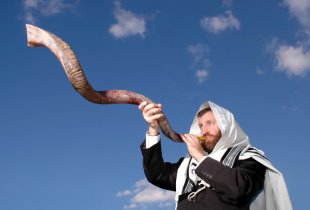
During this time, practicing Jews attend special services at their local synagogue where Rosh Hashanah is marked with the blowing of a ram’s horn known as a shofar. Traditional Rosh Hashanah foods include apples and honey, previously collected this season, to symbolize sweetness in the coming year.

This year Rosh Hashanah marks the first day of the year 5771 in the Jewish calendar.

Michaelmas

September 29

And when the tenants come to pay their quarter’s rent
They bring some fowle at Midsummer, a dish of fish in Lent,
At Christmasse a capon, at Michaelmasse a goose;
And somewhat else at New-yeres tide, for feare their lease flie loose.

Gasciogne, Posies (1575)

September 29 is the Feast Day of the Archangel St. Michael and All Angels.

The archangel Michael is featured prominently in both the Old and New Testaments, as well as apocryphal writings such as the book of Enoch. The appeal of the Archangel spread throughout Christendom during the Middle Ages. Perhaps because of his position as the leader of the army of angels in Revelation, Michael became the patron saint of knights, whom fighters called upon in times of battle.

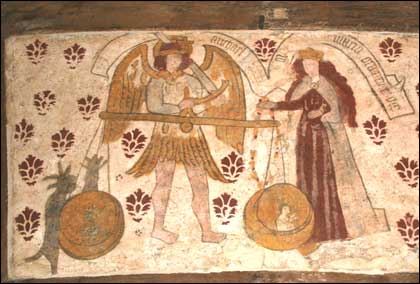
He is also the “good guy” Angel of Death–the one with wings and a scale, not with a black cloak and scythe. Michael’s symbolic scale was believed to weigh the souls of the recently deceased, to determine their worthiness in heaven. Fittingly, St. Michael’s Feast falls during the zodiac sign of Libra, the scales.

The medieval painting above shows St. Michael's scales, weighing the soul of a tiny figure hoping to enter the kingdom of heaven. The devil weighs down the scale on the left while the Virgin Mary weighs down the right with a rosary.

Just as the figure of Michael replaced pagan deities such as the Germanic Wotan (Norse Odin) and the Greek Hermes during the conversion of Europe, his feast day on September 29 replaced nature-based celebrations of the autumnal equinox and the harvest. During the Middle Ages, the equinox fell on or around September 29.

In England, Michaelmas was one of the four quarter days by which debts and suits had to be settled, falling roughly on the solstices and equinoxes: Lady Day (March 25), Midsummer Day (June 24), Michaelmas (September 29) and Christmas (December 25).

Geese, which were fat and hardy this time of year, were often given to landlords and creditors as part of repayment. Goose became the traditional meal of Michaelmas, and a symbol of good luck; hence the saying:

Whoever eats goose on Michaelmas Day
Shall never lack money his debts to pay

In the Church of Latter-Day Saints, before Michael became an angel, he was Adam, the first man. Jehovah’s Witnesses, meanwhile, believe that Michael and Jesus are but one and the same.

Michaelmas was considered the last day to safely eat the season’s blueberries.

…We’ll pick in the Mortenson’s pasture this year.
We’ll go in the morning, that is, if it’s clear,
And the sun shines out warm; the vines must be wet.
It’s so long since I picked I almost forget
How we used to pick berries: we took one look round,
Then sank out of sight like trolls underground…

from Blueberries by Robert Frost

Confucius’s Birthday – Teachers’ Day

September 28

confucian

Before embarking on a journey of revenge, dig two graves.

Confucius

+++

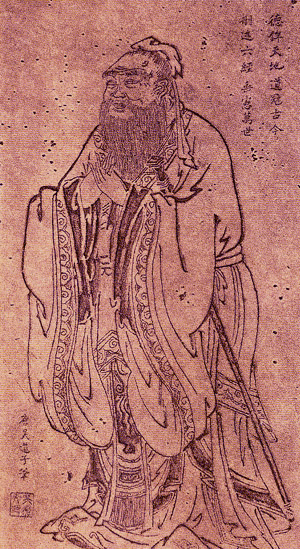
Today is the (observed) birthday of the man whom many believe to be the greatest teacher ever, Master Kung, K’ung Fu Tzu. Or as he’s known in English: Confucius.

Compared to his legacy, the circumstances of his life were somewhat underwhelming.

He was born in 551 BC in Lu, China, into a poor, once noble family. His father died when he was three. According to the Chinese philosopher Mencius, Confucius worked as a storekeeper, and also tended to oxen and sheep in the public fields.

A large chunk of Confucius’ life is missing from the record, as can be expected from a non-royal figure who lived 2500 years ago. But these gaps have been filled in by millennia of legends. We do know that by his early fifties, Confucius was in the employ of the Duke of Lu, Ding, as Minister of Public Works and as Minister of Crime. But Confucius left Lu and the court of the Duke at age 52. Whether it was because of some moral ambiguity on the part of the Duke’s, because of a social snub toward Confucius, or because of animosity from those vying for the Duke’s power, we can’t be sure.

Confucius spent the next several years traveling through China, to the states of Wei, Song, Chen, Cai, and Chu.
He returned to Lu in 484 BC where he lived out his remaining years. By the time of his death he had amassed a sizable following of students, who would formalize and carry on his teachings.

Like I said, underwhelming. But by the next century, Mencius would write, “Ever since man came into this world, never has there been one greater than Confucius.” Confucius was remembered as a sage who should have been king, in a world too shortsighted to see that.

Confucius once said he was not a “maker” of knowledge, but a “transmitter” of it. “I am not one who was born in the possession of knowledge; I am one who is fond of antiquity, and earnest in seeking it there.” (Analects)

Though his teachings and philosophy were based on studies of history, they were vastly different from those that came before.

He taught that rulers who governed by example and by virtue would have more loyal subjects than those who governed by force alone. That the society governed by the former system, and the people within it, would eventually lean toward goodness. And that humans are similar by nature, but their habits and practices “carry them far apart.” (Analects)

He defined the practices of virtue as Gravity, Generosity of Soul, Sincerity, Earnestness, and Kindness.

He condoned strong attachment to family and respect toward elders and ancestors.

And he put into words the Golden Rule of reciprocity: Don’t impose upon other what you would not want for yourself.

Ancient scholars studied for their own improvement. Modern scholars study to impress others.

There are an estimated 6 million followers of Confucianism around the world today, but these are a small minority of those who follow the teachings laid out by Confucius over 2500 years ago. Confucianism remains a dominant philosophical system in Chinese life. His philosophy and teachings fundamentally influenced Eastern thought since his lifetime, as well as Western thought following Confucianism’s introduction into Europe by Jesuit Matteo Ricci in the 16th century.

Since the 1990s, birthday ceremonies in honor of the Great Teacher have flourished in China, after decades of repression.

The nation of Taiwan celebrates this day as Teacher Day.

Confucius Temple Ceremony in honor of Confucius’s birthday.

Meanings of Confucianism

Confucianism Overview @ religioustolerance.org

Saudi National Day

September 23

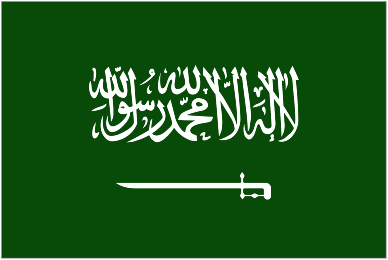
In 2008, National Day in Saudi Arabia was a muted celebration. It coincided with the end of the holy month of Ramadan, one of the most auspicious times of the year. And in Saudi Arabia, when it comes between the state and Islam, Islam has the first, last, and every word in between.

Islam is not just the official religion of Saudi Arabia, it’s the only religion. The law of the land is Shari’a–Islamic religious law based on the teachings of the Qur’an.

Shari’a covers everything from banking to hygiene. According to “Islamic Finance: Law, Economics, and Practice”:

…we do not mean that the Holy Quran and Sunna of the Holy Prophet or the rulings of Islamic scholars provide a specific answer to each and every minute detail of our socioeconomic life. What we mean is that the Holy Quran and the Holy Sunna of the Prophet have laid down the broad principles in the light of which the scholars of every time have deduced specific answers to the new situations arising in their age.

Saudi Arabia is one of the last true monarchies, where the king is also the head of state. The Saud royal family has ruled the bulk of the Arabian peninsula off and on since the 18th century. September 23 commemorates the creation of the modern Saudi Arabian state in 1932, but the date has only been celebrated as a holiday since 2005.

1932 was also the year that the discovery of oil in nearby Bahrain set off a wave of Western speculation. The following year Standard Oil of California struck a deal with the Saudi government to explore for oil. Pay dirt came in 1938 when the first of numerous massive oil reservoirs were discovered. Today Saudi Arabia is the largest oil exporter in the world.

In 2006, Forbes Magazine ranked Saudi Arabia’s Prince Alwaleed Bin Talal Alsaud the 8th richest man in the world, the youngest of the top ten. And the national oil company, Saudi Aramco, is believed to be the world’s most profitable company; however, their finances are not made public.

The country’s most invaluable treasures however–as any Saudi Arabian will tell you–are Al-Masjid al-Harām (“the Sacred Mosque”) at Mecca and Al-Masjid al-Nabawi (“Mosque of the Prophet”) in Medina.

The Sacred Mosque can accommodate over 800,000 worshippers, and over two million Muslims gather there each year during the Hajj, the great pilgrimage of Islam. At its center is the Kabba, where Ibrahim (or Abraham) is believed to have offered to sacrifice his son for God. Muslims around the world face this spot in Mecca when they pray.

The original Mosque in Medina was built by the Prophet Mohammad, who is buried at the site.

Recent National Day celebrations have been more jubilant (Saudi Arabia Celebrates National Day – AFP), but they don’t get going until nightfall. Temperatures in the 100’s (F) keep tend to keep celebrants inside during the day.

Grape Day – Vendémiaire 1st – French New Year

September 22

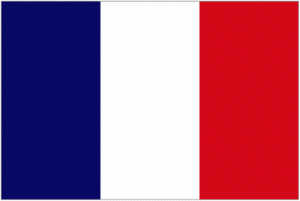
flag_france

Happy New Year!

Today is the first day of the first month (Vendémiaire, or “grape harvest”) of the French Republican Calendar, which was used between 1792 and 1806.

The French Republican Calendar divided the year into twelve months of 30 days each. Each month was further divided into 3 “decades”—weeks of 10 days each.

But that wasn’t enough to signify the end of the old era. The French went one step further, naming every single day of the year for a crop or plant. (Except for every fifth day, which was named for an animal or tool.)

For example, today, the 1st day of Vendémiaire, is Raisin, which in French means—you guessed it—“grape”.

Vendémiaire 9th is Panais (parsnip), the 18th is Sarrazin (buckwheat), and the 21st is Chanvre (hemp).

Horse, Donkey, and Cattle are also honored in Vendémiaire on the 5th, 15th, and 25th respectively.

Three agricultural tools are honored on the 10th, 20th, and 30th: the Tub, the Wine-Press, and the Barrel. We’re assuming this tub is for wine, not bathing. (Or both?)

There was debate as to whether the new epoch delineated by the calendar would begin in 1789, the year of the revolution, or 1792, the year of the formation of the Republic. The government settled upon the latter, marking the autumnal equinox (September 22) as Year I of the new era.

Vendémiaire 1st occasionally began on September 23, and once on September 24 (in 1804).

Around the time of the creation of the calendar, those wacky French were also establishing new-fangled standards of measurement like the metre (distance), gram (weight) and the litre (volume). Over the next 200 years the Metric System would be adopted by all present nations except Burma, Liberia, and the United States. The Republican Calendar however did not fare so well. It was abolished by Napoleon in 1806.

Nevertheless, today we urge you to imbibe the fruits of the raisin, as we toast to the New Year and to days of Auld Lang Syne. Or as the French would say, “Aux jours du bon vieux temps.

Les vieux amis du temps passé,
Se sont-ils oubliés ?
Alors que nos coeurs ont gardé
L’amour du temps passé ?

Old friends from long ago
Are they forgotten?
While our hearts have kept
Love from long ago?

Choral des Adieux

Mabon

Vernal Equinox – on or around September 21 (Northern Hemisphere)
“Blessed be, by the Lady and the Lord, on this Mea’n Fo’mhair. It is the time of the second harvest, one of fruit and wine abundance. Tonight holds equilibrium of all things. Everything is in balance with one another. God and Goddess, Life and Death, Light and Dark.”
Immortal Boundaries, Aubrey Jones

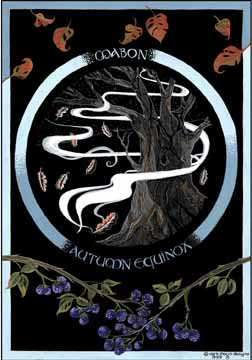
References to the Welsh god Mabon ap Mydron (Mabon, Son of Modron, or ‘Great Son of the Great Mother’) date back well over a thousand years. Today the name Mabon conjures up images of ancient Celtic rituals, of the fruits of the harvest, of flickering flames beneath an autumn moon.  So you may be surprised to learn that ‘Mabon’—in reference to the autumnal equinox—dates not to the Dark Ages, but to the Disco Age (a dark age in its own right), the 1970s.

The holiday Mabon was coined by a grad student, Aidan Kelly, as part of a religious studies project. Kelly was following the Celtic and pagan tradition of naming holy days after gods and goddesses. Lughnasadh honors the Irish sun god Lugh. Beltane is believed to originate from Ba’al. The spring equinox is named for the German goddess Ostara, from which our word Easter also derives.

There was a holiday known as “Mabon’s Day” in Wales in the 19th century. But that holiday was named for William “Mabon” Abraham, a labor leader responsible for improving miners’ working conditions in Wales, (Mabon is a colloquialism for “young leader” in Welsh) and took place on the first Monday of each month.

Since the 1970s, the autumnal holiday Mabon has gained wide acceptance as a Wiccan and neo-pagan celebration in North America. The Celts, however, didn’t observe the autumnal equinox as much as the cross-quarter days of Lughnasadh (early August) and Samhain (Halloween), the latter of which was Celtic New Year.

The “Second Harvest” is known by many names: Cornucopia, Wine Harvest, Harvest Home, and the Feast of Avalon.

Avalon, one of the many Celtic names for the Land of the Dead, literally means the “land of applesCelebrating new-made wine, harvesting apples and vine products, and visiting burial cairns to place an apple upon them were all ways in which the Celts honored this Sabbat.

Edain McCoy, Celtic Myth & Magick

It’s a joyous celebration, but whereas the spring festivals celebrate birth and fertility, at the time of the harvest, Mabon participants remember their ancestors.

A similar tradition exists in Japanese culture. On the equinox, the Japanese visit the graves of their ancestors. It is known as O-higan, or “the Other Shore.” Buddha is said to walk the earth when night and day are equally divided.

Mabon is also known by variants of Fomhair. In Gaelic, the months of September and October are the only two to share a name: Mi Mean Fomhair and Mi Deireadh Fomhair: mid-harvest month and end-harvest month.

Chilean Independence

September 18

Live with honor or die with glory.

— Bernardo O’Higgins

Bernardo O’Higgins is known as the liberator and national hero of Chile, but he had humble beginnings.

He was the illegitimate son of an Irish engineer and a young Chilean socialite. His father Ambrosio, had been a servant boy in Ireland. Ambrosio emigrated to Spain as a young man, then to Spain’s colonies in the Americas. He settled in Peru, studied to be an engineer, and eventually worked his way up to becoming the Spanish Viceroy of Peru, the highest office in Spain’s greatest colony.

It’s believed that Bernardo never met his father; he was raised by his mother’s family. But through correspondence Ambrosio made it possible for Bernardo to be schooled in England. Bernardo lived briefly to Spain where he met the future Argentinean liberator Jose de San Martin. When he returned to Chile, Bernardo took his father’s name, O’Higgins, and was determined to fight for an independent Chile.

As with other South and Central American colonies, Chile’s initial declaration of independence can be seen as a bizarre act of loyalty to Spanish royal family. Chile refused to recognize Napoleon’s appointment of his brother to the throne of Spain, after the French emperor had deposed the royal family in Madrid. At a public meeting on September 18, 1810, Chileans demanded that the Spanish government in Chile be replaced with a junta of Chilean citizens.

By the time Spain regained control of its homeland and expelled Napoleon’s forces from Iberia, the South American colonies had already tasted independence, and it tasted good.

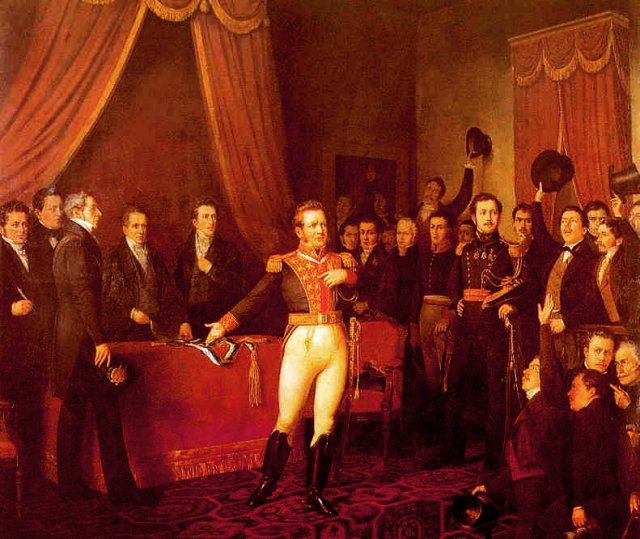
Resignation of Bernando OHiggins
Resignation of Bernando O'Higgins

Bernardo served as a soldier, an officer, and then as one of three leaders of the Chilean rebel forces. But he was defeated by the Spanish, and was forced to retreat east to Argentina. He crossed the Andes to combine forces with his old friend San Martin. After liberating Argentina, he and San Martin made the most spectacular military maneuver in South American history. The entire army crossed the Andes mountains, fell on Santiago from above, and drove out the Spanish.

San Martin took the army north to drive the Spanish out of their stronghold in Peru. O’Higgins remained in Chile to become that country’s first leader. Five years later, when political elements demanded his resignation, he stepped down without a fight, and went into voluntary exile in Peru, where he lived the rest of his life.

“Since my childhood I have loved Chile; and I have shed my blood on the battle-fields which secured her liberties. If it has not been my privilege to perfect her institutions, I have the satisfaction of knowing that I am leaving her free and independent, respected abroad, and glorious in her victories.”

The Chileans celebrate Dieceocho with a slew of Fiestas Patrias, parades, feasts, and open-air dances that go on for days. The day after Independence Day is Armed Forces Day, the main event of which is a large military parade through the capital.

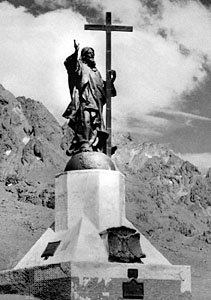
Over a hundred years ago a territorial dispute over the Argentina-Chile border in the Andes nearly led to war between the two nations. The conflict was settled diplomatically. Soon after, a statue of Christ was erected between Argentina and Chile, atop the mountains O’Higgins and San Martin once scaled together. The plaque reads:

“Sooner shall these mountains crumble into dust, than Chileans and Argentines shall break the peace to which they have pledged themselves at the feet of Christ the Redeemer.”