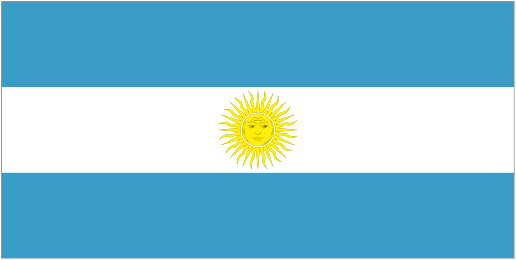
Death of San Martín

August 17

…never had I entertained any ambition other than to merit the hatred of the ungrateful and the esteem of the virtuous.

-José de San Martín, July 22, 1820

San Martín did both.

One of the greatest heroes of Pan-American history, San Martín was an exceptionally rare kind in that, after achieving what he had set out to accomplish–namely the liberation of most of South America–he held true to his word. He relinquished all power and returned home following a fateful and mysterious meeting with fellow libertador Simón Bolívar.

Both men had hopes for a united South America, and both were disillusioned by the continual conflicts that thwarted their idealistic vision.

Upon vanquishing the Spanish army from Argentina, San Martín had hardly set foot outside his newly independent homeland when internal divisions led that nation to civil war. San Martín’s powerful army and his own fame could have swayed the civil war, but he chose to fight the Spanish in Chile and Peru rather than return to Argentina with his army to take sides and shed the blood of his countrymen.

He was proclaimed Protector of Peru, a title he relinquished after his meeting with Bolívar, along with command of his army. He then returned briefly to his farm in Mendoza, Argentina. After the death of his wife, San Martín placed himself in voluntary exile in Europe, moving to France with his daughter Mercedes. He would spend the rest of his life in France, a nation he had once fought against as a youth in service to Spain.

Today San Martín is revered as the national hero of Argentina.
The Life of José de San Martín

Xicolatada – France

August 16

flag_france

Today (August 16) the town of Palau de Cedagne in Southwestern France celebrates Xicolatada. At 11 am on this date, residents indulge in a delicious cup of piping hot chocolate.

This 300+ year-old tradition grew out of another festival. According to legend (i.e., Wikipedia):

15 August was once a festival day, and the locals would drink quite a bit, to the point that they felt a bit ill the following morning. To feel better, the village chocolatier would offer them a hot chocolate, which he claimed was an excellent remedy. Over the years, this habit grew into a custom, and eventually a municipal association was formed to remember the tradition and to organise the distribution of hot chocolate every year on 16 August, at precisely 11 in the morning.

At the time, chocolate was imported through Spain from the Latin American colonies. Located on the border of Spain and France in the Pyrenees, Palau de Cedagne was perfectly situated along popular trade routes.

Today the hot chocolate brewing follows an age-old secret recipe, cooked up in cauldrons, by a brotherhood of well-trained “Mestres xicolaters” (maîtres chocolatiers).

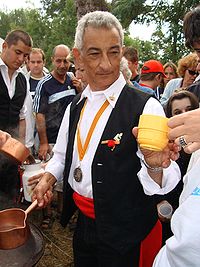
A Master Chocolatier, Xicolatada
A Master Chocolatier serves Xicolata

Xicolatada – specialities-de-france.com

Xicolatada – histoireduroussillon.free.fr

Children’s Day – Paraguay

August 16

flag_paraguay

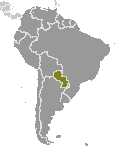
Children’s Day in Paraguay has its roots in the War of the Triple Alliance (1864-1870), the most devastating war ever fought in South America. It was fought between Paraguay (on one side) and Brazil, Argentina, and Uruguay (on the other).

Needless to say, Paraguay didn’t win. In fact, it lost half its population during the war—including nearly all its fighting-age men—as well as 60,000 square miles of territory to Brazil and Argentina. (Latin America’s Wars: the Age of the Caudillo (1791-1899) Robert Scheina)

Children’s Day recalls the anniversary of the one of the last battles of the war in 1869, the Battle of Acosta Nu. Having already lost most of his army, Paraguayan dictator Francisco Lopez used younger and younger recruits. The 6,000 strong force in August of that year was largely made out of children. On August 16, the small retreating army was overtaken by a force of 20,000 men from Brazil and Argentina. Within eight hours, over 2000 Paraguayans lay dead.

Paraguayans say the additional tragedy was that the war was already over at that point, but that the Brazilian government refused to stop until Lopez was captured.

The War of the Triple Alliance remains one of the darkest chapters in South American history.

Paraguay in green
Paraguay in green

Melon Day – Turkmenistan

2nd Sunday in August

All right you cucurbitaceans, you’ve waited all year for this!

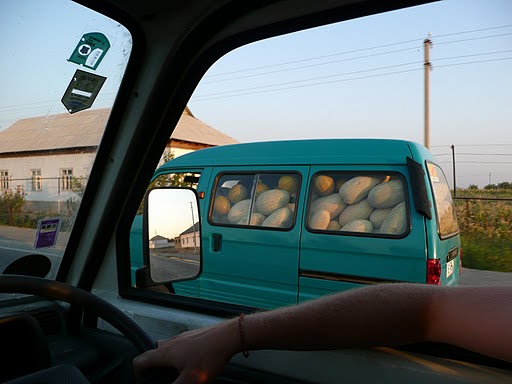
Today, the second Sunday of August, the country of Turkmenistan celebrates, not independence, not victory or freedom or liberty, but the glorious, almighty melon.

Yes, melons.

Now, I know what you’re thinking. “Melon Day? Shouldn’t we honor the melon, the noblest of fruits, every day?”

Yes we should. But in Turkmenistan they have taken melon worship to a new level, dedicating one of the country’s 19 national holidays to the fruit.

All Turkmens celebrate this holiday. The Turkmen melon is the source of our pride, its taste has no equal in the world, the smell makes your head spin,” proclaimed Turkmenistan’s former leader, the late President Niyazov, who created the holiday in 1994.

Turkmenistan grows over 200 types of melon, ranging in size from a potato-sized melon to 18kg monsters. The national melon is the muskmelon.

So celebrate Melon Day by partaking in one of your favorite muskmelon recipes and don’t miss this clip of the Melon Day festivities!

Melon Days are here again!

Whether the knife falls on the mellon or the melon on the knife, the melon suffers.

African proverb

Many wagon-loads of enormous water-melons were brought to market every day, and I was sure to see groups of men, women, and children seated on the pavement round the spot where they were sold, sucking in prodigious quantites of this water fruit. Their manner of devouring them is extremely unpleasant; the huge fruit is cut into half a dozen sections, of about a foot long, and then, dripping as it is with water, applied to the mouth, from either side of which pour copious streams of the fluid, while, ever and anon, a mouthful of the hard black seeds are shot out in all directions, to the great annoyance of all within reach. When I first tasted this fruit I thought it very vile stuff indeed, but before the end of the season we all learned to like it.

Frances Trollope, Domestic Manners of the Americans, 1832

Hungry Ghost Festival

August 14, 2011
August 30, 2012
August 20, 2013

No, not those kind of ghosts.

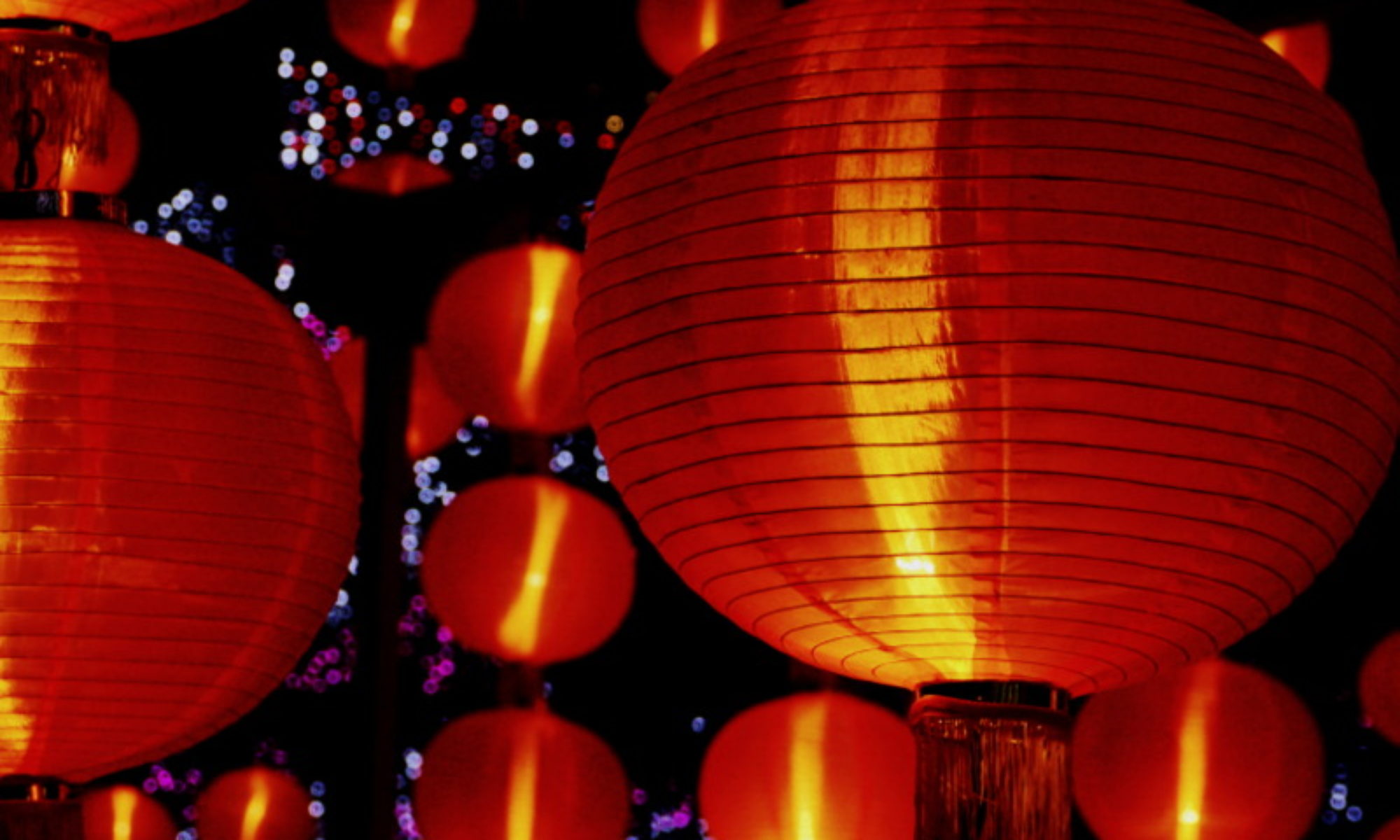
The period of Ghost Month–the seventh month of the Chinese lunar calendar–comes to a climax on Zhong Yuan, the Hungry Ghost Festival, on the eve of the fifteenth day. During Ghost Month the gates of the afterworld open to allow the dead to walk the earth and seek food.

Families prepare meals for the departed on Zhong Yuan. Many say prayers and burn special incense. Also, it is said these ghosts can enact revenge on those who wronged them in life.

There is a superstition against doing all sorts of activities during Ghost Month, including swimming–kind of unfortunately, as the Olympic swimming events occur smack in the middle this year.

In China the festival bears some similarity to Qingming–Tombsweeping Day–except the Ghost Festival focuses solely on the departed of previous generations.

Other traditions include the placement of a chair and alter outdoors in a prominent location for priests. Dishes of peaches and special flour-made rice are placed underneath the alter and spread by the priest to the souls of the dead. Atop the alter are symbolic sacrifices, including food and cakes, meant to invoke the gods for better weather and healthy crops. Families also make and burn fake paper money in tribute to the dead.

Zhongyuan Festival china.org.cn

Links:

http://shuangxingfu.blogspot.com/2009/08/hungry-ghost-festivalof-seventh-lunar.html

Raksha Bandhan

August 13, 2011

All across India sisters tie special colored bracelets of thread around their brothers’ wrists, as a symbol of protection. Likewise, the thread reminds the brother of his pledge and duty to protect his sister.

The threaded bracelet is called a rakhi and the holiday is Raksha Bandhan, a Hindu and Sikh celebration of brothers and sisters. It falls on the full moon (Shravan Poornima) in August. (August 16, 2008. August 5, 2009.)

There are two main stories of how the tradition came about.

One is that the goddess Draupadi tore a strip from her sari and wrapped it around Krishna’s wounded finger after battle. Later, Krishna returned the favor. When Draupadi’s malevolent brother-in-law attempted to dishonor her by removing her sari, Krishna continuously elongated her sari so she could not be disrobed.

Another is that Shashikala blessed a silken talisman and tied it around Lord Indra’s right wrist to protect him from harm during the battle of gods and demons. The rakhi gave him the strength to defeat them.

The tradition was further popularized during India’s Moghul period in the 16th century. Facing attack from the sultan of Gujarat, Queen Karnavati of Rajasthan sent a sacred Rakhi thread to the Mughal emperor Humayan, to remind him of their special connection and in the hopes of receiving assistance against the enemy.

This year in Ahmedabad, Gujarat, about 700 young men and women at H.K. Arts College reversed the tradition. Boys bestowed Rakhi on the girls as a symbol of determination to stop female foeticide, a crime that is largely responsible for lopsided male:female ratio in India, especially in states like Gujarat where that ratio is 100 to 83.

Female Foeticide in India

Women’s Day – Tunisia

August 13

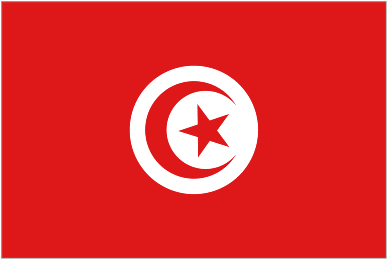
Women’s Day in Tunisia isn’t celebrated on March 8th like much of the rest of the world, but on August 13, in commemoration of the Tunisian Code of Personal Status, enacted on this day in 1956.

The Code and the principles it endorsed sent shock waves across the Islamic world when it was created. Among other things, the Code established judicial divorce proceedings, gave women the right to request divorce, set the minimum age for marriage at 17, abolished polygamy, regulated alimony payments, improved women’s standing in child custody proceedings and inheritance matters, and reduced gender inequality in general.

The Code of Personal Status was one of the first major legislative actions of the new government. Tunisia had only gained independence from France in March of that year.

It’s been said, the Code differs from women’s rights legislation in other nations in that, though supported by active women’s groups such as the National Union of Tunisian Women, the Code was not a reaction to a widespread grass-roots movement, but an action of a reformist government in a recently-independent nation with the purpose of modernizing Tunisian societal structure to enable Tunisia to compete in an industrialized, post-war world.

Glorious 12th

The Game Act of 1773 established what has come to be known as “the Glorious 12th” in England. Not to be confused with Northern Ireland’s Glorious Twelfth in July, August’s Glorious 12th is the first day of hunting season of red grouse in England. Apparently this is a big deal.

The foregoing observations relative to partridges may be nearly as well applied to grouse shooting, when we recollect that Lord Strathmore’s keeper, in killing forty-three brace of muir-game before two o’clock in the afternoon, had only bagged three birds at eight in the morning…The chief difficulty to be guarded against in this delightful sport, is the maneuvre of the old cock, who is cackling forward, in order to lead you away from the brood.

Instructions to Young Sportsmen in All that Relates to Guns and Shooting – by Peter Hawker, 1844

Grouse-shooting Behind Global Warming?