The Truth about Santa – St Nick’s Eve

December 5

About this time of year parents deliberately wait in long lines in overcrowded shopping malls so their kids can sit on the lap of a fat red stranger.

Some cultures might call this odd. We call it Christmas.

Though the Christmas season begins commercially on Black Friday, and religiously on Advent, tonight kicks off the season for children in Europe, including the Netherlands, Germany, Belgium, the Czech Republic, and Austria.

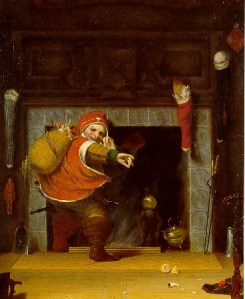
Saint Nicholas, 1838 - by Robert Weir

It’s St. Nicholas’ Eve, and though the date and the figure go by many names, the themes remain the same: kids and candy.

The jolly bearded guy known as Santa Claus in the United States is actually is an amalgamation of numerous folk figures.

The United States imported “Santa Claus” mainly from the Dutch Sinterklaas. Long before that, the Dutch learned of the saint, Saint Nicholas, from Spanish sailors, who believed Saint Nicholas had the power to save sailors by stemming storms at sea. Even today Sinterklaas arrives in Holland on or around November 17 each year, not on a sleigh from the North Pole, but on a ship from Spain.

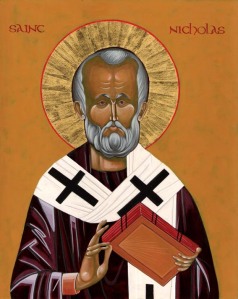
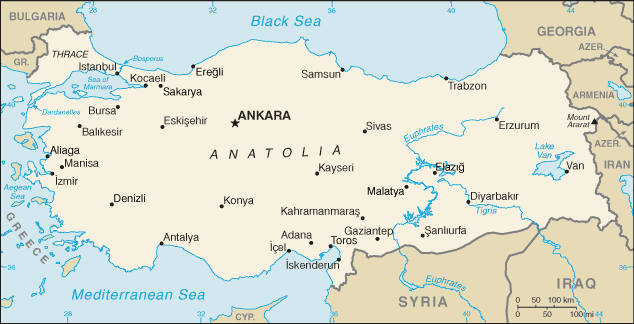
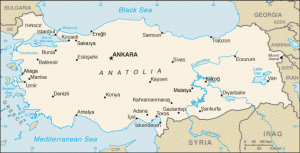
No one would be more surprised at the role Santa plays in modern society than Saint Nicholas himself, who was actually a bishop in the ancient town of Myra, Turkey (then Asia Minor) around 300 AD.

Saint Nick, old skool

Saint Nicholas was imprisoned for 5 years for refusing to recognize the Roman Emperor Diocletian as a god. He was released after the Christian Emperor Constantine took the throne and removed Christianity from the Roman “terrorist watchlist.”

Today Saint Nicholas is remembered less for his role in destroying pagan temples than for his acts of kindness toward children. Like secretly giving poor families of young girls money for a dowry, so they could marry rather than become prostitutes.

Legends of Saint Nicholas’s devotion to the poor spread throughout the centuries. As his posthumous fame grew, children would leave their boots outside on St. Nicholas Eve in the hopes that St. Nick would fill them with goodies.

In Protestant Germany, Martin Luther replaced the Catholic gift-giving Saint Nicholas with the Christkindl, or “Christ Child.” Over time Christkindl’s name morphed to Krist Kindel. You may know him however as Kris Kringle.

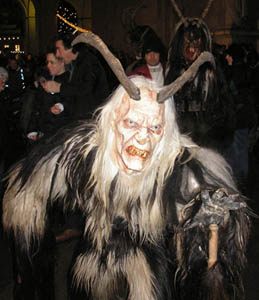
In North America Santa Claus travels by reindeer-guided sleigh, while in Europe the gift-giver is accompanied by figures such as Zwarte Piet (Black Piet) or Krampus (The Claw), the latter being a goat-headed demonish entity who whips bad children with a switch. The Bad Cop to Santa’s Good Cop.

Whether you call him Santa, Kris Kindl, or Father Christmas, you better watch out, you better not cry, you better not pout, I’m telling you why: Christmas is still 20 days out and believe me, you don’t want to end up on Krampus’s naughty list!

Krampus
Krampus

There Really is a Santa Claus – William Federer

Sankt Nikolaus und der Weihnachtsmann

Saint Nicholas Customs Around the World

Sinterklaas

St. Nicholas Day in Germany

National Day – United Arab Emirates

December 2

flag_uae

You’ve heard all about the city on its way to becoming the 8th wonder of the modern world, Dubai, but what do you know about the country in which it lies: the United Arab Emirates, or UAE?

According to the World Factbook, the UAE is one of the wealthiest nations on Earth, with the 12th highest GDP per capita. The UAE has come a long way from the collection of sheikdoms striving to recover from the collapse of the pearl diving industry. Today, this tiny stretch of land between the Arabian desert and the Persian Gulf is the 4th largest oil exporter in the world, and has more oil reserves than Russia, China, and the United States combined. [And at this rate will have more Starbucks too! (-: ]

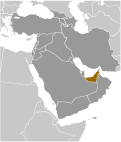
UAE (brown) & Arabian peninsula

The UAE’s robust economy stems partly from its leaders decision to reinvest oil and gas revenues in the country’s infrastructure, to diversify the economy, and to attract foreign capital and workers.

Dubai boasts the tallest building in the world, the Burj Dubai. At over 800 meters, it’s nearly twice the height of the Empire State Building.

Burj Dubai ©2009 Imre Solt

But the capital of the UAE is not Dubai. It’s Abu Dhabi. Abu Dhabi is the largest of the UAE’s seven sheikdoms, comprising 80% of the country’s land. Combined with Dubai, the two sheikdoms make up the vast majority of the country’s population.

Abu Dhabi holds the Sheikh Zayed Mosque, named after the country’s first President. The mosque can accommodate 40,000 worshippers, and is one of the largest mosques in the world.

The UAE has eight public holidays, of which six are Muslim holidays. The other two are New Year’s Day (January 1) and today, December 2. (ameinfo.com) National Day marks the anniversary of the union of the seven sheikdoms to form the UAE after British withdrawal in 1971.

UAE has the world’s highest net migration rate. Only about a fifth of the country’s residents are citizens. Most of the remainder are expatriates from all over the globe.

Though the UAE is one of the Middle East’s great economic success stories, there has been concern during the financial downturn. Recently, the corporation Dubai World — the company famous for its unprecedented housing projects — made headlines for defaulting on half its $60 billion debt. Ironically, for the average UAE resident, there’s no such thing as bankruptcy. If you can’t pay your debt, you go to jail. (The Dark Side of Dubai – Johann Hari, The Independent) Though the UAE government refused to cover Dubai World’s losses, Asian banks have stepped in with a pledge of support. Evidently Dubai World has learned from its Western counterparts. Lose millions = jail. Lose billions = bailout.

Palm Island Resort seen from space

Rosa Parks Day

December 1

rosaparks
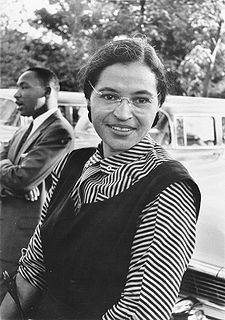
Rosa Parks, 1913-2005

On this day in 1955 a 42 year-old woman in Montgomery, Alabama, made history for something she didn’tdo.

Stand up.

When bus driver James Blake told 4 African-Americans to give their seats to white patrons, 3 of them did so. Rosa Parks, a department store employee on her way home, refused to move. Blake threatened to have her arrested. She replied, “You may do that.”

Rosa Parks wasn’t the first African-American woman to defy Montgomery’s segregated bus system, but hers was the case that captured America’s attention.

Long ago I set my mind to be a free person and not to give in to fear…When I sat down on the bus the day I was arrested, I was thinking of going home…After so many years of oppression and being a victim of the mistreatment that my people had suffered, not giving up my seat–and what I had to face after not giving it up–was not important. I did not feel any fear sitting in the seat I was sitting in. All I felt was tired. Tired of being pushed around. Tired of seeing the bad treatment and disrespect of children, women, and men just because of the color of their skin.

Rosa Parks, Quiet Strength

After Parks’ arrest, Civil Rights activists Edgar Nixon and Jo Ann Robinson organized a one-day boycott practically overnight. What started as a one-day boycott of Montgomery’s bus system lasted 381 days. A young minister from Atlanta named Dr. Martin Luther King Jr. was elected to head the boycott. Tens of thousands of African-Americans, who comprised the vast majority of Montgomery bus patrons, walked the long road to work or school rather than ride the bus.

The following year the Supreme Court deemed Montgomery’s bus segregation unconstitutional in Browder v. Gayle.

Parks died on October 24, 2005, just a month before the 50th anniversary of her famous stand–or sit rather.

In 2008, during Barack Obama’s historic election campaign, a short poem traveled across the web and radio:

Rosa sat

So Martin could walk

So Barack could run

So our children can fly.

St. Andrew’s Day – Scotland

November 30

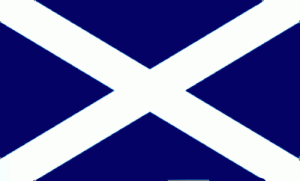
flag_scotland

November 30, St. Andrew’s Day, is the national day of Scotland.

St. Andrew is said to be the first disciple of Christ, though he’s got some competition from his brother Simon Peter.

As Jesus was walking beside the Sea of Galilee, he saw two brothers, Simon called Peter and his brother Andrew. They were casting a net into the lake, for they were fishermen. “Come, follow me,” Jesus said, “and I will make you fishers of men.”

— Matthew 4:18-19

The Book of John, however, proclaims Andrew and an unnamed disciple of John the Baptist as the first two, and Simon Peter as the third. When John the Baptist calls Jesus “the Lamb of God”, Andrew and the unnamed disciple choose to follow Jesus. Only after spending the day with Jesus, does Andrew get his brother Simon Peter to tell him they’ve found the Messiah.

Andrew is also present with Peter, James, and John on the Mount of Olives opposite the temple when Jesus tells them of false prophets and prophesies to be fulfilled:

“Nation will rise against nation, and kingdom against kingdom…

“…You will be handed over to the local councils and flogged in synogogues…Whenever you are arrested and brought to trial, do not worry beforehand about what to say. Just say whatever is given you at the time, for it is not you speaking, but the Holy Spirit.”

— Mark 13

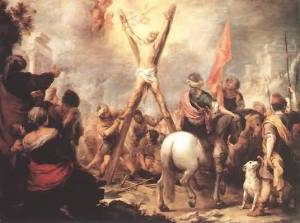
We don’t know Andrew’s last words. According to the Acts of St. Andrew, a third century text, he preached in Asia Minor, the Black Sea area, and Greece, and was crucified around 60 A.D. Tradition has it he was tied (not nailed) to an x-shaped cross, now known as St. Andrew’s Cross, or Saltire. Today the diagonal cross forms the banner of Scotland, of which St. Andrew is the patron saint. (Andrew the Apostle: Profile & Biography – About.com)

Martyrdom of St. Andrew

Saint Andrew is also the patron saint of Russia, the Ukraine, Greece, and Romania. But why Scotland? A country he never came a thousand miles from? The answer may lie with some of the Saint’s relics.

“…the monastery of Kilrymont (later St Andrews) in Fife claimed to have three fingers of the saint’s right hand, a part of one of his arms, one kneecap, and one of his teeth. It is possible that these were brought to Fife (which was at that time part of the kingdom of the Picts) from the neighbouring kingdom of Northumberland, where veneration of St Andrew was particularly strong. St Andrews became a popular pilgrimage destination after miracles were attributed to the saint.”

Saint Andrew seals Scotland’s Independence

St. Andrew’s Day didn’t become an official Bank Holiday in Scotland until 2006, a move that met with some controversy.

“There will always be someone to argue against something as unambiguously positive and celebratory as Saint Andrew’s Day. They’ll say it’s all a load of patriotic nonsense; they’ll say that Saint Andrew never set foot in Scotland, they’ll question why we have to share a saint with the Ukraine, Russia, Greece and so on. Maybe they’ll whinge that it’s too Christian, too partial, or not multicultural enough, and ask why it has to be that particular saint in the first place. But it all misses the point. Let’s face it, nobody thinks Saint Patrick’s Day is really about Saint Patrick; everybody knows it’s all about Ireland. And so it should be with Saint Andrew’s Day. It’s not really about celebrating Saint Andrew, it’s about celebrating Scotland.”

Azeem Ibrahim, Is Saint Andrew’s Day Worth Celebrating?

Historically, the night before St. Andrew’s Day served as a divination night for unmarried girls, who could discern information about their future mate through age-old rituals:

“Throw a shoe at a door. If the toe of the shoe pointed in the direction of the exit, then she would marry and leave her parents’ house within a year…

“Peel a whole apple without breaking the peel and throw the peel over the shoulder. If the peel formed a letter of the alphabet, then this suggested the name of her future groom.”

— http://www.woodlands-junior.kent.sch.uk/months/andrew.html

St. Andrew’s Eve Divination and Rituals

Gettin’ Zany with Albania

November 28

Albania, Albania,
You border on the Adriatic
Your land is mostly mountainous
And your chief export is chrome

Albanian National Anthem

Ok, the above lyrics are not from the Albanian national anthem. They’re from that episode of Cheers where Coach demonstrates how it’s easier to learn factoids when they’re set to music. (Sung to the tune of “When the Saints Go Marching In“.)

Albania is one of the most overlooked countries of Europe, yet one of the most beautiful. And Albanians are fiercely proud of this fact. On no day is Albanian pride more evident than on November 28, Albania’s Flag Day, Independence Day, and just about everything else all wrapped up into one.

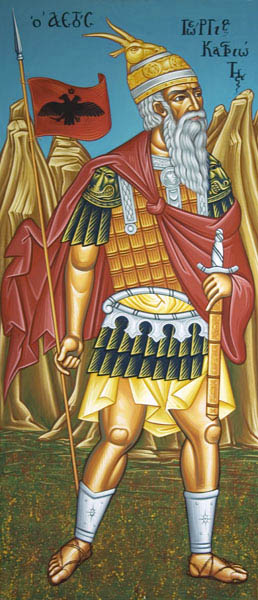
Giorgios Kastriotis, Skanderbeg

Back in 1443 an Albanian by the name of Giorgios Kastrioti, aka Skanderbeg (Lord Skander) was fighting on behalf of the Ottoman Empire against the Hungarians. Years before, the Sultan had usurped the Kastrioti family’s lands. The family had submitted to his rule, converted to Islam, and young Giorgios and his brothers were conscripted. Giorgios was granted the title “Beg”, or Lord. He even became a general in the Ottoman army, winning several battles against the Greeks, the Serbs and the Hungarians.

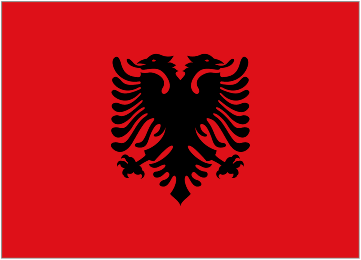
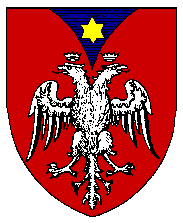
On November 28, 1443, during a battle against the Hungarians, Skanderbeg and 300 Albanians fighting for the Ottoman Empire suddenly switched sides. Skanderbeg first raised the double-headed eagle banner that is now the flag of Albania.

Skanderbeg soon united the Albanian princes against the Sultan. Through strategy, trickery, wits and will, his greatly outnumbered forces held the Ottoman Empire at bay for over two decades, even after the fall of Constantinople in 1453. The Ottoman army finally subdued Albania in 1479, ten years after Skanderbeg’s death by malaria.

skanderbeg_coat_of_arms

The Ottoman Empire ruled Albania until the early 20th century. In 1908 Albanian fighters sided with the Young Turks, a group fighting to restore constitutional government across the Empire. After the Sultan conceded, the Young Turks loosened restrictions that had banned Albanian language and culture. However, when Albanian nationalism resurfaced, the Young Turk government cracked down harder than before, crushing the Albanian rebellion and enforcing “Ottomanization’.

The tightening of power only inflamed the independence movement. In 1911 Albanian fighters defeated a group of Turkish troops and raised the double-headed eagle flag for the first time since the days of Skanderbeg.

On November 28, 1912, during the height of the First Balkan War, the National Assembly announced that “delegates from all parts of Albania, without distinction of religion, who have today met in the town of Valona, have proclaimed the political independence of Albania…” (Albanian Declaration of Independence)

In 1939 Albania met a new enemy, this time in the West. Italian dictator Mussolini, envious of the ease with which Hitler annexed neighboring countries, tried his own hand as Conqueror. He chose as his victim the mighty kingdom of Albania. King Zog was forced to flee, and Albania experienced 5 years under the Axis. Communist-led nationalist forces liberated the country (Albanians are quick to point out they were liberated not by the USSR but by themselves) on November 29, 1944.

Albania became a communist country, but wasn’t dominated by Moscow. In fact they broke ties with the Soviet Union during the latter’s de-Stalinization. Post-Stalin USSR just wasn’t communist enough for Albania.

On November 28, 1998, Albania voted for a new parliamentary constitution–555 years to the day after Skanderbeg first raised the Albanian flag.

For all these reasons, today, November 28, is Albania’s National Day.

+  +  +

In American cinema, Albania enjoys a unique status as the country we’re most likely to scapegoat for arbitrary reasons. In Wag the Dog, Robert Dinero and Dustin Hoffman cook up a fake war against Albania to take the attention off the President’s affair…

“Why Albania?”

“Why not?”

“What have they ever done to us?”

“What have they ever done for us?”

In Tune in Tomorrow, radio serial writer Peter Falk so offends the Albanian-American population with his random Albanian jokes, that he is forced to pick a new arbitrary target: Norwegians.

Late Medieval Balkans – by John Van Antwerp

Black Friday

Day after Thanksgiving

Before long, every entrance to the Exchange became so blocked by the still-gathering legions, that strength and patience were required by him who desired or found it necessary to work his way through the press of people…

What had happened to values? What did it mean? Tampering with gold…had precipitated an alarmingly unsettled condition, which might reach disastrously from one end of the land to the other…

Frederic Stewart Isham, Black Friday, 1904

Greetings, children. Buy Nothing Day is the day after Thanksgiving. The Devil calls it Black Friday.

Reverend Billy Talen, What Would Jesus Buy?

Black is the color ascribed to those terrifying autumnal days when the Stock Market takes a nose dive. Black Monday (October 19, 1987), Black Thursday (October 24, 1929) and the original Black Friday (September 24, 1869), when the price of gold fell dramatically after Jim Fisk and Jay Gould attempted to corner the market.

In the 21st century, Black Friday is day after Thanksgiving and the start of the Christmas shopping season, when stores hope to get their balance sheets back ‘in the black’ (positive, as opposed to ‘in the red’) after one of the busiest shopping days of the year.

The term Black Friday supposedly originated not with accountants but with Philadelphia bus drivers and police officers, who lamented the traffic congestion that inevitably gridlocked the city on the day after Thanksgiving.

In 2008, consumers got a reminder of the crowd-control meaning behind Black Friday’s name. A Wal-Mart employee was trampled to death by a mob of shoppers storming into the Long Island store to buy whatever holiday item is so important that one must kill one’s neighbor to purchase it. A pregnant woman in the same melee was hospitalized and reportedly suffered a miscarriage.

On the other side of the country, an argument in the electronics department of a Palm Desert Toys ‘R’ Us ended with two men shooting each other.

A brief aberration? Or a sign of things to come? According to Reverend Billy Talen, the Shopocalypse is upon us…

Guard against every kind of greed. Life is not measured by how much you own.

Luke 12:15

Thanksgiving!

4th Thursday in November
Oops, wrong picture!
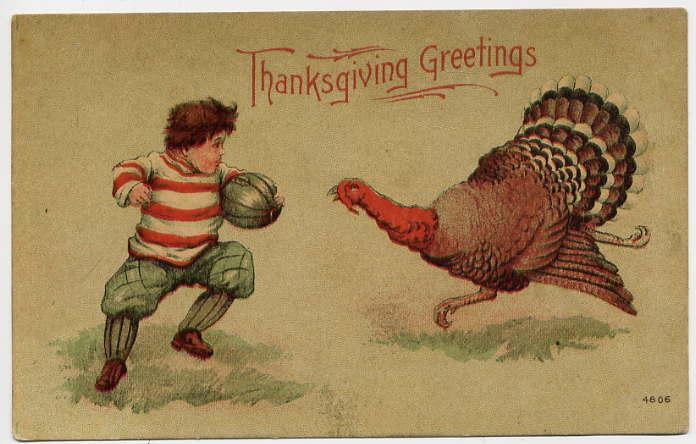
Today Americans join with friends and family to declare thanks for the past year’s blessings.

Though scholars argue over the first true Thanksgiving in North America, popular tradition attributes the holiday to the three-day feast of the Plymouth Rock Pilgrims and the Wampanoag Indians who showed them the ropes in 1621.

The celebrants feasted on deer and corn as well as turkey, and did so in early Autumn rather than in November. The Pilgrims had chosen to migrate to New England during the height (or depth) of the Little Ice Age, meaning Massachusetts was even colder in November than it is now. (Yes, hard to imagine.)

And the Pilgrims didn’t consider it a “Day of Thanksgiving” either.

To the Pilgrims, “Days of Thanksgiving” were solemn occasions of prayer, not feasts, during which labor and recreation were both discouraged. The Pilgrims’ first official Thanksgiving was a day of prayer in July 1623, after a drought. In the 19th century the memory of this event merged in the public eye with the autumn 1621 feast, perhaps given a boost by the rediscovery of the Plymouth Governor William Bradford’s journal by an English bishop in the 1850’s.

Though the British don’t celebrate Thanksgiving, the American tradition hails from England. Queen Elizabeth I had proclaimed a Day of Thanksgiving in 1588 after the destruction of the Spanish Armada. The first annual Day of Thanksgiving in Britain was declared in November 1605 after London authorities thwarted a terrorist plot to blow up Parliament, an event celebrated today as Guy Fawkes Day.

Autumnal harvest festivals were nothing new, but Days of Thanksgiving were also proclaimed after victories in times of war. In 1676, for example, descendants of the Pilgrims declared a Day of Thanksgiving for their victory over their former friends, the Wampanoag.

101 years later in the midst of the Revolutionary War, the Continental Congress declared December 18, 1777 a day of “solemn thanksgiving and praise,” and a day to support the troops through prayer.

George Washington declared Thursday, November 26, 1789 a day of Thanksgiving during his first year as President, a tradition continued by John Adams. But a national Thanksgiving fell by the wayside until Congress and President Madison declared a Thanksgiving Day in 1814, following the end of the War of 1812.

The biggest Thanksgiving bump occurred in 1863, when the nation was at war with its most formidable enemy: itself. Three months after the Battle of Gettysburg, President Lincoln sought to unify the country through prayer, by asking all Americans to “set apart and observe the last Thursday of November next, as a day of Thanksgiving and Praise to our beneficent Father who dwelleth in the Heavens.

It was the first Thanksgiving following the enactment of the Emancipation Proclamation.

Thanksgiving’s association with the first Pilgrims solidified throughout the 19th century as the reunified country sought to fortify its own unique national traditions.

Lincoln’s “last Thursday in November” became the official Thanksgiving rule until 1933.

That year, Franklin D. Roosevelt’s first year in office, November had five Thursdays, and Thanksgiving was to fall on the last day of the month. As one merchant organization wrote:

“It is an established fact that Christmas buying begins vigorously every year in the retail stores the day following Thanksgiving and that the Thanksgiving to Christmas period is the busiest retail period of the whole year. The Downtown Association of Los Angeles feels that Abraham Lincoln’s Proclamation of 1864 setting aside a day for Thanksgiving to be the 4th or last Thursday in November of each year can be carried out to the letter by designating in your Thanksgiving Proclamation this year, November 23rd, the fourth Thursday in November as the day of Thanksgiving.”

FDR moved Thanksgiving to the 4th Thursday in November, and did so again in 1939, despite letters of protest from calendar makers who had printed their calendars, universities that had planned their football season and vacations, traditionalists who believed that centuries-old holidays shouldn’t revolve around department stores, and one tongue-in-cheek West Virginian who wrote:

“I see by the paper this morning where you want to change Thanksgiving Day to November 23 of which I heartily approve. Thanks.

Now, there are some things that I would like done and would appreciate your approval:

1. Have Sunday changed to Wednesday;

2. Have Monday’s to be Christmas;

3. Have it strictly against the Will of God to work on Tuesday;

4. Have Thursday to be Pay Day with time and one-half for overtime;

5. Require everyone to take Friday and Saturday off for a fishing trip down the Potomac.”

Shelby O. Bennett, August 15, 1939

FDR’s tradition stuck. Today Thanksgiving falls on the 4th Thursday of November.

Americans are a grateful people, ever mindful of the many ways we have been blessed. On Thanksgiving Day, we lift our hearts in gratitude for the freedoms we enjoy, the people we love, and the gifts of our prosperous land…

Since the first National Day of Thanksgiving was proclaimed by President George Washington, Americans have come together to offer thanks for our many blessings. We recall the great privilege it is to live in a land where freedom is the right of every person and where all can pursue their dreams.

President George W. Bush, Thanksgiving Proclamation; November 15, 2007

First Thanksgivings: Original Sources

Presidential Thanksgiving Proclamations 1789-1815

Lincoln’s Proclamation, 1863

FDR’s letters re: Thanksgiving 1933 & 1939

1564: The First Forgotten French Pilgrims – NY Times 2008
World Toilet Day – Why you should give a s***

November 19

Privy at Goat Peak, Curt Smith

November 19 is World Toilet Day.

You should be in for a funny post.

Unfortunately you are not.

Poor sanitation kills more people each year than AIDS, but you won’t see any celebrities sporting brown ribbons at this year’s Oscars, and discussions of toilets still emit a response from educated adults akin to the uncomfortable, strained snickering of 7th graders during a sex ed lesson.

“As we passed along the reeking banks of the sewer, the sun shone upon a narrow slip of the water…more like watery mud than muddy water…we saw drains and sewers emptying their filthy contents into it…we heard bucket after bucket of filth splash into it; and the limbs of the vagrant boys bathing in it…we saw a little child…lower a tin can with a rope to fill a large bucket that stood beside her…As the little thing dangled her tin cup as gently as possible into the stream, a bucket of night-soil was poured down from the next gallery.”

India? Bangladesh? Nope, the above description is from the London Morning Chronicle, circa 1849, during a devastating cholera epidemic that few understood. Today we know about the importance of separating feces from drinking water. Yet toilets are not considered a top priority for many inhabitants of developing countries, even for those residents who chat on their new cell phones in public, but do their business in the stream. And even in countries like the U.S. it was only recently that public outcry over restaurant sanitation led to that industry’s standardized ratings system.

web-banner-1-your-gift

World Toilet Day was created by the World Toilet Organization not only to spread awareness of sanitation issues, but to lend ‘speakability’ to one of the most important and overlooked inventions of the past 200 years.

A lot of people asked why we use the word ‘toilet‘,” says Naureen Nayyar, a representative of the WTO…

“It’s because…if we tell people we want to change the role and the way people view toilets we can’t go about it in a bashful manner. Every change that’s come about in society…has come from making people uncomfortable at first.”

The World Toilet Organization has taken on the extremely uphill battle of making the toilet ‘sexy’ and hence desirable to residents of countries seeking to emulate Western lifestyles. While cell phones are the rage, you won’t find toilets of the rich and famous on film or TV. In fact, the ubiquitous porcelain bowl didn’t make its big screen debut until the 1960 Alfred Hitchcock thriller Psycho.

With the trendiness of the green movement and environmentalism, sanitation has finally come to the forefront of world attention, but for some reason the concept of the toilet has remained behind (no pun intended).

On the World Toilet Organization’s website, you can sponsor a household toilet for $140. I asked Nayyar why on earth toilets are so expensive in the 3rd World. She explained that part of the money goes toward education, teaching the public about the importance of a safe, separate place for defecation.

“Toilets are not a great topic, they are not loved, they are not appreciated, but they are a huge necessity that could help reduce the increase of diseases as populations grow, and the sanitation business is a vital part of keeping our waters and world clean.”

The river runs stinking, and all its brink
Is a fringe of every detectable stink:
Bone-boilers and gas-workers and gut-makers there
Are poisoning earth and polluting air.
But touch them who dares; prevent them who can;
What is the Health to the Wealth of man?

Punch, Sept. 2, 1854

The Ghost Map – Steven Johnson – The Story of London’s Most Terrifying Epidemic and How It Changed Science, Cities, and the Modern World

Ode to the Commode – LA Times