Maha Saptami, Maha Ashtami

The seventh and eighth days of Durga Puja are two of the most auspicious days of the great Bengali festival. (You’ll notice a lot of ‘Maha’ in Hindu festivals. It’s a prefix meaning ‘great’.)

Maha Saptami

According to www.indiasite.com

The morning of maha saptami (seventh day) is taken up with the worship of the deity, followed by anjali when a devotee offers prayers and flowers on an empty stomach, amidst the chanting of mantras to the Goddess. Only then can one make a beeline for the prasad (sweetmeat offered to the deity).

The lunchtime meal is called Bhog. By evening, the streets pulse with the sounds of the dhaki drums and the pandals buzz with anticipation of Maha Ashtami.

Maha Ashtami

The eighth day of Durga Puja actually begins at 8:30 tonight. On this day the priest (purahi) offers prayers (aradhana) and breathes life into the idol of the goddess Durga’s.

During the Puja week, the entire state of West Bengal as well as in large societies of Bengalis everywhere, life comes to a complete standstill. In traffic circles, playgrounds, ponds, wherever space is available — elaborate structures called Pandals ‘are set up, many with nearly a year’s worth of planning behind them.

pak-times.com

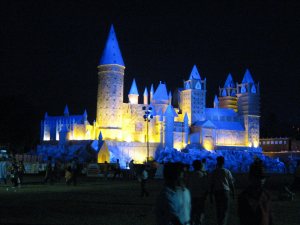
These pandals aren’t tents. They can be massive and ornate structures, and come in all varieties. Recently, a legal furor arose over one such pandal that bore an uncanny resemblance to Harry Potter’s Alma Mater, Hogwarts:

Harry Pandal?

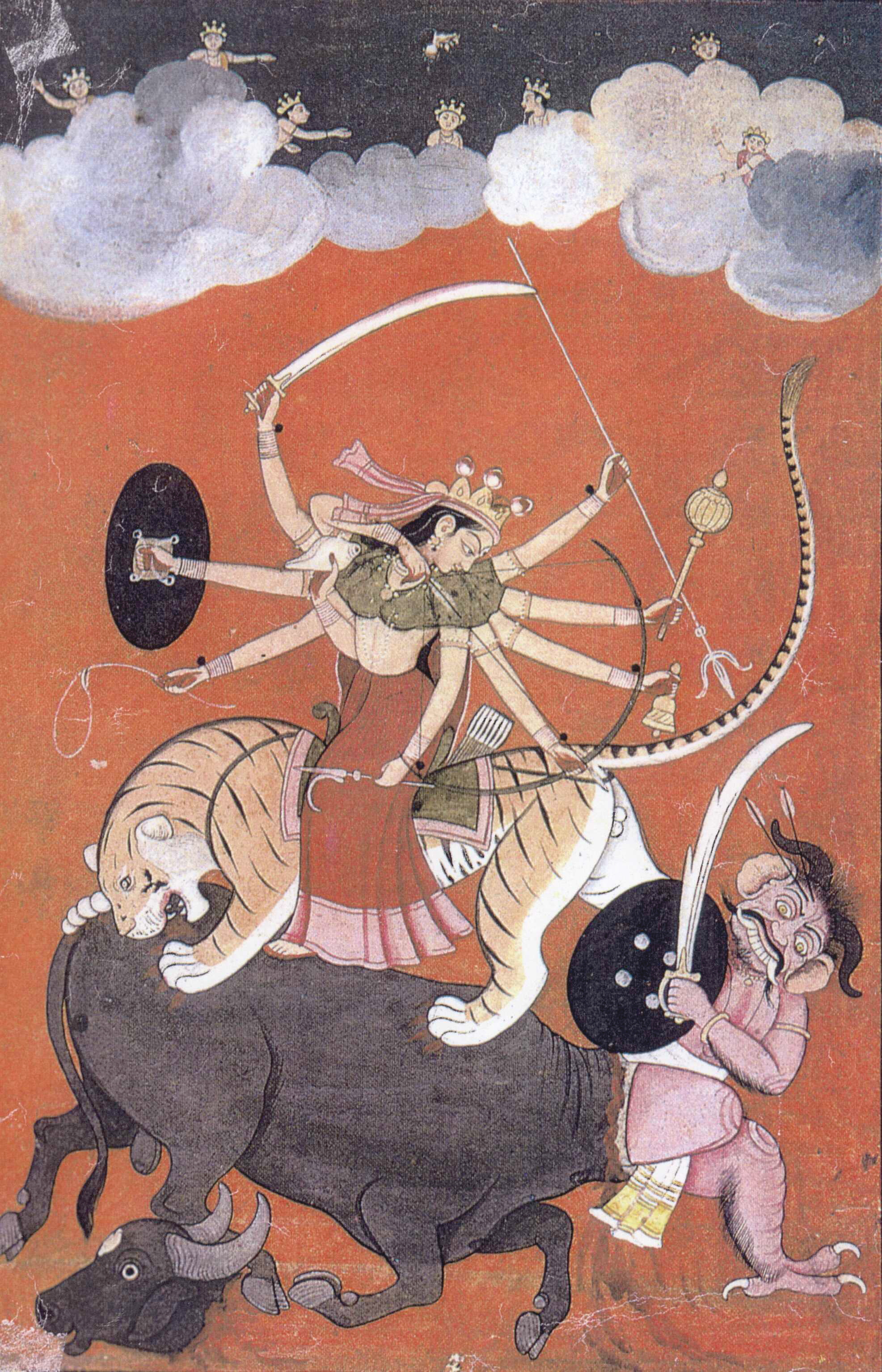
Maha Ashtami is the most venerated day of the festival because it celebrates the victory of Durga over the demon Mahishasura. (See Durga Puja.)

durgapuja-images.blogspot.com

Durga Puja – Bengal

Durga Puja is the largest celebration of Bengal and Bangladesh, and is also celebrated throughout Bhutan, and Nepal. It worships the mother goddess Durga, who was called into existence by the trinity of Hindu gods, Shiva, Brahma and Vishnu, to defeat the demon Mahishasura.

According to legend, Shiva gave the once-loyal Mahishasura a power that he would later regret: that Mahishasura would not be killed by any man.

Confident he could never be stopped, Mahishasura went all maniacal on the lesser gods (Devtas) and plunged the Universe into havoc.  The gods pleaded with Shiva, Brahma, and Vishnu. The three created the only thing that could stop Mahishasura: an all-powerful goddess.

Durga was made from the best of all gods:

Her face reflected the light of Shiva,
her ten arms were from Lord Vishnu,
her feet were from Lord Brahma,
the tresses were formed from the light of Yama, the god of death
and the two breasts were formed from the light of Somanath, the Moon God,
the waist from the light of Indra, the king of gods,
the legs and thighs from the light of Varun, the god of oceans
and hips from the light of Bhoodev (Earth),
the toes from the light of Surya (Sun God),
fingers of the hand from the light of the Vasus, the children of Goddess river Ganga
and nose from the light of Kuber, the keeper of wealth for the Gods.
The teeth were formed from the light of Prajapati, the lord of creatures,
the Triad of her eyes was born from the light of Agni, the Fire God,
the eyebrows from the two Sandhyas,ie, sunrise and sunset,
the ears from the light of Vayu, the god of Wind.

http://www.durga-puja.org/mythology.html

The gods then armed her to the teeth (which as we know, were Prajapati’s) and she proceeded to kick the surprised Mahishasura’s butt. Since that day, Durga has symbolized the unity of the forces of good over those of wickedness.

Durga Puja lasts almost a fortnight, beginning on the 12th of Aashin in the Bengla calendar (September 29 in 2008), but doesn’t really get kicking until the 18th of Aashin (October 5 this year) and lasts four or five days:

October 2008 (Aashin 1415)

October 3 (evening) to October 4: Maha Panchami

October 4/5: Maha Shashti

October 5/6: Maha Saptami

October 6/7: Maha Ashtami

October 8: Maha Navami

October 9: Dashami

Today’s Maha Shashti is “the sixth day of the moon when Goddess Durga is welcomed with much fanfare and gusto. Look for the ‘Bodhon’ rituals when Goddess Durga is unveiled.” –http://www.durgapujagreetings.com/nirghonto.html

Though the religious aspects of the festival are still strong, Durga Puja has become a cultural and community celebration in recent decades.

German Unity Day

October 3

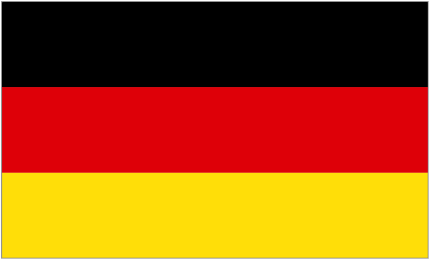
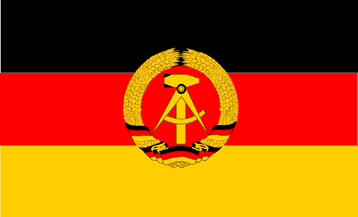
On this day in 1990 the great divide between East and West Germany, the front line between Soviet and Western ideologies for over four decades, was erased in an instant. Germany became one nation for the first time since 1945.

Fall of the Berlin Wall, Nov. 9, 1989

The reunification of Germany on October 3, 1990 followed the dramatic destruction of the Berlin Wall on November 9 the previous year.

A whole generation of young Germans have grown up post-reunification; the oldest are now adults. Despite the spontaneous joy and camaraderie that accompanied reunification, for many years a few Germans on both sides of the former Iron Curtain waxed nostalgic and echoed Ronald Reagan’s sentiments with a twist: “Mr. Putin, Put back this Wall!”

The West’s discontent lay partially in the economic struggle they had shouldered since 1990, adapting to both a new European Union and the weaker economy of the East. In the East, on the other hand, though they may have lacked fancy cars and TVs during the Soviet era, many missed the security that socialism afforded.

Unity Day doesn’t provide a solution to economic woes, but it offers something more than that. An opportunity to declare something that for many decades was forbidden in Germany: pride in one’s country.

The expression of national pride, something taken for granted in much of the rest of the world, was a big no-no during the half-century following World War II.

On October 3, as Oktoberfest nears its end, the ban on pride is lifted for a day. From the snow-covered peaks of Garmish-Partenkirchen, to the white cliffs of Rugen, to the harbors of Hamburg, to the phoenix that is Leipzig, Germans come together to celebrate what they all have in common.

Gandhi Jayanti

October 2

It is not my purpose to attempt a real autobiography. I simply want to tell the story of my numerous experiments with truth, and as my life consists of nothing but those experiments, it is true that the story will take the shape of an autobiography.

Mohandas Karamchand Gandhi, 1940

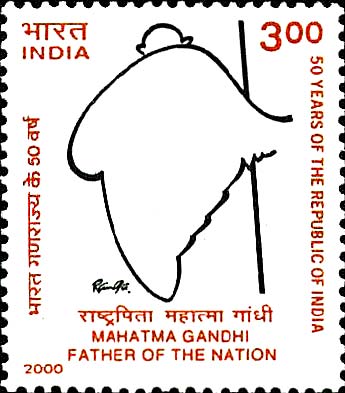
India, a land overflowing with the holy days of its many religions, has only three official national holidays of its own: Republic Day, Independence Day, and Gandhi Jayanti.

The first two celebrate the power and the freedom of the state and its people. The third celebrates the power and humbleness of a man, the Father of the Nation, Mahatma Gandhi.
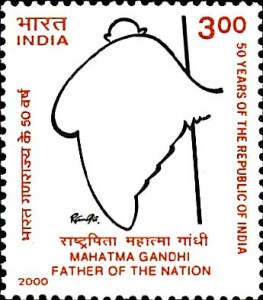
Mohandas Karamchand Gandhi was born on this day in 1869 in Porbander, Gujarat. He was influenced by his mother’s Jainism, and its concept of Ahimsa, but he was not particularly religious, or even spiritual as a child.

His father died when he was 15, and at 18 he left India to study law at University College London. It was there, when faced with the different lifestyles of Westerners, he reflected on his own beliefs. As a vegetarian, he joined the Vegetarian Society, and began reading in earnest the scriptures of Hinduism, including the Bhagavad Gita, as well as doctrines on Buddhism, Christianity and Islam.

After returning briefly to India, he took a position at an Indian firm in South Africa. The post was supposed to be for a year, but Gandhi stayed for twelve. First he worked with Indians to oppose a bill denying Indians the right to vote. The bill passed despite his efforts. In 1897, he was nearly lynched by an angry white mob, but Gandhi refused to prosecute his assailants.

Then Gandhi led the Indian resistance against forced registration in South Africa. It was during this time Gandhi solidified his theories of peaceful resistance through civil disobedience, eventually forcing the government to agree to a compromise.

In 1915, at age 45, Gandhi returned to his homeland. He would spend the remaining 30+ years of his life fighting–through nonviolence–for the independence of his country, for the rights of his countrymen, and for peace between his brothers. It was this last cause for which he would give his life.
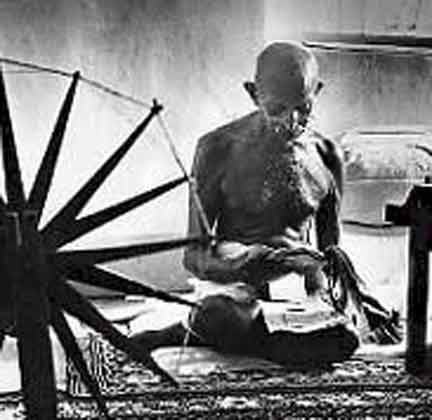
Gandhi’s weapons included strikes, protests, and boycotts of British goods. He encouraged Indians to spin their own cloth and renounce British titles of nobility.

Following a mass protest that ended in violence in 1922, Gandhi served two years in prison for sedition. Afterward, Gandhi worked to bridge the gap between the Indian political divisions that had intensified during his imprisonment.

In the Spring of 1930, Gandhi led the 400 kilometer Salt March, in which thousands of Indians journeyed to the sea to make their own salt, in protest of the Salt Tax. The British arrested tens of thousands of Indians in the wake of the campaign.

Gandhi continued his opposition to British rule throughout World War II. In 1947, India finally won its long awaited independence. To avoid an impending civil war between India’s Muslims and Hindus, Gandhi reluctantly agreed to support the partition of the country into two republics, India and Pakistan.

Just as Gandhi feared, the partitioning was accompanied by mass bloodshed.

On January 30, 1948, Gandhi was taking his nightly walk through the garden of the Birla Bhavan house in New Dehli when he was shot and killed by a radical Hindu, angry at Gandhi’s support of payment to country of Pakistan.

At his request, his ashes were spread throughout India.

“It is a superstition and an ungodly thing to believe that an act of a majority binds a minority. Many examples can be given in which acts of majorities will be found to have been wrong, and those of minorities to have been right. All reforms owe their origin to the initiation of minorities in opposition to majorities…

Democracy cannot be evolved by forcible methods. The spirit of democracy cannot be imposed from without. It has to come from within…

Liberty and democracy become unholy when their hands dyed red with innocent blood.”

Gandhi on Democracy

Gandhi was instrumental in civil rights movements on two continents, Asia and Africa. His teachings inspired leaders of the civil rights movement on a third continent, North America, after Gandhi’s death.

For these reasons and more, in 2007 the United Nations declared October 2 “International Day of Non-Violence.” The Dalai Lama once said of Gandhi:

His life has inspired me ever since I was a small boy. Ahimsa or nonviolence the powerful idea that Mahatma Gandhi made familiar throughout the world. Nonviolence does not mean the absence of violence. It is something more positive, more meaningful than that, for it depends on wholly on the power of truth.

See also: School Day of Peace and Non-Violence
China National Day

October 1

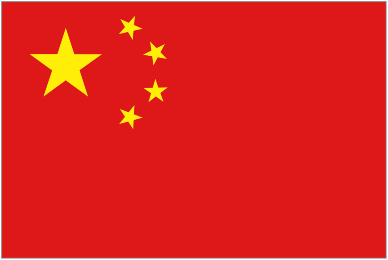
flag_china

By population, it’s the biggest National Day in the world. On this day (October 1) in 1949 Mao Zedong and the Communist Party of China declared victory against the National army of Chiang Kai Shek and announced the birth of a new nation. A grand ceremony was held in Tiananmen Square celebrating the new People’s Republic of China.

Over sixty years later the Chinese continue to celebrate the country’s National Day with three full days of festivities. The holiday runs from October 1 to October 3 each year, but the whole week is referred to as a “Golden Week”. The other “Golden Week” is during Chinese New Year.

Parades, fireworks, and music concerts are some of the key features of the holiday, especially in larger cities like Shanghai. In the past, approximately 800,000 volunteers have helped out around the country to ensure the festivities go smoothly. (Guardian 9/30/09)

The main parade in Beijing can involve hundreds of thousands of people. The parade is an opportunity to show national spirit, and also for the government to strut its military stuff in peacetime.

Of course not all spectators are equally enthralled.

“This is basically a live action Powerpoint presentation, except more painful because the slides actually have to slowly walk by.”

Chen Xi, 10/1/09

But most see a great deal of symbolism and take pride in the ceremonies:

” Amid 60 gun salutes, 200 national flag guards in olive green uniforms walked down the platform of the Monument to the People’s Heroes in the center of Tian’anmen Square, marching northward on ared carpet toward the national flag post.

“The guards walked a total of 169 steps, which symbolized 169 years since 1840, a watershed in China’s history when the country lost the Opium War with Britain. That eventually led to the scramble of Western powers in China.

“The founding of the People’s Republic ended China’s history of being humiliated by outside forces. The country now is emerging as a major political and economic power on the international stage…

“…The 440,000-square-meter Tian’anmen Square is believed to be the largest city square in the world. Six decades ago, the founding ceremony of the PRC was held on the square and late Chairman Mao Zedong announced the birth of New China. Mao himself pressed the button to hoist the first national flag of the PRC.”

Flag-raising Ceremony Held for China’s National Day Celebration

Rosh Hashanah

September 29, 2011
September 17, 2012
September 5, 2013

Happy New Year!

It’s New Year’s in the Jewish calendar, but you won’t hear Jews counting down to midnight, or dropping a big sparkly ball from the Western Wall.

For one, the Jewish day—and thus all Jewish holidays—begin at sundown the night before. Second, Rosh Hashanah is not so much a time of celebration as a time of reflection and repentance.

Despite its name, “Head of the Year”, Rosh Hashanah actually marks the beginning of the seventh month of the Hebrew calendar. The first month is known as Nisan, which falls in the spring.

The Hebrew Calendar actually has four “New Year’s”:

1. In Winter, Tu B’Shevat is the New Year of Trees, originally the day farmers took inventory of trees for tax purposes.

2. In Spring, Jews welcome Nisan as the “first” month of the year, as God commanded Moses in the Jewish holy book, the Torah.

This month hall be considered by you as the First of the Months; it is the First for you of the months of the year.” — Exodus 12:2

3. In Summer, Rosh Chodesh Elul is the New Year of Animals, during which animals and property were counted.

4. Yet, it’s in the Fall that the big New Year is celebrated. According to Jewish tradition, Rosh Hashanah marks the sixth day after creation, the birthday of humanity. Thus, the beginning of the relationship between God and man.

Just as Tu B’Shevat and Rosh Chodesh Elul call for an inventory of property, Rosh Hashanah requires an inventory of the soul. Some scriptures say it’s during this time that God sits upon a throne with a book entailing the deeds of each human life. Rosh Hashanah is the beginning of a ten-day period of introspection, collectively known as the High Holy Days, which culminates with the holiest day of the year, Yom Kippur.

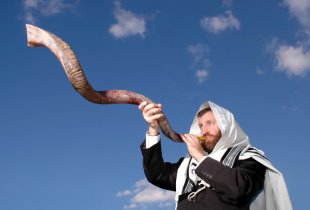
During this time, practicing Jews attend special services at their local synagogue where Rosh Hashanah is marked with the blowing of a ram’s horn known as a shofar. Traditional Rosh Hashanah foods include apples and honey, previously collected this season, to symbolize sweetness in the coming year.

This year Rosh Hashanah marks the first day of the year 5771 in the Jewish calendar.

Michaelmas

September 29

And when the tenants come to pay their quarter’s rent
They bring some fowle at Midsummer, a dish of fish in Lent,
At Christmasse a capon, at Michaelmasse a goose;
And somewhat else at New-yeres tide, for feare their lease flie loose.

Gasciogne, Posies (1575)

September 29 is the Feast Day of the Archangel St. Michael and All Angels.

The archangel Michael is featured prominently in both the Old and New Testaments, as well as apocryphal writings such as the book of Enoch. The appeal of the Archangel spread throughout Christendom during the Middle Ages. Perhaps because of his position as the leader of the army of angels in Revelation, Michael became the patron saint of knights, whom fighters called upon in times of battle.

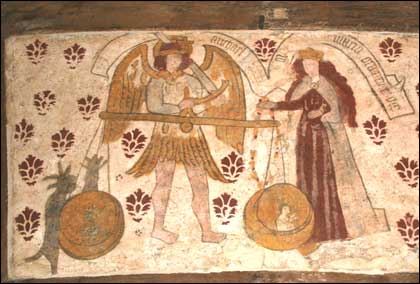
He is also the “good guy” Angel of Death–the one with wings and a scale, not with a black cloak and scythe. Michael’s symbolic scale was believed to weigh the souls of the recently deceased, to determine their worthiness in heaven. Fittingly, St. Michael’s Feast falls during the zodiac sign of Libra, the scales.

The medieval painting above shows St. Michael's scales, weighing the soul of a tiny figure hoping to enter the kingdom of heaven. The devil weighs down the scale on the left while the Virgin Mary weighs down the right with a rosary.

Just as the figure of Michael replaced pagan deities such as the Germanic Wotan (Norse Odin) and the Greek Hermes during the conversion of Europe, his feast day on September 29 replaced nature-based celebrations of the autumnal equinox and the harvest. During the Middle Ages, the equinox fell on or around September 29.

In England, Michaelmas was one of the four quarter days by which debts and suits had to be settled, falling roughly on the solstices and equinoxes: Lady Day (March 25), Midsummer Day (June 24), Michaelmas (September 29) and Christmas (December 25).

Geese, which were fat and hardy this time of year, were often given to landlords and creditors as part of repayment. Goose became the traditional meal of Michaelmas, and a symbol of good luck; hence the saying:

Whoever eats goose on Michaelmas Day
Shall never lack money his debts to pay

In the Church of Latter-Day Saints, before Michael became an angel, he was Adam, the first man. Jehovah’s Witnesses, meanwhile, believe that Michael and Jesus are but one and the same.

Michaelmas was considered the last day to safely eat the season’s blueberries.

…We’ll pick in the Mortenson’s pasture this year.
We’ll go in the morning, that is, if it’s clear,
And the sun shines out warm; the vines must be wet.
It’s so long since I picked I almost forget
How we used to pick berries: we took one look round,
Then sank out of sight like trolls underground…

from Blueberries by Robert Frost

Confucius’s Birthday – Teachers’ Day

September 28

confucian

Before embarking on a journey of revenge, dig two graves.

Confucius

+++

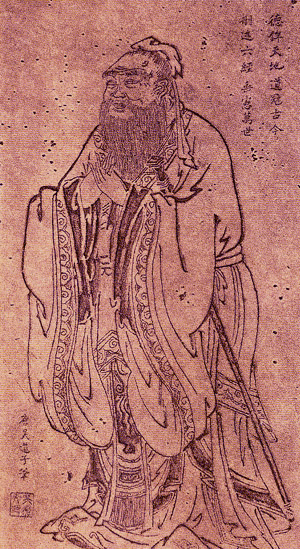
Today is the (observed) birthday of the man whom many believe to be the greatest teacher ever, Master Kung, K’ung Fu Tzu. Or as he’s known in English: Confucius.

Compared to his legacy, the circumstances of his life were somewhat underwhelming.

He was born in 551 BC in Lu, China, into a poor, once noble family. His father died when he was three. According to the Chinese philosopher Mencius, Confucius worked as a storekeeper, and also tended to oxen and sheep in the public fields.

A large chunk of Confucius’ life is missing from the record, as can be expected from a non-royal figure who lived 2500 years ago. But these gaps have been filled in by millennia of legends. We do know that by his early fifties, Confucius was in the employ of the Duke of Lu, Ding, as Minister of Public Works and as Minister of Crime. But Confucius left Lu and the court of the Duke at age 52. Whether it was because of some moral ambiguity on the part of the Duke’s, because of a social snub toward Confucius, or because of animosity from those vying for the Duke’s power, we can’t be sure.

Confucius spent the next several years traveling through China, to the states of Wei, Song, Chen, Cai, and Chu.

He returned to Lu in 484 BC where he lived out his remaining years. By the time of his death he had amassed a sizable following of students, who would formalize and carry on his teachings.

Like I said, underwhelming. But by the next century, Mencius would write, “Ever since man came into this world, never has there been one greater than Confucius.” Confucius was remembered as a sage who should have been king, in a world too shortsighted to see that.

Confucius once said he was not a “maker” of knowledge, but a “transmitter” of it. “I am not one who was born in the possession of knowledge; I am one who is fond of antiquity, and earnest in seeking it there.” (Analects)

Though his teachings and philosophy were based on studies of history, they were vastly different from those that came before.

He taught that rulers who governed by example and by virtue would have more loyal subjects than those who governed by force alone. That the society governed by the former system, and the people within it, would eventually lean toward goodness. And that humans are similar by nature, but their habits and practices “carry them far apart.” (Analects)

He defined the practices of virtue as Gravity, Generosity of Soul, Sincerity, Earnestness, and Kindness.

He condoned strong attachment to family and respect toward elders and ancestors.

And he put into words the Golden Rule of reciprocity: Don’t impose upon other what you would not want for yourself.

Ancient scholars studied for their own improvement. Modern scholars study to impress others.

There are an estimated 6 million followers of Confucianism around the world today, but these are a small minority of those who follow the teachings laid out by Confucius over 2500 years ago. Confucianism remains a dominant philosophical system in Chinese life. His philosophy and teachings fundamentally influenced Eastern thought since his lifetime, as well as Western thought following Confucianism’s introduction into Europe by Jesuit Matteo Ricci in the 16th century.

Since the 1990s, birthday ceremonies in honor of the Great Teacher have flourished in China, after decades of repression.

The nation of Taiwan celebrates this day as Teacher Day.

Confucius Temple Ceremony in honor of Confucius’s birthday.

Meanings of Confucianism

Confucianism Overview @ religioustolerance.org