Earth Overshoot Day

August 21, 2010

September 25, 2009
earth

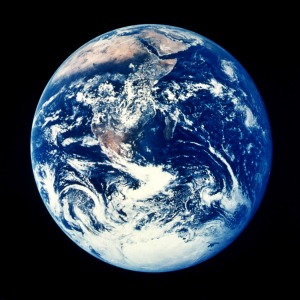
This has nothing to do with giant killer asteroids nearly demolishing the planet. (That’s Near Miss Day, celebrated on March 23, the anniversary of the the day in 1989 that a 1000-foot asteroid passed the spot Earth had been six hours earlier.) No, Earth Overshoot Day is a symbolic measure of humanity’s energy consumption, and it falls on a different day each year.

Put simply, Earth Overshoot Day estimates the amount of days it takes humanity to use a year’s worth of the Earth’s renewable energy resources. Ideally, Earth Overshoot Day would occur on December 31, or better yet, there would be no Earth Overshoot Day, because we would consume less energy in a year than the Earth naturally regenerates, and create less pollution than the planet can reabsorb, but that hasn’t happened since 1986.

“…before that time [1986] the global community consumed resources and produced carbon dioxide at a rate consistent with what the planet could produce and reabsorb. By 1996, however, humanity was using 15 percent more resources in a year than the planet could supply, with Earth Overshoot Day falling in November.”

http://www.planet2025news.net/

According to Top Scientists, we now use approximately 40% more energy than the Earth is capable of sustaining. That means this year (2009) Earth Overshoot Day falls on September 25.

The good news is that Earth Overshoot Day was September 23 in 2008. So maybe we’re headed it the right direction. Of course, 2008 was also a Leap Year, so don’t go celebrating just yet. And if you do go celebrating, don’t start a tire bonfire.

2010 Update: This year Earth Overshoot Day fell over a month before last year’s. Definitely not a good sign. The good news is, now that we’re past Overshoot Day, we can consume all the energy we want since it won’t count toward next year. Right? At this rate, we’ll be celebrating Overshoot Day in January by the end of the next decade.

2011 Update: The good news: Even as we reach 7 billion people, this year’s Earth Overshoot Day is over a month later than last year’s. Is the world getting more efficient? Time Magazine says no. “Amid Paeans to Energy Efficiency, World is Getting Less Efficient

Global Footprint Network – Earth Overshoot Day


Balboa Day

September 25

There are two separate holidays on September 25, celebrated in 4 hemispheres, that collectively mark the beginning and the end of colonialism.

Balboa Day

Balboa plays wave-jumping in the Pacific
Balboa plays "wave-jump" in the Pacific

Vasco Nunez de Balboa was 26 in 1500. It was only 8 years after Columbus’s first voyage, and the young Spaniard sought adventure in the New World. Balboa joined the crew of an expedition headed west to Hispaniola (Cuba) and on to Colombia with the purpose of establishing a settlement.

Due to lack of men, the Spanish were unable to maintain a colony in Colombia. Balboa returned to Hispaniola and pursued Plan B: pig farming. Evidently, Balboa was not a very good pig farmer. He went broke, and was even unable to join the next mission to Colombia because he owed so much money.

The following year he didn’t ask. He snuck aboard a ship carrying supplies to the new settlement.

When the ship arrived in South America the newbies found the Spanish colony deserted. Unable to defend the colony or to sustain their food supply, the Spanish settlers had hightailed it back home. Balboa, who had some familiarity with the land, recommended the group move west, where the indigenous tribes were more peaceful. Thus, the stowaway became the group’s unofficial leader.

Balboa and his crew had many riotous adventures, making slaves of the native populations, stealing gold, and setting wild dogs upon 40 natives exercising the “foulest vice” of male-love. (Right)

In 1513, Balboa heard rumors of a sea to the south, across what is now Panama. Balboa led a group of 90 men southwest across the isthmus. On September 25, 1513, Balboa scaled the highest summit and became the first European to set eyes upon the eastern half of the Pacific Ocean.

Unable to fathom its vastness, he called it the “South Sea” because it appeared to follow Panama’s southern shore.

It was downhill from there for Balboa, literally and figuratively.

A few years later a new governor arrived in town, appointed by the King of Spain. To ensure Balboa would not usurp him, the governor accused Balboa of treason. Balboa and 4 of his men were tried and beheaded in 1519.

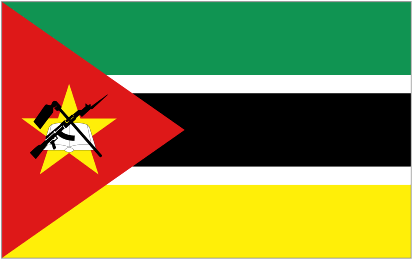
Armed Forces Day – Mozambique

From the Northern and Western Hemispheres we move half a world and four and a half centuries later to the coast of Africa.

In the 1500s, Portugal owned half the world (’cause the Pope said so). By the 1960s, the former Iberian powerhouse was tightly clenching its few remaining colonies.

Spurred on by success in Tanzania, FRELIMO, Mozambique’s anti-colonialist liberation party, formed (illegally) in 1962, and received support from China and the Soviet Union. On September 25, 1964, FRELIMO went militant, attacking a Portuguese base in Cabo Delgado.

The fight for independence would be bloody and costly, lasting over a decade. Ultimately, Mozambique won independence, like other Portuguese colonies, because of a government coup in Portugal in 1974. Thus ending almost 500 years of Iberian colonialism in Africa and the Americas.

In memory of that bloody first day, September 25 is Armed Forces Day in Mozambique.

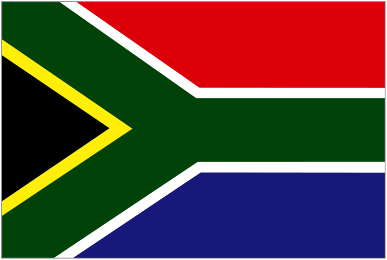
Heritage/Braai Day – South Africa

September 24

We have 11 different official languages but only one word for the wonderful institution of braai. It’s braai in Xhosa, it’s braai in English, it’s braai Afrikaans…All it calls for is come with your friends and family, have a little fire, and braai…That should make you proudly South African.

Nobel Peace Prize laureate Archbishop Desmond Tutu

The 24th of September was once known as Shaka Day, in honor of the Zulu king, but these days it’s celebrated throughout South Africa on as Heritage Day, or Braai Day. Today the “Rainbow Nation’s” near 50 million people come together to partake in the country’s national past time.

http://www.youtube.com/watch?v=2q9MxdAS1YE

According to braai4heritage.co.za

“Cooking food on an open fire is an international phenomenon, but to braai is a truly unique South African past time that penetrates racial, cultural, religious and social boundaries.”

Heritage Day–or Braai Day as it’s been called the last few years–is one of several holidays that came into being with the fall of the Apartheid government in the 1990s. These new holidays sought to remember dates that resonate with all South Africans.

Braai Day Video – 2009

Other national holidays include:

March 21: Human Rights Day

In memory of the sacrifice of 69 protesters killed by police on this day in 1960. The demonstrators were protesting the infamous pass laws. In the wake of the Sharpeville Massacre, the government outlawed black political organizations.

April 27: Freedom Day

The anniversary of the first truly free election in South Africa in 1994.

June 16: Youth Day

Dedicated to those his lost their lives in the protests and riots of 1976, fighting for equal education.

August 9: National Women’s Day

When 20,000 women marched to Pretoria’s government buildings in 1956 to protest the pass laws.

Women’s ‘Repeal the Pass Laws’ flyer

December 16: Day of Reconciliation

Both the anniversary of the beginning of the armed anti-Apartheid movement in 1961 and of the defeat of the Zulu army at Battle of Blood River in 1838. That South Africans have their different reasons for remembering the date underscores its true purpose: to come to terms with the country’s often brutal past of racism, violence, and injustice.

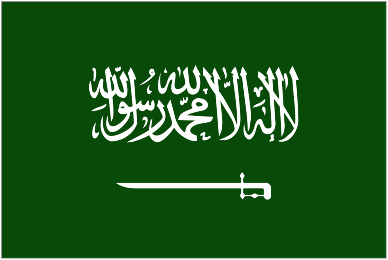
Saudi National Day

September 23

In 2008, National Day in Saudi Arabia was a muted celebration. It coincided with the end of the holy month of Ramadan, one of the most auspicious times of the year. And in Saudi Arabia, when it comes between the state and Islam, Islam has the first, last, and every word in between.

Islam is not just the official religion of Saudi Arabia, it’s the only religion. The law of the land is Shari’a–Islamic religious law based on the teachings of the Qur’an.

Shari’a covers everything from banking to hygiene. According to “Islamic Finance: Law, Economics, and Practice”:

…we do not mean that the Holy Quran and Sunna of the Holy Prophet or the rulings of Islamic scholars provide a specific answer to each and every minute detail of our socioeconomic life. What we mean is that the Holy Quran and the Holy Sunna of the Prophet have laid down the broad principles in the light of which the scholars of every time have deduced specific answers to the new situations arising in their age.

Saudi Arabia is one of the last true monarchies, where the king is also the head of state. The Saud royal family has ruled the bulk of the Arabian peninsula off and on since the 18th century. September 23 commemorates the creation of the modern Saudi Arabian state in 1932, but the date has only been celebrated as a holiday since 2005.

1932 was also the year that the discovery of oil in nearby Bahrain set off a wave of Western speculation. The following year Standard Oil of California struck a deal with the Saudi government to explore for oil. Pay dirt came in 1938 when the first of numerous massive oil reservoirs were discovered. Today Saudi Arabia is the largest oil exporter in the world.

In 2006, Forbes Magazine ranked Saudi Arabia’s Prince Alwaleed Bin Talal Alsaud the 8th richest man in the world, the youngest of the top ten. And the national oil company, Saudi Aramco, is believed to be the world’s most profitable company; however, their finances are not made public.

The country’s most invaluable treasures however–as any Saudi Arabian will tell you–are Al-Masjid al-Harām (“the Sacred Mosque”) at Mecca and Al-Masjid al-Nabawi (“Mosque of the Prophet”) in Medina.

The Sacred Mosque can accommodate over 800,000 worshippers, and over two million Muslims gather there each year during the Hajj, the great pilgrimage of Islam. At its center is the Kabba, where Ibrahim (or Abraham) is believed to have offered to sacrifice his son for God. Muslims around the world face this spot in Mecca when they pray.

The original Mosque in Medina was built by the Prophet Mohammad, who is buried at the site.

Recent National Day celebrations have been more jubilant (Saudi Arabia Celebrates National Day – AFP), but they don’t get going until nightfall. Temperatures in the 100’s (F) keep tend to keep celebrants inside during the day.

Native American Day

 Fourth Friday in September

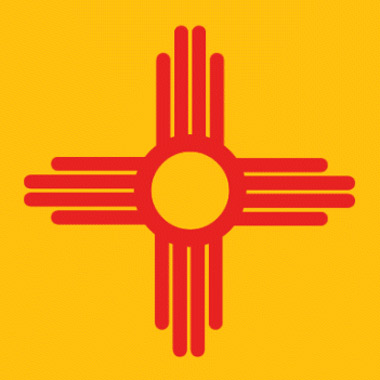
The flag of New Mexico honors the Four Directions
The flag of New Mexico honors the 'Four Directions'

The fourth Friday in September is known as Native American Day in California and across much of the United States. California recognizes over 100 tribes, more than any other state in the nation.

The original resolution establishing “American Indian Day” was signed by Governor Ronald Reagan in 1968.

30 years later, the California legislature declared:

An emphasis on freedom, justice, patriotism, and representative government have always been elements of Native American culture, and Native Americans have shown their willingness to fight and die for this nation in foreign lands.

Native Americans honor the American flag at every pow wow and at many gatherings, and remember veterans through song, music, and dance.

Native Americans use songs to honor the men and women of this country who have fought for freedom.

Native Americans love the land that has nurtured their parents, grandparents, and unnamed elders since time began, and they honor the Earth that has brought life to the people since time immemorial.

Native Americans have given much to this country, and in recognition of this fact, it is fitting that this state returns the honor by recognizing Native Americans for all of their offerings to this beloved land through the establishment of a state holiday referred to as “Native American Day.”

No mention of genocide, but that’s not what today’s about. Californians of all backgrounds and cultures meet in San Bernardino to celebrate the diversity and heritage of the land’s first residents.

+++++

John Harrington, Chickasaw astronaut

Elsewhere in the U.S., John Harrington, who turned 40 on September 14, is in the middle of a 4,000 mile bike-ride from Cape Flattery, Washington, to Cape Canaveral, Florida. (So what’s your excuse for not working out?)

As a member of the Chickasaw tribe, he carried a Chickasaw flag into space with him, aboard STS-113 in 2002.

His purpose for the bike-ride is to “encourage student participation in Science, Technology, Engineering and Mathematics.”

Good luck, John!

Shuubun no hi

…when the night and day are equally divided, Buddha appears on earth for a week to save stray souls and lead them to Nirvana.”

http://mothra.rerf.or.jp/ENG/Hiroshima/Festivals/35.html

…Thus, in Japan, the spring equinox (shunbun no hi) and the fall equinox (shuubun no hi) are known as O-higan. Days on which families visit and honor the graves of the departed. Ancestors are said to watch over the family like tutelary, guardian deities. That’s why the Japanese give thanks to their ancestors whenever they encounter success or prosperity. (But of course if you fail, it’s your own damn fault.)

Favorite foods are prepared for the departed, such as Ohagi (soft rice balls covered in sweetened bean jam), sushi, and vinegar rice & veggies. On the last day of the week, rice flour dumplings, special fruits and sweets are offered.

In Buddhism, O-higan is a time to focus on the 6 Perfections, or Pāramitā:

1. Dana – generosity

2. Sila – virtue

3. Ksanti – patience

4. Virya – effort

5. Dhyana – meditation (also ‘zen’)

6. Prajna – wisdom

The O-higan days have been celebrated in Japan since the 8th century. The name Higan literally means, “the other shore” and is short for Tohigan—to arrive at the other shore. Buddhists believe that the Pāramitā form the bridge that enable humans to cross over to the other shore, to Nirvana.

Grape Day – Vendémiaire 1st – French New Year

September 22

flag_france

Happy New Year!

Today is the first day of the first month (Vendémiaire, or “grape harvest”) of the French Republican Calendar, which was used between 1792 and 1806.

The French Republican Calendar divided the year into twelve months of 30 days each. Each month was further divided into 3 “decades”—weeks of 10 days each.

But that wasn’t enough to signify the end of the old era. The French went one step further, naming every single day of the year for a crop or plant. (Except for every fifth day, which was named for an animal or tool.)

For example, today, the 1st day of Vendémiaire, is Raisin, which in French means—you guessed it—“grape”.

Vendémiaire 9th is Panais (parsnip), the 18th is Sarrazin (buckwheat), and the 21st is Chanvre (hemp).

Horse, Donkey, and Cattle are also honored in Vendémiaire on the 5th, 15th, and 25th respectively.

Three agricultural tools are honored on the 10th, 20th, and 30th: the Tub, the Wine-Press, and the Barrel. We’re assuming this tub is for wine, not bathing. (Or both?)

There was debate as to whether the new epoch delineated by the calendar would begin in 1789, the year of the revolution, or 1792, the year of the formation of the Republic. The government settled upon the latter, marking the autumnal equinox (September 22) as Year I of the new era.

Vendémiaire 1st occasionally began on September 23, and once on September 24 (in 1804).

Around the time of the creation of the calendar, those wacky French were also establishing new-fangled standards of measurement like the metre (distance), gram (weight) and the litre (volume). Over the next 200 years the Metric System would be adopted by all present nations except Burma, Liberia, and the United States. The Republican Calendar however did not fare so well. It was abolished by Napoleon in 1806.

Nevertheless, today we urge you to imbibe the fruits of the raisin, as we toast to the New Year and to days of Auld Lang Syne. Or as the French would say, “Aux jours du bon vieux temps.

Les vieux amis du temps passé,
Se sont-ils oubliés ?
Alors que nos coeurs ont gardé
L’amour du temps passé ?

Old friends from long ago
Are they forgotten?
While our hearts have kept
Love from long ago?

Choral des Adieux

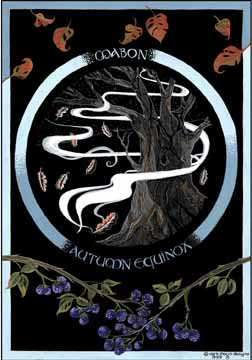
Mabon

Vernal Equinox – on or around September 21 (Northern Hemisphere)
“Blessed be, by the Lady and the Lord, on this Mea’n Fo’mhair. It is the time of the second harvest, one of fruit and wine abundance. Tonight holds equilibrium of all things. Everything is in balance with one another. God and Goddess, Life and Death, Light and Dark.”
Immortal Boundaries, Aubrey Jones

References to the Welsh god Mabon ap Mydron (Mabon, Son of Modron, or ‘Great Son of the Great Mother’) date back well over a thousand years. Today the name Mabon conjures up images of ancient Celtic rituals, of the fruits of the harvest, of flickering flames beneath an autumn moon.  So you may be surprised to learn that ‘Mabon’—in reference to the autumnal equinox—dates not to the Dark Ages, but to the Disco Age (a dark age in its own right), the 1970s.

The holiday Mabon was coined by a grad student, Aidan Kelly, as part of a religious studies project. Kelly was following the Celtic and pagan tradition of naming holy days after gods and goddesses. Lughnasadh honors the Irish sun god Lugh. Beltane is believed to originate from Ba’al. The spring equinox is named for the German goddess Ostara, from which our word Easter also derives.

There was a holiday known as “Mabon’s Day” in Wales in the 19th century. But that holiday was named for William “Mabon” Abraham, a labor leader responsible for improving miners’ working conditions in Wales, (Mabon is a colloquialism for “young leader” in Welsh) and took place on the first Monday of each month.

Since the 1970s, the autumnal holiday Mabon has gained wide acceptance as a Wiccan and neo-pagan celebration in North America. The Celts, however, didn’t observe the autumnal equinox as much as the cross-quarter days of Lughnasadh (early August) and Samhain (Halloween), the latter of which was Celtic New Year.

The “Second Harvest” is known by many names: Cornucopia, Wine Harvest, Harvest Home, and the Feast of Avalon.

Avalon, one of the many Celtic names for the Land of the Dead, literally means the “land of applesCelebrating new-made wine, harvesting apples and vine products, and visiting burial cairns to place an apple upon them were all ways in which the Celts honored this Sabbat.

Edain McCoy, Celtic Myth & Magick

It’s a joyous celebration, but whereas the spring festivals celebrate birth and fertility, at the time of the harvest, Mabon participants remember their ancestors.

A similar tradition exists in Japanese culture. On the equinox, the Japanese visit the graves of their ancestors. It is known as O-higan, or “the Other Shore.” Buddha is said to walk the earth when night and day are equally divided.

Mabon is also known by variants of Fomhair. In Gaelic, the months of September and October are the only two to share a name: Mi Mean Fomhair and Mi Deireadh Fomhair: mid-harvest month and end-harvest month.