Jan Hus – Czech Republic

July 6

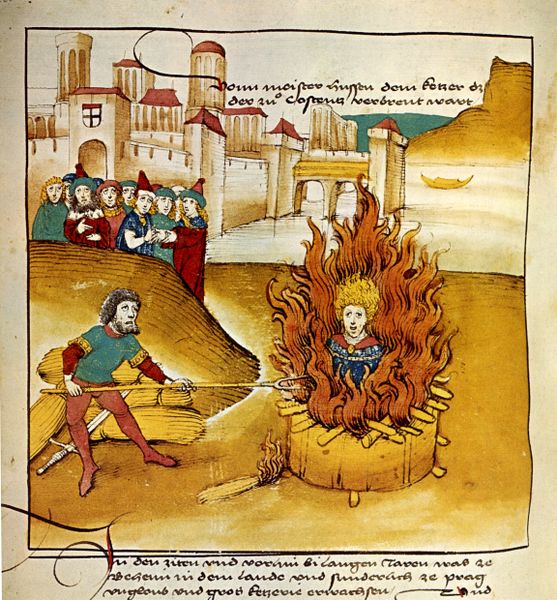
It’s a busy week in the Czech Republic, where inhabitants celebrate not one, but two public holidays in honor of not two, but three prominent theologians. Yesterday Czechs and Slovaks alike honored the Saints Cyril and Methodius, and today Czechs recall national hero Jan Hus, the forerunner of Protestant Reformation who was burnt at the stake on this day in 1415.

Statue of Jan Hus in Prague

The late 14th century was not the best of times for the Papacy. Having just returned from 70 years in France, later called the “Babylonian captivity” of the Papacy, French cardinals were eager to elect another French Pope. Riotous Roman crowds had another idea. Under duress the cardinals elected a Neapolitan to the Papacy in 1378, then hightailed it back to France to elect the “real” French Pope. Of course both Popes retained the title, and governments around Europe were forced to declare allegiance to one or the other.

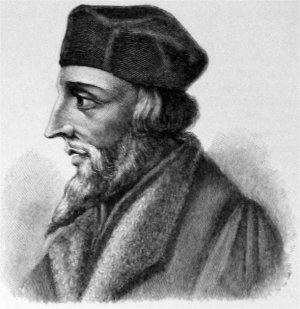
Jan Hus grew up in Bohemia during this tumultuous epoch. He studied at the recently-established University of Prague, becoming a professor of theology in 1398, a priest at Bethlehem Chapel two years later, and eventually rector of the University.

Hus was an outspoken proponent of church reform. At this time the Church owned nearly half the land in Bohemia, yet taxed the poor rampantly. Hus spoke out against abuses in the church, including the widespread indulgence system which undermined the sanctity of Christian piety. He supported the preaching and reading of the Bible in common languages, and he opposed the recent doctrine of Papal infallibilit. Most controversially, Hus made the ‘heretical’ claim that the final authority of Christian Law lay not with pope, but with the Bible.
In 1409, in an attempt to end the papal Schism, bishops at the Council of Pisa elected a third Pope (Alexander “the Antipope” V) to replace the other two. However, rather than resolve the Schism, this only resulted in three concurrent Popes.

Jan Hus and his supporter King Wenceslaus declared allegiance to the third Pope, but when Alexander V’s successor issued a new wave of indulgences to raise money for a war against the King of Naples, Hus proclaimed that no pope or bishop had the right to take up the sword in the name of the Church. In rallying his followers against the indulgences, he also lost the support of King Wenceslaus who was sharing in the profits.

In 1414 Hus was asked to journey to Council of Constance (which sought to end the Schism once and for all), to which he was assured safe conduct by the Emperor of Luxembourg. When he arrived he found himself put on trial by the Council and imprisoned in Gottlieben Castle in chains. The bishops had convinced the Emperor that promises of safe conduct did not apply to heretics.

Hus was given many chances to recant his writings. He deplored false interpretations of his works, but stated he could not renounce beliefs unless they could be proven untrue by the words of the Holy Scripture. He was condemned to death in July 1415. Just before his execution he declared,

God is my witness that I have never taught that of which I have been accused by false witnesses. In the truth of the Gospel which I have written, taught, and preached I will die to-day with gladness.

Hus was also said to have uttered a prediction that in 100 years a man would come whose calls for reform could not be ignored, foreshadowing Martin Luther and the Protestant Revolution.
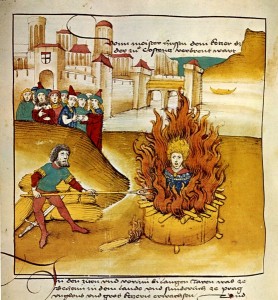
Spiezer Chronik's depiction of the death of Jan Hus, 1485

Hussitism and the Heritage of Jan Hus
John Huss, Priest and Martyr

John Hus: English Bible History

Jan Hus: Final Declaration

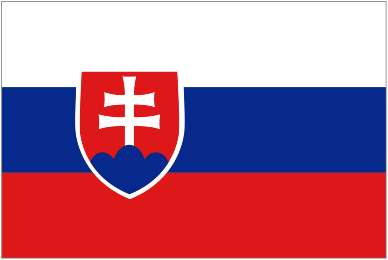
Saints Cyril & Methodius – Slovakia

July 5

St. Cyril and St. Methodius, the two missionary brothers who gave birth to the written Slovak language, are celebrated by the Eastern Catholic Church in May. (The exploits of the Brothers are detailed here.) But in the early 20th century the Roman Catholic feast day for the saints, held on July 5, took on a new importance.

After the formation of Czechoslovakia in 1918, Slovaks around the world struggled to defend their national identity. When the Czechs declared July 6 a public holiday, in honor of 15th century Protestant forerunner Jan Hus, Slovaks pushed for the feast day of Sts. Cyril and Methodius, July 5, as a national celebration as well as religious one. Today it’s celebrated in both Slovakia and the Czech Republic.

Gettin’ Glagolitic with Cyril & Methodius

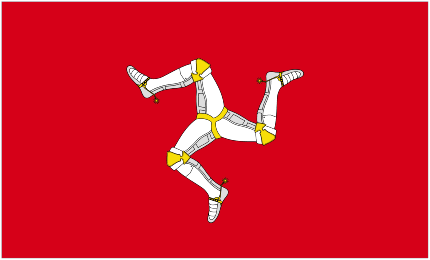
Tynwald Day – Isle of Man

Usually July 5

Tynwald is the legislative body of the Isle of Man, located between England and Ireland in the Irish Sea. Founded in 979 AD, Tynwald is said to be the oldest continuously active parliament in the world. It is descended from the Norse thing–the Parliamentary body developed by the Vikings. Vikings settled on the previously island beginning in the eighth and ninth centuries, but the island maintained much of its Celtic heritage.

On Tynwald Day, the island’s national holiday, the parliament meets in an open air ceremony presided over by the Lieutenant Governor or the Lord of Mann. The British monarch is the official head of state (since Charlotte Murray, 8th Baroness Strange, sold the sovereignty of the Isle for £70,000 in 1765) but the Isle of Man is not a part of the United Kingdom. As Lord of Mann, Queen Elizabeth presided over Tynwald’s 1000th anniversary session in July 1979.

Ballakilleyclieu - Isle of Man © Jon Wornham, www.island-images.co.uk

Tynwald Day originally fell on Midsummer’s Day, June 24, in the Julian calendar. When the Isle of Man switched to the Gregorian calendar, they lost 11 days, but continued to celebrate its national day on June 24 Julian (July 5 Gregorian). As is the case this year, Tynwald Day is held the following Monday if the 5th falls on a weekend.

According to legend, the Isle of Man was once ruled by a Celtic sea god named Manannan, who would shroud the isle in his misty cloak to protect it from invaders. Residents paid tribute to the sea god in the form of bundles “of course meadow grass yearly, and that, as their yearly tax, they paid to him each midsummer eve.” —Mannanan Beg Mac y Leirr

Today the bundling of reeds is still a part of the Tynwald Day festivities.

America Is a Cancer

July 4

Born on July 4, 1776, America is—zodialogically speaking—a cancer. And had our forefathers been more astrologically attuned, our national symbol might have been the New England crab. Fortunately we settled on an eagle (though the turkey was a serious contender).

As everyone knows, the members of the Continental Congress in Philadelphia declared the 13 colonies of North America to be free and independent states in 1776, on that historic date, July 2nd.

That’s right, two days ago. You’re late for the party. You should have barbecued those hot dogs Friday. So what the heck were the forefathers doing between July 2 and July 4?

On July 3, 1776, John Adams wrote his wife Abigail:

“Yesterday the greatest Question was decided, which ever was debated in America, and a greater perhaps, never was or will be decided among Men. A Resolution was passed without one dissenting Colony ‘that these united Colonies, are, and of right ought to be free and independent States… (Letters of Members of the Continental Congress)

…The Second Day of July 1776, will be the most memorable Epocha, in the History of America. I am apt to believe that it will be celebrated, by succeeding Generations, as the great anniversary Festival…It ought to be solemnized with Pomp and Parade, with Shews, Games, Sports, Guns, Bells, Bonfires and Illuminations from one End of this Continent to the other from this time forward forever more.” (American Historical Review)

Adams was two days off. The event that spawned his great anniversary Festival was yet to come.

On July 3 and 4 the Congress debated the language of the formal document declaring the reasons for the break, to be sent to England. They agreed on the final draft on July 4th, the date inscribed at the top.

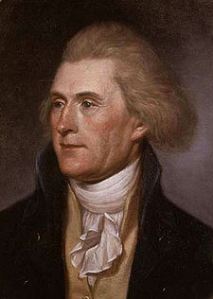
Thomas Jefferson

The task of penning the document had fallen to a young Virginian named Thomas Jefferson. According to Adams…

Mr. Jefferson had been now about a Year a Member of Congress, but had attended his Duty in the House but a very small part of the time and when there had never spoken in public: and during the whole Time I satt with him in Congress, I never heard him utter three Sentences together. The most of a Speech he ever made in my hearing was a gross insult on Religion, in one or two Sentences, for which I gave him immediately the Reprehension, which he richly merited. (Diary and Autobiography of John Adams)

For all Jefferson’s fame, it has not been lost on historians that his Declaration of Independence bears much in common with the beginning of George Mason’s Virginia Declaration of Rights, adopted by that state just one month earlier:

I. That all men are by nature equally free and independent, and have certain inherent rights, of which, when they enter into a state of society, they cannot, by any compact, deprive or divest their posterity; namely, the enjoyment of life and liberty, with the means of acquiring and possessing property, and pursuing and obtaining happiness and safety.

Nor was it lost on Jefferson himself that the birth certificate of the nation was fraught with contradiction. Most notably, that despite acknowledging the unalienable rights of Life, Liberty and the Pursuit of Happiness, and self-evident equality of all men, it made no effort to defend these rights among a large segment of the population currently being denied them. At least not in the final draft. Jefferson writes that prior to approval of the Declaration, the original clause…

…reprobating the enslaving the inhabitants of Africa, was struck out in compliance to South Carolina and Georgia, who had never attempted to restrain the importation of slaves, and who on the contrary still wished to continue it. Our Northern brethren also I believe felt a little tender under these censures; for tho’ their people have very few slaves themselves yet they had been pretty considerable carriers of them to others. (The Social Science Review, 1865)

The nation would have to wait nearly a hundred years to begin enforcing its own credo.

On July 4, 1776, the Continental Congress signed the Declaration and shipped it off to King George III.

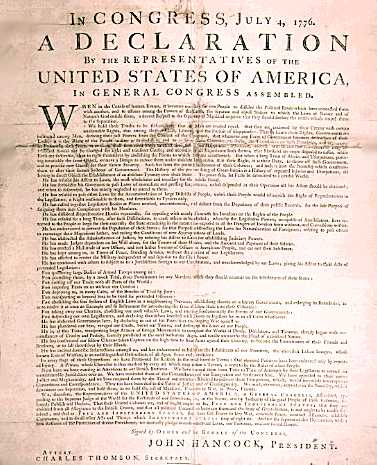
Actually, no. Congress President John Hancock sent two copies of the Declaration to King George on July 5, 1776, printed with only his own name and that of Secretary Charles Thomson’s. But the Declaration wasn’t signed by the full Congress until August 2, and those names weren’t made public knowledge until the following year.

Today the Declaration of Independence is remembered as a whiny list of petty greivances scribbled by a band of traitors with absolutely no legitimate legal authority. Or, at least that’s how it might be remembered today had the insurrection been less successful.

As it is, we’ll wish this cancer a Happy 235th.

[In 1989 a man purchased a $4 painting at a flea market because he liked the frame. When he removed the picture, he found an original 1776 Dunlap Broadside Declaration of Independence print. It was appraised as one of the 3 best preserved of the 25 known to exist, and last sold in 2000 for $8 million.

So today, Americans, enjoy your hot dogs, your fireworks, and your independence, and maybe check out that flea market you’ve been eyeing…]

Text of Declaration of Independence

History of Declaration of Independence

8 Works of Art Found Accidentally

Epitaph: Apparently John Adams did have a soft spot for July 4 after all. Both he and Thomas Jefferson died on July 4, 1826, the country’s 50th birthday.

Belarus – Independence Day

July 3

“After 60 years of peaceful life, Chernobyl, dismantling of the USSR, 14 years of sovereignty, still WWII remains a major emotional rift in the Belarusian soul.”
http://www.belarusguide.com/history1/WWII_partisan_resistance_in_Belarus.htm
“We want the peaceful sky not to know the fire of war” — My Dear Motherland, station designator of Belarusian Radio
Belarus as we know it today declared its independence from the Soviet Union on July 27, 1990, and became the Republic of Belarus the following year.
But the country celebrates Independence Day on July 3, in memory of the liberation of its capital city Minsk from Nazi forces in 1944.
We know all about D-Day on June 6th and the liberation of Paris on August 25th that year, but at that same time, the Soviet Union was conducting an equally pivotal advance against German forces.
The Belorussian Strategic Offensive Operation (Operation Bagration, named for a 19th century Georgian general) was “the most calamitous defeat of all the German armed forces in World War II” according to Bagration 1944 author Steven Zaloga. (http://books.google.com/books?id=1DAYmRrJTDAC&dq=operation+bagration&as_brr=3&client=safari&source=gbs_navlinks_s)
Operation Bagration began on June 22, 1944, exactly three years after the Nazi invasion of the Soviet Union. The Soviets successfully used a bevy of ploys to confuse the Germans about their plan of attack, and borrowed a page from the Nazi military playbook…
“A Soviet force of one and quarter million men punched a two-hundred-mile hole in the German front between Ostrov and Kovel…ironically having mastered enveloping tactics once used by the Germans themselves.”
In just over a week, the Red Army crossed the Berezina River. Three days later, on July 3, 1944, they liberated the Belorussian capitol of Minsk.
“…as the Russians crossed Belorussia, they encountered a ‘desert zone’ with a million houses burned, crops deliberately ploughed under, and no evidence of livestock.”
According to Pravda…
Every fourth citizen of Belarus was killed in the war.
http://english.pravda.ru/world/ussr/03-07-2009/107933-belarus-0

Our Bloody History –

belarusguide.com

http://www.belarusguide.com/as/history/history.htmJuly 3


“After 60 years of peaceful life, Chernobyl, dismantling of the USSR, 14 years of sovereignty, still WWII remains a major emotional rift in the Belarusian soul.”

— Partisan Resistance in Belarus During World War II

Belarus declared its independence from Russia on March 25, 1918 (an independence which lasted about 10 months) and again from the Soviet Union on July 27, 1990. But Belarus celebrates neither of those dates as its official independence day. Instead, the festivities of July 3rd commemorate the liberation of Belarus’s capital city of Minsk from Nazi forces in 1944.

+  +  +

We know all about D-Day on June 6th, 1944 and the liberation of Paris that summer, but simultaneously the Soviet Union’s Red Army conducted an equally pivotal advance against German forces.

The Belorussian Strategic Offensive Operation (Operation Bagration, named for a 19th century Georgian general) was “the most calamitous defeat of all the German armed forces in World War II” according to Bagration 1944 author Steven Zaloga.

Operation Bagration began on June 22, 1944, exactly three years after the Nazi invasion of the Soviet Union. The Soviets successfully used a bevy of ploys to confuse the Germans about their plan of attack, and borrowed a page from the Nazi military playbook…

“A Soviet force of one and quarter million men punched a two-hundred-mile hole in the German front between Ostrov and Kovel…ironically having mastered enveloping tactics once used by the Germans themselves.” — Michael Burleigh, The Third Reich

In just over a week, the Red Army crossed the Berezina River. Three days later, on July 3, 1944, they liberated the Belorussian capitol of Minsk.

“…as the Russians crossed Belorussia, they encountered a ‘desert zone’ with a million houses burned, crops deliberately ploughed under, and no evidence of livestock.” (Burleigh)

According to Pravda, “Every fourth citizen of Belarus was killed in the war.”

The division among Belorussians referred to in the opening quote stems from the notion that World War II was merely one occupation replaced by another. Prior to the Nazi invasion in 1941, the Soviet Union under Joseph Stalin conducted mass executions in Belarus—the mass graves from which were uncovered in the 1980s. In 1986 the Chernobyl Disaster and the Soviet Union’s initial denial of the nuclear accident fueled the flame of nationalism and independence once more.

Our Bloody History – belarusguide.com

Happy Moving Day! I mean Canada Day

July 1

C’mon Jessica, C’mon Tori,
let’s go to the mall you won’t be sorry.
Dad says I’m too young to date.
But baby I don’t wanna wait…
That’s okay…
I’m gonna rock your body till Canada Day.

Let’s Go To the Mall,” Canadian National Anthem

Canada Day isn’t an anniversary of independence but of unity. On July 1, 1867 the colonies of Upper Canada, Lower Canada, New Brunswick, and Nova Scotia united to form “one dominion under the name of Canada”. The day was known as Dominion Day until 1982 when it was officially changed to Canada Day–although the populace had long since taken to calling it Canada Day.

On this, the 142th anniversary of the first Canada Day, we ask: “Where did Canada get its name?”

According to answerbag.com, “Canada” means:

  1. An Indian word meaning ‘Suburb of Detroit’.
  2. George St. Pierre, the UFC Welterweight Champion of the World. Yea baby!!!
  3. Place where Americans come to ask stupid questions.

Another theory of the origin of Canada’ is that it is an Wendat (Huron/Iroquois) word meaning ‘village’ or ‘collection of huts’. The Wendat were a confederacy of four tribes who spoke the same language in what is now Ontario and Quebec.

According to the Department of Canadian Heritage, in 1535 explorer Jacques Cartier was mapping the area north of the present-day St. Lawrence River when…

“two Indian Youths told Jacques Cartier about the route to ‘kanata.’ They were referring to the village of Stadacona…but for want of another name, Cartier used “Canada” to refer not only to Stadacona (the site of present day Quebec City), but also to the entire area subject to its chief, Donnacona.”

Cartier named the St. Lawrence River the ‘riviere de Canada’, and by 1547, maps of the area labeled the land north of that river “Canada”.

Though this theory is widely accepted, some dispute its accuracy, suggesting that the Hurons didn’t occupy the area at the time of Cartier’s exploration.

Another theory is that Spanish explorers wrote “aca nada” on their maps, meaning ‘nothing here’.

The arguments are moot in Quebec, where most of the populace doesn’t celebrate Canada Day at all. Rather, in Quebec, July 1 is better known as “Moving Day.” Since 1971, apartment leases there have begun and ended on Canada’s national holiday.

Stonewall

June 28

June 1969. Two months before Woodstock, another New York event changed America in a profound way.

There’s no one moment that “started” the gay rights movement, but many say it began around 1:20 in the morning on June 28, 1969 at the Stonewall Inn in New York City.

The Stonewall Inn was a gay bar on Christopher Street in Greenwich Village. When a handful of officers raided Stonewall in the wee hours of June 28th, they were well within their rights. The bar was owned by the mafia, and it didn’t have a proper liquor license. But the gay clubs were raided with uncharacteristic frequency, and the police would go the extra step of arresting customers en masse for “disorderly conduct.”

The half dozen police officers expected that the gay clientele would comply and line up docilely, which may have accounted for the lack of backup. The last thing they imagined was that their safety would be in danger from drag queens and other gays and lesbians who had been harassed one time too many.

Back in 1969 homosexual sex was outlawed in virtually every state. Even New York City, vigilante crews had formed to rid the city of the gay menace. Expressing a homosexual orientation in public could mean not just being ostracized, but beaten or even killed.

Stonewall’s windows were painted black. To get in patrons knocked on the club door and were peered at through a peephole. By raiding Stonewall, the police brought homosexuality into the outside world, but not in the “shameful” way they anticipated. Instead, as word spread quickly of the raid, homosexuals converged from all parts of the Village, to join in the Boston Tea Party of modern times. Essentially, ‘gayness’, normally confined to the interiors of clubs, exploded onto the streets, loud and wild and raucous. Rioters shook buses, blocked traffic, and shouted “Christopher Street belongs to the queens!”

Stonewall Jackson ('cause there are no public domain pics of the Stonewall riots.)

“…as the patrons trapped inside were released one by one, a crowd started to gather on the street. It was initially a festive gathering, composed mostly of Stonewall boys who were waiting around for friends still inside. Cheers went up as favorites emerged from the door, striking a pose and swishing by the detective with a “Hello there, fella.”… Suddenly a paddywagon arrived and the mood of the crowd changed. Three of the more blatant queens—in full drag—were loaded inside, along with the bartender and doorman, to a chorus of catcall and boos from the crowd…The next person to come out was a dyke, and she put up a struggle. At that moment, the scene became explosive.” (Village Voice, June 19, 1989, Lucian K. Truscott IV)

The following evening the rioting grew fiercer. Supporters, both gay and straight, gathered along Christopher Street, and the Tactical Patrol Force couldn’t bring order back to the streets.

Meanwhile the owners of the club changed Stonewall overnight to seize onto the symbolic value their club had suddenly attained. By Saturday night they served only sodas and were giving them away for free.

Before June 28, 1969, “the Stonewall Inn attracted larged crowds of chino-clad gay men in their late teens and early twenties because the Mafia-owned bar allowed men to dance with each other as long as they were willing to pay exorbitant prices for watered down drinks.” (From Perverts to Fab Fave, Bigner & Streitmatter) After June 28, 1969, it brought gay rights to the public consciousness and became the rallying cry for a new nation-wide civil rights movement.

Four years later homosexuality was reclassified in the DSM (Diagnostic & Statistical Manual of Mental Disorders) from a mental disorder to a “sexual orientation disturbance.”

Police departments also learned from the mistakes at Stonewall. First and foremost, never raid a gay bar right after Judy Garland’s funeral. Judy Garland died in London the week before of an overdose of sleeping pills. Her body was transported to New York, and Wednesday through Friday, thousands of her fans, many of them gay, passed by her coffin to pay their respects. The raid was that night. Recalled Seymour Pine, the officer who planned and led the raid, “If I had known that Judy had died at that point, I wouldn’t have had the raid.” (The Villager, June 2004)

Judy Garland, 1957

Romanian Flag Day

June 26

Awaken thee, Romanian, shake off the deadly slumber

Today is National Flag Day in Romania.

The three colors of the Romanian flag represent the blood of the people, the golden crops of the land, and the blue sky above…according to the Communists who ruled Romania from 1947 to 1989. But much has changed since the fall of the Iron Curtain, including the country’s national anthem, which was “Three Colors” from 1977 to 1989.

Like the flag itself, the country is an amalgamation of three nations: Dacia, Wallachia, and their all-too-famous cousin Transylvania. Though Transylvania is the most notorious, Romania was actually formed by the merging of the other two, Moldavia and Wallachia in 1859. Transylvania didn’t join the club until 1918.

Peles Castle, Romania © David Watterson
Who put the Roman in Romania?

After decades of clashes between Rome and the land known as Dacia, the Roman Emperor Trajan attacked and conquered the defiant kingdom around 100 AD. The war had tested and refined Roman military ingenuity. Dacia was powerful, wealthy, and no stranger to war. Trajan declared 123 days of celebration in Rome following the victory.

Two full Roman legions were posted in Dacia even in peacetime. The soldiers and Dacians intermarried, as did their native tongues. Dacian fighters repelled the Roman invaders around the 4th century, but even today Romania bears the name of the ancient empire. Romania, meaning Land of the Romans, didn’t become the official name until 1862, three years after the creation of the Moldavia-Wallachia state.

The Romanian flag has survived in one form another for 1500 years. Emperor Justinian issued a decree in 535 describing the region’s coat of arms and banner:

“On the right…a red shield, on which towers can be seen, signifying the other Dacia; in the second section a blue-sky shield, with the ensigns of the Bur tribe…and golden in the middle.”

A thousand years later the colors still coincided with the three major regions: red for Moldavia, gold for Wallachia, and blue for Transylvania. And in 1600, the prince Michael the Brave briefly united the three provinces before his assassination in 1601. The colors were used during this time to symbolize the amalgamated territories.

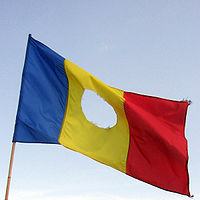
During the Communist regime a coat of arms was added to the banner, but removed in 1989, sometimes quite literally…