Republic Day – Turkey

October 29

If the earth were a single state, Constantinople would be its capital.

–Napoleon Bonaparte

In the 17th century, the Ottoman Empire stretched from Transylvania to Ethiopia, from Algiers to the Caspian Sea.

By the end of the 19th century, France had chipped away at much of North Africa, the Ottoman Empire’s ‘ally’ Britain had assumed protective control of Egypt, Balkin republics were declaring their independence in Europe, while Arab groups to the East were fighting for the same. In addition, the Empire was crippled by a mountain of debt to European creditors brought on by the Crimean War and the numerous wars that followed.

During World War I, the Ottoman Empire sided with the Central Powers (Austro-Hungary) against the Allied Powers (Britain, France, and Russia). The Empire met with initial successes, but weakened during the War’s progress, partially by internal conflicts such as the Great Arab Revolt and independence movements encouraged by the Allies.

A young military commander by the name of Ataturk, who rose to fame at the Battle of Gallipoli, was enraged at the Allied partitioning of the Ottoman Empire and the occupation of Constantinople. Between 1919 and 1923 he led the resistance in the Turkish War of Independence, fought mainly against Greece, France, and Armenia.

In 1923, after 8 months of negotiations, representatives of the warring states signed the Treaty of Lausanne. The treaty negated Ottoman claims in Iraq, Syria, and Cyprus, and acknowledged the Republic of Turkey as the successor to the Ottoman Empire. The Republic was officially proclaimed on October 29, 1923, and Mustafa Kemal Ataturk became its first president.

Ataturk and the Republic of Turkey

Armed Forces Day – Romania

October 25

“Over the centuries you will be remembered and praised, you, the officers and soldiers who have freed Transylvania.”

–General Gheorghe Avramescu, October 29, 1944

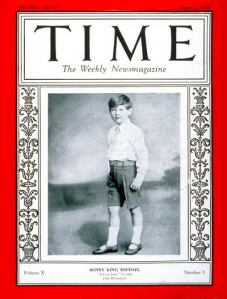
On this day in 1944 Romanian troops liberated Carei, the last German-occupied city in Romania. It is also the birthday of Romania’s last king, Michael I. (Pre-emptive answer: No, I don’t know why the there is a “I” if there won’t be a second.)

King Michael, or Mihai, became heir apparent of Romania at age 4 after his father Crown Prince Carol II abandoned his claim to the throne to elope with his mistress. When his grandfather, King Ferdinand died, the 6 year-old boy became king.

However in 1930, Carol II returned to the throne, becoming perhaps the only European king to have succeeded his own son.

In 1940, Carol II refused to go along with pro-Nazi Romanian leaders. He was forced to abdicate the throne for his son, 18 year-old Michael, who was expected to rule as a puppet monarch for a fascist Romanian government allied with Hitler.

There are conflicting stories of Michael’s motivations for turning against Germany in 1944. Some portray him as a hero whose daring fight against fascist leaders hastened the Nazi defeat, thus saving tens of thousands of lives. Others claim he was a pragmatist who had no choice but to switch once it became clear the Soviets were winning.

According to future Soviet leader Nikita Khurshchev…

In 1944, as we approached Bessarabia and fighting broke out on its territory, and then as we approached the borders of Romania itself, it became evident that the pointer on the scale had tipped strongly in the direction of victory for our side…Then a coup occurred in Romania. The young King Michael took part it it…In Romania a situation took shape in which the sympathies of the people moved to the left, the authority of the Communist Party rose, and the king decided the Communists should participate in the new government that was being formed…The question of whether Romania would take the socialist path did not come up at the time.”

–Memoirs of Nikita Khruschchev

The U.S. awarded King Michael the Legion of Merit for his bravery, and the Soviets awarded him the Order of Victory. But proof that no good deed goes unpunished, the Romanian Communist government abolished the monarchy in January 1948 and forced Michael to leave the country. According to Khrushchev, Michael was told, “he could take everything with him that he considered necessary, but he had to leave his kingdom.”

In exile, he married Princess Anne of Bourbon-Parma with whom he raised 5 daughters in Switzerland. The former king worked for an aircraft company training European pilots to fly with American instruments.

The former king once said:

“Though many people think that not to be allowed back into your country is easier to bear than not to be allowed out of it, this is not true. The feeling of powerlessness and loss of liberty is associated with both.

Michael of Romania: The King and the Country

King Michael was invited to return briefly to Romania in 1992, after the collapse of the Soviet Union.

He is one of the last surviving heads of state from World War II.

October 25: Romanian Armed Forces Day

A Survivor: Romania’s Lucky Enough King

Memoirs of Nikita Khrushchev

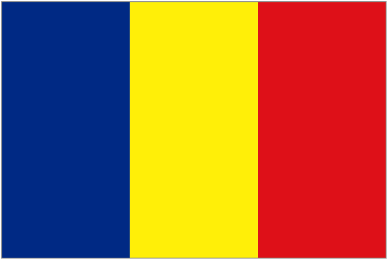
Romanian Flag Day

Hungary – Republic Day

October 23

For three decades Hungarians were forbidden to mention the events that occurred on October 23, 1956.

After World War II, Hungary found itself increasingly under the thumb of the Soviet occupiers that had liberated the country from the Nazis. The Communist Party slowly replaced the democratically elected Hungarian government, and the Hungarian State Security Police “purged” thousands of political dissidents through relocation, imprisonment, and execution.

In 1955 Hungarians hoped their country might go the way of Austria, becoming a demilitarized, independent country. However, the Warsaw Pact of that year bound Hungary to the USSR and formed part of “the Iron Curtain”.

In Poland, public outcry at Soviet quashing of an uprising had led the Soviets to make concessions to Poland in October 1956. Hungarian students expressing solidarity with the Poles by holding a demonstration in Budapest at statue of Polish-Hungarian General Józef Bern. Students cut the Soviet coat of arms from the Hungarian flag and sang the old national song, Nemzeti dal, “We vow we will no longer remain slaves.”

According to reports, the crowd swelled from 20,000 people to as many as 200,000. By evening, the crowd had toppled the 10 meter tall statue of the recently-deceased Soviet leader Joseph Stalin and placed Hungarian flags in his boot. As the demonstrations multiplied and crowds grew unruly, Soviet tanks rolled into Budapest. But it was the much reviled Security Police that fired the first shots into the crowd.

News of the clashes in Budapest spread throughout the country. Protests and demonstrations broke across Hungary, followed by mob violence against the Security Police and full-scale revolution.

On the 28th of October, Soviets called for a ceasefire and Soviet forces withdrew from Budapest. A new national Hungarian government was proclaimed, led by Imre Nagy, with the intention of becoming a neutral multi-party democracy.

The joy was brief. On November 3, the infant government was invited to negotiate the withdrawal of Soviet forces. Arriving at the meeting point, the delegation was arrested. Soviet tanks attacked Budapest in “Operation Whirlwind”. By November 10, when the last rebels conceded defeat, 2,500 Hungarians and 722 Soviet troops were dead.

It would be a long road to freedom for the Hungarians. On October 23, 1989, just before the collapse of the Berlin Wall, the Republic of Hungary was proclaimed, and October 23 was declared a national holiday in memory of the short-lived government and the revolution that refused to be forgotten.

Assassination of Molchior Ndadaye

October 21

“The was no way to predict or prepare for Rwanda.”

Not exactly true. In 1993, a year prior to the Rwanda genocide, a nearly identical scenario occurred in Burundi.

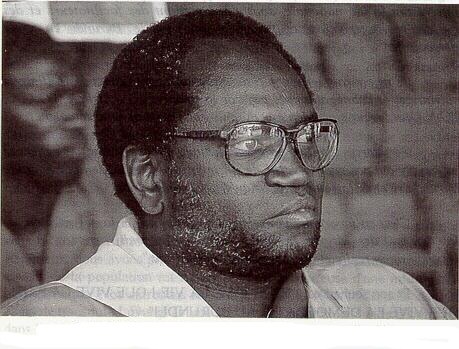
After years of Tutsi rule, Hutu political parties united in their support to elect Melchior Ndadaye, a Hutu, as President of Burundi. The Hutu parties succeeded, ousting the incumbent President Pierre Buyoya, a Tutsi, in the country’s first democratic election.

Ndadaye was 40 years old. He had grown up during the intense ethnic wars of 1972. He studied at the University of Rwanda and at the National Academy of Arts and Trades in France. He sought to bridge the ethnic divide in Burundi by appointing Tutsis to top governments posts, including that of Prime Minister. But less than three months from taking office a coup erupted to removed the ruling Hutu government. On October 21, 1993, under the guise of protection, Tutsi security forces escorted Ndadaye and top government officials to a secret location, and murdered them.

The coup ultimately failed, but the President’s death sparked passion and anger across the country, fueled by radio and other mass media. Hutus attacked Tutsis in mass, neighbor against neighbor. The weapon of choice, the machete. The Tutsi-led army retaliated by killing tens of thousands of Hutu men, women, and children. Before long, an estimated 100,000 Hutu and Tutsi Burundians lay dead.

And the world was none the wiser.

Despite the lessons learned from Burundi, the United Nations remained ill-equipped to combat the ethnic massacres in Rwanda the following year. In July 1994, a plane carrying both the Rwandan President and the new President of Burundi crashed, igniting the bloodiest massacre in modern times. In a matter of months, a million men, women, and children were slaughtered by their own neighbors.

The Burundi Civil War continued until 2005, taking the lives of over a quarter million Hutus and Tutsis.

The wounds are slow to heal. Burundi is one of the ten poorest countries in the world. Today its people remember the horrors of 1993 and the assassination of President Molchior Ndadaye.

Molchior Ndadaye
Molchior Ndadaye

http://vugaduhabwe.blogspot.com/2008/10/paying-tribute-to-ndadaye-melchior.html

http://wrburundi.blogspot.com/2007/05/kayanza.html

http://www.globalsecurity.org/military/world/war/burundi.htm

http://burundiyouth.blogspot.com/2008/08/story-of-survival.html

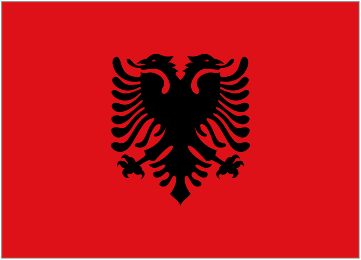
Mother Teresa Day – Albania

October 19

“If in coming face to face with God we accept Him in our lives, then we are converting. We become a better Hindu, a better Muslim, a better Catholic, a better whatever we are…

“What approach would I use? For me, naturally, it would be a Catholic one…What God is in your mind you must accept. But I cannot prevent myself from trying to give you what I have…”

Mother Teresa

Agnes Gonxha Bojaxhiu was born in Skopje, Albania (now Macedonia) between the Ilinden anti-Ottoman Uprising and the outbreak of the First World War.

At age 8, her father died. At 18, she moved to Ireland to join the Sisters of Loreto, with whom she began her monastic training in India the following year. Agnes chose the name Teresa, after Teresa of France, the patron saint of missionaries who died in 1897 at age 24.

Sister Teresa taught students at the Loreto convent school in Calcutta for several years. On September 10, 1946, on her annual retreat to Darjeeling, she felt the call of God, telling her to work not within the confines of the school, but among the sick and poor of the streets.

She exchanged her convent habit for a simple cotton chira, became an Indian citizen, and continued to help the poorest of the poor for nearly 50 years. She established the Missionaries of Charity in 1950 to help “the hungry, the naked, the homeless, the crippled, the blind, the lepers, all those people who feel unwanted, unloved, uncared for throughout society…”

The Missionaries currently operate over 600 missions in 123 countries.

I don’t think there is anyone else who needs God’s help and grace more than I do…I need His help twenty-four hours a day. And if days were longer, I would need even more of it.

Mother Teresa

Today, Mother Teresa’s homeland of Albania honors her with a national holiday. October 19 is the anniversary of the day in 2003 that she was beatified by the Vatican.

“Christ will not ask how much we did but how much love we put into what we did.”

Mother Teresa

“Do not imagine that love to be true must be extraordinary. No, what we need in our love is the continuity to love the One we love.”

My 1st Canadian Thanksgiving

2nd Monday in October

This weekend I shared something with my one year-old niece: our first Canadian Thanksgiving. She was born just after Thanksgiving last year.

The most glaring difference I’ve noticed between Thanksgiving in the U.S. and in Canada is that Canadian Thanksgiving is on a Monday. Other than that, it’s pretty much the same.

In the process of celebrating Canadian Thanksgiving, I have learned a few other things about our Canuck brethren and sisteren.

1. Conservatives are blue and liberals are red, which when you think about it, makes more sense.

2. Election season in Canada is only SIX WEEKS LONG! Two years less than what we’ve had to endure south of the border.

3. It’s traditional for the Finance Minister to wear brand-new shoes when presenting the new budget.

4. Saskatchewan, despite its reputation as a barren wasteland, is the sunniest province in Canada. (Which is like being the rainiest place in the Sahara.)

5. Ottawa is the second or third coldest capital in the world, tied with Moscow, and right behind Ulan Batar, Mongolia.

6. Terrence & Philip is not a real TV show.

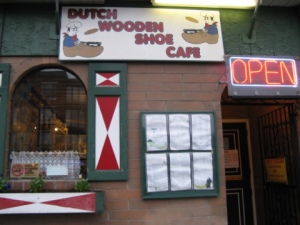
No Thanksgiving would be complete without breakfast at the Dutch Wooden Shoe Pannekoek House

We celebrated like true Canucks, enjoying breakfast at the Dutch Wooden Shoe Pannekoek House. In the afternoon we followed the age old wisdom of Canadian superstar Robin Sparkles…

[published October 13, 2008]

German Unity Day

October 3

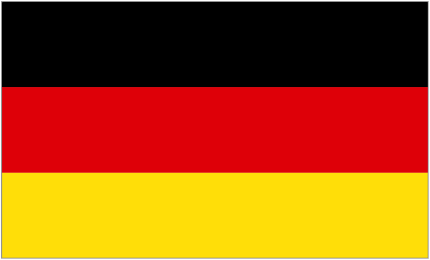
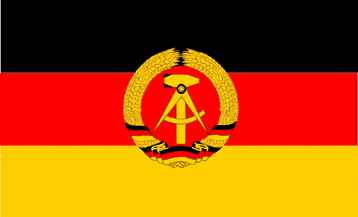
On this day in 1990 the great divide between East and West Germany, the front line between Soviet and Western ideologies for over four decades, was erased in an instant. Germany became one nation for the first time since 1945.

Fall of the Berlin Wall, Nov. 9, 1989

The reunification of Germany on October 3, 1990 followed the dramatic destruction of the Berlin Wall on November 9 the previous year.

A whole generation of young Germans have grown up post-reunification; the oldest are now adults. Despite the spontaneous joy and camaraderie that accompanied reunification, for many years a few Germans on both sides of the former Iron Curtain waxed nostalgic and echoed Ronald Reagan’s sentiments with a twist: “Mr. Putin, Put back this Wall!”

The West’s discontent lay partially in the economic struggle they had shouldered since 1990, adapting to both a new European Union and the weaker economy of the East. In the East, on the other hand, though they may have lacked fancy cars and TVs during the Soviet era, many missed the security that socialism afforded.

Unity Day doesn’t provide a solution to economic woes, but it offers something more than that. An opportunity to declare something that for many decades was forbidden in Germany: pride in one’s country.

The expression of national pride, something taken for granted in much of the rest of the world, was a big no-no during the half-century following World War II.

On October 3, as Oktoberfest nears its end, the ban on pride is lifted for a day. From the snow-covered peaks of Garmish-Partenkirchen, to the white cliffs of Rugen, to the harbors of Hamburg, to the phoenix that is Leipzig, Germans come together to celebrate what they all have in common.

Gandhi Jayanti

October 2

It is not my purpose to attempt a real autobiography. I simply want to tell the story of my numerous experiments with truth, and as my life consists of nothing but those experiments, it is true that the story will take the shape of an autobiography.

Mohandas Karamchand Gandhi, 1940

India, a land overflowing with the holy days of its many religions, has only three official national holidays of its own: Republic Day, Independence Day, and Gandhi Jayanti.

The first two celebrate the power and the freedom of the state and its people. The third celebrates the power and humbleness of a man, the Father of the Nation, Mahatma Gandhi.
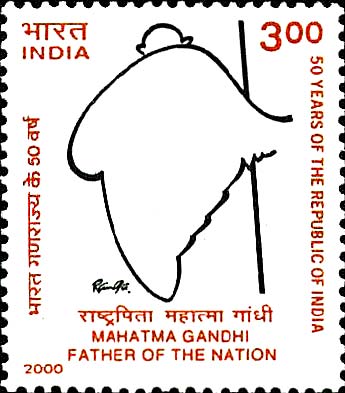
Mohandas Karamchand Gandhi was born on this day in 1869 in Porbander, Gujarat. He was influenced by his mother’s Jainism, and its concept of Ahimsa, but he was not particularly religious, or even spiritual as a child.

His father died when he was 15, and at 18 he left India to study law at University College London. It was there, when faced with the different lifestyles of Westerners, he reflected on his own beliefs. As a vegetarian, he joined the Vegetarian Society, and began reading in earnest the scriptures of Hinduism, including the Bhagavad Gita, as well as doctrines on Buddhism, Christianity and Islam.

After returning briefly to India, he took a position at an Indian firm in South Africa. The post was supposed to be for a year, but Gandhi stayed for twelve. First he worked with Indians to oppose a bill denying Indians the right to vote. The bill passed despite his efforts. In 1897, he was nearly lynched by an angry white mob, but Gandhi refused to prosecute his assailants.

Then Gandhi led the Indian resistance against forced registration in South Africa. It was during this time Gandhi solidified his theories of peaceful resistance through civil disobedience, eventually forcing the government to agree to a compromise.

In 1915, at age 45, Gandhi returned to his homeland. He would spend the remaining 30+ years of his life fighting–through nonviolence–for the independence of his country, for the rights of his countrymen, and for peace between his brothers. It was this last cause for which he would give his life.
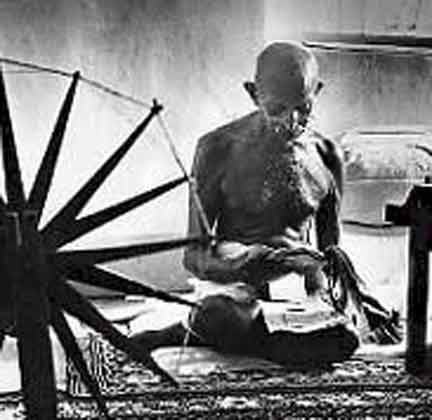
Gandhi’s weapons included strikes, protests, and boycotts of British goods. He encouraged Indians to spin their own cloth and renounce British titles of nobility.

Following a mass protest that ended in violence in 1922, Gandhi served two years in prison for sedition. Afterward, Gandhi worked to bridge the gap between the Indian political divisions that had intensified during his imprisonment.

In the Spring of 1930, Gandhi led the 400 kilometer Salt March, in which thousands of Indians journeyed to the sea to make their own salt, in protest of the Salt Tax. The British arrested tens of thousands of Indians in the wake of the campaign.

Gandhi continued his opposition to British rule throughout World War II. In 1947, India finally won its long awaited independence. To avoid an impending civil war between India’s Muslims and Hindus, Gandhi reluctantly agreed to support the partition of the country into two republics, India and Pakistan.

Just as Gandhi feared, the partitioning was accompanied by mass bloodshed.

On January 30, 1948, Gandhi was taking his nightly walk through the garden of the Birla Bhavan house in New Dehli when he was shot and killed by a radical Hindu, angry at Gandhi’s support of payment to country of Pakistan.

At his request, his ashes were spread throughout India.

“It is a superstition and an ungodly thing to believe that an act of a majority binds a minority. Many examples can be given in which acts of majorities will be found to have been wrong, and those of minorities to have been right. All reforms owe their origin to the initiation of minorities in opposition to majorities…

Democracy cannot be evolved by forcible methods. The spirit of democracy cannot be imposed from without. It has to come from within…

Liberty and democracy become unholy when their hands dyed red with innocent blood.”

Gandhi on Democracy

Gandhi was instrumental in civil rights movements on two continents, Asia and Africa. His teachings inspired leaders of the civil rights movement on a third continent, North America, after Gandhi’s death.

For these reasons and more, in 2007 the United Nations declared October 2 “International Day of Non-Violence.” The Dalai Lama once said of Gandhi:

His life has inspired me ever since I was a small boy. Ahimsa or nonviolence the powerful idea that Mahatma Gandhi made familiar throughout the world. Nonviolence does not mean the absence of violence. It is something more positive, more meaningful than that, for it depends on wholly on the power of truth.

See also: School Day of Peace and Non-Violence