Teachers Day – India

September 5

True seekers are those who never end their quest.

–Sarvepalli Radhakrishnan

All across India hundreds of millions of schoolchildren celebrate Teachers’ Day. In many schools, children dress up like their teachers. Teachers meanwhile, sit in the back of the room, like students, as the students lead class, and roles are reversed for a day. Students have a chance to see from their mentors’ eyes, and teachers remember what is was like to be a student, to have the one other job as important as teaching: learning.

The lesson plan may include a look at the man behind Teachers Day, Sarvepalli Radhakrishnan.

Born on this day in 1888 in Tamil Nadu, India, Radhakrishnan became one of the leading philosophers of the 20th century. According to George Conger:

“…Among the philosophers of our time, no one has achieved so much in so many fields as has Sarvepalli Radhakrishnan of India … William James was influential in religion, and John Dewey has been a force in politics. One or two American philosophers have been legislators. Jacques Maritain has been an ambassador. Radhakrishnan, in a little more than thirty years of work, has done all these things and more… Never in the history of philosophy has there been quite such a world-figure…. like a weaver’s shuttle, he has gone to and fro between the East and West, carrying a thread of understanding, weaving it into the fabric of civilization.”

Radhakrishnan taught subjects including philosophy, ethics and comparative religion at the Universities of Calcutta, Oxford, and Ahndra.

In 1952 he was elected the first Vice-President of India. Ten years later the philosopher became India’s second President.

When his friends and former students wished to make his birthday a holiday, Radhakrishnan did not forget his first calling. He replied, “Instead of celebrating my birthday, it would be my proud privilege if 5 September is observed as Teachers’ Day.

Throughout the rest of his life, Radhakrishnan went on learning and teaching, holding true to his most firmly held belief:

“The true seekers are those who never end their quest. Even at the termination of one’s life one is still searching. Fulfillment is a distant goal.”

Founding of Los Angeles

September 4

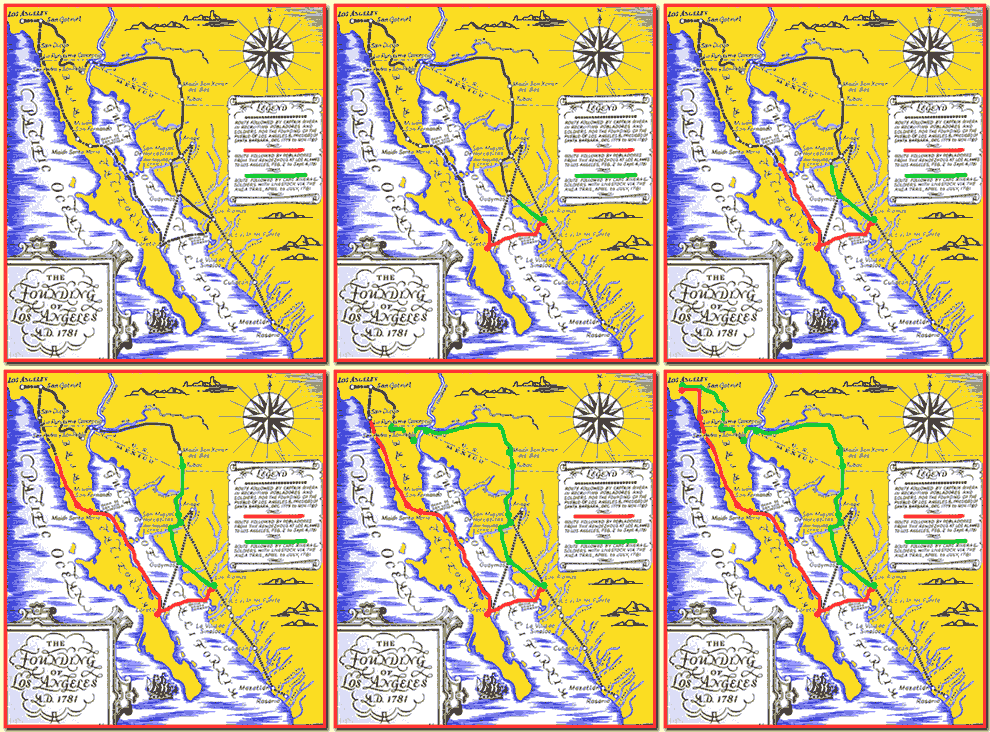
Every year on September 4 (or the weekend closest to) approximately 200 Angelinos, known as the Pobladores recreate a nine-mile walk from San Gabriel to downtown Los Angeles, California, originally taken on this day in 1781. The Pobladores are descendants of the original permanent settlers of Los Angeles, eleven families and four Spanish soldiers who journeyed from Northern Mexico to what is now Los Angeles.

The final leg of the journey ran from the San Gabriel Mission to near what is now Olvera Street.

Actually the original settlement was right on the banks of the Los Angeles River, then called the Rio de Nuestra Senora, Santa Maria, Reyna de los Angeles de Porciuncula. (Our Lady Santa Maria, Queen of the Angels of Porcuicula River.) It had been so named on July 31, 1769 by a Spanish expedition led by Gaspar de Portola.

Porciuncula means “small portion of land” but it also has a spiritual connotation. The most famous ‘porziuncula’ was the small portion of land, and the tiny chapel upon it, bequeathed to St. Francis of Asissi in the 13th century. It was from this church that the Franciscan Order spread. ‘Porciuncula’ was often used to refer to a special place of retreat.

The natives gave the settlers funny looks in 1781, for building their pueblo right on the river, and come the rainy season the settlers found out why. Their little settlement was flooded out, and they rebuilt the Pueblo further away from the river, where it still stands today.

Fortunately for posterity, the name “El Pueblo de Nuestra Senora Reyna de los Angeles” has been shortened to just Los Angeles. And for those for whom that’s too much a mouthful, it’s simply L.A.

Routes of the Pobladores

The Pobladores were a mixed-race group, with over half claiming black and Native American blood. Each year, Angelinos watch and join the descendants of the Pobladores as they retrace the steps of the ancestors on the nine-mile walk.

The 44-person pueblo has grown into a city of 4 million, with over 12 million in the metropolitan area. L.A. is the only city outside Europe to have hosted the Olympics twice. L.A. has four major airports, one of which is the 5th busiest in the world. In the late 19th century, Los Angeles was a fairly sleepy city. Settlers began arriving from all parts of the country, attracted first by the region’s agricultural advantages, and in the 20th century by its aviation and film industries. All of these benefited from Southern California’s famous year-round sunshine.

The city in the desert survives largely because of water imported from the Owens Valley. The Los Angeles Department of Water and Power is the largest municipal utility in the U.S.

The Los Angeles neighborhood known as Hollywood (there is a movement to make it its own city) is largely responsible spreading Southern California culture across the world.

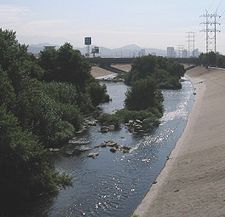
The Los Angeles (Porciuncula) River, not quite as scenic as it once was

Foundation of San Marino

September 3

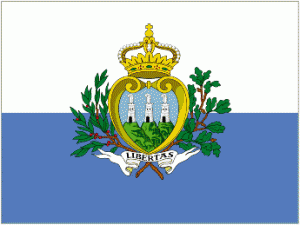
flag_sanmarino

Some sources cite the tiny nation of San Marino as the oldest country in the world. According to tradition, San Marino declared itself a constitutional republic in 301 AD. Founded by a Christian stonemason (Marinus of Rab) fleeing persecution, San Marino declared itself a constitutional republic in 301 AD.

San Marino lies entirely within Italy.

The secret to San Marino’s longevity? It takes soothing milk baths and does not engage in Middle-East land wars. It also helped that during the tumultuous Italian unification period in the 19th century, San Marino granted asylum to commander Giuseppe Garibaldi and 4000 of his men retreating from French forces in 1849. Later Garibaldi, as leader of a newly unified Italy, returned the favor by granting San Marino’s wish to remain independent.

The country’s official name is the “Most Serene Republic of San Marino”. [Makes one wonder if there are other, less serene republics of San Marino?] At 24 square miles, it’s the fourth smallest nation in the world (About 1/10th the size of Charlotte, North Carolina). And with only 30,000 residents, it’s got a smaller population than many universities.

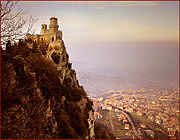
Guaita Tower, San Marino

But what San Marino lacks is size, it more than makes up for in tourists. 3.5 million people visit the ancient locale each year, enjoying its breathtaking views of the Adriatic (San Marino itself is landlocked) and its scenic medieval mountaintop fortifications. Its location high atop Mount Titano is one of the reasons it was only overrun twice in its recorded history, briefly in 1503 and again in 1739, though the neutral country was bombed once by the Allies during World War II, believing the Germans had taken it.

San Marino is also one of the oldest countries in the world in another respect…its average life expectancy is 81 years.

Today, September 3, is celebrated as the Feast Day of its patron and founder, St. Marinus of Rab.

http://www.everyculture.com/No-Sa/San-Marino.html

September 3 will mark 1707th Anniversary of World’s First Christian State

Vietnam Independence Day

September 2

On this day in 1945, Ho Chi Minh read the Declaration of Independence of the newly-proclaimed Democratic Republic of Vietnam.

To sum up the prior 2000 years of Vietnamese history in an internet-friendly morsel:

Vietnam was ruled by China for nearly a thousand years, until 938 AD, when a Vietnamese Lord defeated the Chinese at Bach Dang River. The Vietnamese then enjoyed 900 years of autonomy (though not necessarily peace), after which the Europeans moved in, first as allies against neighboring armies, then as conquerors. The French gained control of the region known as Indochina in a series of conflicts in the 19th century and maintained control until World War II when the Japanese invaded.

At the time, France was occupied by Japan’s ally, Germany, and an uneasy alliance of power developed between Japan and Vichy France, the French puppet government that Germany had installed. French authorities in Indochina were thus able to maintain the illusion of sovereignty.

However, in March 1945 the Japanese staged a coup, kicking out the French and dispelling any notions of European dominance.

The Japanese surrendered to the Allies in August of that year, and British and Chinese troops were sent to Vietnam to quell the growing independence movement. But by that time, Vietnam had already proclaimed its independence. Ho Chi Minh became the head of the provisional government of the Democratic Republic of Vietnam.

The First Indochina War would last nine years.

Ho Chi Minh declares independence, September 2, 1945

The Declaration of Independence that Ho Chi Minh read on September 2, 1945, began with a familiar ring:

All men are created equal. They are endowed by their Creator with certain inalienable rights, among them are Life, Liberty, and the pursuit of Happiness.”

This immortal statement was made in the Declaration of Independence of the United States of America in 1776. In a broader sense, this means: All the peoples on the earth are equal from birth, all the peoples have a right to live, to be happy and free.

The Declaration of the French Revolution made in 1791 on the Rights of Man and the Citizen also states: “All men are born free and with equal rights, and must always remain free and have equal rights.”

Those are undeniable truths.

Nevertheless, for more than eighty years, the French imperialists, abusing the standard of Liberty, Equality, and Fraternity, have violated our Fatherland and oppressed our fellow-citizens. They have acted contrary to the ideals of humanity and justice…

They have built more prisons than schools. They have mercilessly slain our patriots; they have drowned our uprisings in rivers of blood….

After the Japanese had surrendered to the Allies, our whole people rose to regain our national sovereignty and to found the Democratic Republic of Vietnam…

Our people have broken the chains which for nearly a century have fettered them and have won independence for the Fatherland. Our people at the same time have overthrown the monarchic regime that has reigned supreme for dozens of centuries. In its place has been established the present Democratic Republic…

We are convinced that the Allied nations which at Tehran and San Francisco have acknowledged the principles of self-determination and equality of nations, will not refuse to acknowledge the independence of Vietnam.

Ho Chi Minh’s northern-based government did not receive the support it had hoped for from the U.S. The Second Indochina War began not long after the first had ended. The U.S. supported the South Vietnamese government against Ho Chi Minh’s Communist government in the North; the Second Indochina War took the lives of millions of Vietnamese as well as 58,000 Americans. The U.S. withdrew completely in 1975 and North and South Vietnam unified as the Socialist Republic of Vietnam.

With over 86 million people, today Vietnam is the 13th largest country in the world by population.

Full Text of Declaration of Independence

Libya – Revolution Day?

September 1

flag_libya

With the 2011 revolution overthrowing Muammar Qaddafi, it remains to be seen whether the country will continue to remember September 1 as Revolution Day, marking the day in 1969 that Qaddafi rose to power.

Libya had an extremely rough colonization period under Italy in the early part of the 20th century. In 1951, Libya gained independence as a constitutional monarchy under King Idris.

King Idris held a decidedly pro-Western stance, and ruled the country for nearly two decades. He arranged to transfer power to his son on September 2, 1969. However, on September 1 that year, a coup led by officer Muammar Gaddafi deposed the King and his son, citing how the country’s wealth had managed to fall into the hands of the very few, notably the king’s inner circle. The 27 year-old Gaddafi gained his title: “Brother Leader and Guide of the Revolution.”

Gaddafi proposed that Libya would form a new type of government economy, neither capitalist nor socialist, but a third road between the two.

Gaddafi’s government’s links to the Soviet Union in the 1970s and 1980s, and its links to terrorist groups and bombings in the 1980s led to increase pressure from the West, and finally to U.S. air strikes in 1986 (which killed Gaddafi’s adopted daughter). In 1988, Libyan intelligence agents were involved in the bombing of Pan Am Flight 103 over Scotland. Libya spent the next decade under U.N. sanctions.

In 1999, U.N. sanctions were lifted after Gaddafi extradited Libyans suspected in the bombing. After 9-11, Gaddafi denounced Al-Qaeda; U.S. sanctions were lifted in 2003 when Libya agreed to pay billions of dollars to victims of Pan Am 103 and other bombings.

In terms of GDP per capita, Libya is the second richest nation in Africa. Its official name is the Great Socialist People’s Libyan Arab Jamahiriya (Arabic for “state of the masses), and it stands out from all other nations in terms of its flag: it’s the only single-color banner. Green symbolizes both Libya and the Islamic religion.

Over the decades, Libya has moved away from solidarity with the Middle-East and more toward taking a leadership role in the development of Africa.

Gaddafi Losing Grip Over Libya – 2011

Gaddafi Vows to Push African Unity – 2009

Gaddafi and the Libyan Crown Prince, 1992

Independence Day

August 31

Name that country:

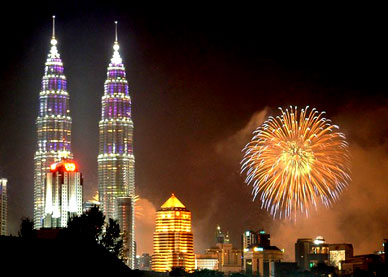
Until just a few years ago, it was home to the two tallest buildings in the world, the Twin Towers.

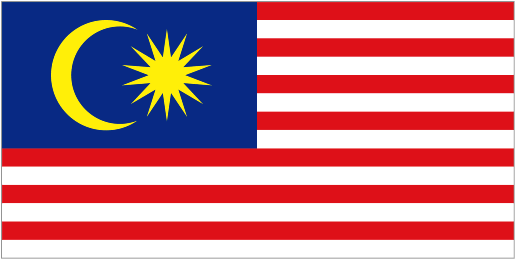
Its flag boasts over a dozen horizontal red and white stripes and a blue rectangle in the upper left corner displaying certain celestial objects.

It won its Independence from Great Britain.

(Got it yet? Okay, one more…)

Its head of state is the Yang di-Pertuan Agong, and its official religion is Islam.

That’s right! Malaysia!

Petronas Twin Towers, Kuala Lumpur

The Petronas Twin Towers were completed in Kuala Lumpur in 1998 and were opened on this day in 1999. At almost 1,500 feet, they’re taller than the Sears Tower by 33 feet, and were they were the tallest buildings in the world up until 2004 when they were surpassed by “Taipei 101”. (They’re still there, they’re just not the tallest buildings in the world anymore.)

The Malaysian flag contains 14 red and white stripes which symbolize the equal standing of the country’s 13 states and its federal government. The 14-point “Federal Star” represents Malaysia and its monarchy, while the yellow crescent moon represents Islam.

Though the official religion is Islam, Malaysia has significant populations of Buddhists and Hindus as well as a smaller Christian population.

And today is the biggest civic holiday of the year. Malaysians celebrate Hari Merdeka, (Independence Day), which marks Malaysia’s formation as a unified modern state and its independence from Great Britain over half a century ago, on August 31, 1957.

Happy Birthday Malasia! And Selamat Hari Merdeka!

La Tomatina

Last Wednesday in August
August 31, 2011
August 29, 2012

364 days out of the year, Buñol is a quiet, ordinary Spanish town country nestled in the foothills of the Valencia mountains about 40 kilometers from the Mediterranean coast; its population is just shy of 10,000.

But if you happen to visit Buñol on the last Wednesday of August, don’t wear your finest. You will notice that the population has tripled in size, the bulk of these tens of thousands have amassed along a few narrow streets, and they’re all engaged in a peculiar activity: throwing tomatoes.

Lots of tomatoes.

Over a hundred TONS of tomatoes.

La Tomatina is essentially the world’s largest food fight. (Although the Great Kettering Elementary School Food Fight of 1986 comes close.)

We wish we could say La Tomatina originates from an ancient pagan fertility rite, but it’s only 60 or so years old. Stories of the festival’s origin vary. Combining them would sound like this:

During a Gigantes y Cabezudos festival (the kind with the really big heads as featured in Borat) some rowdy spectators attempted to become participants, knocking over a big-head-carrying procession member in the process. A scuffled ensued among the hot-tempered youths.

Now, the people of Buñol had always enjoyed throwing things at each other. And fortunately for posterity, a truck or cartload of tomatoes had overturned just prior this auspicious occasion, providing the feuding parties with the perfect ammunition.

The following year authorities hoped to stem a repeat of the disaster, but the veterans of the previous year had some unfinished business to attend to.

The activity was first sanctioned by Town Hall in 1950. It was permitted and prohibited intermittently over the next few years. It got out of hand in 1956, townspeople got hurt, and it was canceled the following year. Some folks held a Tomatina Funeral instead. The festival was brought back by popular demand in 1959–but with regulations*–and they’ve been throwing tomatoes ever since.

Yes, La Tomatina started out as a Buñol style gang war. Perhaps in the States, if we armed our inner-city youths with tomatoes (in LA, avocados) we would attract tourists instead of violence.

As it is, in Buñol tens of thousands of tourists flock to La Tomatina each year. The festivities begin with the scaling of the “soap pole”. A ham is stuck atop a tall greased pole, and the tomato throwing can’t begin until a brave crowd member retrieves it.

*If you go, it’s considered proper Tomatina etiquette to squish your tomato before hurling it. Don’t bring bottles or anything that could cause injury, and be careful not to rip other people’s clothes. And it doesn’t matter if you’re wearing red or not. You will be.

La Tomatina

WARNING: NOT FOR THE TOMATO-PHOBIC!

One writer’s horrifying story:

“Our red tornado became an inexorable hurricane. It was becoming difficult to stand upright in so much slush and with so many wet missiles impacting from every possible direction. We blotted out the sun and sky…I had become one vast squelching mound of pulped tomato…

Seeing Red — Louis de Bernieres

What To Do With Your Extra Tomatoes

Victory Day – Turkey – Zafer Bayrami

August 30

flag_turkey

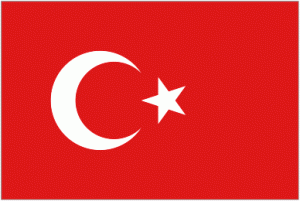
Today (August 30) Turkey celebrates Victory Day. The day honors those who have served in Turkey’s military and who fought heroically in the nation’s battles. Throughout the past two millennia, some of history’s greatest battles have been fought on what is now Turkish soil, but of all these, the Battle of Dumlipinar, fought in August 1922, was singled out to serve as the country’s Victory Day.

The Battle of Dumlipinar was the last major battle of the Greek campaign of the Turkish War for Independence (1919-1923).

After World War I, the Ottoman Empire found itself, along with Germany and the Austro-Hungarian Empire, at the losing end of an Armistice. The Treaty of Mudros didn’t reflect the reality of a war that in many ways was a stalemate. Western powers seized Ottoman towns and territory in the coming years…

“Greece, in a wild imperial venture supported by Britain, had invaded western Anatolia, hoping to make itself an Aegean ‘great power’ and to construct a ‘greater Greece’ out of the ruins of the Ottoman Empire. But the invasion ended not simply in Greece’s defeat at the battle of Dumlupinar in 1922, but in a calamitous rout and slaughter which drove not only the Greek armies but much of the Greek civilian population of Anatolia into the sea.”

— Neal Ascherson, Black Sea

As part of the treaty following the Greco-Turkish War, Turks and Greeks engaged in a population exchange, whereby Greek Muslims moved to Turkey and Turkish Christians moved to Greece. (Population Exchange Commission, 1923)

During these same years, Turkish revolutionaries under Mustafa Kemal simultaneously defeated the French and the Armenians in separate campaigns, forcing the Allies to revisit earlier treaties. The Turks dissolved the Sultanate of the Ottoman Empire, and a new Turkish Republic was established, with Mustafa Kemal as its leader.

The Turkish Nation consists of the valiant descendants of a people that has lived independently and has considered independence the sole condition of existence. This nation has never lived without freedom, cannot and never will.

— Mustafa Kemal Ataturk