Hungary – St. Stephen’s Day

August 20

Today Hungarians honor the founder of their nation. Over a thousand years ago King Stephen (that’s Saint Stephen to you) was crowned King of Hungary. Though a saint, King Stephen was not someone you’d want on your bad side. He once killed an opponent by having his eyes gouged out and pouring molten led into his ears. And that was his cousin.

King Stephen. No, its not a fro.
King Stephen. No, it's not a fro.

The whole molten-ear thing aside, he was considered a pious king, who imbued his dominion with Christian principles and established a Hungarian state very similar to the one still in existence. Even then Hungary was a multicultural nation, which the king encouraged:

“Foreigners coming from different countries and places to settle here bring with them a variety of languages, customs, instructive matters, and arms, which all contribute to adorn and glorify the royal court…A country speaking but one language, and where uniform customs prevail, is weak and fragile.”

King Stephen’s words have survived to this day. He once wrote to his son Emeric:

“Thou hast been brought up amidst delights and treasures, and knowest nothing of the arduous labors of war and the perils of hostile invasions by foreign nation, in the midst of which nearly my whole life has been passed.

The time has arrived to leave behind thee those pillows of luxuriousness which are apt to render thee weak and frivolous, to make thee waste thy virtues, and to nourish in thee thy sins…

…Rule over [thy subjects] peaceably, humbly, and gently, without anger, pride, and envy, bearing in mind that all men are equal, that nothing exalts more than humility, nor is there any thing more degrading than pride and envy.”

He forgot, however, to pass on the most valuable wisdom a parent can offer a child: “Ease off the boar hunting.”

Emeric was killed in a boar hunt accident in 1031–according to legend, on the same day he was set to inherit the kingdom. King Stephen never fully recovered from the loss.
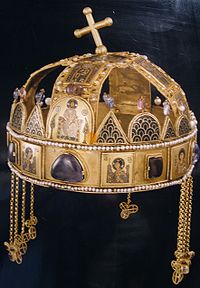
Holy Crown of Istvan (Stephen)

For a man so blessed in other arenas, Stephen had poor fortune when it came to progeny. The father of the nation had no children of his own to take over the crown.

He died on August 15, 1038. His saint day is the following day in the Roman Catholic church: August 16. However, the Hungarians honor him on August 20–the anniversary of the date his remains were brought to Buda. It turns out that not only were Stephen’s words, his Christian piety and his principles preserved, so was his hand.

His right hand. And each year on St. Stephen’s Day Hungarians line the streets as the king’s surprisingly well-preserved 1000 year-old right hand is paraded through the capital.
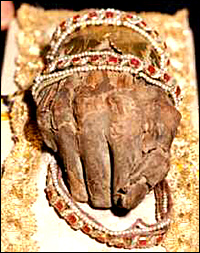
Stephens right hand
King Stephen's handy relic

Birthday of Virginia Dare

August 18

There sang a mother to her babe–
A mother young and fair–
“No flower like thee adorns the vale,
O sweet Virginia Dare…

Whatever Became of Virginia Dare?

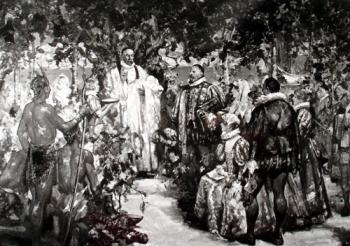
On this day in 1587 the first child of English parents was born in America. Virginia Dare was the daughter of Ellinor and Ananias Dare, and granddaughter of John White, governor of the colony known as Roanoke in what is now North Carolina.

Baptism of Virginia Dare

History texts record Ananias as both a former bricklayer from London and as an “aristocratic young man.” He was one of the Governor’s Assistants, in addition to being his son-in-law.

We only know about Viriginia Dare’s existence because shortly after her birth and baptism, her grandfather John White left the colony for England to seek materials and support. The journey took six months, during which time he encountered pirates, bad weather, and a near shipwreck, before finally landing–not in England, but Ireland.

When he finally returned to the colony in 1591, all trace of the colony, including his daughter and granddaughter, had disappeared.

To this day, whatever became of the “Lost Colony” of Roanoke remains a mystery. Virginia Dare has been the subject of historians and novelists, and the inspiration of poets and other artists in America for 400 years. From the poetry of Lydia Howard Sigourney to TV’s Buffy the Vampire Slayer. Today, inhabitants of Roanoke Island celebrate the 423nd birthday of Virginia Dare and ponder the fate of America’s first colony.

He calls–he shouts–the cherished names,
But Echo makes reply.
“Where art thou, Ellinor! my child!
And sweet Virginia Dare…”

–Lydia Howard Sigourney

Lost Colony Still Lost

Roanoke DNA Project

A Virginia Dare Day Proposal

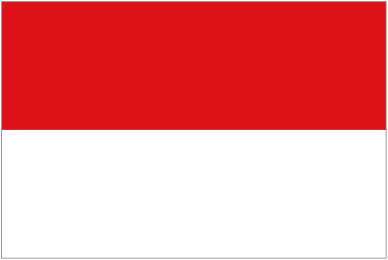
Independence Day – Indonesia

August 17

We, the Indonesian people, hereby declare the independence of Indonesia. Matters concerning the transfer of power, etc., will be carried out in a conscientious manner and as speedily as possible.

Jakarta, 17th day of the 8th month, 1945
Soekarno/Hatta

Just two days after Emperor Hirohito announced the surrender of Japan, Indonesia’s first president, Sukarno, proclaimed Indonesia’s independence, in what has to be one of the shortest Declarations of such in the world. (Full text above.)

The Second World War brought tragedy to Indonesia, but it also brought an end to hundreds of years of European colonialism. The Japanese invaded Dutch-controlled Indonesia in 1942, eager to utilize the island colony’s abundant natural resources, such as oil. There was little Holland could do in the matter, being an occupied nation itself. The Germany army had invaded Holland in 1940.

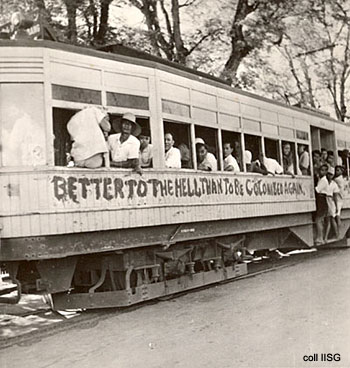
Better to the Hell than to be Colonized again
"Better to the Hell than to be Colonized again"

The Japanese fueled the flames of Indonesian independence, and replaced Dutch colonial administrative and economic infrastructure, making self-governance feasible in a way it had not been prior to the occupation. Sukarno’s cooperation with the Japanese during the war earned him the ire of many enemies, but his position was vindicated when Japan announced its intention for Indonesia’s independence in 1944.

The date of independence had not been determined when the Japanese surrendered on August 15, 1945. After the surrender, Sukarno and other pro-Independence leaders wasted no time. They met at the house of Rear-Admiral Maeda Tadashi and scratched out the declaration on the night of August 16.

The Declaration however, did not mean an end to the struggle, but the beginning of a new one. British troops arrived in Indonesia to stave off the revolution until the Dutch–recently liberated themselves–could reassemble their military. By 1947 the Dutch had over 100,000 troops stationed in the area, and the battle was on its way to becoming one of the bloodiest revolutions of the 20th century.

The Dutch emphasized Sukarno’s connection with the Japanese, declaring him an enemy collaborator against the Indonesian people, but it became clear that the fight for independence was not comprised solely of isolated guerrilla groups and political extremists, but was a widespread movement with national support. Also, diplomatic efforts by Indonesian independence leaders increased international support for the nationalist cause

The Netherlands recognized Indonesian independence in November 1949.

Today, Indonesia is the fourth largest nation by population, after China, India, and the United States, and it is the most populous Muslim nation in the world.

Independence for Indonesia

Death of San Martín

August 17

…never had I entertained any ambition other than to merit the hatred of the ungrateful and the esteem of the virtuous.

-José de San Martín, July 22, 1820

San Martín did both.

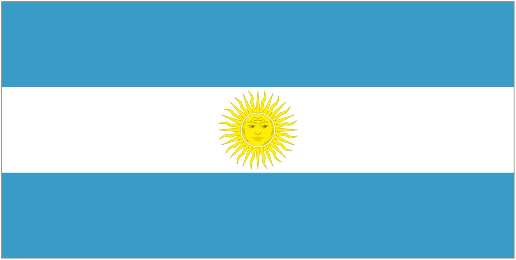
One of the greatest heroes of Pan-American history, San Martín was an exceptionally rare kind in that, after achieving what he had set out to accomplish–namely the liberation of most of South America–he held true to his word. He relinquished all power and returned home following a fateful and mysterious meeting with fellow libertador Simón Bolívar.

Both men had hopes for a united South America, and both were disillusioned by the continual conflicts that thwarted their idealistic vision.

Upon vanquishing the Spanish army from Argentina, San Martín had hardly set foot outside his newly independent homeland when internal divisions led that nation to civil war. San Martín’s powerful army and his own fame could have swayed the civil war, but he chose to fight the Spanish in Chile and Peru rather than return to Argentina with his army to take sides and shed the blood of his countrymen.

He was proclaimed Protector of Peru, a title he relinquished after his meeting with Bolívar, along with command of his army. He then returned briefly to his farm in Mendoza, Argentina. After the death of his wife, San Martín placed himself in voluntary exile in Europe, moving to France with his daughter Mercedes. He would spend the rest of his life in France, a nation he had once fought against as a youth in service to Spain.

Today San Martín is revered as the national hero of Argentina.

The Life of José de San Martín

Children’s Day – Paraguay

August 16

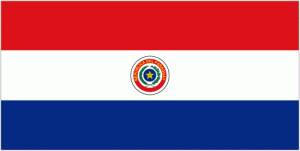
flag_paraguay

Children’s Day in Paraguay has its roots in the War of the Triple Alliance (1864-1870), the most devastating war ever fought in South America. It was fought between Paraguay (on one side) and Brazil, Argentina, and Uruguay (on the other).

Needless to say, Paraguay didn’t win. In fact, it lost half its population during the war—including nearly all its fighting-age men—as well as 60,000 square miles of territory to Brazil and Argentina. (Latin America’s Wars: the Age of the Caudillo (1791-1899) Robert Scheina)

Children’s Day recalls the anniversary of the one of the last battles of the war in 1869, the Battle of Acosta Nu. Having already lost most of his army, Paraguayan dictator Francisco Lopez used younger and younger recruits. The 6,000 strong force in August of that year was largely made out of children. On August 16, the small retreating army was overtaken by a force of 20,000 men from Brazil and Argentina. Within eight hours, over 2000 Paraguayans lay dead.

Paraguayans say the additional tragedy was that the war was already over at that point, but that the Brazilian government refused to stop until Lopez was captured.

The War of the Triple Alliance remains one of the darkest chapters in South American history.

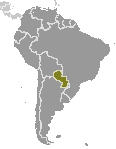
Paraguay in green
Paraguay in green

Indian Independence

August 15

The Twentieth Century witnessed over 140 countries gain independence. [35 of them in the years 1960 and 1991 alone]. But few, if any, stirred such emotion, involved so much conflict, changed and disrupted so many lives, inspired so many future leaders, and so fundamentally altered the world we live in, both politically and philosophically, as the independence of India.

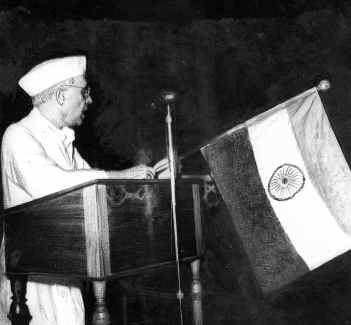
A hundred-year struggle against imperialism and colonization came to a climax as Prime Minister Jawaharlal Nehru addressed his people on the eve of India’s long-awaited independence:

Long years ago we made a tryst with destiny, and now the time comes when we shall redeem our pledge, not wholly or in full measure, but very substantially. At the stroke of the midnight hour, when the world sleeps, India will awake to life and freedom. A moment comes, which comes but rarely in history, when we step out from the old to the new, when an age ends, and when the soul of a nation, long surpressed, finds utterance.

Nehru during his Tryst with Destiny speech
Nehru's "Tryst with Destiny" speech

India found that, like so many other countries, while freedom and self-determination solved some ills, other problems were exacerbated. The partition of India into two separate, independent nations disrupted millions of lives and led to a bloody conflict that has not healed to this day.

Less than six months after independence, the Pakistani-Indian conflict would take the life of Mohandas Gandhi himself, the Indian former-lawyer who used civil disobedience to combat racial injustice in South Africa and who raised peaceful resistance to a new level to free his own countrymen in India. On January 30, 1948, Gandhi was shot by a Hindu radical, who was angry at Gandhi’s cooperation with Muslim Indians and Pakistanis.

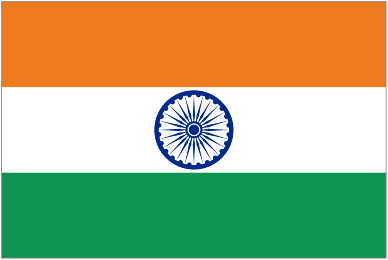
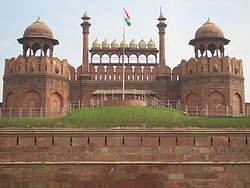
Indian flag rises above Red Fort, Delhi

Despite the death of its greatest leader, the story of Indian independence showed the world that the principles Gandhi preached, concepts of non-violence and the power of peace, were not mere religious dogma, not words spouted by the powerful to keep the powerless meek and compliant, but were weapons capable of ending an Empire.

Swami Vivekananda was once asked by an Englishwoman, “What have you Hindus done? You have never even conquered a single nation.” To which the Swami replied…

That is true from the point of view of the Englishman…but from ours it is quite the opposite. If I ask myself what has been the cause of India’s greatness, I answer, because we have never conquered.

The gift of India is the gift of religion and philosophy, and wisdom and spirituality. And religion does not want cohorts to march before its path and clear its way. Wisdom and philosophy do not want to be carried on floods of blood. Wisdom and philosophy do not march upon bleeding human bodies…but come on the wings of peace and love, and that has always been so.

Swami Vivekananda Vedanta Lecture – Spirituality, the Gift of India

Independence Day – P.A.K.iS.tan

August 14

We are convinced there can be no peace and progress in India if we, the Muslims are duped into a Hindu dominated federation in which we cannot be the masters of our own destiny and captains of our own souls.

Choudhary Rahmat Ali

Choudhary Rahmat Ali was not the leader of a nation, a war hero, a politician, or a prince’s son. But his contribution to the world over 60 years ago can be seen clearly on any map of the world.

He was born in Punjab in 1897 in what was then British India. He was a graduate student at Cambridge University in England during the 1930s, a turbulent decade in his homeland. Muslims in British India saw the winds of change approaching as Indian leaders of both religions pushed for independence from the British Empire. Muslims were concerned about being a minority in a Hindu nation.

In January 1933, Rahmat Ali wrote a booklet, “Now or Never,” in which he laid out the concerns of 30 million Muslims and non-Hindus in the region. He described India not as a country, but as a continent, too diverse to be simplified and categorized as a Hindu nation.

He proposed that the Muslim territories of Punjab, Afghan (Northwest Frontier Province), Kashmir, Sind and Baluchistan be accorded “national status, as distinct from the other inhabitants of India” and be granted “a separate Federal Constitution on religious, social, and historical grounds.”

His proposal was not a new one. But he did suggest a name for the separate nation. Taking the first initials of four provinces–Punjab, Afghan, Kashmir, and Sind–and the end of Baluchistan, he created the name “PAKiStan.” The name also had another meaning: in Urdu pak means “pure” and stan means land.

Rahmat Ali provided an all-encompassing name for a diverse, amorphous group of 30 million people previously known to the outside world as ‘Indians’; the name Pakistan resonated both with the Muslims of India and the non-Urdu speaking world. The name and the idea of a separate Pakistan stuck.

India-Pakistan partition (red = conflict areas)

On August 14, 1947 the British Indian Empire was partitioned into two separate nations: the Union of India and the Dominion of Pakistan.

In terms of speed and sheer numbers, the mass migration that followed the partition has no equal in human history.

In a matter of months, over 7 million Muslims living in the newly-independent nation of India moved to the new nation of Pakistan, located in two separate parts, east and west of India. (East Pakistan is now Bangladesh). Meanwhile, another 7 million, Hindus and Sikhs, moved from those areas into the new nation of India. Violence between Muslims and Hindus escalated. There are no precise statistics, but it is believed about half a million people died during the migration, from bloody conflicts and from the dire living conditions that neither nation was prepared to combat.

Today is Independence Day in Pakistan, a time of celebration, but also of remembrance.

Pakistan itself became the subject of partition in 1971. The Bengali-dominated eastern-half of the country, known as East Pakistan, broke away to become what is now Bangladesh.

Even without Bangladesh, by population Pakistan is the 6th largest nation in the world.

Chad Independence Day

August 11

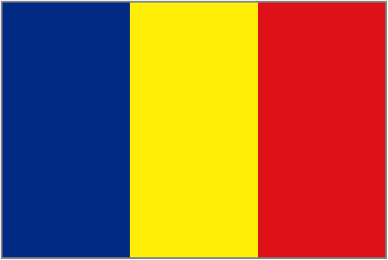
flag_chad

Chad was one of 9 African nations to gain independence in August of 1960:

August 1, 1960 – Benin
August 3, 1960 – Niger
August 5, 1960 – Burkina Faso
August 7, 1960 – Cote d’Ivorie
August 11, 1960 – Chad
August 13, 1960 – Central African Republic
August 15, 1960 – Congo, Dem. Rep. of the
August 17, 1960 – Gabon
Sept. 22, 1960 – Mali

Apparently odd-numbered days are much better days to win sovereignty. Mali, being the rebel of the bunch.

map_chad_africa

Chad gets its name from the Lake on its western border, which provides water for 20 million people in Chad, Niger, Nigeria, and Cameroon. Chad means “lake” so essentially it’s “Lake Lake.”

6,000 years ago Lake Chad covered 150,000 square miles. 50 years ago—when Chad won its independence from France—the lake had shrunk to 10,000 square miles. Now, because of climate change and increased human usage (including irrigation), it’s down to only 500 square miles and disappearing fast. And as you can see from the video, waterfront property is getting harder and harder to find.

Watch Lake Chad disappear in real (sped-up) time! (1963-present)

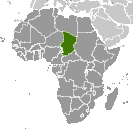
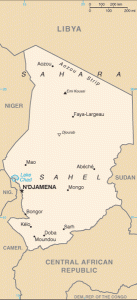
map_chad
Chad

On the landlocked country’s western border, the heat is on to determine who controls the precious water rights to the shrinking pool. Meanwhile, Chad’s eastern border is home to over a quarter million refugees from the Darfur region, due to the war that has ravaged west Sudan since 2003.

According to the Corruption Perceptions Index, Chad is the 7th most corrupt country in the world. Chad may rank near the bottom of the Human Development Index, but it’s rich in history. In 2002, scientists in Chad unearthed the oldest known hominid skull fossil, dating back some 7 million years.

Toumai, the 7M year-old skull