Ecuador National Day – the “Grito” of Quito

August 10

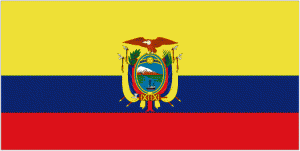
flag_ecuador

Today is Ecuador’s National Day, and the event it celebrates is considered the first cry for independence in Latin America. It took place in Quito, Ecuador, on August 10, 1809.

South America’s “Primer Grito de la Independencia” (first shout for independence) was ironically a show of fidelity to Spain. On the other side of the Atlantic, Napoleon of France had invaded Spain and installed his brother Joseph Bonaparte on the Spanish throne in 1808.

When the news spread to South America, the criollos (Spanish descendants born in the New World) initially called for independence as a show of support. On August 10, 1809, they declared their unity behind the former King Ferdinand of Spain and they refused to recognize the legitimacy of officials appointed by the Bonaparte government. Over the next several years, several similar “gritos” would be issued by Latin American assemblies all the way from Mexico to Argentina.

But when the Spanish regained control of their own country, and turned their attention back to South America, the criollos who had been fighting for their freedom had no intention of turning back.

Independence however would be a long time coming. The Wars of Independence from Spain raged throughout South America for over a decade.

With support from the armies of Simón Bolivar and José de San Martín, Ecuador’s national hero Antonio José de Sucre eventually liberated the Quito region from Spanish forces in 1822. The final Battle of Pichincha, fought atop the slopes of a towering volcano overlooking Quito, took place on May 24 of that year.

Antonio José de Sucre

In the end, the long struggle worked out, and all told, the Ecuadorians would get not just one, but four annual holidays out of the War of Independence: today’s holiday, Independence of Guayaquil (October 9, 1820), Independence of Cuenca (November 3, 1820), and the Battle of Pichincha (May 24, 1822).

Even though the region was liberated, Ecuador’s own independence as a sovereign nation wouldn’t come for another eight years, during which Quito and the surrounding provinces were considered part of Bolivar’s “Gran Colombia.” The three southern provinces of Gran Colombia became “Ecuador”—so named because it straddles the equator—in 1830.
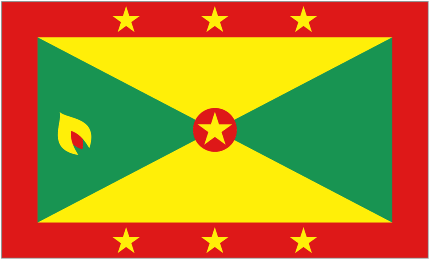
Carnival – Grenada

August 8-9, 2011

Key ingredients:

Take a warm August Caribbean day.

Add Music: Calypso, Steel drums, Soca, and other traditional rhythms.

Mix with bright, colorfully-costumed dancers and musicians atop or around decorated floats

And set amid thousands of spectators dancing along the procession route.

You have yourself Carnival.

Serves more than you can imagine.

Carnival in Trinidad (March)

Though many locales celebrate before Ash Wednesday, such as Haiti, Martinique and Trinidad and Tobago, others celebrate in August, including Antigua and Barbados, Grenada, and, of course, Notting Hill. Today Grenada celebrates Carnival.

The festival has its roots in the synthesis of French-Catholic and West African cultures in the Caribbean in the 16th though 19th centuries.

Traditions include the crowning of a Calypso King or Monarch, Battle of the Steel Bands (Panorama) and J’Ouvert–the wild parade of the festival occurring from the middle of the night till just before dawn.

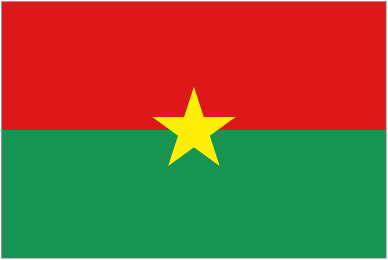
Independence Day – Burkina Faso

August 5

Do you do the Ouagadougou?

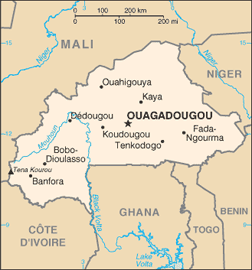
It’s not the craziest new dance sensation sweeping the nation (though it should be). No, Ouagadougou [pronounced ‘wa-ga-du-gu’] means “place where people get honor and respect.” It was named so by Naba Wubri, a 15th century warrior, but we have the French to thank for its cruel and unusual orthography.

The French captured this capital city and home to the Mossi people in 1896, completing their colonization of the area known as French West Africa. Over the next 50 years the territory merged with and separated from other French territories in West Africa, including Senegal, Nigeria, and the Cote d’Iviore.

In 1958 the self-governing Republic of Upper Volta (today’s Burkina Faso) was formed. President Maurice Yaméogo declared the country’s full independence from France on this day (August 5) in 1960.

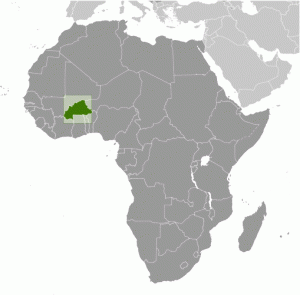
burkina_faso

Independence Day in Burkino Faso falls just one day after the nation’s Revolution Day, celebrated on August 4.

On August 4, 1983, reformist Thomas Sankara took the reigns of the country, with the help of ally Captain Blaise Compaore, and changed the country’s name from Upper Volta’s to Burkina Faso. It means “land of the men of integrity.”

In its short history as a sovereign nation, Burkina Faso has observed the anniversaries of numerous “Revolution Days”.

Between January 3, 1966 (the coup in which the first president, Yaméogo, was ousted) and October 15, 1987 (Burkina Faso’s last putsch to date), the country had a coup every few years. In 1987, Blaise Campaore overthrew his former ally Thomas Sankara four years after he helped to make him President.

Though implicated in Sankara’s assassination, Compaore has remained president for over 20 years.

Evidently, Campaore knows how to do the Ouagadougou.

burkina_faso2

1987 Coup

Political Reform in Francophone Africa – by Clark & Gardinier

Saint Sithney – Patron Saint of Mad Dogs

August 4

On August 4, Cornwall, England celebrates the Feast Day of Saint Sithney, the patron saint of mad dogs.

Legend has it that the Lord Almighty asked good ol’ Sithney if he would be the patron saint of girls seeking husbands. Sithney politely declined the offer, fearing he would be besieged with prayers for rich hubbies and fancy jewelry and the whatnot. Instead, Sithney said he’d rather be the patron saint of something like mad dogs, and the request was granted.

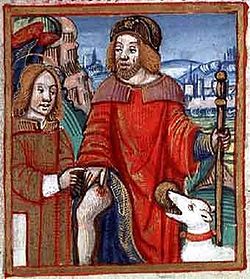
Saint Roch (Sithney wasn't available for photoshoot)

August 4 is also the birthday of U.S. President Barack Obama. We know when he was born, but where exactly where he was born is at present a topic of heated debate, dominating the media coverage on conservative talk shows. It may be that one day a child will review the historical archives of August 2009 and be surprised that the question of Obama’s citizenship even existed, let alone monopolized the news cycle, between the death of Michael Jackson and the devastation of Hurricane Grace. But until that day, we wish the President good luck in his quest to prove he’s American, and we ask Sithney to hasten his healing efforts on certain unnamed talk show hosts.

Venezuela – Flag Day

August 3 (since 2006)

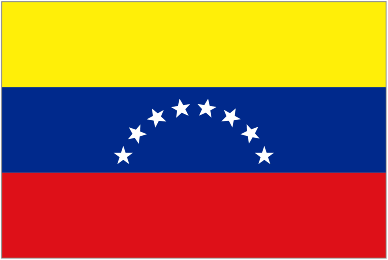
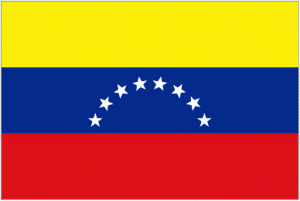
flag_venezuela

Up until 2006, Venezuelans celebrated El Día de la Bandera (Flag Day) on March 12th, in honor of the day in 1806 that Francisco de Miranda first hoisted the future flag of Venezuela on the ship Leander.

Miranda was born in Caracas, Venezuela. During the American Revolutionary War, Miranda fought for Spain in Florida. In France he served in the French Revolutionary Army. And between those two revolutions he lived in England, Italy, Prussia, and the Ottoman Empire.

But he’s most famous for his role in the liberation of his homeland Venezuela, a crusade that occupied the last decade of his life.

In 1806 Miranda acquired unofficial British support to lead a rebellion against Spain in South America. On March 12, 1806, Miranda raised the tricolor flag, which he himself designed, atop the ship Leander, just before she and two other ships set forth from Haiti to liberate South America.

The plan didn’t work.

The other two ships were captured by the Spanish, their occupants tried, and many were put to death. The Leander escaped, arriving in La Vela de Coro on August 3, 1806, flag in tact.

Miranda led the struggle against Spanish forces for the next several years. On Maundy Thursday in 1810 a military junta established a provisional Venezuelan government, to which Miranda was appointed as a delegate from El Pao. The congress adopted Miranda’s tricolor flag as the official banner the following year.

However, later losses, and a huge earthquake which hit Venezuela on Maundy Thursday two years after the junta (taken by many as a sign from God against the revolution) reduced Venezuelan morale and popular support. Miranda became a generalissimo with dictatorial powers, but as the revolutionary effort crumbled, he began considering an armistice with Spain.

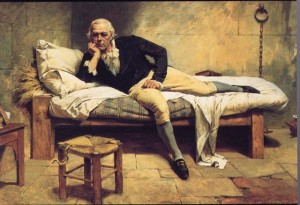
Simon Bolivar and other revolutionaries viewed Miranda as a traitor. In one of Bolivar’s less touted moves, he and his co-patriots turned Miranda over to the Spanish. Miranda was transported Spain, incarcerated, and died in his cell four years later—on July 14 (Bastille Day) 1816.

He was buried in a mass grave.

Francisco de Miranda in Cadíz

In 2006, the Venezuelan government voted to change the date of Flag Day to August 3rd to celebrate the 200th anniversary of the flag’s (and Miranda’s) arrival on Venezuelan soil.

“Miranda was a man of the eighteenth century whose genius lay in raising the consciousness and confidence of his fellow Americans. Although he prided on being a soldier, his greatest battles were fought with his pen.”

Francisco de Miranda, a Transatlantic Life in the Age of Revolution, by Karen Racine

Venezuelan Flag & Flag Day

St. Elias & Ilinden

August 2-3 (Gregorian) every year; July 20 (O.S.)

The traditional feast day for the saint known as Elijah, Elias, or Ilya is July 20. In and around the Balkan states where St. Elias is most venerated, July 20 in the Eastern Orthodox Calendar falls on August 2 in the Gregorian.

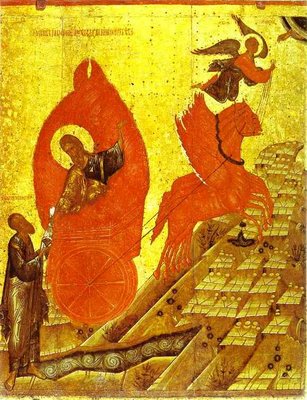
In the Old Testament, Elijah is the Hebrew prophet who rode to heaven in a chariot and who would come back to earth to foretell the coming of the Messiah. He could make fire fall from the sky, as in the case of the showdown at Mt. Carmel, which is how he came to be associated with thunder and lightning among formerly pagan cultures of South-eastern Europe.

In the New Testament, Elijah is one of the prophets—along with Moses—that Peter sees talking with Christ during the Transfiguration. The New Testament also describes St. John the Baptist as an incarnation of Elijah, who came back to announce the coming of Christ.

Elijah’s Greek translation “Elias” suggests the prophet may be a form of the Greek sun god Helios. Helios drove the sun across the sky in a chariot.

Elijah taken to heaven in a chariot
Elias taken to heaven in a chariot

Elias is especially revered in the countries of Macedonia and Bulgaria, where he’s also known as St. Ilya.

In many of the villages of old Macedonian Bulgaria, all the weddings for each town that year would take place on the same day. The most popular days for weddings were St. Peter’s Day (June 29), the Assumption (August 15) and, July 20, St. Elias’s Day, or Ilinden.

“After the conclusion of the liturgy, the oldest inhabitant, flanked by the village priest and the headman, would go to the centre of the village, call the young men together and declare: “God willing, the weddings will commence’. Everyone present then fired a few shots into the air to confirm the start of the wedding ceremonies. This was the signal for red wedding banners, topped with apples wrapped in gold foil, to be hoisted on the houses where weddings had been arranged. The customary preliminary rituals, lasting the best part of a week, were performed by each family individually, but all the couples, with their respective entourages, went to the church to be married one after the other on the same Sunday, and then all assembled on the village green, where they danced the horo together before returning to their separate homes to feast and to carry out the remaining rituals.”

Bulgarian Folk Customs, Mercia MacDermott (summarizing Stefan Verkovich’s account of Ilinden in A Description of the Way of Life of the Macedonian Bulgarians)

In the early years of the 20th century the saint’s feast acquired a whole new meaning. Macedonia at that time was still under control of the Ottoman Empire. In 1903 Macedonian insurgents planned and launched a widespread uprising beginning on Ilinden (August 2, Gregorian). Though the Turks put down the insurrection the following month, the Ilinden Uprising became a symbol of Macedonian nationalism.

Swiss National Day

August 1

“In Switzerland they had brotherly love — they had 500 years of democracy and peace, and what did that produce? The cuckoo clock.”

So goes Orson Welles’ famous line from The Third Man. But the Swiss will tell you Switzerland has produced much more than the cuckoo clock, the army knife, holey cheese, and those nifty bank accounts. Here, for the first time ever, ranked by the world’s most brainiest scientists, are the top 20 things to come out of Switzerland over the last 500 years:

20. internal combustion engine
19. e (as 2.71828 )
18. fondue
17. Amish people
16. Nescafe
15. velcro
14. absinthe
13. William Tell
12. i (square root of negative 1)
11. LSD
10. LCDs
9. Rorschach tests
8. Diesel
7. aluminum foil
6. cheese spread
5. the Red Cross
4. the World Wide Web
3. Toblerone
2. photosynthesis
and…
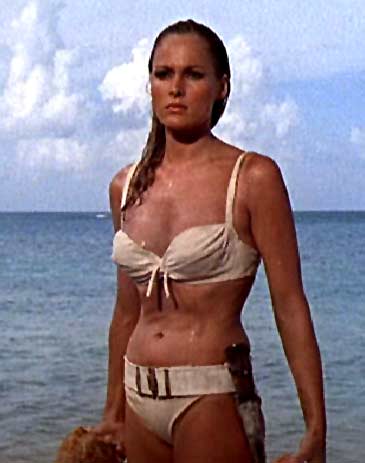
1. Ursula Andress

Ah the Swiss...Ursula Andress in Dr. No

Despite these achievements, women in Switzerland didn’t get the right to vote until 1971. Since then, however, they’ve had two female Presidents.

Today’s National Day celebrates the Federal Charter of 1291, penned in August of that year. It states:

…know all men, that the people of the valley of Uri, the democracy of the valley of Schwyz, and the community of the Lower Valley of Unterwalden, seeing the malice of the age, in order that they may better defend themselves, and their own, and better preserve them in proper condition, have promised in good faith to assist each other with aid…against one and all, who may inflict upon any one of them any violence, molestation or injury, or may plot any evil against their persons or goods.

And they meant it. Mild-mannered as they seem today, the Swiss Confederation was the terror of Europe starting in the days of national hero William Tell in the 14th century until 1515 when French, German, and Venetian troops defeated 20,000 Swiss–the best trained army on the continent–in the Battle of Marignano. The battle also marked the end of the days of pikes and phalanxes and the beginning of the dominance of field artillery.

Switzerland joined the United Nations in 2002.

Lughnasadh

July 31-August 1

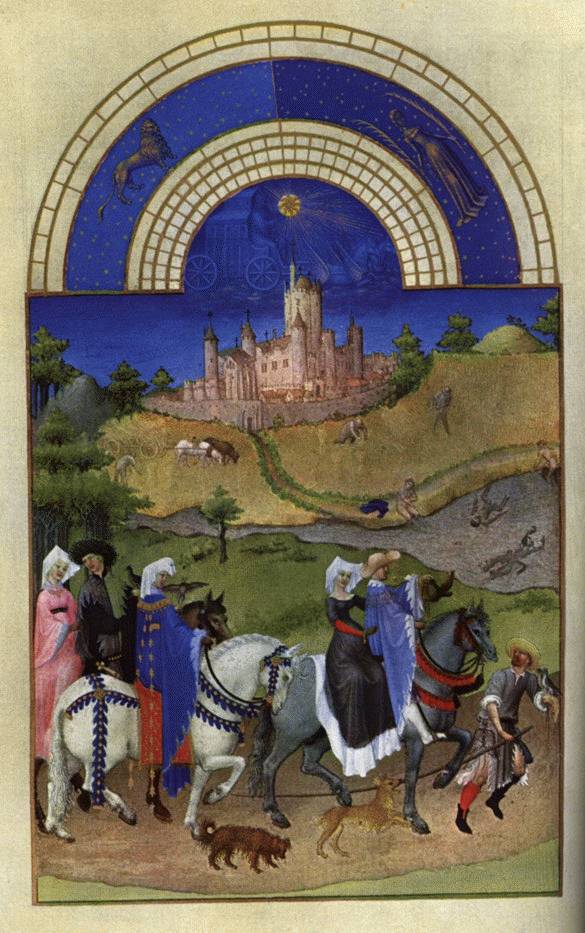
Book of Hours, August

Today is Lughnasadh! Not to be confused with Lasagna Day. That was July 29.

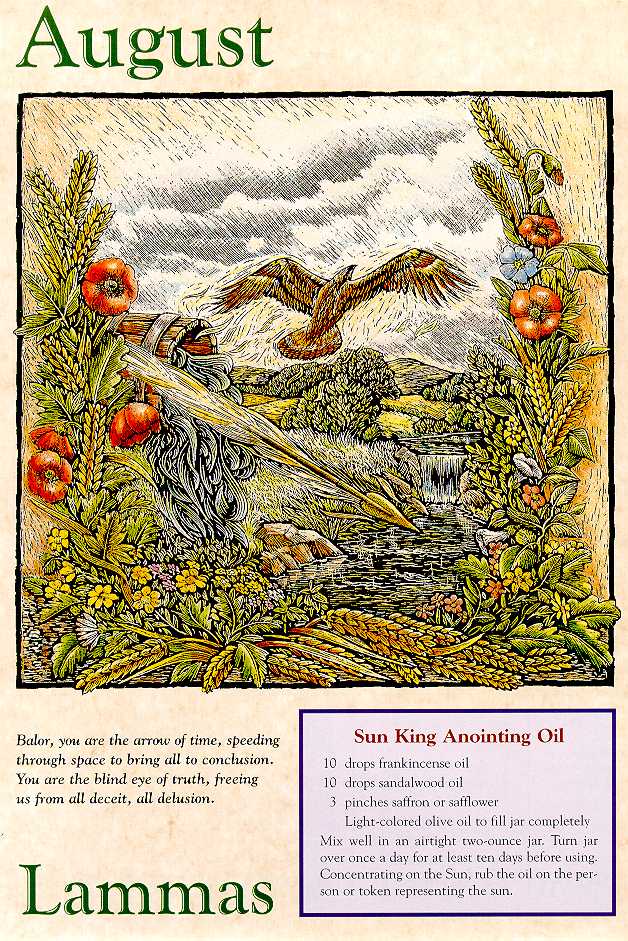
Also known by its more Christian name, Lammas, aka “Loaf-mas”, Lughnasadh marked the time of year villagers would celebrate the first Harvest, on or around August 1, by baking and sharing bread from the first grain of the season.

Lughnasadh is a cross-quarter day—days that fall directly between equinoxes and solstices—the others being Imbolc (Candlemas), Beltane (May Day), and Samhain (Halloween).

The holiday would have been celebrated by the Celts starting at sundown (on the 31st) until the following day.

July 31 is also Harry Potter’s Birthday! Coincidence?

Today the ancient pagan tradition is carried on by wiccans and is becoming increasingly popular in neopaganism.

from http://jksalescompany.com/dw/wicca_calendar.html

http://thunder.prohosting.com/~cbarstow/lammas.html

Lughnasadh recipes