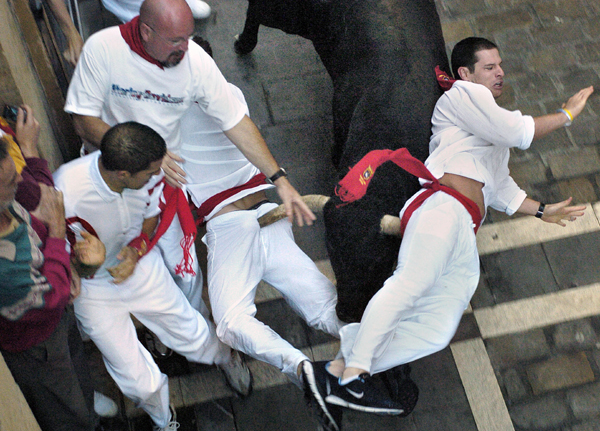
14 people have been killed in the San Fermin Running of the Bulls since 1924, when they began counting. To give you an idea of the scope of the mayhem, that’s almost equal to the number of people killed by vending machines in the U.S. since 2001.
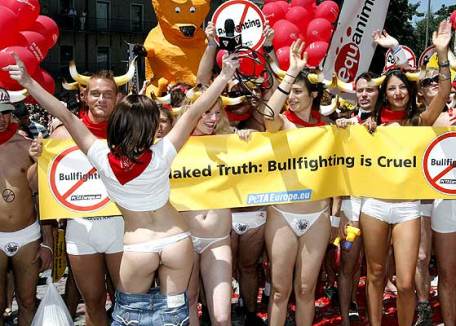
Running with the Bulls (aka the Encierro) has been a Pamplona tradition for centuries. Local organizers remind tourists to take safety precautions and warn them of the potential for serious injury. The warnings are often shrugged off, but last year two California brothers got the point in the end.Protesters aren’t so concerned with injuries to humans, but with cruelty to animals. 40,000 bulls are killed by the bullfighting industry each year in Europe. These and other facts about bullfighting are ‘exposed’ during PETA’s Running of the Nudes, which coincides with the festival each year.
Who knows which Run the good Saint Fermin would prefer?
Q: So who is this Saint Fermin anyway, and what does he have to do with bulls?
A: St. Fermin was the son of a Roman senator in Pamplona. He converted to Christianity, was named a Bishop in Amiens, returned to Pamplona to lead his flock, and was martyred back in Amiens in 303 AD. He was actually beheaded, not slaughtered by bulls. And in September, not July.
It was his predecessor Bishop Saturninus of Toulouse who had the honor of being tied to a bull by his legs and dragged to his death. The two saints’ martyrdoms are sometimes confused because of Fermin’s association with the Encierro.
The tradition of honoring St. Fermin in Pamplona dates back to 1186, though the liturgical festival was originally in October. It was moved to July 7 in 1591 to coincide with the summer market fairs and bull ceremonies.
The Martyrdom of Saturninus of Toulouse
So if you’re running with the bulls this week, stretch beforehand, wear good shoes, and be careful where you slip.
[Also on July 7: the Japanese celebrate Tanabata, the reunion of the lovers Orihime and Hikoboshi—stars in the heavens who are permitted to visit each other one day of the year—the seventh day of the seventh month. People create beautiful origami in their honor and write wishes on tanzuku to send up to the two briefly reunited lovers.]
He was born this day in 1935, the fifth of 16 children, nine of whom survived to adulthood. He has spent five of his seven decades as Tibetan Buddhism’s spiritual leader outside his homeland.
China invaded Tibet in 1950. The Dalai Lama escaped from Tibet in 1959 during the March 10 uprising, in which followers gathered outside his palace to prevent the People’s Liberation Army from kidnapping him. The Dalai Lama fled the country to avoid potential violence.
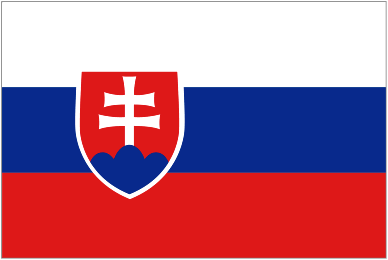
St. Cyril and St. Methodius, the two missionary brothers who gave birth to the written Slovak language, are celebrated by the Eastern Catholic Church in May. (The exploits of the Brothers are detailed here.) But in the early 20th century the Roman Catholic feast day for the saints, held on July 5, took on a new importance.
After the formation of Czechoslovakia in 1918, Slovaks around the world struggled to defend their national identity. When the Czechs declared July 6 a public holiday, in honor of 15th century Protestant forerunner Jan Hus, Slovaks pushed for the feast day of Sts. Cyril and Methodius, July 5, as a national celebration as well as religious one. Today it’s celebrated in both Slovakia and the Czech Republic.
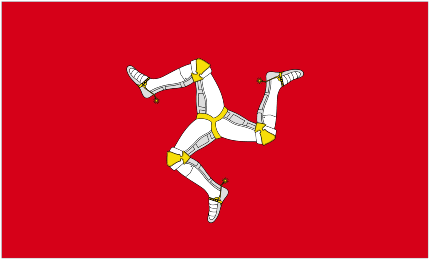
Tynwald is the legislative body of the Isle of Man, located between England and Ireland in the Irish Sea. Founded in 979 AD, Tynwald is said to be the oldest continuously active parliament in the world. It is descended from the Norse thing–the Parliamentary body developed by the Vikings. Vikings settled on the previously island beginning in the eighth and ninth centuries, but the island maintained much of its Celtic heritage.
On Tynwald Day, the island’s national holiday, the parliament meets in an open air ceremony presided over by the Lieutenant Governor or the Lord of Mann. The British monarch is the official head of state (since Charlotte Murray, 8th Baroness Strange, sold the sovereignty of the Isle for £70,000 in 1765) but the Isle of Man is not a part of the United Kingdom. As Lord of Mann, Queen Elizabeth presided over Tynwald’s 1000th anniversary session in July 1979.
Tynwald Day originally fell on Midsummer’s Day, June 24, in the Julian calendar. When the Isle of Man switched to the Gregorian calendar, they lost 11 days, but continued to celebrate its national day on June 24 Julian (July 5 Gregorian). As is the case this year, Tynwald Day is held the following Monday if the 5th falls on a weekend.
According to legend, the Isle of Man was once ruled by a Celtic sea god named Manannan, who would shroud the isle in his misty cloak to protect it from invaders. Residents paid tribute to the sea god in the form of bundles “of course meadow grass yearly, and that, as their yearly tax, they paid to him each midsummer eve.” —Mannanan Beg Mac y Leirr
Today the bundling of reeds is still a part of the Tynwald Day festivities.
Born on July 4, 1776, America is—zodialogically speaking—a cancer. And had our forefathers been more astrologically attuned, our national symbol might have been the New England crab. Fortunately we settled on an eagle (though the turkey was a serious contender).
As everyone knows, the members of the Continental Congress in Philadelphia declared the 13 colonies of North America to be free and independent states in 1776, on that historic date, July 2nd.
That’s right, two days ago. You’re late for the party. You should have barbecued those hot dogs Friday. So what the heck were the forefathers doing between July 2 and July 4?
On July 3, 1776, John Adams wrote his wife Abigail:
“Yesterday the greatest Question was decided, which ever was debated in America, and a greater perhaps, never was or will be decided among Men. A Resolution was passed without one dissenting Colony ‘that these united Colonies, are, and of right ought to be free and independent States… (Letters of Members of the Continental Congress)
…The Second Day of July 1776, will be the most memorable Epocha, in the History of America. I am apt to believe that it will be celebrated, by succeeding Generations, as the great anniversary Festival…It ought to be solemnized with Pomp and Parade, with Shews, Games, Sports, Guns, Bells, Bonfires and Illuminations from one End of this Continent to the other from this time forward forever more.” (American Historical Review)
Adams was two days off. The event that spawned his great anniversary Festival was yet to come.
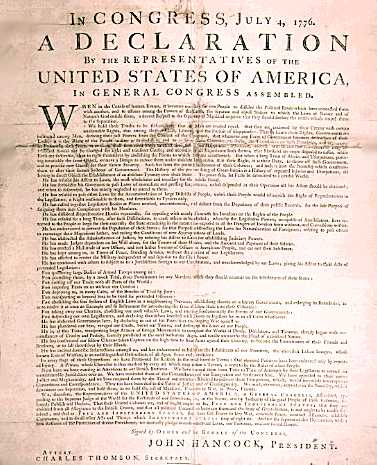
On July 3 and 4 the Congress debated the language of the formal document declaring the reasons for the break, to be sent to England. They agreed on the final draft on July 4th, the date inscribed at the top.
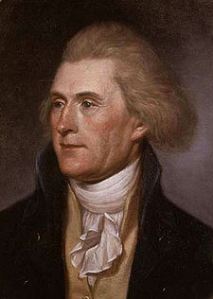
Thomas Jefferson
The task of penning the document had fallen to a young Virginian named Thomas Jefferson. According to Adams…
Mr. Jefferson had been now about a Year a Member of Congress, but had attended his Duty in the House but a very small part of the time and when there had never spoken in public: and during the whole Time I satt with him in Congress, I never heard him utter three Sentences together. The most of a Speech he ever made in my hearing was a gross insult on Religion, in one or two Sentences, for which I gave him immediately the Reprehension, which he richly merited. (Diary and Autobiography of John Adams)
For all Jefferson’s fame, it has not been lost on historians that his Declaration of Independence bears much in common with the beginning of George Mason’s Virginia Declaration of Rights, adopted by that state just one month earlier:
I. That all men are by nature equally free and independent, and have certain inherent rights, of which, when they enter into a state of society, they cannot, by any compact, deprive or divest their posterity; namely, the enjoyment of life and liberty, with the means of acquiring and possessing property, and pursuing and obtaining happiness and safety.
Nor was it lost on Jefferson himself that the birth certificate of the nation was fraught with contradiction. Most notably, that despite acknowledging the unalienable rights of Life, Liberty and the Pursuit of Happiness, and self-evident equality of all men, it made no effort to defend these rights among a large segment of the population currently being denied them. At least not in the final draft. Jefferson writes that prior to approval of the Declaration, the original clause…
…reprobating the enslaving the inhabitants of Africa, was struck out in compliance to South Carolina and Georgia, who had never attempted to restrain the importation of slaves, and who on the contrary still wished to continue it. Our Northern brethren also I believe felt a little tender under these censures; for tho’ their people have very few slaves themselves yet they had been pretty considerable carriers of them to others. (The Social Science Review, 1865)
The nation would have to wait nearly a hundred years to begin enforcing its own credo.
On July 4, 1776, the Continental Congress signed the Declaration and shipped it off to King George III.
Actually, no. Congress President John Hancock sent two copies of the Declaration to King George on July 5, 1776, printed with only his own name and that of Secretary Charles Thomson’s. But the Declaration wasn’t signed by the full Congress until August 2, and those names weren’t made public knowledge until the following year.
Today the Declaration of Independence is remembered as a whiny list of petty greivances scribbled by a band of traitors with absolutely no legitimate legal authority. Or, at least that’s how it might be remembered today had the insurrection been less successful.
As it is, we’ll wish this cancer a Happy 235th.
[In 1989 a man purchased a $4 painting at a flea market because he liked the frame. When he removed the picture, he found an original 1776 Dunlap Broadside Declaration of Independence print. It was appraised as one of the 3 best preserved of the 25 known to exist, and last sold in 2000 for $8 million.
So today, Americans, enjoy your hot dogs, your fireworks, and your independence, and maybe check out that flea market you’ve been eyeing…]
Epitaph: Apparently John Adams did have a soft spot for July 4 after all. Both he and Thomas Jefferson died on July 4, 1826, the country’s 50th birthday.
“After 60 years of peaceful life, Chernobyl, dismantling of the USSR, 14 years of sovereignty, still WWII remains a major emotional rift in the Belarusian soul.”
“We want the peaceful sky not to know the fire of war” — My Dear Motherland, station designator of Belarusian Radio
Belarus as we know it today declared its independence from the Soviet Union on July 27, 1990, and became the Republic of Belarus the following year.
But the country celebrates Independence Day on July 3, in memory of the liberation of its capital city Minsk from Nazi forces in 1944.
We know all about D-Day on June 6th and the liberation of Paris on August 25th that year, but at that same time, the Soviet Union was conducting an equally pivotal advance against German forces.
The Belorussian Strategic Offensive Operation (Operation Bagration, named for a 19th century Georgian general) was “the most calamitous defeat of all the German armed forces in World War II” according to Bagration 1944 author Steven Zaloga. (http://books.google.com/books?id=1DAYmRrJTDAC&dq=operation+bagration&as_brr=3&client=safari&source=gbs_navlinks_s)
Operation Bagration began on June 22, 1944, exactly three years after the Nazi invasion of the Soviet Union. The Soviets successfully used a bevy of ploys to confuse the Germans about their plan of attack, and borrowed a page from the Nazi military playbook…
“A Soviet force of one and quarter million men punched a two-hundred-mile hole in the German front between Ostrov and Kovel…ironically having mastered enveloping tactics once used by the Germans themselves.”
In just over a week, the Red Army crossed the Berezina River. Three days later, on July 3, 1944, they liberated the Belorussian capitol of Minsk.
“…as the Russians crossed Belorussia, they encountered a ‘desert zone’ with a million houses burned, crops deliberately ploughed under, and no evidence of livestock.”
According to Pravda…
Every fourth citizen of Belarus was killed in the war.
“After 60 years of peaceful life, Chernobyl, dismantling of the USSR, 14 years of sovereignty, still WWII remains a major emotional rift in the Belarusian soul.”
Belarus declared its independence from Russia on March 25, 1918 (an independence which lasted about 10 months) and again from the Soviet Union on July 27, 1990. But Belarus celebrates neither of those dates as its official independence day. Instead, the festivities of July 3rd commemorate the liberation of Belarus’s capital city of Minsk from Nazi forces in 1944.
+ + +
We know all about D-Day on June 6th, 1944 and the liberation of Paris that summer, but simultaneously the Soviet Union’s Red Army conducted an equally pivotal advance against German forces.
The Belorussian Strategic Offensive Operation (Operation Bagration, named for a 19th century Georgian general) was “the most calamitous defeat of all the German armed forces in World War II” according to Bagration 1944 author Steven Zaloga.
Operation Bagration began on June 22, 1944, exactly three years after the Nazi invasion of the Soviet Union. The Soviets successfully used a bevy of ploys to confuse the Germans about their plan of attack, and borrowed a page from the Nazi military playbook…
“A Soviet force of one and quarter million men punched a two-hundred-mile hole in the German front between Ostrov and Kovel…ironically having mastered enveloping tactics once used by the Germans themselves.” — Michael Burleigh, The Third Reich
In just over a week, the Red Army crossed the Berezina River. Three days later, on July 3, 1944, they liberated the Belorussian capitol of Minsk.
“…as the Russians crossed Belorussia, they encountered a ‘desert zone’ with a million houses burned, crops deliberately ploughed under, and no evidence of livestock.” (Burleigh)
According to Pravda, “Every fourth citizen of Belarus was killed in the war.”
The division among Belorussians referred to in the opening quote stems from the notion that World War II was merely one occupation replaced by another. Prior to the Nazi invasion in 1941, the Soviet Union under Joseph Stalin conducted mass executions in Belarus—the mass graves from which were uncovered in the 1980s. In 1986 the Chernobyl Disaster and the Soviet Union’s initial denial of the nuclear accident fueled the flame of nationalism and independence once more.
C’mon Jessica, C’mon Tori, let’s go to the mall you won’t be sorry.
Dad says I’m too young to date.
But baby I don’t wanna wait…
That’s okay…
I’m gonna rock your body till Canada Day.
“Let’s Go To the Mall,” Canadian National Anthem
Canada Day isn’t an anniversary of independence but of unity. On July 1, 1867 the colonies of Upper Canada, Lower Canada, New Brunswick, and Nova Scotia united to form “one dominion under the name of Canada”. The day was known as Dominion Day until 1982 when it was officially changed to Canada Day–although the populace had long since taken to calling it Canada Day.
On this, the 142th anniversary of the first Canada Day, we ask: “Where did Canada get its name?”
George St. Pierre, the UFC Welterweight Champion of the World. Yea baby!!!
Place where Americans come to ask stupid questions.
Another theory of the origin of Canada’ is that it is an Wendat (Huron/Iroquois) word meaning ‘village’ or ‘collection of huts’. The Wendat were a confederacy of four tribes who spoke the same language in what is now Ontario and Quebec.
According to the Department of Canadian Heritage, in 1535 explorer Jacques Cartier was mapping the area north of the present-day St. Lawrence River when…
“two Indian Youths told Jacques Cartier about the route to ‘kanata.’ They were referring to the village of Stadacona…but for want of another name, Cartier used “Canada” to refer not only to Stadacona (the site of present day Quebec City), but also to the entire area subject to its chief, Donnacona.”
Cartier named the St. Lawrence River the ‘riviere de Canada’, and by 1547, maps of the area labeled the land north of that river “Canada”.
Though this theory is widely accepted, some dispute its accuracy, suggesting that the Hurons didn’t occupy the area at the time of Cartier’s exploration.
Another theory is that Spanish explorers wrote “aca nada” on their maps, meaning ‘nothing here’.
The arguments are moot in Quebec, where most of the populace doesn’t celebrate Canada Day at all. Rather, in Quebec, July 1 is better known as “Moving Day.” Since 1971, apartment leases there have begun and ended on Canada’s national holiday.
In a word,
Never let go on these three things:
Faith, hope and love.
And know that the greatest of these
Will always be love
I Corinthians 13:13
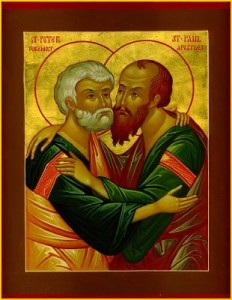
June 29 is the Feast Day of St. Peter and St. Paul. Each gets his own saint day, but in the Venn diagram of the Catholic Church, June 29 marks the intersection of the two.
The two Apostles couldn’t have been more different. St. Peter was Christ’s most devoted follower and leader of the Apostles. A simple fisherman, he was born as Simon. His name Peter comes from Petros for ‘rock’. Jesus referred to Simon as his rock, saying “Upon this Rock I will build my church.”
Paul was born Saul, a wrathful and often vicious persecutor of the early Christians, who never encountered Jesus outside his visions. It wasn’t until his vision on the road to Damascus that he was “blinded by the light”. Following his conversion, Paul became the most prolific converter of non-Christians to the faith the world has ever known.
The scriptures don’t detail the death of either saint. It’s believed St. Peter was crucified upside-down. As a Roman citizen, Paul was very likely beheaded. The saints are remembered jointly today because their remains were temporarily moved on June 29, around the year 258 AD to prevent their desecration during the Valerian persecution.
 Protesters aren’t so concerned with injuries to humans, but with cruelty to animals. 40,000 bulls are killed by the bullfighting industry each year in Europe. These and other facts about bullfighting are ‘exposed’ during PETA’s Running of the Nudes, which coincides with the festival each year.