Gettin’ Glagolitic with Cyril & Methodius

May 11

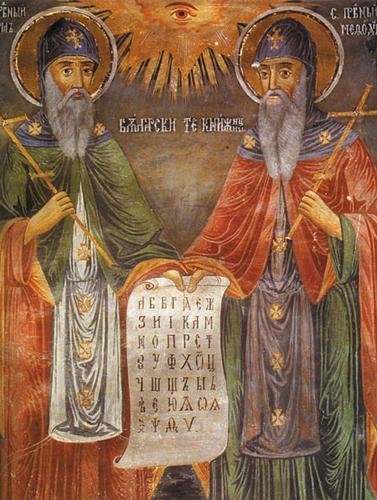
Born in Thessaloniki in the 820’s, Cyril and Methodius are considered ‘Equals with the Apostles’ in the Eastern Orthodox Church, but were overlooked by the Roman Catholic Church for nearly a thousand years.
Sts. Cyril & Methodius

Cyril & Methodius were two missionary brothers with a gift for language. In the 860’s the Prince of Great Morovia (in Eastern Europe) entrusted them with the task of translating Biblical texts into the Slavic tongue of Great Morovia. They had one major obstacle: No such language existed. At least not in any standardized, written form. The Slavic languages were a collection of spoken dialects that stretched from Russia to the Adriatic coast.

The brothers first had to devise a whole new alphabet, named Glagolitsa (a variation of the Greek alphabet) to capture the Slavic language in writing.

The language the brothers developed, known today as Old Bulgarian, fortified the spread of Christianity across Eastern Europe. The brothers died in 869 and 882. But as a posthumous reward for their noble efforts, the East Frankish clergy outlawed the brothers’ language and imprisoned 200 of their students and disciples.

Old Bulgarian posed a political threat to the West. The codification of civil laws in a non-Latin, non-Germanic text limited Frankish-German control over the Slavic rulers. But ironically, the exile and diaspora of the users of Old Bulgarian to other parts of Eastern Europe only served to spread the knowledge and use of the language.

The Glagolitic alphabet was soon replaced with a descendant called Cyrillic (sorry Methodius), developed by a student of theirs, and is still in use over a thousand years later.

It wasn’t until the 1880s that the Saintly brothers got their own feast day in the Roman Catholic Church (July 5), and in 1980 Pope John Paul II deemed Cyril and Methodius two patron saints of Europe.

In the Eastern Orthodox Church, Saints Cyril and Methodius Day is observed on May 11 (Julian calendar) which is May 24 in the Gregorian calendar. It is also known as the Day of Letters.

In the Roman Catholic Church, their feast day is February 14.
 

Stonewall Jackson Day

May 10

“Had Jackson lived to command the right or left wing at Gettysburg, the Confederacy might be approaching its 150th year of independence today.”

– General Wesley Clark, “Stonewall Jackson“, by D. Davis

Two years ago, I was informed by a reader and friend that it is the duty of Every Day’s a Holiday to warn unsuspecting visitors to South Carolina not to bother going to the DMV on May 10. Any such excursions will certainly result in failure. For today state offices, banks, and businesses shut down to honor the memory of Thomas Jonathan Jackson, a man better known by his nickname: “Stonewall”.

Jackson has one-and-a-half holidays devoted to him. South Carolina commemorates the anniversary of his death on May 10, while Virginia combines the birthdays of Jackson (January 21, 1824) and Robert E. Lee (January 19, 1807) to celebrate Lee-Jackson Day.

Jackson lost his father and mother at an early age, and was raised by relatives. The orphan attended the U.S. Military Academy at West Point, and despite starting with an educational handicap, he graduated 17th out of a class of 59. He then served in the Mexican-American War, and taught at the Virginia Military Institute.

Three months after the outbreak of the Civil War in April 1861, Jackson was promoted to Brigider-General.

Stonewall Jackson as a young man, Virginia Military Institute

At the First Battle of Bull Run, when Union forces broke through Confederate lines, Jackson’s troops stood their ground defending the hill, causing Confederate General Barnard Bee to exclaim to his men, “There stands Jackson like a stone wall!” The name stuck. “Stonewall” Jackson and his “Stonewall Brigade” became symbols of Southern bravery.

Of course there may be another reason Jackson stood like a stone wall. As a student at West Point, one of Jackson’s many eccentricities was a belief that, if he bent over, it could damage his internal organs.

Jackson’s odd behaviors and personality traits caused some modern scholars to suggest…

“Stonewall Jackson meets the criteria for Asperger Syndrome, with clear evidence of a qualitative impairment in social interaction and restricted, repetitive, and stereotyped patterns of behavior, interests, and activities. Although individuals with Asperger Syndrome demonstrate major problems in social relationships, many are capable of great creativity because of their ability to focus on a single topic — in this case, on the field of battle and in military affairs.”

Genius Genes: How Asperger Talents Changed the World, by Michael Fitzgerald and Brendan O’Brien

Jackson was one of the greatest military strategists in U.S. history. By October he was promoted to Major General. He led his troops to striking victories in the Shenandoah Valley Campaign. The Stonewall Brigade distinguished itself at Antietam and numerous other battles. It’s been said that had Jackson lived long enough to assist Lee at the Battle of Gettysburg, the South might have won the war’s bloodiest stalemate, and maybe even the war.

But it wasn’t to be. Jackson met his end at the Battle of Chancelorsville in May 1863. Jackson showed little concern regarding bullets whizzing about him, and on May 2, he was wounded by Confederate troops who mistook his convoy for Yanks. His arm was amputated, and he died of misdiagnosed pneumonia eight days later.

“Sadly, in April of 1865, only 210 men from the original Stonewall Brigade were left at Appomattox.  Because of the reputation of the brigade on both sides of the war, the Stonewall Brigade was the first to march through the Federal lines at the surrender.”

— www.stonewallbrigade.com

Thomas "Stonewall" Jackson

Mother’s Day

Second Sunday in May

Mother of Hermes! and still youthful Maia!
May I sing to thee
As thou wast hymned on the shore of Baiae?

When the 22 year-old Keats wrote the beginning of his “Ode to Maia,” he had been an orphan for eight years. He was traveling to the seaside town of Teignmouth for the spring, to take care of his brother Tom, who was dying of tuberculosis—the same illness that took their mother and would later take Keats himself.

The first several lines of Keats’ ode were recorded in a letter to a friend: “I wrote them on May-day and intend to finish the ode all in good time.

The ‘good time’ never came. Keats died three years later. The poem was never written.

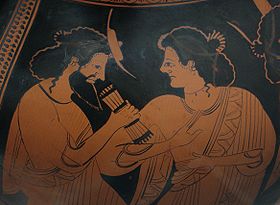
In Keats’ day it was well-known that May was named for the Greek and Roman goddess of spring, the eldest sister of the seven Pleiades and the mother to Hermes/Mercury by father Zeus/Jupiter. She was also trusted by the philandering Zeus to be his son Arcas’s wet-nurse when his jealous wife Hera turned Arcas’s biological mother into a bear.

Hermes & Maia

Some say our own tradition for dedicating a day to mothers comes out of Maia’s Roman feast. Her day was on the 15th, the Ides (full moon) of the month. Her name not only meant mother, but also “increasing”, referring to the abundance of flora and fauna in spring. (Likewise, the Angles and Saxons called the month “Tri-milchi”, because they could start milking their cows three times a day due to the plentiful grass.)

In other parts of the world, particularly the Middle East, Mother’s Day is celebrated closer to the vernal equinox, while in the U.K., “Mothering Sunday” is celebrated on the Sunday three weeks before Easter, usually in March. Beginning in the 1600s, employers would traditionally give servants the fourth Sunday of Lent off allowing them to attend services at their “mother church”. Mothering Sunday became synonymous for family reunions.

Mother’s Day in America

Mother’s Day in the United States is largely the work of two women.  Julia Ward Howe and Anna Jarvis.

Julia Ward Howe

Julia Ward Howe was the abolitionist famous for turning the lackluster lyrics of “John Brown’s Body” into the “Battle Hymn of the Republic.” After the Civil War Howe changed her tune–or lyrics actually–to focus on on the women’s suffrage movement and the creation of a “Mothers’ Day for Peace” (note the apostrophe). During the Franco-Prussian War she spoke in London and Paris, and brought the idea of a Mothers’ Day for Peace back home to Boston. The holiday, which she envisioned would be celebrated in June, didn’t get much further than New England, but her Mothers’ Day Proclamation of 1870 stirred women across the country:

“Arise then…women of this day! Arise, all women who have hearts! Whether your baptism be of water or of tears! Say firmly: “We will not have questions answered by irrelevant agencies, our husbands will not come to us, reeking with carnage, for caresses and applause. Our sons shall not be taken from us to unlearn all that we have been able to teach them of charity, mercy and patience. We, the women of one country, will be too tender of those of another country to allow our sons to be trained to injure theirs.”

“…Blood does not wipe our dishonor, nor violence indicate possession.
As men have often forsaken the plough and the anvil at the summons of war, let women now leave all that may be left of home for a great and earnest day of counsel. Let them meet first, as women, to bewail and commemorate the dead. Let them solemnly take counsel with each other as to the means whereby the great human family can live in peace…”

Her vision of Mothers’ Day was one of maternal cohesion, women coming together to work for social justice.

But Mother’s Day as we know it—a day on which children celebrate and honor their own mothers—bears more in common with the vision of a West Virginian by the name of Anna Jarvis…

continued: Anna Jarvis — Mother’s Day in America

Mother’s Day in America – Anna Jarvis

continued from Mother’s Day

Ann Jarvis (left) & daughter Anna
Ann Jarvis (left) and daughter Anna

Before Julia Ward Howe began her Mothers’ Day for Peace campaign, another mother, Mrs. Ann Jarvis, had established a network of “Mothers’ Day Friendship Clubs” to improve sanitation conditions throughout West Virginia. She taught other mothers how to disinfect wounds, sterilize bottles, and prevent food from spoiling.

When the Civil War broke out, Jarvis and her clubs refused to take sides. Instead they tended to the wounded of both sides. After the war, having seen the carnage inflicted by and upon Union and Confederate troops, she pushed for the observance of a “Mothers’ Day”. Like Howe, Ann Jarvis’s Mothers’ Day stressed peace and social activism.

It was her daughter however–Anna Jarvis–who created Mother’s Day as we know it.

In 1907 Anna arranged a memorial service for her mother, the previously mentioned Ann Jarvis, who had passed away on May 9, 1905. Determined to help others appreciate their mothers when they were alive, Anna Jarvis held the first official Mother’s Day the following year, on the second Sunday of May, 1908.

Over 100 years ago this weekend, 407 children and their mothers participated at the first Mother’s Day service at the Andrews Methodist Episcopal Church in Grafton, West Virginia.

Andrew Methodist Episcopal Church, Grafton, WV

Anna had a very specific idea of Mother’s Day. It was to be celebrated on Sunday rather than a specific date because it was a ‘holy day’, not a ‘holiday’. (Also, her mother taught Sunday school for 25 years.)

She even specified where the apostrophe was to fall: it was Mother’s Day, not Mothers’ Day. It would be a personal celebration in honor of one’s own mother, rather than for all mothers in general.

This version of Mother’s Day spread quickly–spurred on by the letters of Anna and her friends promoting the holiday. In 1910 West Viriginia became the first state to declare the holiday. Just four years later the resolution passed in both houses of Congress, and Woodrow Wilson proclaimed the second Sunday in May “a public expression of our love and reverence for the mothers of our country.”

But by the 1920s the new holiday met with opposition from an unexpected source:

Anna Jarvis herself.

Anna had no idea the commercial epidemic she would unleash upon the American public. Appalled by the materialistic takeover of what was to her a very personal day, she spent much of the rest of her life denouncing the exploitation of the day she had helped to create. She wrote:

A printed card means nothing, except that you are too lazy to write to the woman who has done more for you than anyone in the world.

Perhaps the irony is that the younger Jarvis succeeded where the elder Jarvis and Julia Ward Howe had not precisely because her incarnation of Mother’s Day was commercially exploitable. Americans could purchase gifts for their own mothers, as opposed to the concepts of Howe and the elder Jarvis, who envisioned a day of unity for social change.

Today Mother’s Day is a $15 billion dollar industry. More flowers are sold for Mother’s Day than even Valentine’s Day. More cards are sent than for any other holiday but Christmas. And more people will eat out this evening than any other day of the year.

Whereas previous activists like Howe and Jarvis Sr. looked at Mothers’ Day from the point of view of a parent—as a day for mothers to unite against war and injustice to make the world safer for their children—the younger Jarvis never saw it that way. To Anna this day would always be a gift to her mother.

Anna Jarvis, the mother of Mother’s Day, had no children.

[Speaking of commercialism, you probably couldn’t spot Maia and her sisters in the sky, but the Pleiades constellation looks like this:

You might recognize it better as this:

subaru

Subaru is the Japanese name for the constellation. The auto manufacturer’s logo shows the six stars normally visible to the naked eye.]

Day of Hıdırellez

May 6

Hidrellez

The Day of Hıdırellez (Ruz-ı Hızır) tip-toes across national borders, stretches its limbs across feuding religions, and dances from one culture to another borrowing steps from each it passes.

The ancient spring festival is celebrated from Turkey to the Balkans. The word Hıdırellez itself is a mixed-up amalgamation of the names of the two well-traveled yet elusive prophets it recalls: Hızır and Ilyas (Elijah).

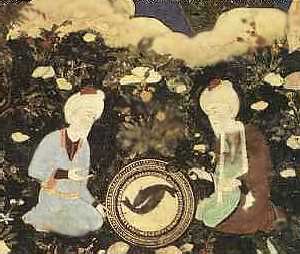
Hızır (Al-Khidr) means, literally, “the green one.” No, he’s not green, but he represents the spring and summertime. Or more accurately, the season lasting from May 6 to November 8 known as Hızır günleri, or “days of Hızır.” Hızır watches over and protect his followers, and is responsible for the growth of crops. Pictured with a long white beard and large white turban…

Hızır walks the earth with more men than any other Moslem immortal…Hızır is the last-minute rescuer from disaster, a deus ex machina, when all other assistance, natural and supernatural, has failed.

Walker & Uysal, An Ancient God in Modern Turkey

Hizir kicks it with Alexander the Great

The other season of the Turkish folk calendar lasts from November 8 to May 6. It’s called Kasım günleri, roughly “Days of November”. On May 6 Hızır reaches out his hand to grasp that of his colleague Ilyas, aka Elijah, a prophet from the Qur’an, the New Testament, and the Old Testament.

If you make a wish on Hıdırellez night…

“…it will come true if one just remains alert enough to glimpse the embrace of the star-Lords Hizir and Ilyas in the sky.

— G.W.Trompf

Before Islam, Christianity, and maybe even the Greeks, Hızır was an ancient pagan spring deity, symbolizing water and growth. He gained immortality by drinking of the Spring of Life.

In the Qur’an, Hızır guides the prophet Moses on his journey. He tells Moses he can come along, as long as Moses promises not to talk. After the duo make a safe passage on a friendly ship, Hizir damages the ship, making it unseaworthy. Moses breaks his promise and chastises Hizir for doing such a thing. Later, Hizir and Moses are denied shelter in a town. Leaving, Hizir pauses to mend a crack in the city wall. Again Moses breaks his promise, this time to chide Hizir for rewarding an enemy. Hizir explains his actions. Soon, he explains, there will be a war, and the king will conscript all seaworthy ships, which is why he temporarily damaged the good captain’s ship. As for the wall, he explains a good man hid his money in the wall before he died. Hizir mended the wall keep the treasure protected for the man’s orphan children.

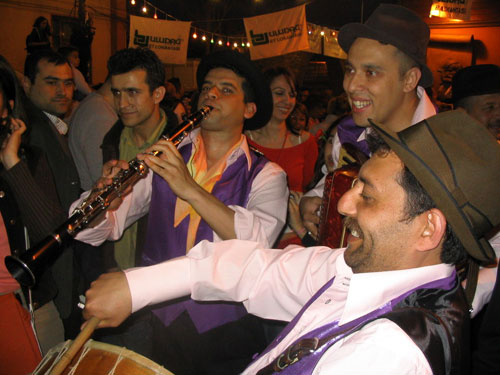
Hızır is the patron saint of travelers, which is why the Roma (Gypsies) revere him. It is they who helped to spread this spring festival from Anatolia to the Balkans (or vice-versa) and beyond. Today Hıdırellez is celebrated with plenty of live music, dancing, picnics and outdoor entertainment into the night.

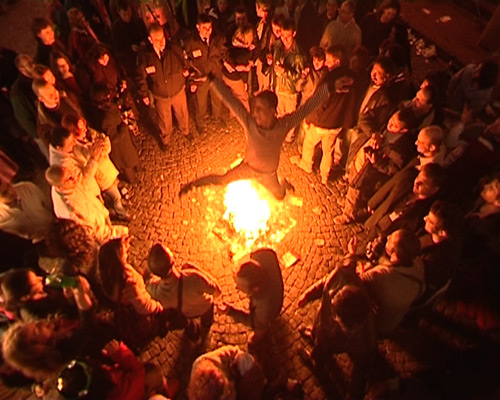
“Jumping over a bonfire, something that is also seen during Nevruz celebrations, is significant in that fire is seen as a cleansing force, and so leaping over flames on Hıdırellez is also believed to be one way to wash away bad spirits and enter into the new season with a cleansed being.

— Julia Konmaz

Other traditions include the making of yogurt. And the “play of the wish.”

Everybody throws a sign into the pot holding water…sweet basil, mint, ‘mantuvar’ flower in addition to usually ring, earring, etc. The pot is covered with a cloth on the eve of Hıdırellez and placed under a rosewood.

The next day, girls stand by as one-by-one their items are drawn from the pot. Whichever song is sung when each girl’s item is removed, dictates what the year has in store for her. Song themes range anywhere from ‘love’ to ‘living abroad.’

So this Hıdırellez make a wish! And watch the skies…

Hızır Arrives with Drops from Heaven

Ahirkapi Hidirellez Festival

Greenery Day – Japan

May 4

A small cloud has fallen
The white mist hits the ground
My lungs comfort me with joy.

Green Day, by Green Day

Ok, the above’s not a Japanese haiku, nor is about today’s holiday. (It bears more in common with one that takes place on 4/20) But today is “Midori no Hi”—literally Green Day, or Greenery Day. Midori means Green—hence the green, melon-based liqueur—and Hi means Day.

Greenery Day (Midori no Hi) originated from the celebration of the birthday of the late Emperor Hirohito, who reigned for most of the 20th century. In Japan, he’s known as the “Showa” Emperor. Showa means harmony, or enlightened peace, or the “search for balance between two different, often opposing elements”. (It is also a Japanese glove company.)

In Japan, the reigning Emperor’s birthday is a national holiday; after the Showa Emperor died in 1989, the Japanese people wanted to continue celebrating his birthday (April 29). They chose the name Greenery Day after the late Emperor’s love of nature. Between 1989 and 2006, Greenery Day was celebrated on April 29.

Beginning in 2007, the Japanese government renamed April 29 “Showa no Hi” (Showa Day) to formally honor the late Emperor, and moved Greenery Day to May 4.

Why May 4?

May 4 was already a holiday (and no we’re not talking about Star Wars Day). May 4 falls between two major holidays, Constitution Day and Children’s Day. And in Japan, any day that falls between two holidays is a holiday itself. [My kind of country. –Ed.] Besides, Greenery Day sounds better than Generic National Holiday.

Falling in the middle of Spring, Greenery Day is a time to commune with nature and enjoy the outdoors.

Showa Day, Constitution Day, Greenery Day, and Children’s Day make up what’s known as Golden Week in Japan. (Technically, Showa Day is an independent holiday, not part of Golden Week, but we’re not technical here.) Golden Week is one of, if not the biggest week for travel in the Japanese calendar. It makes American Thanksgiving look like a Wednesday in February. So if you’re traveling in Japan this week, hopefully you made all your arrangements in the Bronze Age.

Midori no Hi — Transparent Language Japanese blog

Showa Day holiday — hoofin.wordpress.com

Constitution Day – Japan & Poland

May 3

May 3 is Constitution Day in two countries on opposite sides of the globe.

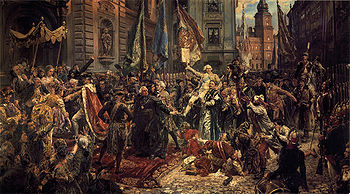
May 3 Constitution, by Jan Matejko, 1891

Poland’s most recent constitution dates only to 1997, but it stems from the Constitution of May 3, 1791, one of the oldest codified constitutions in the world. Only the Constitution of the United States is older. [The Constitution of San Marino dates to 1600, but apparently is not codified enough to compete with the big boys. — Ed.]

The 1997 Constitution was a response to Poland’s changing position in the world, from a one-party socialist state under the control of its powerful neighbor, the Soviet Union, to a multi-party independent state.

The Japanese Constitution was put into effect on May 3, 1947. Its creation dealt with Japan’s changing role in the world after World War II. The Constitution altered not only the government—a government in which the Emperor would have less say in matters of state—but also the Japanese way of life. The Constitution protects standard basic freedoms, such as freedom of speech, freedom of the press, and freedom of religion, but goes one step further. Article 19, for example, proclaims:

“Freedom of thought and conscience shall not be violated.”

One of the most long-reaching impacts of the Constitution is Article 9, which deals with the renunciation of warfare:

“Aspiring sincerely to an international peace based on justice and order, the Japanese people forever renounce war as a sovereign right of the nation and the threat or use of force as means of settling international disputes. In order to accomplish the aim of the preceding paragraph, land, sea, and air forces, as well as other war potential, will never be maintained. The right of belligerency of the state will not be recognized.”

So you’re probably thinking, No military? I could go over there with a dinghy and a BB gun and take over the country!

You would be met with a surprisingly powerful defense force. Japan still maintains its ability to defend its homeland, and…

“By 1990 estimates of Japan’s defense budget were that it was either the third or fourth largest in the world and Japan’s SDF was a high technology fighting force.”

The Rule of Law in Japan — Carl F. Goodman

Japan’s Constitution Day falls right in the middle of “Golden Week”, a congruence of four holidays, beginning with Showa Day (April 29) and ending with Children’s Day (May 5).

Japan’s Commission on the Constitution — the Final Report, 1980

Mayday Mayday

May 1

I was taught in elementary school that we didn’t celebrate May Day anymore because it was a Communist holiday.

Not only was this a lame excuse not to celebrate a holiday, it also wasn’t true.

In ancient and medieval Europe, seasons were determined not by equinoxes and solstices, but by the days that fell directly in between, known as “cross-quarter days.” The first cross-quarter day of the year is Groundhog Day or Candlemas, between winter solstice and spring equinox. The second is today, May Day, which once marked the beginning of summer.

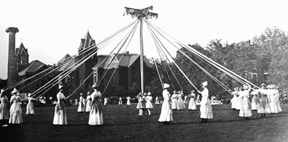
May Day traditions such as creating floral wreaths date back to the Romans and Celts (Beltane), and survived well into the 20th century, including dancing around the Maypole and crowning a ‘May Queen.’

Mizzou, Missouri, 1911

In the 19th century May Day became a standard date for workers to re-negotiate contracts with employers. One reason may be because it was one of the few days off workers had that wasn’t a Sunday (church day) or a religious holiday. Thus, as communities got together to celebrate, the workers–usually the fathers of the family–could also unite for better wages or working conditions.

Over time May Day was adopted by (or hijacked by, depending on your politics) communist, socialist and labor groups. May Day fell out of favor in the U.S. where the first of May is celebrated with other, more patriotic holidays, including:

  • Law Day
  • Loyalty Day
  • National Day of Prayer (1st Thursday in May)

and the more casual

  • Lei Day.

Lei Day is, believe it or not, the oldest of those four holidays. It’s the Hawaiian version of May Day, dating to the 1920s. Loyalty Day, Law Day, and National Day of Prayer were officiated in the 1950s under Presidents Truman and Eisenhower.

In the United States, Labor Day is celebrated on the first Monday in September.

Even though May Day was seen as a communist import in America, it was in Chicago, Illinois, that May Day gained notoriety as a day for workers and eventually became the international holiday known as Labour Day.

Oh, and the distress call ‘Mayday! Mayday!‘ has nothing to do with the holiday. It’s from the French venez m’aider, meaning ‘come help me.’