Native American Day

 Fourth Friday in September
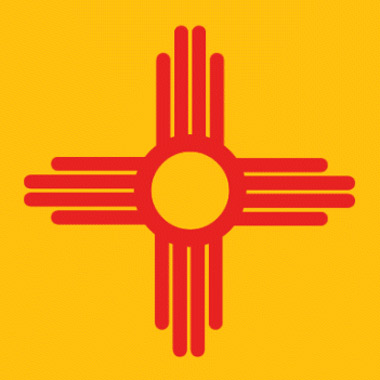
The flag of New Mexico honors the Four Directions
The flag of New Mexico honors the 'Four Directions'

The fourth Friday in September is known as Native American Day in California and across much of the United States. California recognizes over 100 tribes, more than any other state in the nation.

The original resolution establishing “American Indian Day” was signed by Governor Ronald Reagan in 1968.

30 years later, the California legislature declared:

An emphasis on freedom, justice, patriotism, and representative government have always been elements of Native American culture, and Native Americans have shown their willingness to fight and die for this nation in foreign lands.

Native Americans honor the American flag at every pow wow and at many gatherings, and remember veterans through song, music, and dance.

Native Americans use songs to honor the men and women of this country who have fought for freedom.

Native Americans love the land that has nurtured their parents, grandparents, and unnamed elders since time began, and they honor the Earth that has brought life to the people since time immemorial.

Native Americans have given much to this country, and in recognition of this fact, it is fitting that this state returns the honor by recognizing Native Americans for all of their offerings to this beloved land through the establishment of a state holiday referred to as “Native American Day.”

No mention of genocide, but that’s not what today’s about. Californians of all backgrounds and cultures meet in San Bernardino to celebrate the diversity and heritage of the land’s first residents.

+++++

John Harrington, Chickasaw astronaut

Elsewhere in the U.S., John Harrington, who turned 40 on September 14, is in the middle of a 4,000 mile bike-ride from Cape Flattery, Washington, to Cape Canaveral, Florida. (So what’s your excuse for not working out?)

As a member of the Chickasaw tribe, he carried a Chickasaw flag into space with him, aboard STS-113 in 2002.

His purpose for the bike-ride is to “encourage student participation in Science, Technology, Engineering and Mathematics.”

Good luck, John!

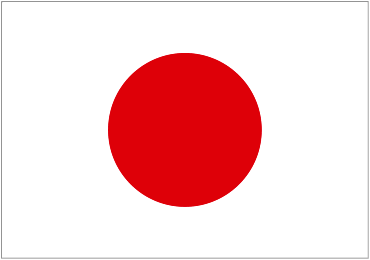
Shuubun no hi

…when the night and day are equally divided, Buddha appears on earth for a week to save stray souls and lead them to Nirvana.”

http://mothra.rerf.or.jp/ENG/Hiroshima/Festivals/35.html

…Thus, in Japan, the spring equinox (shunbun no hi) and the fall equinox (shuubun no hi) are known as O-higan. Days on which families visit and honor the graves of the departed. Ancestors are said to watch over the family like tutelary, guardian deities. That’s why the Japanese give thanks to their ancestors whenever they encounter success or prosperity. (But of course if you fail, it’s your own damn fault.)

Favorite foods are prepared for the departed, such as Ohagi (soft rice balls covered in sweetened bean jam), sushi, and vinegar rice & veggies. On the last day of the week, rice flour dumplings, special fruits and sweets are offered.

In Buddhism, O-higan is a time to focus on the 6 Perfections, or Pāramitā:

1. Dana – generosity

2. Sila – virtue

3. Ksanti – patience

4. Virya – effort

5. Dhyana – meditation (also ‘zen’)

6. Prajna – wisdom

The O-higan days have been celebrated in Japan since the 8th century. The name Higan literally means, “the other shore” and is short for Tohigan—to arrive at the other shore. Buddhists believe that the Pāramitā form the bridge that enable humans to cross over to the other shore, to Nirvana.

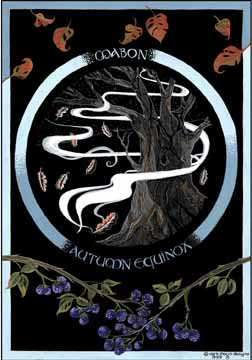
Mabon

Vernal Equinox – on or around September 21 (Northern Hemisphere)
“Blessed be, by the Lady and the Lord, on this Mea’n Fo’mhair. It is the time of the second harvest, one of fruit and wine abundance. Tonight holds equilibrium of all things. Everything is in balance with one another. God and Goddess, Life and Death, Light and Dark.”
Immortal Boundaries, Aubrey Jones

References to the Welsh god Mabon ap Mydron (Mabon, Son of Modron, or ‘Great Son of the Great Mother’) date back well over a thousand years. Today the name Mabon conjures up images of ancient Celtic rituals, of the fruits of the harvest, of flickering flames beneath an autumn moon.  So you may be surprised to learn that ‘Mabon’—in reference to the autumnal equinox—dates not to the Dark Ages, but to the Disco Age (a dark age in its own right), the 1970s.

The holiday Mabon was coined by a grad student, Aidan Kelly, as part of a religious studies project. Kelly was following the Celtic and pagan tradition of naming holy days after gods and goddesses. Lughnasadh honors the Irish sun god Lugh. Beltane is believed to originate from Ba’al. The spring equinox is named for the German goddess Ostara, from which our word Easter also derives.

There was a holiday known as “Mabon’s Day” in Wales in the 19th century. But that holiday was named for William “Mabon” Abraham, a labor leader responsible for improving miners’ working conditions in Wales, (Mabon is a colloquialism for “young leader” in Welsh) and took place on the first Monday of each month.

Since the 1970s, the autumnal holiday Mabon has gained wide acceptance as a Wiccan and neo-pagan celebration in North America. The Celts, however, didn’t observe the autumnal equinox as much as the cross-quarter days of Lughnasadh (early August) and Samhain (Halloween), the latter of which was Celtic New Year.

The “Second Harvest” is known by many names: Cornucopia, Wine Harvest, Harvest Home, and the Feast of Avalon.

Avalon, one of the many Celtic names for the Land of the Dead, literally means the “land of applesCelebrating new-made wine, harvesting apples and vine products, and visiting burial cairns to place an apple upon them were all ways in which the Celts honored this Sabbat.

Edain McCoy, Celtic Myth & Magick

It’s a joyous celebration, but whereas the spring festivals celebrate birth and fertility, at the time of the harvest, Mabon participants remember their ancestors.

A similar tradition exists in Japanese culture. On the equinox, the Japanese visit the graves of their ancestors. It is known as O-higan, or “the Other Shore.” Buddha is said to walk the earth when night and day are equally divided.

Mabon is also known by variants of Fomhair. In Gaelic, the months of September and October are the only two to share a name: Mi Mean Fomhair and Mi Deireadh Fomhair: mid-harvest month and end-harvest month.

Feasts of the Cross

September 14

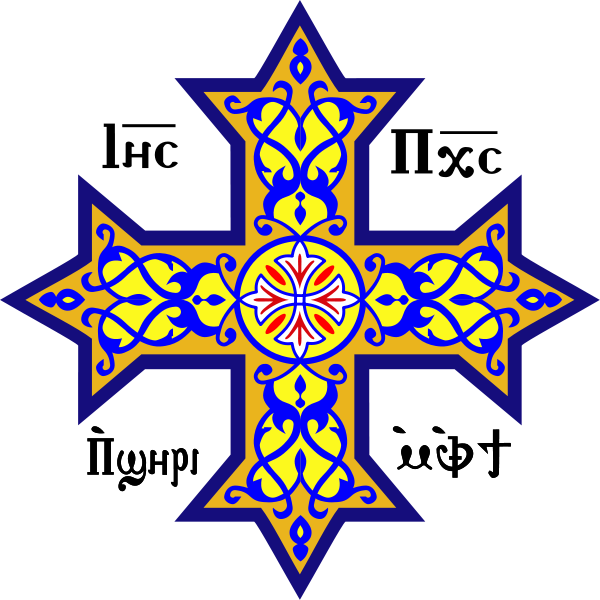
September 14 is the Triumph of the Cross, in the Roman Catholic Church, or the Exaltation of the Cross in the Eastern Orthodox Church.

It commemorates the rediscovery of the cross on which Christ was executed. The True Cross was discovered by Helena, mother of Constantine, the first Christian Emperor of Rome, during her pilgrimage to Jerusalem in 326 AD.

Constantine later ordered a church to be built at the spot where the True Cross was found. The Church of the Holy Sepulchre was dedicated on September 13, 335. The following day, September 14, a portion of the Cross was placed outside the church for followers to worship.

The Cross was taken by the Persians in 614 AD. Fourteen years later it was reclaimed by Byzantine Emperor Heraclius. Today’s feast day also celebrates that recapture of the Cross in 628.

Other names for the Feast:

  • Universal Exaltation of the Precious and Life-Creating Cross (Eastern Orthodox)
  • Raising Aloft of the Precious Cross (Greek)
  • Holy Cross Day (Anglican)
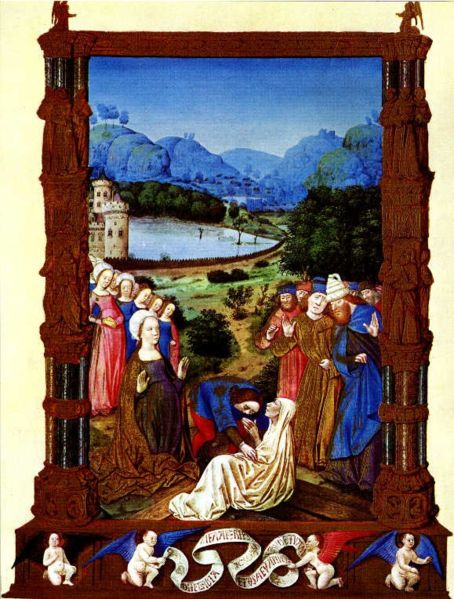
Proving of the True Cross, Jean de Colombe, 1410

“Hail, O Cross! Brighter than all the stars! To the eyes of men thou art exceedingly lovely!” (Magnificat Antiphon I)

“The pieces of this true cross, which are worshipped in different parts of Catholic countries, would, (says a competent judge,) if collected in one place, amount to more splinters than might be taken from the mainmast of a man-of-war.” (Ingram Cobbin, 1842)

Ludi Romani – Roman Games

September 13

toga

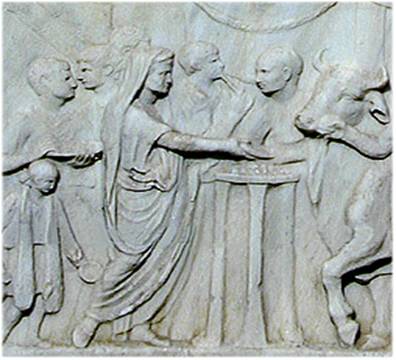
The Romans knew how to party. So much so that their toga ensemble has become the symbol of a decadent good time, especially in the “Greek” system in colleges across North America. Of course the Greeks didn’t wear togas—the Romans got it from the Etruscans—but we’ll let that slide.

Thanks to writers like Ovid and Cicero, we know that every month of the Roman calendar was flooded with festivals and sacred days for the pantheon of gods and goddesses. With one exception:

September.

There were only two notable holidays in the seventh month. (September didn’t become the 9th month until the second century BC.)

On September 13th, Romans observed the Ides, the day honoring the Roman king of the gods, Jupiter.

But the Romans honored Jupiter every month on the Ides. The 15th of March, May, July, October, and December; the 13th of all other months.

The other September event was known as Ludi Romani, or the “Roman Games“.

Ludi Romani was one of the most anticipated and biggest events of the year, and in its heyday stretched for over two full weeks, from September 4 to September 19.

According to tradition, the first games were instituted by King Tarquinius Pricscus (Tarquin the Elder) in the 6th century BC, after a Roman military conquest. He created the Circus Maximus to hold such an event.

recreation of Circus Maximus
How the Circus Maximus would have looked

The Circus Maximus was constructed between two of Rome’s seven hills, Aventine Hill and Palatine Hill. At over 2,000 feet long, the Circus could seat upwards of 150,000 spectators, and more could view the Games from the surrounding hillsides.

The main event of the Games was chariot racing, or ludi circenses. These races could be far bloodier than any Ben Hur movie. Other attractions included boxing, battles with wild animals, and gladiator bouts, though these were all later moved to other venues designed for such events. (The lack of a barrier between the stands and the track didn’t protect spectators too well from wild animals.)

Originally the Games were only one day, then two: September 12th and 14th.

The Games were celebrated intermittently until 366 BC when they became “the first set of Ludi to receive annual sponsorship by the Roman state…” (The Roman Games: a Sourcebook, by Alison Futrell)

Three years later, ludi scaenici, or theater plays inspired by the Greek, premiered at the Games.

By the time of Julius Caesar the Games lasted two full weeks. After his assassination, Rome honored him…by adding another day.

Enkutatash – Ethiopian New Year

September 11 (September 12 prior to leap years)

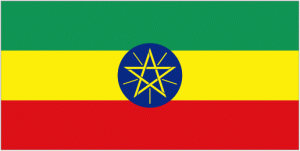
flag_ethiopia

Happy New Year!

September 11th (or 12th) is New Year’s Day in Ethiopia, following the Coptic calendar and observed in the Rastafarian tradition. It marks the end of the rainy season in Ethiopia.

2000 years ago, the Ethiopian calendar fell on the equivalent of August 8 or 9. However, because of disparities between different calendars, the day now falls in September.

“The name Enkutatash was given when the famous Queen of Sheba returned from her expensive jaunt to visit King Salomon in Jerusalem. Her chiefs welcomed her back by replenishing her treasury with “Fuku,” or jewels.”

— Ethiopia, by Pascal Belda

2009’s celebration marks the year 2002 AM in the Ethiopian Calendar. The festival is also the saint day of John the Baptist.

Enkutatash is celebrated with bonfires on New Year’s Eve, dancing, singing and prayers. On September 11, 2001, Ethiopians in the homeland and around the world were celebrating Enkutatash when planes flew into the World Trade Center.

“People who passed by and did not know what we were here for thought we were celebrating the attack, but we would never do anything like that,” said Ras Delbert Christie of the Montego Bay Ethiopian World Federation. (“Rastafarians Celebrate Ethiopian New Year in Jamaica”, World Wide Religious News, 2002)

Two weeks after Enkutatash, Ethiopians celebrate the finding of the true cross, or Meskel.

Nativity of the Virgin Mary

September 8

Happy Birthday Madonna!

No, not that one.

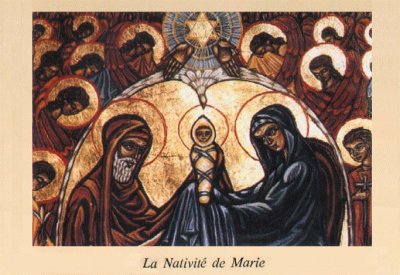
On September 8, the Catholic world celebrates the birth of the Virgin Mary.

Nativity of Mary

Little is know of Mary’s birth from the Bible. The Gospel of James (which didn’t make the final cut) list her folks as Joachim and Anne (Hannah). The couple was childless until they were visited by an angel who informed them a child was forthcoming. Anne promised the child would be brought up to serve the Lord.

Mary would have been born “Mariam” or מרים

For two-thousand years, the Virgin Mary has been the symbol of feminine spirituality in Christian culture. While Eve was unfairly vilified as the bringer of original sin throughout the Middle Ages, Mary represented the opposite, the ultimate purity and the the bringer of God.

Pope John Paul ll in his 2000 millennium message elevates the status of both Eve and Mary. He describes Eve as the original symbol of Humanity, the mother who gave birth to Cain and Abel, and Mary, who gave birth to Jesus, as a symbol of the New Humanity; one in which All Humanity is One in Spirit with God. This statement changes the context which the Christian doctrine has relegated to women; that the Spirit of God resides equally in male and female.

Contemplation of Mary – St. Mary’s at Penn

Visions of the Virgin Mary have been spotted by worshippers throughout the Christian world. One of the most famous of these was witnessed initially by three children in Fatima, Portugal in 1917.

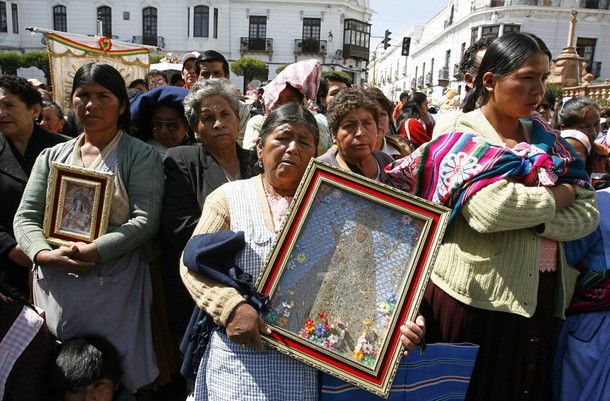
On the Nativity of the Virgin Mary, many Mediterranean and Latin-American villages carry her statue from local churches through the streets. Local Spanish processions are known as Virgin de la Pena, Virgin de la Fuesanta, and Virgin de la Cinta. Peru has the Virgin of Cocharcas, and in Bolivia it’s the Virgin of Guadalupe.

Virgin of Guadalupe procession in Bolivia (c) Reuters
Virgin of Guadalupe procession in Bolivia © Reuters

And it may not be Madonna (Madonna Louise “Like A Virgin” Ciccone)’s birthday, but singer-songwriter Aimee Mann turns 51 today…and rumor has it she’s still a Virginian.

Easter comes and goes
Maybe Jesus knows…

Aimee Mann, “Thirty One Today”

Feast of the Nativity of the Blessed Virgin Mary

Eid al Fitr

End of Ramadan (Gregorian date changes each year)

Empire State Building lit green for Eid al Fitr

This week Muslims around the world follow up the moderation and solemnity of Ramadan with the joy and festivity of Eid-al-Fitr. Fitr means breaking of the fast, [actually “natural condition”; see comment below!] referring to the month-long fast during Ramadan. Eid means “festival”, of which Islam has only two: today’s Eid-al-Fitr and Eid-al-Adha (Festival of the Sacrifice).

The days before Eid-al-Fitr are some of the biggest shopping days of the year in Muslim communities. Families stock up on special foods in preparation for celebrating the Fitr meal(s), buy or make presents and new clothes for the holiday events, and make sure to purchase extra food (Zakat) that will be distributed among the poor, ensuring that all families have enough to celebrate with during the three-days of festivities.

Muslims recite a special Eid prayer during Eid-al-Fitr. According to Islamicity.com

Eid prayer is wajib (strongly recommended, just short of obligatory). It consists of two Rakaat (units) with six or thirteen additional Takbirs. It must be offered in congregation. The prayer is followed by the Khutbah.

At the conclusion of the prayer the Muslims should convey greetings to each other, give reasonable gifts to the youngsters and visit each other at their homes.

With its emphasis on family, celebration, and gratitude toward God, Eid-al-Fitr might be compared to both Christmas and Thanksgiving in the West. Unlike Christmas, the season changes slightly year by year. Because the Gregorian calendar is 11 days longer than the Islamic calendar, by 2023 Eid-al-Fitr will fall during spring. Around 2030 it will fall during winter.

This year Eid-al-Fitr coincides with the Jewish holiday Rosh Hashanah, the beginning of ten days of repentance.

http://www.youtube.com/watch?v=oArYE4PaXX8

Eid-al-Fitr – from Ignite the Light Within