When I tell people what I do—write about holidays every day—they inevitably ask, “So, like real holidays? Or, like Talk Like a Pirate Day?”
The implication being that the latter is a “made up” holiday.
Which it is.
First of all, all holidays are “made up”. It’s just the ones we take for granted were made up before you were born.
Second, if the age be the sole determiner of legitimacy, Talk Like a Pirate Day is older than other, several nations’ independence days, including Serbia, Kosovo, Montenegro, and East Timor.
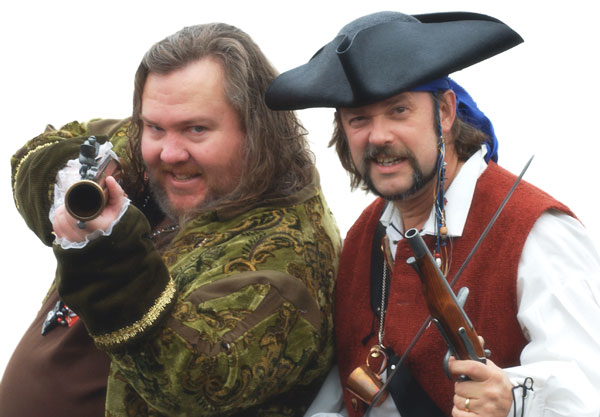
So the legend goes…In the mid-1990s, one of the two salty sea-dogs pictured above had a bizarre sports injury that briefly caused him to talk like a pirate. Every year thereafter (except for when they forgot to) they spoke ‘pirate’ for a day–though not on the anniversary of the injury, which was on June 6 (D-Day).
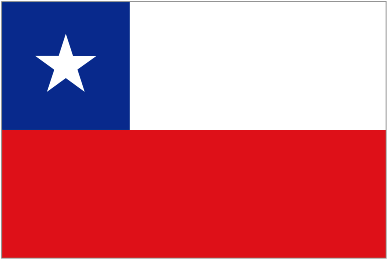
They chose September 19, because it was Cap’n Slappy’s wench’s birthday at the time. Also no doubt because—as I too have discovered—September 19 holiday pickings are slimmer than Panama at high-tide. No offense to St. Kitts and Nevis, which celebrates Independence Day today. But as we’ve covered the Independence Days of 7 other American nations this week (Mexico, Chile, Guatemala, El Salvador, Honduras, Costa Rica and Nicaragua) I’ve opted to let my hair down, hoist the jib, walk the plank, and do whatever it is that pirates do these days when they’re not illegally downloading software.
But, ahoy, if ye yellow-bellied sapsuckers harbor a tight lip, for fear of soundin’ land-locked, this video surely’ll be fixin’ ta loosen yer tongue.
Bernardo O’Higgins is known as the liberator and national hero of Chile, but he had humble beginnings.
He was the illegitimate son of an Irish engineer and a young Chilean socialite. His father Ambrosio, had been a servant boy in Ireland. Ambrosio emigrated to Spain as a young man, then to Spain’s colonies in the Americas. He settled in Peru, studied to be an engineer, and eventually worked his way up to becoming the Spanish Viceroy of Peru, the highest office in Spain’s greatest colony.
It’s believed that Bernardo never met his father; he was raised by his mother’s family. But through correspondence Ambrosio made it possible for Bernardo to be schooled in England. Bernardo lived briefly to Spain where he met the future Argentinean liberator Jose de San Martin. When he returned to Chile, Bernardo took his father’s name, O’Higgins, and was determined to fight for an independent Chile.
As with other South and Central American colonies, Chile’s initial declaration of independence can be seen as a bizarre act of loyalty to Spanish royal family. Chile refused to recognize Napoleon’s appointment of his brother to the throne of Spain, after the French emperor had deposed the royal family in Madrid. At a public meeting on September 18, 1810, Chileans demanded that the Spanish government in Chile be replaced with a junta of Chilean citizens.
By the time Spain regained control of its homeland and expelled Napoleon’s forces from Iberia, the South American colonies had already tasted independence, and it tasted good.
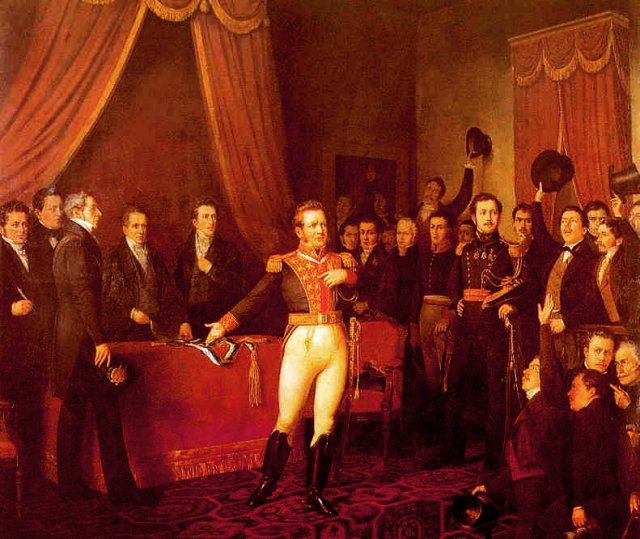
Resignation of Bernando O'Higgins
Bernardo served as a soldier, an officer, and then as one of three leaders of the Chilean rebel forces. But he was defeated by the Spanish, and was forced to retreat east to Argentina. He crossed the Andes to combine forces with his old friend San Martin. After liberating Argentina, he and San Martin made the most spectacular military maneuver in South American history. The entire army crossed the Andes mountains, fell on Santiago from above, and drove out the Spanish.
San Martin took the army north to drive the Spanish out of their stronghold in Peru. O’Higgins remained in Chile to become that country’s first leader. Five years later, when political elements demanded his resignation, he stepped down without a fight, and went into voluntary exile in Peru, where he lived the rest of his life.
“Since my childhood I have loved Chile; and I have shed my blood on the battle-fields which secured her liberties. If it has not been my privilege to perfect her institutions, I have the satisfaction of knowing that I am leaving her free and independent, respected abroad, and glorious in her victories.”
The Chileans celebrate Dieceocho with a slew of Fiestas Patrias, parades, feasts, and open-air dances that go on for days. The day after Independence Day is Armed Forces Day, the main event of which is a large military parade through the capital.
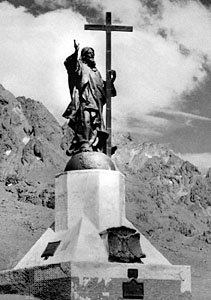
Over a hundred years ago a territorial dispute over the Argentina-Chile border in the Andes nearly led to war between the two nations. The conflict was settled diplomatically. Soon after, a statue of Christ was erected between Argentina and Chile, atop the mountains O’Higgins and San Martin once scaled together. The plaque reads:
“Sooner shall these mountains crumble into dust, than Chileans and Argentines shall break the peace to which they have pledged themselves at the feet of Christ the Redeemer.”
September 17 is one of the most important dates in U.S. history. In fact, it’s known as Citizenship Day, yet most Americans would be hard-pressed to tell you why.
On September 17, 1630, the city of Boston—North America’s cradle of liberty—was founded by some of the country’s first immigrants.
Governor John Winthrop and the Massachusetts Bay Colony Puritans christened the 780-acre peninsula after the town from which many of them hailed. Boston, Lincolnshire, in England was a city about 100 kilometers north of London, named for a 7th century English abbot, St. Botolph. Botolph’s Town was shortened to Bo’s’town, and later to Boston. (Tale of Two Bostons)
Wee shall be as a Citty upon a Hill, the eies of all people are uppon us.
John Winthrop, 1630
But that’s not why September 17 is Citizenship Day.
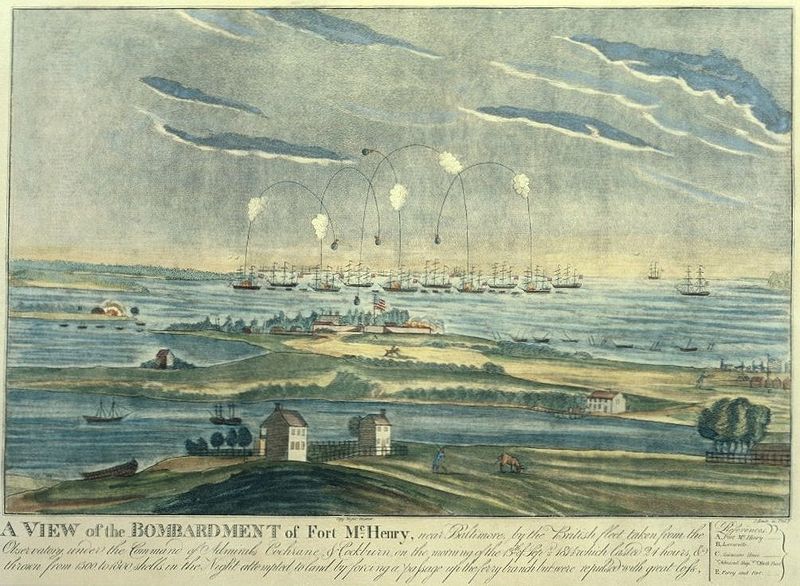
No, September 17 was the day in 1814 that a 35 year-old lawyer-poet printed a poem based on his experiences in the bombardment of Baltimore in the War of 1812.
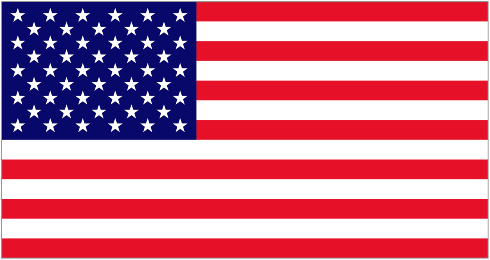
In August 1814, Francis Scott Key had been sent on a mission to negotiate the release of a popular, elderly American physician captured by the British. The British agreed to do so, but because Key had heard of the planned attack on Baltimore, he was forced to stay a captive aboard a British vessel during the battle. The next morning, Key was inspired to see the star-spangled American flag waving defiantly above Fort McHenry. Key’s poem was set to the tune of an old English drinking song and eventually became the country’s national anthem. (Star-Spangled Banner)
Bombardment of Fort McHenry, 1814
But that’s not why today is a national holiday.
Nope. In fact, September 17, 1862 was the bloodiest day in American history.
Troops under Confederate General Robert E. Lee and Union General George McClellan faced off at the Battle of Antietam in Maryland. By day’s end over 20,000 Americans would lie dead or wounded. The horrific battle was a draw, but the devastating loss of men forced Lee to halt his invasion of the North. (Battle of Antietam)
For President Lincoln, it was a much-needed, well, tie. He’d been waiting for a Union victory to issue his proclamation to end slavery, without it looking like a last-ditch act of desperation on behalf of the North, which had been losing battle after battle. Five days after the carnage of Antietam, Lincoln announced that as of January 1, all slaves in areas of rebellion would be free.
Lincoln and McClellan, two weeks after Antietam
But again, that has nothing to do with September 17 being Citizenship Day.
Citizenship Day honors perhaps the most important date in American history. Yet you will hear no fireworks, see no parades or marching bands, and you won’t get a day off school or work. Unless you’re in grade school, you will probably go throughout your day without any sign of its passing.
If you are in grade school, however, U.S. federal law mandates that your lessons this week include instruction on the document created on this day in 1787 by the Constitutional Convention in Philadelphia.
That’s right, September 17 is Constitution Day in the United States, aka Citizenship Day. Before the Constitution, the Articles of Confederation had kept the newly-independent states loosely “united”, but made no provisions for a central government with any practical power. The Articles’ weakness was made apparent by a rebellion of irate farmers’ (Shay’s Rebellion) that U.S. troops were unable to stem, and which was finally put down by state militia.
A convention of state delegates convened in 1787 to resolve the problem of the Articles. James Madison, a 5’4″ Princeton graduate and a delegate from Virginia, was 36 years old at the time. His studies of political theory and European governments convinced him that only a system of checks and balances could prevent a strong government from descending into tyranny. Madison, who would be the country’s fourth President, is also considered the Father of the Constitution.
In addition to checks and balances between the executive, legislative, and judicial branches, the Constitution’s secret to longevity was a self-contained instruction guide for amending itself. The first ten amendments, ratified in 1791, guaranteed the states that the Congress of this new powerful, strong central government would pass no law restricting essential freedoms.
The Constitution was amended just five times over the next 100 years. Over the past 100 years, it’s been amended another dozen times.
The most recent amendment to the Constitution was the 27th Amendment, which restricts pay raises of Senators and Representatives:
No law, varying the compensation for the services of the Senators and Representatives, shall take effect, until an election of Representatives shall have intervened.
The amendment holds the record for the longest stretch between the proposal and ratification. The Amendment was introduced in 1789 as the second of twelve proposed amendments, ten of which became of the Bill of Rights. The 27th amendment was passed in 1992, after only two centuries in Congressional purgatory. (And they say nothing ever gets done in Congress!)*
In 2005 Congress changed “Citizenship Day” to “Citizenship Day and Constitution Day” to explicitly remind those of us out of school what today represents, and on the continuing struggle to form “a more perfect Union.”
*(In fairness to Congress, I should point out it wasn’t entirely their fault it took 202 1/2 years to pass an amendment. The amendment had to be ratified by 3/4’s of the states. Only 6 states ratified it initially, 4 short of the 10 necessary back when there were only 13 states. In 1992, the amendment finally reached the 3/4’s mark when Alabama became the 38th state to ratify it.)
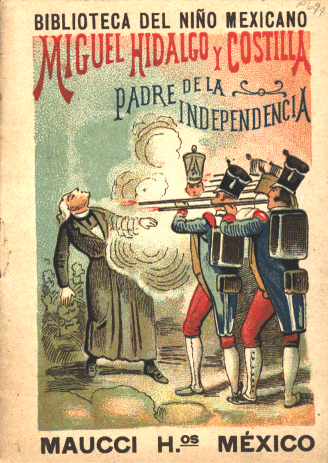
Before dawn, on the morning of September 16, 1810, townspeople of Dolores, Mexico, heard the church bells ring violently. They approached to find the parish priest, 57 year-old Father Miguel Hidalgo y Costilla. But the speech the criollo Father shouted was far from the sermon they had in mind.
Father Hidalgo had just learned that a plan to overthrow the Spanish rulers had been betrayed. Soon the Spanish would arrest all those involved and quash the independence movement. The exact words of the priest’s plea to the townspeople to bring an end to hundreds of years of European rule over the mestizo inhabitants, were not written down. It is said he raised the image of the dark-skinned Virgin of Guadalupe and concluded with a shout: Mexicanos, viva Mexico!
Mexico was still called “New Spain” at that point. Just addressing the crowd as Mexicanos, and willing into existence a land of “Mexico” was revolutionary. Father Hidalgo’s plea is called the Grito de Dolores, the “Cry of Dolores”, after the village in which it was made. But, as Dolores also means ‘sorrows’, it can also be interpreted as the Cry of Sorrows.
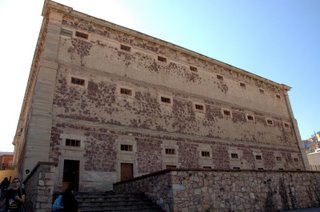
Just after dawn, the infant rebel army marched to San Miguel. By the time the rag-tag force reached Guanajuanto at the end of the month, it had swelled to 20,000 men. Though the men were poorly armed and insufficiently trained, their sheer numbers overpowered the small force of Spanish soldiers holed up at the Alhóndiga (public granary). Rebels stormed the Alhóndiga and most of the Spanish, as well as wealthy criollos, were massacred.
Alhóndiga de Guanajunato
Hidalgo and three other Mexican leaders were captured the following year on March 21, near the U.S.-Mexican border. They were convicted of treason, executed, and decapitated. Their heads were placed atop the four corners of the Alhóndiga in Guanajuanto as a message to the Mexican insurgents. There the heads remained for ten years.
On February 24, 1821, Mexican leaders signed the Plan de Iguala, which put forth the principles on which the country would be based, if the independence movement succeeded. Partly inspired by the Plan, conflicting Mexican forces joined together and defeated the Spanish army. The Treaty of Corboda assured the country’s long sought independence.
Father Hidalgo’s body was reburied in the country’s capital.
Today Mexicans celebrate their independence on the day of Father Hidalgo’s fateful shout for the autonomy, freedom, and equality for the Mexican people.
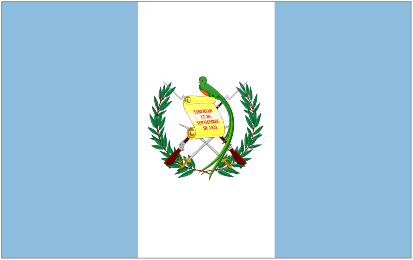
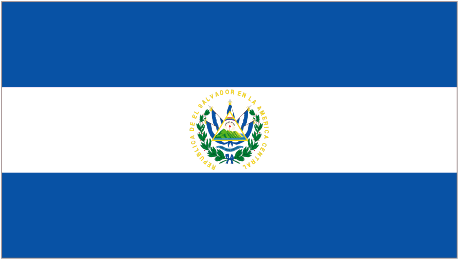
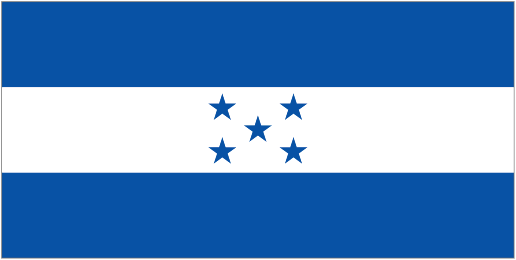
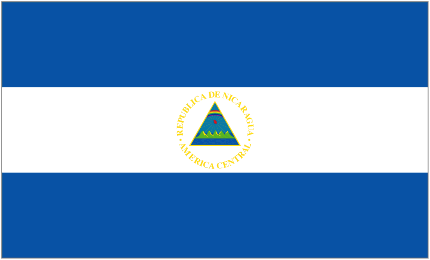
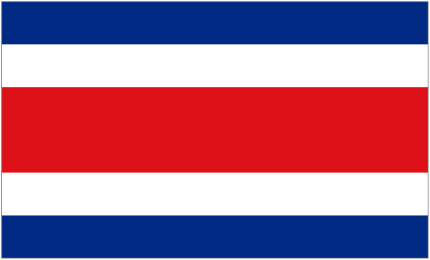
After 300 years of Spanish rule, the Captaincy General of Guatemala cut ties with the Old World in a declaration of Independence on September 15, 1821. The Spanish colony consisted of what is now Guatemala, El Salvador, Honduras, Nicaragua and Costa Rica. The proclamation was made in the capital, Guatemala City, in the northwestern corner of the isthmus. But Costa Rica, in the southeast, didn’t learn of its independence until a month later.
Today the five nations celebrate their collective independence. One relatively new tradition is the Torch of Independence relay across hundreds of miles of the Pan-American highway. The relay follows the symbolic path by which word of independence was spread from Guatemala to Costa Rica. Across Central America, schoolchildren in towns and cities take part in parades and processions, dressed in traditional attire and performing regional dances.
The 5
Guatemala is the Heart of the Mayan Empire. The country’s large indigenous population speaks 23 Mayan-based languages. Guatemala Antigua was once the capital of the entire region, stretching from the southern border of Mexico down to the tip of South America. It was founded in 1542 after a mudflow from the Agua Volcano flooded the previous capital, now called “Ciudad Vieja” (Old City). In 1773, Guatemala Antigua was mostly destroyed by earthquakes, and the current city of Guatemala was built nearby.
El Salvador is the home of the late Archbishop Oscar Romero. Romero was assassinated in 1979 and though not yet a saint, is sometimes called the patron saint of the Americas. The brutal 12-year civil war that erupted following his death took the lives of an estimated 75,000 El Salvadorians.
Honduras is the only volcano-less country of the five and is the only one that is totally self-sufficient in terms of electricity. Though spared the bloodshed and violence of the civil wars that rocked its neighbors, Honduras and El Salvador clashed in the 100-hour “Soccer War” of 1969, and Honduras was used as a base and training ground for U.S.-backed forces against Nicaragua in the 1980s. In 1998 Hurricane Mitch killed 5000 Hondurans and wiped out 70% of the country’s crops.
Of the five, Nicaragua has arguably been most effected by U.S. interests, beginning in 1855—when Tennessee entrepreneur William Walker hired an army of mercenaries, overthrew the Nicaraguan government and set himself up as President—all the way up to the Iran-Contra affair of the 1980s, and the CIA mining of three Nicaraguan ports in 1984. According to the World Bank, as of 1995, Nicaragua’s per capita GDP was the same as in 1945.
Costa Rica is the only country in the Americas not to have a military, and is one of the most eco-friendly countries in the world. Covering only .03% of the earth’s land surface, Costa Rica contains 5% of the world’s biodiversity.
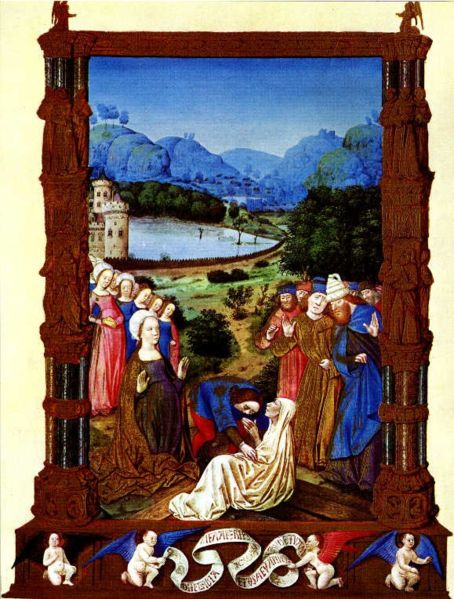
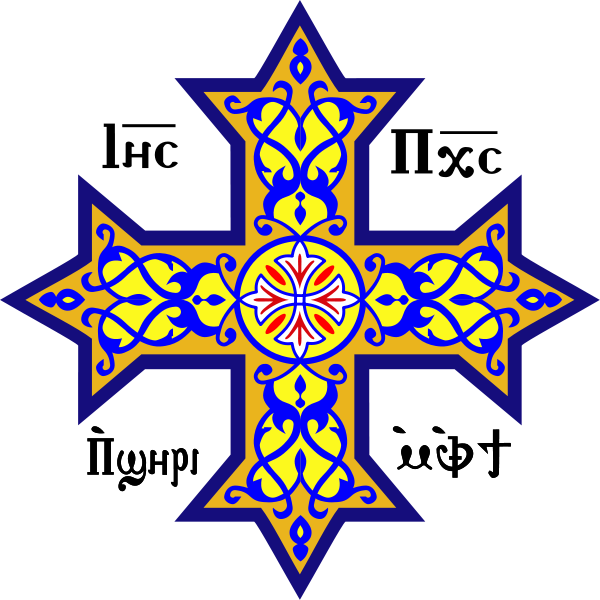
September 14 is the Triumph of the Cross, in the Roman Catholic Church, or the Exaltation of the Cross in the Eastern Orthodox Church.
It commemorates the rediscovery of the cross on which Christ was executed. The True Cross was discovered by Helena, mother of Constantine, the first Christian Emperor of Rome, during her pilgrimage to Jerusalem in 326 AD.
Constantine later ordered a church to be built at the spot where the True Cross was found. The Church of the Holy Sepulchre was dedicated on September 13, 335. The following day, September 14, a portion of the Cross was placed outside the church for followers to worship.
The Cross was taken by the Persians in 614 AD. Fourteen years later it was reclaimed by Byzantine Emperor Heraclius. Today’s feast day also celebrates that recapture of the Cross in 628.
Other names for the Feast:
Universal Exaltation of the Precious and Life-Creating Cross (Eastern Orthodox)
Raising Aloft of the Precious Cross (Greek)
Holy Cross Day (Anglican)
Proving of the True Cross, Jean de Colombe, 1410
“Hail, O Cross! Brighter than all the stars! To the eyes of men thou art exceedingly lovely!” (Magnificat Antiphon I)
“The pieces of this true cross, which are worshipped in different parts of Catholic countries, would, (says a competent judge,) if collected in one place, amount to more splinters than might be taken from the mainmast of a man-of-war.” (Ingram Cobbin, 1842)
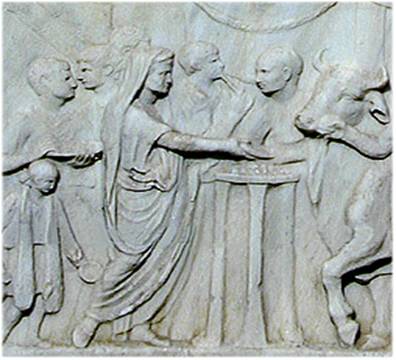
The Romans knew how to party. So much so that their toga ensemble has become the symbol of a decadent good time, especially in the “Greek” system in colleges across North America. Of course the Greeks didn’t wear togas—the Romans got it from the Etruscans—but we’ll let that slide.
Thanks to writers like Ovid and Cicero, we know that every month of the Roman calendar was flooded with festivals and sacred days for the pantheon of gods and goddesses. With one exception:
September.
There were only two notable holidays in the seventh month. (September didn’t become the 9th month until the second century BC.)
On September 13th, Romans observed the Ides, the day honoring the Roman king of the gods, Jupiter.
But the Romans honored Jupiter every month on the Ides. The 15th of March, May, July, October, and December; the 13th of all other months.
The other September event was known as Ludi Romani, or the “Roman Games“.
Ludi Romani was one of the most anticipated and biggest events of the year, and in its heyday stretched for over two full weeks, from September 4 to September 19.
According to tradition, the first games were instituted by King Tarquinius Pricscus (Tarquin the Elder) in the 6th century BC, after a Roman military conquest. He created the Circus Maximus to hold such an event.
How the Circus Maximus would have looked
The Circus Maximus was constructed between two of Rome’s seven hills, Aventine Hill and Palatine Hill. At over 2,000 feet long, the Circus could seat upwards of 150,000 spectators, and more could view the Games from the surrounding hillsides.
The main event of the Games was chariot racing, or ludi circenses. These races could be far bloodier than any Ben Hur movie. Other attractions included boxing, battles with wild animals, and gladiator bouts, though these were all later moved to other venues designed for such events. (The lack of a barrier between the stands and the track didn’t protect spectators too well from wild animals.)
Originally the Games were only one day, then two: September 12th and 14th.
The Games were celebrated intermittently until 366 BC when they became “the first set of Ludi to receive annual sponsorship by the Roman state…” (The Roman Games: a Sourcebook, by Alison Futrell)
Three years later, ludi scaenici, or theater plays inspired by the Greek, premiered at the Games.
By the time of Julius Caesar the Games lasted two full weeks. After his assassination, Rome honored him…by adding another day.
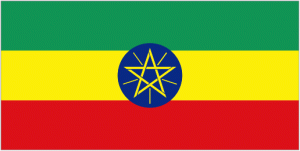
September 11th (or 12th) is New Year’s Day in Ethiopia, following the Coptic calendar and observed in the Rastafarian tradition. It marks the end of the rainy season in Ethiopia.
2000 years ago, the Ethiopian calendar fell on the equivalent of August 8 or 9. However, because of disparities between different calendars, the day now falls in September.
“The name Enkutatash was given when the famous Queen of Sheba returned from her expensive jaunt to visit King Salomon in Jerusalem. Her chiefs welcomed her back by replenishing her treasury with “Fuku,” or jewels.”
2009’s celebration marks the year 2002 AM in the Ethiopian Calendar. The festival is also the saint day of John the Baptist.
Enkutatash is celebrated with bonfires on New Year’s Eve, dancing, singing and prayers. On September 11, 2001, Ethiopians in the homeland and around the world were celebrating Enkutatash when planes flew into the World Trade Center.

 September 17 is one of the most important dates in U.S. history. In fact, it’s known as Citizenship Day, yet most Americans would be hard-pressed to tell you why.