
King Abdullah’s Ascension – Jordan

Anniversary of the Ascension of King Abdullah II – June 9;
Army Day / Anniversary of the Great Arab Revolt – June 10

King Abdullah II of Jordan was not selected as Crown Prince until January 24, 1999, just two weeks before the death of his father. Previously the king’s brother had been heir apparent (and it was speculated that had the king lived longer, Abdullah’s younger half-brother would have been made heir). As it was, upon the king’s death from non-Hodgkin’s lymphoma, Adbullah became the king of Jordan on February 7, 1999. A separate enthronement ceremony was held on June 9 so that…

“future anniversaries of King Abdullah’s accession would not clash with events marking the death of his father.” — (Jordan Crowns New King, June 1999 — BBC.)

•  •  •

Jordan is known as the Hashemite Kingdom of Jordan. The Hashemites descend from Hashim ibn Abd Manaf, the great grandfather of the Prophet Muhammad, through the Prophet’s daughter Fatimah. Hashim means “cuts into pieces. It sounds like a guy you wouldn’t want to mess with, but Hashim earned his nickname benevolently…

“when during a shortage of flour he prepared cakes and flour and gave a grand feast to the entire inhabitants of Makkah.”  (Muhammad… Mercy for the Worlds: Rehmatullil Alameen)

King Abdullah II’s father, King Hussein (1935-1999), once said of the Hashemites…

“We are the family of the prophet and we are the oldest tribe in the Arab world.” (Hussein CNN obit.)

•  •  •

King Abdullah II studied in England and the United States as well as Jordan. In fact he recently established King’s Academy in Jordan in the spirit of his alma mater, Massachusetts’ Deerfield Academy, even hiring the boarding school’s headmaster to lead it.

He served in several capacities in the Jordanian military, including as Commander of Special Operations, and had attained the rank of Major General when he assumed responsibilities as monarch.

Jordan’s geography and history places it in a unique place in Middle Eastern and Western diplomacy. Like his predecessor, King Abdullah has played a key role in the Palestinian-Israeli relations. In a recent speech commemorating the dual anniversaries of the Great Arab Revolt (Army Day) and his 1999 inauguration, the King responded to military personnel who criticized naturalization of Palestinians for fear doing so could weaken plans for a Palestinian state.

“You should be sure that we will not accept, under whatever circumstances, a solution for the Palestinian question at the expense of Jordan. Also, Jordan will not have any role in the West Bank. At the same time, we will not give up our historical role and duty in supporting our Palestinian brethren until they set up their independent state on their national soil.” — King Abdullah II

The West Bank was part of Jordan until the Six Day War in 1967. Over half of Jordan’s population are of Palestinian extraction, including the King’s wife, Queen Rania, who was born in Kuwait to Palestinian parents.

The King’s mother is Princess Muna al-Hussein, born Antoinette Gardiner in Suffolk, England. She met King Hussein on the set of Lawrence of Arabia and converted to Islam; the two were married from 1961 to 1971 and had four children.

King Abdullah II of Jordan

Jordan New Agency – the Hashemites

The Great Arab Revolt

Queen Rania’s Twitter Page

The Peculiar Impact of [the film] Lawrence of Arabia on Today’s Arab World
Daniel Boone Day

June 7

Daniel Boone

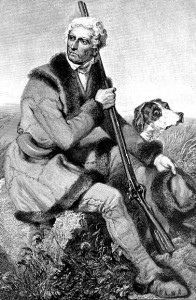
Today the Kentucky Historical Society celebrates the life of Daniel Boone, American pioneer and legendary folk hero.

Daniel Boone was born on a mountaintop in Tennessee, greenest state in the land of the—wait no—mixing up my folk heroes here. Boone was born in Eastern Pennsylvania, not Tennessee, but like Davy Crockett he was indeed raised in the woods so he knew every tree. No record of when he killed his first bear, but he was an expert hunter/trapper by age twelve.

Boone had two siblings who scandalized the Quaker world by marrying “worldlings”, ie. non-Quakers. This scandal may or may not have contributed to the family’s decision to move further west to the Shenandoah Valley and then to North Carolina in 1751. He married Rebecca Bryan five years later, and fought in the French and Indian War.

Legend has it that an American beech tree in Tennessee still bears Boone’s handiwork. The pioneer supposedly carved “D. Boon cilled a bar [killed a bear] on this tree in the year 1760”. (www.inhs.illinois.edu)

June 7 was chosen as Boone Day because it marks the supposed anniversary of the pioneer’s entry into Kentucky in 1767.

Two years later, Boone’s friend, a trader named John Findley, asked Boone to help him explore the unchartered wilderness, and Boone obliged.

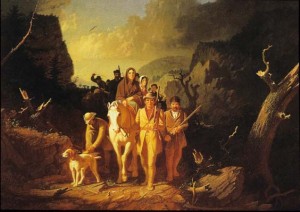
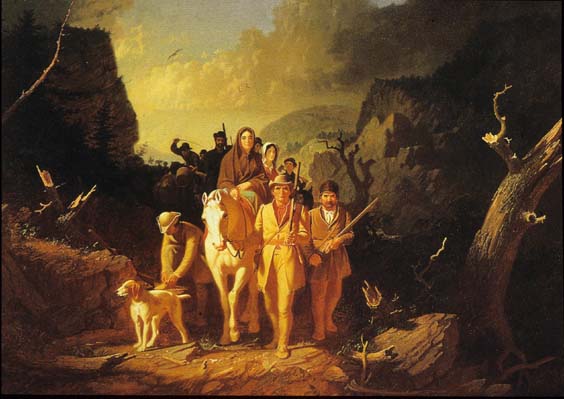
Boone’s most famous trek may have been through 200 miles of Virginian wilderness to the Cumberland Gap, a journey immortalized by Caleb Bingham in his 1851 painting. Thousands of settlers later followed Boone’s path to make their way inland toward the Kentucky River.

Daniel Boone Escorting Settlers the Cumberland Gap, Caleb Bingham, 1851

Daniel Boone Day has been celebrated for over 100 years. The 1908 American Practitioner states that

“Daniel Boone Day will be one of the features of the week, during which there will be sewing bees, apple parings, corn huskings and old-fashioned dances.”

That Boone Day, however, was celebrated on June 15th.

By 1922, the Kentucky Historical Society extended a cordial invitation to readers and friends “to attend Boone Day exercises on June 7”, the traditional anniversary of the day in 1767 that Boone first explored the backwoods of what is now Kentucky.

[And no, despite his penchant for journeying out to the middle of nowhere, Boone had nothing to do with the term “Boondocks”. That comes from the Tagalog word bondoc, which means mountain and was brought to the U.S. by military personnel in the Philippines.]

http://history.howstuffworks.com/american-history/daniel-boone.htm

D-Day Anniversary

June 6


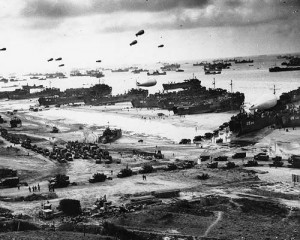
D-Day: Cargo Vehicles

“The eyes of the world are upon you.”

from General Dwight D. Eisenhower’s statement to the soldiers, sailors, and airmen of the Allied Expeditionary Force, June 1944

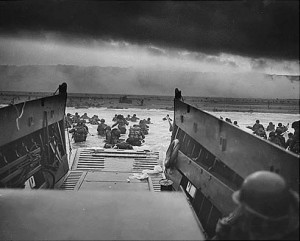
June 6 marks the anniversary of the 1944 Allied invasion of Normandy that precipitated the long and brutal campaign to liberate Western Europe from Nazi power.

The invasion, also known as Operation Overlord, involved the landing of approximately 160,000 Allied troops, including U.S., U.K, Free French, Canadian, and Australian forces, in a single day along the heavily fortified Normandy coast. The day was scheduled to be June 5, but unfavorable weather conditions forced the landing back a day.

Contrary to popular belief, D-Day doesn’t stand for Debarkation Day.

“In fact, it does not stand for anything. The ‘D’ is derived from the word ‘Day.’ ‘D-Day’ means the day on which a military operation begins.”

www.ddaymuseum.co.uk

Operation Overlord referred to the entire operation from the initial assault on June 6 to the crossing of the River Seine on August 19. Operation Neptune referred the beginning of the invasion, covering the assault on the beaches, and ended on June 30.

Then there was the lesser known “Operation Fortitude”. Operation Fortitude entailed a massive invasion through the narrowest point in the English Channel by the “First US Army Group” led by General George S. Patton.

D-Day: Invasion

Operation Fortitude was, needless to say, entirely made-up. A fictitious assault created to mislead the Germans into thinking the invasion would occur at another location. Secrecy was essential as the Germans had 55 divisions at their command in France, and the Allies could only land a maximum of 8 at any one time. Keeping the world’s largest invasion a secret was a feat almost as remarkable as the invasion itself. It required the Allies win complete dominance over UK airspace—Allied air forces suffered tremendous losses in the two months before the invasion in order to make this so. It required the UK to ferret out all German spies within their ranks and region and to force known spies to send misinformation back home.

The deception went so far as to set up a fake base for the “First U.S. Army Group” in England opposite the suspected landing site, complete giant rubber tanks, cardboard weapons, a paper mache oil pump, and scripted radio chatter.

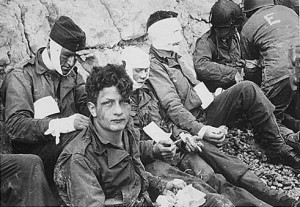
D-Day: Wounded by the Chalk Cliffs

General Patton was an obvious choice for the fictitious assault. The Germans assumed Patton—one of the U.S. most capable generals—could lead such an operation. However, Patton had been disciplined for a “slapping” incident, something the Germans found difficult to believe was true. (It was.)

“Fortitude succeeded beyond anyone’s wildest dreams. Long after June 6th, Hitler remained convinced that the Normandy Landings were a diversionary tactic to induce him to move his troops away from the Pas-de-Calais…He therefore kept his best units in readiness there, until the end of July…”

Normandie Memoire, Operation Fortitude

Within five days, over 325,000 troops had landed in Normandy.

The exact number of casualties and soldiers killed on D-Day itself are difficult to ascertain due to the large scale and complexity of the operation, and the conditions under which it was fought. Traditional estimates put the number of Allied casualties at 10,000 with the number of deaths accounting for a quarter of that.  More recent estimates have put the number of dead alone at over 4400, a little over half of that figure Americans.

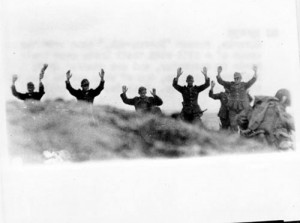
D-Day: German Troops Surrender

“These men came here — British and our allies, and Americans — to storm these beaches for one purpose only, not to gain anything for ourselves, not to fulfill any ambitions that America had for conquest, but just to preserve freedom… Many thousands of men have died for such ideals as these… but these young boys… were cut off in their prime… I devoutly hope that we will never again have to see such scenes as these. I think and hope, and pray, that humanity will have learned… we must find some way… to gain an eternal peace for this world.”

— Former President Eisenhower at the 20th anniversary commemoration of D-Day. (The D-Day Companion: Leading Historians Explore History’s Greatest Amphibious Assault)


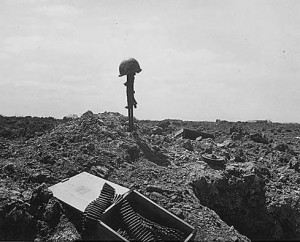
D-Day: Monument

http://www.army.mil/d-day/

65th Anniversary of D-Day on the Normandy Beaches

Dragon Boat Festival

5th day of 5th lunar month
June 23, 2012
June 6, 2011
June 16, 2010;

Dragon Boats

Duanwu is often called Double Fifth, because it falls on the fifth day of the fifth lunar month of the Chinese calendar, but it’s more commonly referred to as the Dragon Boat Festival, after its most famous annual event.

Almost as famous are the delicious special foods prepared for this date. The traditional dish, zongzi, is a triangular rice ball stuffed with sweet or savory fillings, and wrapped in bamboo leaves. The Duanwu beverage of choice is a special realgar yellow rice wine.

zongzi

The inspiration for the holiday comes from the death of one of China’s first great poets, Qu Yuan. Qu Yuan was a political advisor in the late forth century BC who urged his king to unite with other kingdoms against the rising state Qin. However, jealous and corrupt political opponents counseled the king against the advice of Qu Yuan, who was accused of treason and forced into exile. It was during this exile that Qu Yuan traveled the country gathering and recording local folklore and legends.  When Qin did eventually attack and capture the capital city of Ying, Qu Yuan composed one of his greatest works, “Lament for Ying”. He then committed suicide by tying himself to a rock and jumping into a river.

The local fishermen tried to keep the fish from eating Qu Yuan’s body by throwing food into the water. Over time this became a tradition. Later a legend gained credence that Qu Yuan was killed by a great underwater dragon.


Qu Yuan

The Maoist government banned celebrations of Duanwu in 1949. It wasn’t until only a few years ago that the Chinese government officially reinstated three of the country’s most popular holidays: Tomb Sweeping Day, Mid-Autumn Festival and Duanwu.

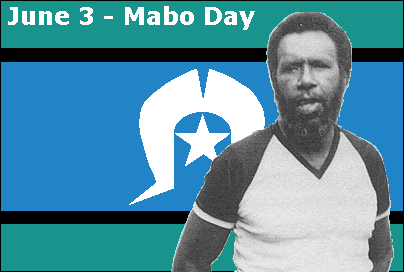
Mabo Day – Australia

On May 27, 1967, the Australian public voted to alter the language of the Constitution to remove discriminatory laws against the indigenous people.

One such Constitutional clause had previously declared:

“In reckoning the numbers of the people of the Commonwealth, or of a State or other part of the Commonwealth, aboriginal natives shall not be counted.”

Still, even decades after this sweeping reform, the Australian court held to a policy known as Terra Nullius. Terra Nullius was the doctrine that insisted that the occupation of the Australian continent did not occur until after European ‘discovery’ and colonialization. This historical whoops now generally estimated to be about 40,000 years off. It wasn’t overturned until the last decade of the 20th century, on June 3, 1992, in the extraordinary case of Eddie Mabo.

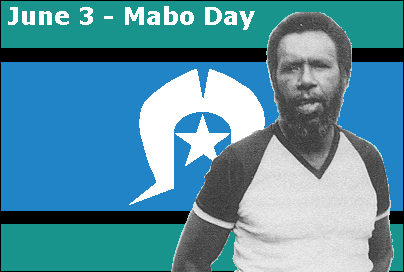
Eddie Mabo - Mabo Day

Born on the island of Mer in the Torres Strait in Queensland, Mabo was working as a gardener and groundskeeper at James Cook University when he was denied passage back to his birth island during a trip to visit his ailing father. Mabo took on the aged Australian albatross of indigenous landrights disputes. While pursuing a teaching degree (in his 40’s) Mabo waged a decade-long legal battle confronting the fallacy of Terra Nullius. He took his case all the way to the highest court in the land.

“The Mabo decision is arguably the most important decision that the High Court of Australia has made since Federation. It states Indigenous people have Legal Rights not just Symbolic Rights to all Crown Land in this country, as well as possible rights to pastoral leases. Mabo Day marked the beginning of a new era for Indigenous people. It changed Australian’s views of themselves and their rights to this land. It has forced mining companies and the corporate world to take stock of Indigenous peoples’ claims. It has radically altered the relationship between Indigenous and non Indigenous people in this country.”

Though Mabo Day is not an official holiday in Australia, the week from May 27 to June 3 is now known as Reconciliation Week. It is a week meant to encourage dialogue and help mend centuries of injustice against the nation’s indigenous people and to foster healing between Australia’s diverse communities.

http://www.takver.com/history/ph_maboday.htm

http://www.abc.net.au/message/blackarts/culture/s853725.htm

No Tobacco Day

May 31

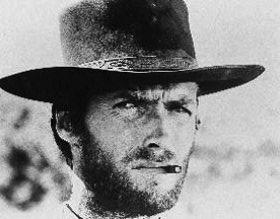
Today is No Tobacco Day, instituted by the World Health Organization in 1987. Originally observed on April 7, 1988 as a day of “No Smoking”, the name was changed to reflect the dangers of all forms of tobacco, and the date was moved to May 31, we assume to celebrate the birthday of Clint Eastwood.

Used to be no movie star would be caught live in front of a camera without a cigarette in his or her mouth. It was an uphill battle convincing cinema-going youth not to smoke what with images of their favorite stars puffing away on screen.

But as their movie heroes died of cancer—from Yul Brynner to John Wayne—the anti-smoking argument became more convincing.

Still, today bloggers like the good doctoratlarge point out the top eleven oft-overlooked advantages of smoking, including:

“8) Nicotine is great for constipation.”

“5) You burn a hole in your pocket (literally if you are not careful), learning to survive with meager resources.”

and:

“2) You learn to kiss butts, and as everyone knows, this is a priceless asset to those wishing to make it big in life…”

Over the past 25 years, the general public’s view on smoking has changed immensely. Even Dirty Harry has altered his views on smoking, (if not on gun control):

Youtube – Clint Eastwood Enforces Smoking Ban


Fall of Constantinople

May 29

Istanbul, not Constantinople
Been a long time gone, Constantinople
Now it’s a Turkish delight on a moonlit night…
Why did Constantinople get the works?
That’s nobody’s business but the Turks.

[published May 29, 2008]

555 years ago today a young soldier by name of Hasan from the small town of Ulubat in what is now Bursa province, Turkey, changed the history of the world.

Hasan was a member of the Sultan Mehmed II’s elite cavalry force during the Siege of Constantinople in 1453 AD.

Preparations for the siege had begun in late 1451 when the Sultan built a fortress on the European side of the Bosporus, north of the city. There Sultan Mehmed commissioned a Hungarian named Urban to design and forge the latest craze in weapons of mass destruction.

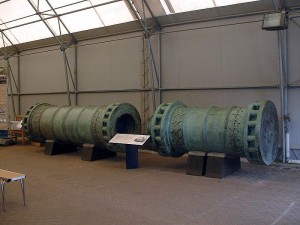
The ‘Great Turkish Bombard’ was the world’s first supergun, an enlargement of a Chinese weapon that used gunpowder. At 17 feet and weighing over 20 tons, Urban’s Bombard could shoot a 680 kg granite projectile over a mile. It took 60 oxen and 400 men to move each one.

(Bombard at the Siege, and today)

Urban originally offered his services to the Byzantines, who were unable to afford him. He took his business elsewhere, to the Sultan, who gave him unlimited funding to create a device that could bring down the “walls of Babylon”.

Each Bombard took three hours to reload. But shot by shot, over a matter of months they broke through the walls of the city that was once declared the new Rome. Walls that were originally built by Constantine, fortified by Theodosius, and which for 1000 years withstood attacks from the Avars, the Persians, the Arabs, the Rus’, and the Bulgars.

On the 28th, as the Ottoman army rested for the final attack the last Byzantine Emperor held a religious ceremony in the Hagia Sophia Church.

At midnight the Sultan ordered the attack.

“The first assault was performed by infantry and it was followed by Anatolian soldiers. When 300 Anatolian soldiers were killed, the Janissaries started their attack.”  — http://www.greatistanbul.com/conquest.htm

One of the first of those to make it through the impenetrable walls was the aforementioned Hasan of Ulubat. He carried a sword, but would be remembered throughout history for what held in his other hand.


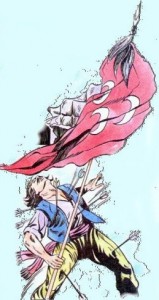
In the midst of battle, Hasan became the first Muslim ever to hoist a crescent banner atop the 1000 year-old Christian city’s walls. The sight of the flag spurred on the invaders and hastened the collapse of the city’s defenses. During this last act, Hasan was struck dead by 27 arrows, but not before his fellow soldiers broke through and held the flag.

Constantine XI, the last Byzantine Emperor, is believed to have been killed in the attack.

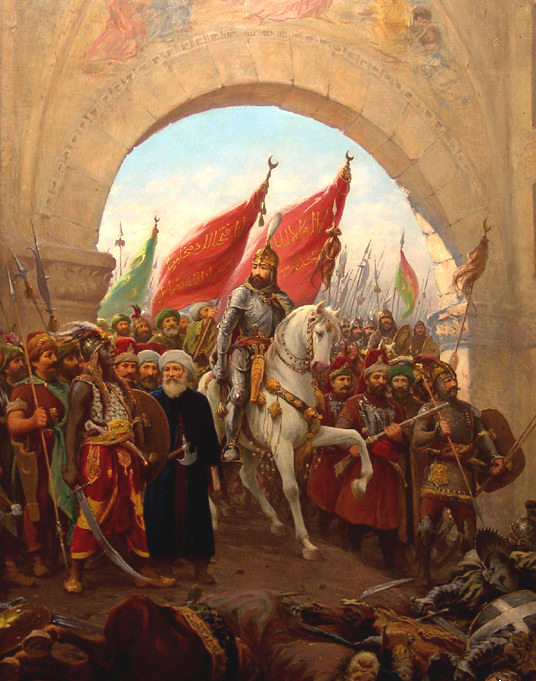
Sultan Mehmed II assumed the Byzantine title of Caesar, and the Ottoman became the undisputed ruler of what was now undoubtedly an empire.

He was 21.

Sultan Mehmed II enters Constantinople

Istanbul, as it’s known today, is the city that spans two continents.

And no, it wasn’t Mehmed who changed Constantinople to Istanbul. The Ottomans continued to call the city “Konstantiniyye” (City of Constantine) for hundreds of years. But the mesh of multi-cultural locals called it by another name. Istanbul is a morph of the Greek “is tin Poli”.

Just like New Yorkers and San Franciscans call their hometown, Istanbul means simply “the City”, or “to the City”.

The name wasn’t officially adopted by the Turkish Postal System until 1926.

So if you’ve got a girl in Constantinople…
…she’ll be waiting in Istanbul.

[And no, They Might Be Giants didn’t write the song. Istanbul Not Constantinople was recorded by the Four Lads in 1953, exactly 500 years after the conquest of Constantinople.]

Sultan Mehmed II approaches Constantinople with his army (Note the Great Turkish Bombard)

Sorry Day – Australia

May 26

That’s the difference between the UN and Australia. The UN would have called it “Day of Remembrance and Apologies for Injustices committed upon Indigenous Peoples” or something longer. Australians cut to the bone.

There are a number of things to be sorry about with regards to treatment of Australia’s Aborigine population, but Sorry Day focuses mostly on one particularly terrifying aspect—the taking of Aboriginal children from their families in an ill-conceived ‘re-education’ project during the early-to-mid 20th century.

Between 1910 and 1970 an estimated 20,000 to 25,000 Aboriginal and Torres Strait Island children were removed from their homes, in what amounted to essentially legally-sanctioned kidnappings. The full scope of the project and its failure were the subject of a government investigation in the 1990s.

Accounts of the “Stolen Generations” have inspired numerous books, plays, and movies, including Doris Pilkington’s 1996 novel Follow the Rabbit-Proof Fence and its 2002 film adaptation Rabbit-Proof Fence.

The results of the government investigation were released in the “Bringing Them Home” report, which was published on May 26, 1997.

The publication of “Bringing Them Home” coincided with another anniversary: the 30th anniversary of the Referendum of May 27, 1967, in which 90% of the Australian public voted to alter the language of the Constitution to remove discriminatory laws against indigenous people.

Henceforth, the week from May 27 to June 3 became Reconciliation Week in Australia.

Our friends Down Under tell us that Sorry Day is no longer an annual observance, but Reconciliation Week is. It is a week meant to encourage dialogue and help mend centuries of injustice against the nation’s indigenous population.