Super Bowl

February 3, 2013
February 5, 2012

It may not be an official holiday, but today is one of the most spiritual days in American culture. For today, over 100 million Americans gather together and pray…that their team will win the Super Bowl.

The Super Bowl is of paramount importance to Americans, and one can tell, not only because of the vast media attention and commercialism that surround it, but because they apply Roman numerals to it., e.g., Super Bowl XLIII.

The location of the Super Bowl changes each year and is determined three to five years in advance. Unlike championships for basketball and baseball, the location has nothing to do with the teams involved. Though 2009’s contenders hail from Pittsburgh and Arizona, Super Bowl XLIII takes place in Tampa Bay, which is expected to see a $300 million boost to its economy because of the festivities. No team has ever played in the Super Bowl on its own turf.

Those spectators who aren’t among the 100,000 or so to attend the live festivities gather in small communal groups, usually in the home of whichever friend has the largest TV. [In previous years Super Bowl week has seen the purchase of 1.5 million TV sets, although that number may have gone down this year.]

Almost as important as the game itself are the commercials during the Super Bowl, which have become a phenomenon in themselves. A 30-second spot during the Super Bowl will cost about $3 million, enough to feed a family of four for four centuries.

There’s a reason they’re so expensive.  According to tampabaysuperbowl.com approximately 140 million Americans watched Super Bowl XLI, more than the number that went out to celebrate New Year’s Eve. The exact number is unknown, since many viewers watch in groups, but Neilson estimates that of the top ten primetime network telecasts since 2000, the Super Bowl has accounted for nine of them.

Super Bowl is also the U.S.’s second-highest food-consumption day of the year, right behind Thanksgiving.

Speaking of which, Reverend Matthew Lawrence, Rector of the Church of the Incarnation in Santa Rosa, has written a Super Bowl Confessional Prayer, in which he points out the similarities between the Super Bowl of today and the bloody “games” of the Roman Coliseum, where unruly pagan crowds once rooted for the slaughter of early Christians:

Most merciful God,
Forgive us for what we are about to do;

For our blood-curdling cries,
Lord, have mercy;
For our lust for violence,
Lord, have mercy;
For our emulation of military conquest,
Lord, have mercy;
For our favor to the strong,
Lord, have mercy;
For our scorn upon the weak,
Lord, have mercy;
For the vengeance which we seek
upon enemies whom we oppose for the most arbitrary of reasons,
Lord, have mercy.

We acknowledge and bewail our mortal sins and weaknesses;
We are troubled by these dark comparisons:
the football stadium and the coliseum;
the fans and the pagan mobs;
the star athletes and the demigods;
the linebackers and the gladiators;
the cheerleaders and the furies;
the commentators and the chorus;
the corporations and the slave owners.

We can only hope that you see, as we do,
that this is only a game;
and that you haven’t lost your sense of humor.
Despite appearances to the contrary, our heart remains faithful to you.
Even as we glory in the spectacle of our football enemies
being pounded into the dust, we will strive to remember you.

God, be with those who will taste dirt this day.
Heal those who will be injured;
Console the losers with gratitude for the privilege of having played;
Ennoble the victors with gentle reminders of their mortality;
And show your favor toward all contestants
Who this day will shed their blood and break their bones
for our trivial sakes…

AMEN.

Women’s Heart Disease Awareness Day

February 5

Today’s Wear Red Day, but it’s not a fashion statement. It’s a life statement: to build awareness of women’s heart disease.

Today women are at greater risk of fatal heart attack than men.

Each year more women die of cardiovascular disease than cancer, tuberculosis, AIDS, and malaria combined. While mortality rates for men have gone down, the danger for women has risen. Around the world 16 women die of cardiovascular illness every minute.

Recognizing the early symptoms of a heart attack is essential in saving lives. Women rush their husband or male family members to the hospital, but tend to be more dismissive of the same warning signs in themselves.

Sweats, heart palpitations, shortness of breath–Could be more than menopause.

The “Hollywood Heart Attack” in which someone clutches their chest in pain is not the standard for everyone. Chest pain is the most common symptom, but almost half of all women who experience a heart attack do not have chest pain. Atypical symptoms include:

  • back, neck or jaw pain
  • nausea or vomiting
  • indigestion
  • weakness, fatigue
  • dizziness, lightheadedness

Symptoms that can occur months prior to a heart attack include:

  • fatigue
  • sleep disturbance
  • shortness of breath
  • chest pain
  • indigestion
  • anxiety
  • shoulder blade or upper back pain

Recognize the symptoms: Women tend to end up at the emergency room 15 to 20 minutes later than men, and those minutes can mean a life.

Both women and men can fight heart disease through cardiovascular exercise, a healthy diet, and regular screenings.
Heart Disease Signs
Heart Healthy Women

February 4

February 4

“It is estimated that over 40% of all cancer can be prevented.”

Today is World Cancer Day:

In a world where our ability to combat and prevent disease has never been better, cancer rates are still on the rise. According to the World Health Organization cancer is “a leading cause of death globally.” 7.6 million people died of cancer in 2005. 84 million people are projected to die from cancer in the next decade.

Birthdays: February 4

Rosa Parks in 1913. Her decision to be arrested rather than give up her seat to a white passenger on a Montgomery bus led to a year-long boycott and sparked the Civil Rights movement in 1955.

Dietrich Bonhoeffer in 1906. As a German pastor he opposed the Nazi government. He was executed in 1945 for his involvement in a plot to kill Hitler.

(Bonhoeffer documentary)

Groundhog Day

February 2

If Candlemas be dry and fair
Half o winter’s yet to come and mair,
If Candlemas be wet and fowl
Half o winter’s gane at Yule.

If Candlemas Day be fair and bright
Winter will have another fight.
If Candlemas Day brings cloud and rain
Winter won’t come again.

Happy Marmota Monax Day!

Not every species gets a holiday. Holidays tend to revolve around the species homo sapien, but February 2 belongs to the marmota monax, aka Groundhog.

In the days before meteorologists, when a few extra weeks of winter could mean the difference of feeding your family or not, cultures had to develop their own traditions of predicting the weather.


The Celtic holiday Olmelc (also Imbolc) meant “ewe’s milk.” When livestock began lactating, Celts knew spring was just around the corner.

Other Europeans looked to the habits of hibernating mammals to determine signs of spring: bears were the chosen prognosticators in England and France, badgers in Germany.

“The badger peeps out of his hole,
If he finds snow, walks abroad
But if he sees the sun shining
he draws back into hole.”

(Let’s just assume it sounds better in German.)

However the practice was not attached to any specific date. Indeed, the idea of a bear coming out of hibernation–or any animal–precisely on February 2, was not only absurb, it was way too early.

Perhaps North Americans discovered that sleeping bears were not so friendly (and were very hungry) after being prodded awake in early February, which is why the American tradition leaned more toward the German way. However, instead of badgers, German settlers in 18th century America prodded woodchucks, aka groundhogs, to come out of their holes.

The resulting synthesis of these traditions in America was recored by James Morris, a shopkeeper in Morgantown, Pennsylvania.

“Last Tuesday, the 2nd, was Candlemas day, the day on which, according to the Germans, the Groundhog peeps out of his winter quarters and if he sees his shadow he pops back for another six weeks nap, but if the day be cloudy he remains out, as the weather is to be moderate.” — February 4, 1841

Today, the most famous groundhog in America is Punxsutawney Phil, who began officially predicting the weather for the proud people of Punxsutawney way back in 1886.

According to the president of the Punxsutawney Groundhog Club in 1978,

“In 92 years of Punxsutawney Phil’s emergence, he has never, never, never been wrong.”

Statistics say another thing. According to stormfax.com, Phil has actually predicted the coming of spring correctly a whopping 39% of the time. This is 2% better than the average Canadian groundhog, but still not inspiring considering the 50/50 call.

+  +  +

Our lives are far less dependent on the weather than in ancient and medieval times. But new age religions have created a resurgence of Imbolc and other seasonal pagan rituals, focusing instead on the purification of the spirit and on the connectivity between all living things.

In North America, the melting pot of all cultures, February 2nd stands out as a perfect example of ancient rituals from Europe and Asia morphing into a truly bizarre amalgamation. The unusual collection of traditions that survive as Groundhog Day makes it the platypus of holidays.

Hmm…Platypus Day…

*google search*

Darn, not the first to think of it. According to http://alum.wpi.edu/~wes/holiday.htm, Platypus Day is February 2. Looks like Phil’s got competition!

Maria Lichtmess – German traditions in February

Groundhog Day

February Facts, Customs and Traditions

Winter-een-mas

Last full week in January

©Tim Buckley

Winter-een-mas is a secular holiday devoted to gaming. The holiday spans the last week in January.

It is celebrated by 14 million people in 32 countries.

(Not really, just made that up.)

Actually it is celebrated by video game addicts, mostly males in their 20s, in the United States, Canada, the U.K., and Japan.

It is sort of the video game world’s Festivus, a holiday alternative to Christmas, publicized by the TV show Seinfeld.

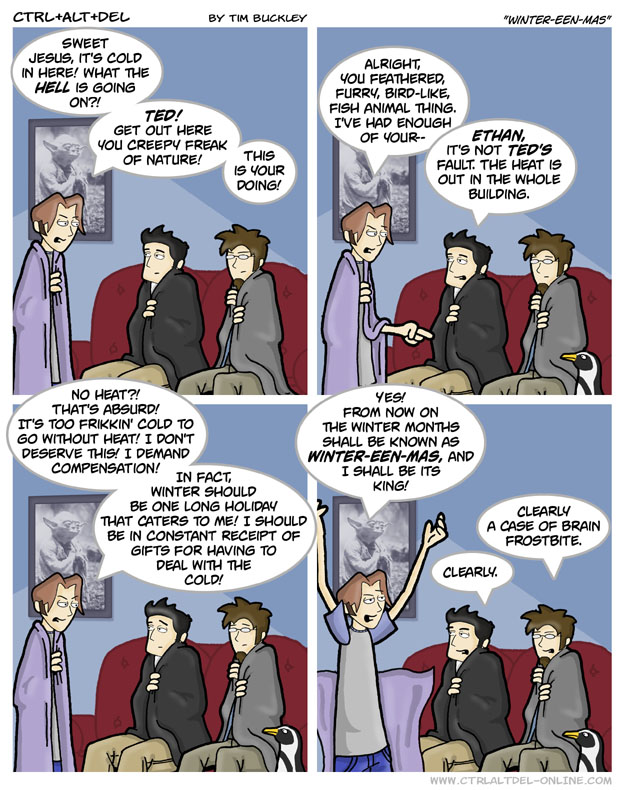
Winter-een-mas originated from Tim Buckley’s comic strip Ctrl+Alt+Del, in which the character Ethan, upset when the heat goes out during a snow storm, makes the following realization:

“In fact, winter should be one long holiday that caters to me! I should be in constant receipt of gifts for having to deal with the cold! Yes! From now on the winter months shall be known as Winter-een-mas, and I shall be its king!”

Eventually Ethan is talked into shortening the holiday to one week.

Winter-een-mas has been celebrated by Ethan and video gamers across the world every year since 2003.

Could it Happen Again?: Holocaust Remembrance

January 27

Today the UK and Germany remember the Holocaust of World War II when 6 million Jews were killed in concentration camps across Europe, along with untold numbers of Roma, communists, homosexuals, the mentally and physically handicapped, and political prisoners.

January 27th marks the anniversary of the liberation of the Auschwitz-Birkenau concentration camp. It is estimated that as many Jews were slaughtered at this one camp than remain on the entire European Continent today.

To this day the Jewish population has never reached its pre-1939 numbers.

Berlin Holocaust Museum Memorial
Berlin Holocaust Museum

It’s easy to be tolerant in times of prosperity.

In better times Hitler may not have appealed to the Germans. But in times of scarce resources the search for a scapegoat as a possible way out was too appealing. The illusion Hitler sold was that Jews were responsible for the recession. The reality was that the seizure of Jewish assets and property meant “free money” for the rest of the nation. It was an offer too good for the Germans to pass up, even if it meant the “dehumanizing” of a minority.

Could it happen in America?

It would take a major catastrophe.

In the days after 9/11, though not widely reported in American media, hate crimes were committed against Muslims for no reason other than their religion. A Sikh man in Arizona was killed simply because he looked Muslim.

The nation waited for the speech in which the President made it clear to the public that Muslims in America are Americans, entitled to the same rights of life, liberty and the pursuit of happiness. And that violence against anyone based on their religion is contrary to the American way of life.

The speech never came. In the crusade against evil, preventing hate crime was not on the top of the agenda.

The weapons of hate aimed at one minority today can and will be used more effectively against others tomorrow, whether they be Jewish, Muslim, Hispanic, Mormon, Catholic, Socialist, or Scientologist…<

As a pastor in Germany once wrote:

First they came for the communists, and I did not speak out because I was not a communist;
Then they came for the socialists, and I did not speak out because I was not a socialist;
Then they came for the trade unionists, and I did not speak out because I was not a trade unionist;
Then they came for the Jews, and I did not speak out because I was not a Jew;
Then they came for me and there was no one left to speak out for me.

[Note: in the Washington DC inscription at the Holocaust Museum, the “Communist” line is not included.]
—————————————————————————————–

Former Indonesian President Suharto, the genocidal architect responsible for the killing of 183,000 East Timorese, a quarter of East Timor’s population, died earlier today [2008].

His obituary reads: Suharto Leaves Legacy of Stability in Region. In some places ethnic cleansing still falls under stability.
And “Never Again” is an ongoing struggle.

What is Holocaust Memorial Day?

Auschwitz

In Pictures: Holocaust Memorial Day

[published January 28, 2008]

Wolfgang Amadè Mozart’s Birthday

January 27

Today, January 27, is Wolfgang Amadè Mozart’s birthday.

If you’re like me, everything you know about Mozart comes from Falco’s immortal ballad “Rock Me Amadeus.”

“1756, Salzburg, January 27, Wolfgang Amadeus Mozart is born.
“1761, at the age of five Amadeus begins composing.
“1773, he writes his first piano concerto…

But did you know that, according to Marcel Danesi’s Forever Young: The Teen-Aging of Modern Culture:

There are solid data to suggest that even minimal exposure to the music of Mozart, for instance, benefits both children and adults in many ways.

Ironically, this maturing effect of Mozart’s music did not work on the great composer himself, who despite his musical genius, lived much of his life in a state of perpetual adolescence. Mozart’s letters are riddled with misspellings, unorthodox grammar, and references to his fecal and scatological obsessions.

“How I like Mannheim?–as well as one can like any place without Baasle [little cousin]. Pardon my poor handwriting, the pen is already old; now I have been shitting for nearly 22 years out of the same old hole and yet it’s not torn a whit!…Now I must close, as it so happens, because I am not dressed yet, and we’ll be eating soon so that afterward we can go and shit again, as it so happens. Do go on loving me as I love you, then we’ll never stop loving each other…”

Nov. 13, 1777, letter, to cousin Maria Anna Thekla Mozart, translated by Robert Spaethling, Mozart’s Letters, Mozart’s Life

Perhaps the fact that Mozart virtually “skipped” childhood [He wrote his first symphony at age 8.] led him to make up for it in later years. Granted, Mozart probably didn’t expect his personal letters to wind up on the Internet, but then who does. Anyway, his eccentricities didn’t detract from his following, either during his life or after.

Nearing the centenary of Mozart’s birth, The Musical World (1855) wrote:

There is no name in music which addresses itself more powerfully and universally than that of Mozart in appeals to the heart as well as to the intellect. From infancy his melodies are made familiar to us; they are hummed at our cradles, taught us at schools, sung at our theatres, and made the groundwork of our musical appreciation.

We’ll never know how Mozart would have aged. He died on December 5, 1791, at age 35. He died of illness, though specifically of what illness we may never know.

Young Mozart
Young Mozart

Mozart’s Requiem

The mystery of Mozart’s death revolves around his haunting final work: Requiem. The Requiem was commissioned anonymously, and conveyed by a “Gray Messenger.”

Before long he became convinced that the Messenger had come to warn him of his own mortality and that he was indeed composing the work for his own death. Concerned with this morbid fascination, his wife Constanze hid the score and forbade him to work on the Requiem for several weeks.  But, shortly after resuming work in mid-November, Mozart became ill and took to his bed. He gathered a choir of friends around his bedside the afternoon of December 4th to sing the movements he had completed. He died less than twelve hours later.

Robert Levin, Requiem by Wolfgang Amadeus Mozart

His death was fictionalized in Peter Schaffer’s Amadeus. Historians believe the Requiem was not a rival composer’s plot to kill Mozart, but was commissioned by an Austrian count and amateur musician who intended to pass the work off as his own, in honor of his deceased wife.

Over 200 years after his death, historians and musicians still place Mozart in a category of his own. Mozart’s ability to connect to music-lovers for over ten generations, and his ability to express the entire range of human consciousness through music is made more remarkable considering the two things the composer never had: a true childhood, and a true adulthood. As the current Pope Benedict XVI once said:

“His music is by no means just entertainment; it contains the whole tragedy of human existence.”

Cardinal Joseph Ratzinger, 1996, quoted in God’s Choice: Pope Benedict XVI and the future of the Catholic Church

SOPA Protest Day

January 18, 2012

Today, in protest of the U.S. Congress’s consideration of the proposed SOPA and PIPA legislation (Stop Online Piracy Act and Protect IP Act), thousands of websites across the webosphere are blacking out, in an effort to inform readers about the legislation and how it could impact the future of the internet.

Craigslist, Reddit, and the apolitical yet ubiquitous Wikipedia are all going black for the day, while Google is blacking out its logo.

Wikipedia offers a brief description of how the legislation could impact the internet, and what you can do to stop it:

http://en.wikipedia.org/wiki/Wikipedia:SOPA_initiative/Learn_more