Birthday of the King: Elvis

January 8

The Mississippi Delta was shining
Like a National guitar,
I am following the river
Down the highway
Through the cradle of the civil war,

I’m going to Graceland, Graceland
In Memphis Tennessee…
…I’ve reason to believe
We both will be received
In Graceland

Paul Simon, Graceland

Today is the birthday of the King of Rock ‘n’ Roll Elvis Presley. Though not an official holiday in any nation, it is observed throughout the world.
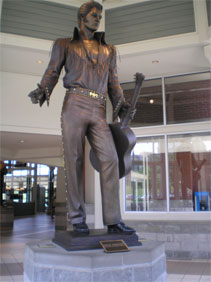
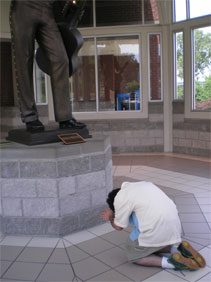
Elvis statue Elvis worshipper

(Above: the author praises the King in Memphis, Tennessee)

The focal point of the celebration is Graceland, Elvis’s former home in Memphis, Tennessee. Festivities begin each year with a gospel tribute at the Gates of Graceland at midnight.

Graceland was not named by Elvis, but by the original owner S.E. Toof after his daughter Grace.

Elvis Presley was born in Tupelo, Mississippi. At age 13 the Presley family moved to Memphis, Tennessee, where Elvis lived for most of his life.

In 1957 the 22 year-old superstar purchased the Graceland mansion in Memphis. He was proud to move his parents into it, a long way from the two-room house where Elvis was raised. His mother Gladys died the following year.

Graceland living room

Early viewers of Elvis’s concerts, such as rock legend Roy Orbison, cite his instinct and incredible energy as a performer as separating him from the artists before him. It is difficult to convey the novelty of Elvis after the half-century of imitations and changes that followed. Various morality groups assailed him for his “vulgar” and “obscene” music and movements on stage.

His discoverer, Sam Phillipsof Sun Studios, said Elvis “put every ounce of emotion…into every song, almost as if he was incapable of holding back.”

When Elvis first entered the Sun Studios, receptionist Marion Keisker asked him who he sounded like. He is reported to have said “I don’t sound like nobody.”

While this was true in mainstream radio, Elvis was heavily influenced by the black gospel singers he had seen at Memphis’ Ellis Auditorium and black blues performers in the clubs along Beale Street.

Stories make it sound like Elvis walked into Sun Studios and the rest is history, but in fact, after his first recording in 1953, Elvis politely hassled Sam Phillips for a year—while working as a truck driver—before Sam teamed him up with bassist Bill Black and guitarist Scotty Moore. The three recorded a high-energy version of black R&B artist Arthur Crudup’s “That’s All Right, Mama” in July and the single was released that month. Some white disc jockeys refused to play Elvis’ music at first, believing Elvis was black.

In January 1956 RCA released Heartbreak Hotel, co-written by a part-time Florida schoolteacher Mae Boren Axton, who was inspired by the newspaper epitaph of a suicide victim: “I walk a lonely street.”

Heartbreak Hotel slowly and steadily climbed the charts, entering at #1 68 in March, and making its way to #1 in May.

Elvis the #1 Hits: The Secret History of the Classics

Though Graceland is considered the musical Mecca for Elvis fans, do not miss Sun Studios just to the east on Union Avenue, for a more in-depth historically revealing tour about Elvis and Memphis music history.
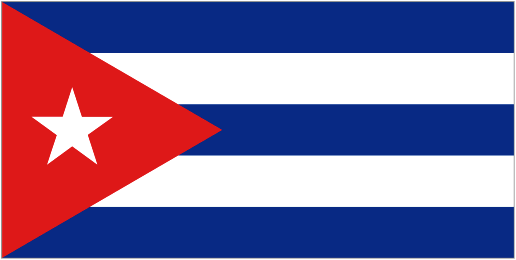
Cuba’s Triumph of the Revolution Day

January 1

Just like the child born on Christmas, Cuba gets the short end of the stick when it comes to celebrating its “Triumph of the Revolution”. That’s because on January 1 the rest of the world is busy celebrating New Year’s. To the Cubans, the world is celebrating with them. It’s all a matter of perspective.

This small island 90 miles to the south of Florida has been the focal point of the struggle between capitalism and socialism in the Western hemisphere for half a century.

On this day in 1959, U.S.-backed President Fulgencia Batista fled the country after his troops faced a disastrous defeat at the hands of Ernesto “Che” Guevara’s and Camilo Cienfuegos’s rag-tag guerrilla armies. This allowed former baseball player and enemy-of-the-state Fidel Castro to assume power of the country, a position he held onto with an iron grip until February 2008. Suffering from an undisclosed illness, Castro turned power over to his brother, Raul Castro. By that time Fidel Castro had become one of the longest reigning rulers in the history of the Western hemisphere.

Cuba has spent the past 50 years defying world expectations. First in 1959, and again in the 1990s, when its sugar-daddy—the Soviet Union—collapsed. But Cuba outlived its supporter, and subsisted without its aid.

That’s not to say the country has flourished economically, or that its one-party government permits basic freedoms. But its people–at home and abroad–understand how to live each day.

It’s illegal for United States citizens to visit Cuba, part of the economic embargo the U.S. has placed on Cuba for over 4 decades. But many Americans do visit the island via other countries. Cuban officials just know not to stamp their passports.

Ujima & Ujamaa and Muhammad Nassardeen

December 28 & 29

December 28th and 29th are the 3rd and 4th days of Kwanzaa. The themes of these days are Ujima (Collective Work and Responsibility) and Ujamaa (Cooperative Economics). On the surface these do not sound like the general feel-good (or feel-bad) sentiments that accompany most holidays. For the record, other days of the celebration include themes such as Unity, Purpose, and Faith–themes more consistent with older holidays. Ujima and Ujamaa may be overshadowed by these more traditional holiday themes, but all are equally important.

Umoja, or Unity, is the first step, asking the community to recognize itself as a united group.

Kujchagulia, Self-determination, asks the African-American community to define itself and its future on its own terms rather than through the eyes of others.

Ujima and Ujamaa are the nuts and bolts of the operation. They require not just talk but actual tangible steps to achieve.

One man who did just that was Muhammad Nassardeen. His organization Recycling Black Dollars was an effort to keep the money of the African-American community within the community. White neighborhoods recycle dollars 5 times. Latino communities recycle dollars 3 times. And Asian-American communities as much as nine times. But Nassardeen found that the African-American community recycled the average dollar less than 1 time.

By creating and encouraging businesses and organizations, including local churches, to bank and buy within the Los Angeles African-American community Nassardeen helped to increase the wealth of the community substantially.

Unfortunately Nassardeen died in October 2007 of a heart attack. But his contributions to Cooperative Economics are remembered this Kwanzaa in the city where Kwanzaa first greeted the world.

[originally published Dec. 29, 2007]

Kwanzaa

December 26 – January 1

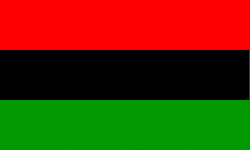
kwanzaaflag

God makes three requests of his children: Do the best you can, where you are, with what you have now.

— African-American Proverb

Originally intended as an Afrocentric alternative to Western holidays in the United States, Kwanzaa is now celebrated by people of African heritage in Europe and the Caribbean as well as by millions in Africa itself. The term Kwanzaa comes from the Kiswahili phrase “ya kwanzaa” meaning “first fruits.” The name refers to the ageless African tradition of harvesting the first fruits of the season. According to afriqueonline.com, “Kwanzaa is a time of year for black people to come together to celebrate the fruits of our labor during the past year.”

Other names you might hear today:

Mishumaa saba: the seven candles.

Nia: purpose

And perhaps most important: Nguzo Saba.

Nguzo Saba means Seven Principles, or Seven Reasons. The week-long celebration of Kwanzaa emphasizes one of the seven principles each day.

  • Umoja – Unity – Dec. 26
  • Kujichagulia – Self-Determination – Dec. 27
  • Ujima – Collective Work and Responsibility – Dec. 28
  • Ujamaa – Cooperative Economics – Dec. 29
  • Nia – Purpose – Dec. 30
  • Kuumba – Creativity – Dec. 31
  • Imani – Faith – Jan. 1

The Nguzo Saba are the “minimum set of values African Americans need to rescue and reconstruct their lives in their own image and interest and build and sustain an Afrocentric family, community and culture.” — Kwanzaa founder Maulana Karenga

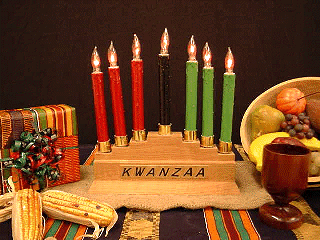
The Kinara (candleholder) symbolizes African ancestors; The Mishumaa Saba (7 candles) symbolize the 7 Principles

Umoja

On the first day of Kwanzaa African-Americans celebrate Umoja, or “unity”. It is the foundation of the seven Nguzo. Politicians often call upon “unity” as a slogan in the national arena, yet the concept of unity is overlooked within our communities and within the family.

Unity of the family is the building block of Umoja. It means unity of father and mother as role models for their children, and respect for one’s elders. Karenga notes that in many Western societies the elderly have been cast aside “leaving them with only failing memories.” African communities utilize the experience of their elders as judges and conflict resolvers. Their participation benefits both the society as a whole and the elders themselves.

A central purpose of Kwanzaa is to teach the younger generation about traditions that were passed down by Africans for countless generations, but were violently torn away during the slave trade and slavery. Marcus Garvey wrote:

A people without knowledge of their past history, origin and culture is like a tree without roots.

Umoja extends from family to community, from community to nation, and from nation to race. Applying the concept of umoja to the entire race is a difficult challenge. The African continent is home to over 50 nations. Each of these nations has not only its own ethnic identity, but several, often competing identities. And attempting to apply umoja to the entire continent and to all those descended from it is nothing less miraculous than uniting the entire planet.

But the principle of umoja is a practice as well as a principle. And the practice of umoja begins at home, one family at a time.

Tomorrow we celebrate the principle and the practice of Kujichagulia: Self-Determination…

Up you mighty race: accomplish what you will.

— Marcus Garvey

The first Kwanzaa stamp, 1997

Boxing Day

December 26

St. Stephen

“In London and other places, St. Stephen’s Day, or the 26th of December, is familiarly known as Boxing-day, from its being the occasion on which those annual guerdons known as Christmas-boxes are solicited and collected…

The Book of Days

As a child I thought it odd that the British, so seemingly refined (compared to us their American cousins), would dedicate the day after Christmas to such a brutal and pugilistic sport. Yet there it was on the calendar: “Boxing Day – UK”.

Apparently the holiday has very little to do with the sport, but everything to do with gift-giving. And no, it’s not about boxing up all the gifts you don’t want so you can return them to the store either.

According to The Book of Days (1882)…

“The institution of Christmas-boxes is evidently akin to that of New-year’s gifts, and, like it, has descended to us from the times of the ancient Romans, who, at the season of the Saturnalia, practised universally the custom of giving and receiving presents. The fathers of the church denounced, on the ground of its pagan origin, the observance of such a usage by the Christians; but their anathemas had little practical effect, and in process of time, the custom of Christmas-boxes and New-year’s gifts, like others adopted from the heathen, attained the position of a universally recognised institution. The church herself has even got the credit of originating the practice of Christmas-boxes…

“…Christmas-boxes are still regularly expected by the postman, the lamplighter, the dustman, and generally by all those functionaries who render services to the public at large, without receiving payment therefor from any particular individual. There is also a very general custom at the Christmas season, of masters presenting their clerks, apprentices, and other employes, with little gifts, either in money or kind.

“St. Stephen’s Day, or the 26th of December, being the customary day for the claimants of Christmas-boxes going their rounds, it has received popularly the designation of Boxing-day.”

Boxing-night was a night of much joy and revelry. The Book of Days goes on to tell us that “the theatres are almost universally crowded to the ceiling on Boxing-night” as the pockets of the working class are stuffed with recently received year-end bonuses.

You can also find some packed pubs and bars on Boxing Day, as celebrants, having spent 24-48 hours with family, join their friends to bid a fond farewell to the Christmas season, if not the Christmas spirit.

[Of course , Boxing Day is actually only the second day of the twelve days of Christmas, so the season doesn’t technically end until Epiphany on January 6.]

George Washington’s Christmas Gift

December 23

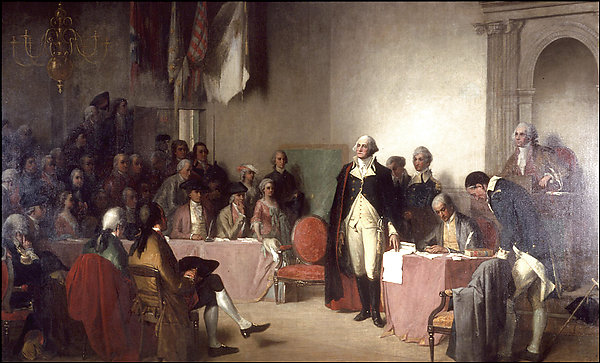
Washington resigns as General

On this day in 1783, the most powerful man in the Western Hemisphere, the Commander-in-Chief of the Army of the United States who had achieved independence from Britain, the world’s strongest superpower, voluntarily surrendered his sword and his title to the Continental Congress in Annapolis, Maryland. He returned to his home in Mount Vernon, Virginia, expecting to live a quiet farm life.

His plans were derailed a few years later when he was elected to serve as President of the 1787 Constitutional Convention in Philadelphia.

Maryland to Unveil Washington’s Resignation Speech
George Washington’s Resignation Speech – 7MB file

Night of the Radish

Forget everything you know about radishes.

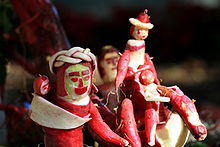
Night of the Radishes is one of the most unique holidays in the Western hemisphere.  It has been celebrated in Oaxaca for hundreds of years, but only became an official holiday in 1897.

Radishes are actually native to China, and were brought to the New World by Spanish explorers in the 1500’s. Two friars encouraged the the townspeople of Oaxaca to cultivate the radishes, and it is believed one of the friars suggested they carve and display the radishes to encourage the locals to buy their produce.

Night of the Radishes

Festivus: a Holiday for the Rest of Us

December 23

On December 18, 1997 Frank Costanza (Jerry Stiller) introduced the TV-watching world to a new holiday tradition. In the Seinfeld episode “The Strike” George’s father explains to Cosmo Kramer how years earlier, fed up with the commercialization of Christmas, he conceived of the new holiday:

“Many Christmases ago, I went to buy a doll for my son. I reached for the last one they had, but so did another man. As I rained blows upon him, I realized there had to be another way.”

Frank summed up the holiday in a simple catch-phrase: “A Festivus…for the rest of us.”

Over a decade later Festivus has exploded into an international–well, okay, national–phenomenon. According to the Big Book of Girl Stuff:

“Festivus was intended to be a holiday that required no shopping. The only Festivus decoration is a bare metal pole, which can be stuck in a pot or hung from the ceiling.”

Festivus Poles

Another Festivus tradition is the “Airing of Grievances” during which family members announce how disappointed they have been in one another over the past year.

As far as cultural anthropologists have deduced, the holiday was invented by the father of Seinfeld screenwriter Dan O’Keefe in the 1960s, although the younger O’Keefe altered the holiday for the Seinfeld version. The original Festivus for example was held anytime from December to May. The modern incarnation is celebrated on December 23, halfway between Winter Solstice and Christmas.

But these days Festivus has competition for the December 23 spot. A holiday known as HumanLight is also celebrated on the 23rd. HumanLight is a non-denominational festival that makes no reference to the divine or supernatural. It was started by a Humanist organization in Verona, New Jersey in 2001. Its purpose: to provide a non-religious alternative to Christmas, Hanukkah, and other December celebrations.

It’s unlikely the December 23rd date was chosen to oust Festivus, but Festivus participants will gladly take on the challenge. You see, the final activity of Festivus is known as “Feats of Strength”: no Festivus party is declared over until someone can successfully pin the host’s head to the ground.

So have a great Festivus, and if you’re throwing a party, consider plush carpeting.