…I do not want much of a present, anyway, this year.
After all I am alive only by accident.
I would have killed myself gladly that time any possible way…
There’s nothing like the poetry of Sylvia Plath to brighten up a birthday celebration. Today, October 27, is Sylvia Plath Day in Northampton, Massachusetts, where Plath attended Smith College. She was born on this day in 1932, and died thirty years later, on February 11, 1963.
Plath lost her father at an early age. She suffered from depression and mental illness, which she described in her semi-autobiographical work, The Bell Jar. The Bell Jar details the mental and emotional journey of college student Esther Greenwood, who interns at a New York fashion magazine. (Think “The Devil Wears Prada” without the catchy soundtrack and more electroshock therapy.)
At age 23, Plath married English poet Ted Hughes. Plath taught at her alma mater Smith before moving to England with Hughes. Her first poetry collection was published in 1960.
Smith suffered a miscarriage, but the couple later had two children, Nicholas and Frieda. Plath and Hughes separated in late 1962.
The following February, a month after the publication of The Bell Jar, Plath placed her head in the oven as her two young children lay sleeping in the next room.
…Sweetly, sweetly I breathe in,
Filling my veins with invisibles, with the million
Probable motes that tick the years off my life…
from A Birthday Present
Nearly two decades after her death, Plath became the first poet to win a posthumous Pulitzer Prize, for “The Collected Poems” published in 1981.
“I think that in today’s Prozac world and with depression often being glamorized as an intrinsic sign of artistic greatness, the real tragic dimensions of the disease get lost in the fervor. Sylvia may have thought her children would be better without her, who knows? From her poems and her journals, her writing indicates that she certainly loved her children and to say that her act was reprehensible belies an understanding of depression, which is not merely a case of the blues. It is a disease that overwhelms even the immeasurable love bonding a parent to a child…
“I assume that Sylvia Plath day is intended to celebrate her life and her talent. As a poet and an academic achiever, she is worthy of admiration. Her suicide is not to be admired but to be lamented.”
“Some return from Alaska. Not all die there. They return blind and rheumatic for the rest of their lives, with hands useless, shriveled as if in a gesture of perpetual anguish. Hands that long hours with the fishnets went numb from cold and chests that, worn-out from coughing lost all strength… Adventures! Fortunes! All a lie! Alaska is the hell that extinguishes faith and quickens curses to the lips.”
Alfonso Fabila, “The Horrible Hell of Alaska,” 1929
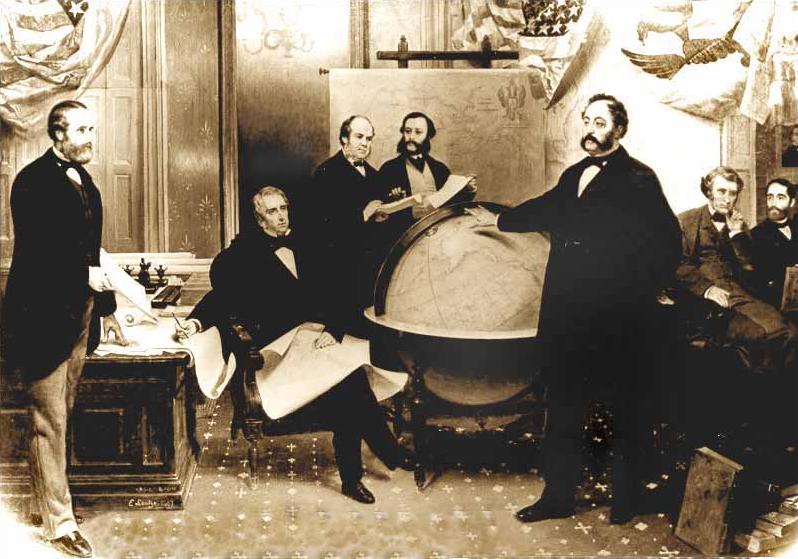
Well things have gotten a little better since Alfonso wrote his memoir, and today the state is home to over 700,000 Americans. October 18 is Alaska Day, celebrating the day in 1867 that Russia transfered 1.7 million square kilometers to the United States.
Signing of Treaty of Cessation of Russian Alaska to US
Recently my optometrist moved there. Now he’s an optical Aleutian. (Rim shot)
+ + +
Alaska is the largest state.
How big is it?
Alaska is so big, if it were a country, it would be the 18th largest in the world.
It’s bigger than France, Germany, the United Kingdom, Ireland, Italy, Switzerland, Portugal, Austria, and Greece combined.
According the Alaska Science Forum, Alaska has more coastline than all other states combined, and its lake areas alone are larger than the Hawaiian Islands.
17 of the 20 highest mountains in the United States are in Alaska.
Its former governor could see Russia from her house. (This has been disputed.)
+ + +
Secretary of State William Seward purchased Alaska from Russia in 1867 for 2 cents an acre. The deal, known as “Seward’s Folly”, paid for itself within 30 years. In 1896, gold was discovered near the Yukon, thus beginning the great Klondike Gold Rush.
After World War II, Seward was further vindicated when Alaska became one of the U.S.’s most prized possessions in terms of strategic defense. At its western-most point, Alaska is only 55 miles from Eastern Siberia.
These days residents of the lower 48 cherish Alaska for its wildlife and environmental diversity, as well for its large reserves of untapped oil. Because of this dichotomy, the state is the frontline in the battle between environmental groups and proponents of cost-efficient energy.
Alaska comes from an Aleut word meaning “the mainland.” The state’s motto is “North To the Future!”
This weekend I shared something with my one year-old niece: our first Canadian Thanksgiving. She was born just after Thanksgiving last year.
The most glaring difference I’ve noticed between Thanksgiving in the U.S. and in Canada is that Canadian Thanksgiving is on a Monday. Other than that, it’s pretty much the same.
In the process of celebrating Canadian Thanksgiving, I have learned a few other things about our Canuck brethren and sisteren.
1. Conservatives are blue and liberals are red, which when you think about it, makes more sense.
2. Election season in Canada is only SIX WEEKS LONG! Two years less than what we’ve had to endure south of the border.
3. It’s traditional for the Finance Minister to wear brand-new shoes when presenting the new budget.
4. Saskatchewan, despite its reputation as a barren wasteland, is the sunniest province in Canada. (Which is like being the rainiest place in the Sahara.)
5. Ottawa is the second or third coldest capital in the world, tied with Moscow, and right behind Ulan Batar, Mongolia.
6. Terrence & Philip is not a real TV show.
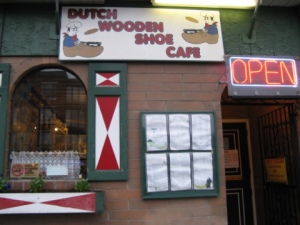
No Thanksgiving would be complete without breakfast at the Dutch Wooden Shoe Pannekoek House
We celebrated like true Canucks, enjoying breakfast at the Dutch Wooden Shoe Pannekoek House. In the afternoon we followed the age old wisdom of Canadian superstar Robin Sparkles…
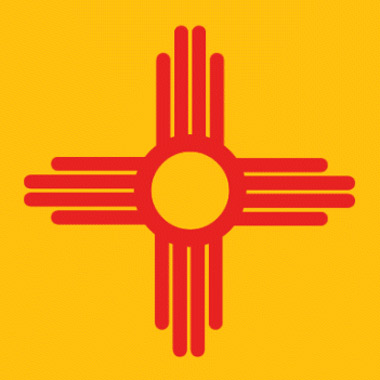
The flag of New Mexico honors the 'Four Directions'
The fourth Friday in September is known as Native American Day in California and across much of the United States. California recognizes over 100 tribes, more than any other state in the nation.
The original resolution establishing “American Indian Day” was signed by Governor Ronald Reagan in 1968.
30 years later, the California legislature declared:
An emphasis on freedom, justice, patriotism, and representative government have always been elements of Native American culture, and Native Americans have shown their willingness to fight and die for this nation in foreign lands.
Native Americans honor the American flag at every pow wow and at many gatherings, and remember veterans through song, music, and dance.
Native Americans use songs to honor the men and women of this country who have fought for freedom.
Native Americans love the land that has nurtured their parents, grandparents, and unnamed elders since time began, and they honor the Earth that has brought life to the people since time immemorial.
Native Americans have given much to this country, and in recognition of this fact, it is fitting that this state returns the honor by recognizing Native Americans for all of their offerings to this beloved land through the establishment of a state holiday referred to as “Native American Day.”
No mention of genocide, but that’s not what today’s about. Californians of all backgrounds and cultures meet in San Bernardino to celebrate the diversity and heritage of the land’s first residents.
+++++
John Harrington, Chickasaw astronaut
Elsewhere in the U.S., John Harrington, who turned 40 on September 14, is in the middle of a 4,000 mile bike-ride from Cape Flattery, Washington, to Cape Canaveral, Florida. (So what’s your excuse for not working out?)
As a member of the Chickasaw tribe, he carried a Chickasaw flag into space with him, aboard STS-113 in 2002.
His purpose for the bike-ride is to “encourage student participation in Science, Technology, Engineering and Mathematics.”
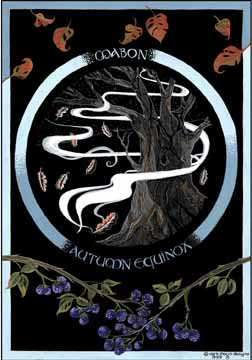
Vernal Equinox – on or around September 21 (Northern Hemisphere)
“Blessed be, by the Lady and the Lord, on this Mea’n Fo’mhair. It is the time of the second harvest, one of fruit and wine abundance. Tonight holds equilibrium of all things. Everything is in balance with one another. God and Goddess, Life and Death, Light and Dark.”
References to the Welsh god Mabon ap Mydron (Mabon, Son of Modron, or ‘Great Son of the Great Mother’) date back well over a thousand years. Today the name Mabon conjures up images of ancient Celtic rituals, of the fruits of the harvest, of flickering flames beneath an autumn moon. So you may be surprised to learn that ‘Mabon’—in reference to the autumnal equinox—dates not to the Dark Ages, but to the Disco Age (a dark age in its own right), the 1970s.
The holiday Mabon was coined by a grad student, Aidan Kelly, as part of a religious studies project. Kelly was following the Celtic and pagan tradition of naming holy days after gods and goddesses. Lughnasadh honors the Irish sun god Lugh. Beltane is believed to originate from Ba’al. The spring equinox is named for the German goddess Ostara, from which our word Easter also derives.
There was a holiday known as “Mabon’s Day” in Wales in the 19th century. But that holiday was named for William “Mabon” Abraham, a labor leader responsible for improving miners’ working conditions in Wales, (Mabon is a colloquialism for “young leader” in Welsh) and took place on the first Monday of each month.
Since the 1970s, the autumnal holiday Mabon has gained wide acceptance as a Wiccan and neo-pagan celebration in North America. The Celts, however, didn’t observe the autumnal equinox as much as the cross-quarter days of Lughnasadh (early August) and Samhain (Halloween), the latter of which was Celtic New Year.
The “Second Harvest” is known by many names: Cornucopia, Wine Harvest, Harvest Home, and the Feast of Avalon.
Avalon, one of the many Celtic names for the Land of the Dead, literally means the “land of apples…Celebrating new-made wine, harvesting apples and vine products, and visiting burial cairns to place an apple upon them were all ways in which the Celts honored this Sabbat.
It’s a joyous celebration, but whereas the spring festivals celebrate birth and fertility, at the time of the harvest, Mabon participants remember their ancestors.
A similar tradition exists in Japanese culture. On the equinox, the Japanese visit the graves of their ancestors. It is known as O-higan, or “the Other Shore.” Buddha is said to walk the earth when night and day are equally divided.
Mabon is also known by variants of Fomhair. In Gaelic, the months of September and October are the only two to share a name: Mi Mean Fomhair and Mi Deireadh Fomhair: mid-harvest month and end-harvest month.
September 17 is one of the most important dates in U.S. history. In fact, it’s known as Citizenship Day, yet most Americans would be hard-pressed to tell you why.
On September 17, 1630, the city of Boston—North America’s cradle of liberty—was founded by some of the country’s first immigrants.
Governor John Winthrop and the Massachusetts Bay Colony Puritans christened the 780-acre peninsula after the town from which many of them hailed. Boston, Lincolnshire, in England was a city about 100 kilometers north of London, named for a 7th century English abbot, St. Botolph. Botolph’s Town was shortened to Bo’s’town, and later to Boston. (Tale of Two Bostons)
Wee shall be as a Citty upon a Hill, the eies of all people are uppon us.
John Winthrop, 1630
But that’s not why September 17 is Citizenship Day.
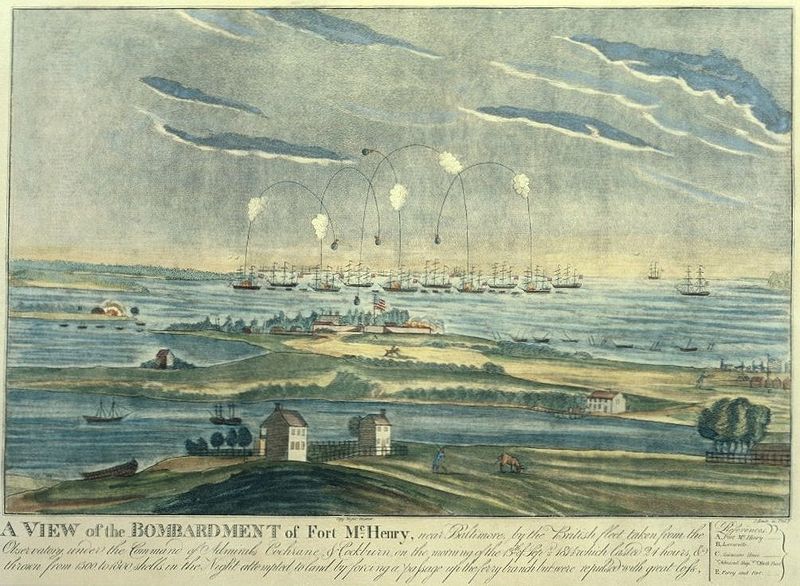
No, September 17 was the day in 1814 that a 35 year-old lawyer-poet printed a poem based on his experiences in the bombardment of Baltimore in the War of 1812.
In August 1814, Francis Scott Key had been sent on a mission to negotiate the release of a popular, elderly American physician captured by the British. The British agreed to do so, but because Key had heard of the planned attack on Baltimore, he was forced to stay a captive aboard a British vessel during the battle. The next morning, Key was inspired to see the star-spangled American flag waving defiantly above Fort McHenry. Key’s poem was set to the tune of an old English drinking song and eventually became the country’s national anthem. (Star-Spangled Banner)
Bombardment of Fort McHenry, 1814
But that’s not why today is a national holiday.
Nope. In fact, September 17, 1862 was the bloodiest day in American history.
Troops under Confederate General Robert E. Lee and Union General George McClellan faced off at the Battle of Antietam in Maryland. By day’s end over 20,000 Americans would lie dead or wounded. The horrific battle was a draw, but the devastating loss of men forced Lee to halt his invasion of the North. (Battle of Antietam)
For President Lincoln, it was a much-needed, well, tie. He’d been waiting for a Union victory to issue his proclamation to end slavery, without it looking like a last-ditch act of desperation on behalf of the North, which had been losing battle after battle. Five days after the carnage of Antietam, Lincoln announced that as of January 1, all slaves in areas of rebellion would be free.
Lincoln and McClellan, two weeks after Antietam
But again, that has nothing to do with September 17 being Citizenship Day.
Citizenship Day honors perhaps the most important date in American history. Yet you will hear no fireworks, see no parades or marching bands, and you won’t get a day off school or work. Unless you’re in grade school, you will probably go throughout your day without any sign of its passing.
If you are in grade school, however, U.S. federal law mandates that your lessons this week include instruction on the document created on this day in 1787 by the Constitutional Convention in Philadelphia.
That’s right, September 17 is Constitution Day in the United States, aka Citizenship Day. Before the Constitution, the Articles of Confederation had kept the newly-independent states loosely “united”, but made no provisions for a central government with any practical power. The Articles’ weakness was made apparent by a rebellion of irate farmers’ (Shay’s Rebellion) that U.S. troops were unable to stem, and which was finally put down by state militia.
A convention of state delegates convened in 1787 to resolve the problem of the Articles. James Madison, a 5’4″ Princeton graduate and a delegate from Virginia, was 36 years old at the time. His studies of political theory and European governments convinced him that only a system of checks and balances could prevent a strong government from descending into tyranny. Madison, who would be the country’s fourth President, is also considered the Father of the Constitution.
In addition to checks and balances between the executive, legislative, and judicial branches, the Constitution’s secret to longevity was a self-contained instruction guide for amending itself. The first ten amendments, ratified in 1791, guaranteed the states that the Congress of this new powerful, strong central government would pass no law restricting essential freedoms.
The Constitution was amended just five times over the next 100 years. Over the past 100 years, it’s been amended another dozen times.
The most recent amendment to the Constitution was the 27th Amendment, which restricts pay raises of Senators and Representatives:
No law, varying the compensation for the services of the Senators and Representatives, shall take effect, until an election of Representatives shall have intervened.
The amendment holds the record for the longest stretch between the proposal and ratification. The Amendment was introduced in 1789 as the second of twelve proposed amendments, ten of which became of the Bill of Rights. The 27th amendment was passed in 1992, after only two centuries in Congressional purgatory. (And they say nothing ever gets done in Congress!)*
In 2005 Congress changed “Citizenship Day” to “Citizenship Day and Constitution Day” to explicitly remind those of us out of school what today represents, and on the continuing struggle to form “a more perfect Union.”
*(In fairness to Congress, I should point out it wasn’t entirely their fault it took 202 1/2 years to pass an amendment. The amendment had to be ratified by 3/4’s of the states. Only 6 states ratified it initially, 4 short of the 10 necessary back when there were only 13 states. In 1992, the amendment finally reached the 3/4’s mark when Alabama became the 38th state to ratify it.)
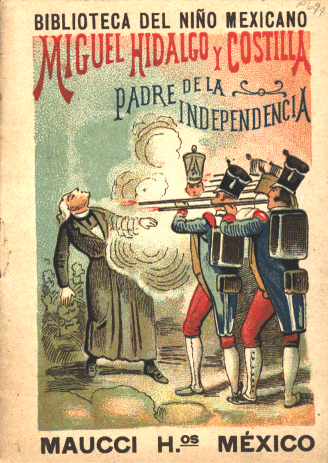
Before dawn, on the morning of September 16, 1810, townspeople of Dolores, Mexico, heard the church bells ring violently. They approached to find the parish priest, 57 year-old Father Miguel Hidalgo y Costilla. But the speech the criollo Father shouted was far from the sermon they had in mind.
Father Hidalgo had just learned that a plan to overthrow the Spanish rulers had been betrayed. Soon the Spanish would arrest all those involved and quash the independence movement. The exact words of the priest’s plea to the townspeople to bring an end to hundreds of years of European rule over the mestizo inhabitants, were not written down. It is said he raised the image of the dark-skinned Virgin of Guadalupe and concluded with a shout: Mexicanos, viva Mexico!
Mexico was still called “New Spain” at that point. Just addressing the crowd as Mexicanos, and willing into existence a land of “Mexico” was revolutionary. Father Hidalgo’s plea is called the Grito de Dolores, the “Cry of Dolores”, after the village in which it was made. But, as Dolores also means ‘sorrows’, it can also be interpreted as the Cry of Sorrows.
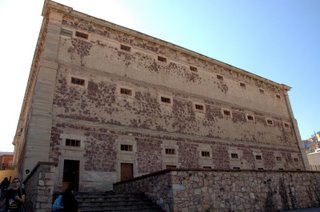
Just after dawn, the infant rebel army marched to San Miguel. By the time the rag-tag force reached Guanajuanto at the end of the month, it had swelled to 20,000 men. Though the men were poorly armed and insufficiently trained, their sheer numbers overpowered the small force of Spanish soldiers holed up at the Alhóndiga (public granary). Rebels stormed the Alhóndiga and most of the Spanish, as well as wealthy criollos, were massacred.
Alhóndiga de Guanajunato
Hidalgo and three other Mexican leaders were captured the following year on March 21, near the U.S.-Mexican border. They were convicted of treason, executed, and decapitated. Their heads were placed atop the four corners of the Alhóndiga in Guanajuanto as a message to the Mexican insurgents. There the heads remained for ten years.
On February 24, 1821, Mexican leaders signed the Plan de Iguala, which put forth the principles on which the country would be based, if the independence movement succeeded. Partly inspired by the Plan, conflicting Mexican forces joined together and defeated the Spanish army. The Treaty of Corboda assured the country’s long sought independence.
Father Hidalgo’s body was reburied in the country’s capital.
Today Mexicans celebrate their independence on the day of Father Hidalgo’s fateful shout for the autonomy, freedom, and equality for the Mexican people.
Today the Irish are as inseparable from the American identity as the stars on the red, white, and blue. But at one time the Irish were as discriminated against as any ethnic group. Immigrants who had crossed the Atlantic, fleeing the Emerald Isle’s deadly potato famine in the 1840s soon learned what N.I.N.A. stood for–No Irish Need Apply.
The wave of German and Irish-Catholic immigration in the mid 19th century was met with an equal wave of xenophobia called Nativism, an anti-Catholic, anti-foreigner movement sweeping through the mostly-Protestant states. This patriotic sentiment was compounded with a territorial war with our neighbor to the south, Mexico, in the 1840s.
John Riley, a native of Clifden, County Galway, was a young veteran of the British Army when he entered the U.S. through Canada. He joined the army in Michigan, and served in the 5th U.S. Infantry Regiment. But the animosity he experience against his religion and his countrymen caused him to desert the army prior to the Mexican-American War.
All told around 1000 Irish deserted the army before and during the war. They were not the first soldiers to do so, but 200 of them did the unforgivable. They banded together and enlisted with their fellow Catholics in the Mexican Army.
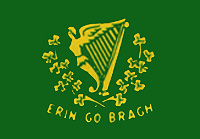
The St. Patrick’s Battalion, or San Patricios, fought in all five major battles of the Mexican-American War. General Santa Anna once said, had he a hundred more troops like Riley’s men, he would have won the war.
At the Battle of Churubusco in 1847, the San Patricios met their end. Of approximately 200 men, 35 were killed and 85 were taken prisoner. Nearly 50 prisoners were sentenced to death by hanging. Riley escaped execution because he had deserted prior to the declaration of war. He was merely given 50 lashes on the back, branded with the letter “D” (for deserter), and forced to wear an iron yoke around his neck for the duration of the war.
The prisoners were hanged between September 10 and September 13, by order of General Winfield Scott, in full view of both armies at the battle of Chapultepec, and were forced to watch from the gallows as the U.S. flag replaced the Mexican flag above the town. The victims included one soldier who had had both legs amputated the day before.
The U.S. Army denied the existence of the St. Patrick’s Battalion until a Congressional investigation in 1915.
In Mexico, the Irish martyrs are remembered during two holidays: St. Patrick’s Day on March 17, and the Commemoracion de los San Patricios on September 12, the anniversary of most of the executions.
And on this one day, Riley’s hometown of Clifden, Ireland, flies the Mexican flag in honor of the men of St. Patrick’s Battalion.


 September 17 is one of the most important dates in U.S. history. In fact, it’s known as Citizenship Day, yet most Americans would be hard-pressed to tell you why.