Birthday of the King: Elvis

January 8

The Mississippi Delta was shining
Like a National guitar,
I am following the river
Down the highway
Through the cradle of the civil war,

I’m going to Graceland, Graceland
In Memphis Tennessee…
…I’ve reason to believe
We both will be received
In Graceland

Paul Simon, Graceland

Today is the birthday of the King of Rock ‘n’ Roll Elvis Presley. Though not an official holiday in any nation, it is observed throughout the world.
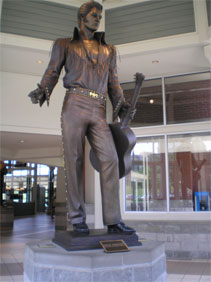
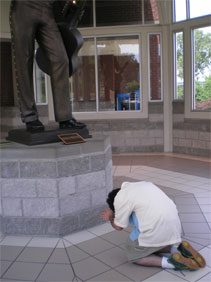
Elvis statue Elvis worshipper

(Above: the author praises the King in Memphis, Tennessee)

The focal point of the celebration is Graceland, Elvis’s former home in Memphis, Tennessee. Festivities begin each year with a gospel tribute at the Gates of Graceland at midnight.

Graceland was not named by Elvis, but by the original owner S.E. Toof after his daughter Grace.

Elvis Presley was born in Tupelo, Mississippi. At age 13 the Presley family moved to Memphis, Tennessee, where Elvis lived for most of his life.

In 1957 the 22 year-old superstar purchased the Graceland mansion in Memphis. He was proud to move his parents into it, a long way from the two-room house where Elvis was raised. His mother Gladys died the following year.

Graceland living room

Early viewers of Elvis’s concerts, such as rock legend Roy Orbison, cite his instinct and incredible energy as a performer as separating him from the artists before him. It is difficult to convey the novelty of Elvis after the half-century of imitations and changes that followed. Various morality groups assailed him for his “vulgar” and “obscene” music and movements on stage.

His discoverer, Sam Phillipsof Sun Studios, said Elvis “put every ounce of emotion…into every song, almost as if he was incapable of holding back.”

When Elvis first entered the Sun Studios, receptionist Marion Keisker asked him who he sounded like. He is reported to have said “I don’t sound like nobody.”

While this was true in mainstream radio, Elvis was heavily influenced by the black gospel singers he had seen at Memphis’ Ellis Auditorium and black blues performers in the clubs along Beale Street.

Stories make it sound like Elvis walked into Sun Studios and the rest is history, but in fact, after his first recording in 1953, Elvis politely hassled Sam Phillips for a year—while working as a truck driver—before Sam teamed him up with bassist Bill Black and guitarist Scotty Moore. The three recorded a high-energy version of black R&B artist Arthur Crudup’s “That’s All Right, Mama” in July and the single was released that month. Some white disc jockeys refused to play Elvis’ music at first, believing Elvis was black.

In January 1956 RCA released Heartbreak Hotel, co-written by a part-time Florida schoolteacher Mae Boren Axton, who was inspired by the newspaper epitaph of a suicide victim: “I walk a lonely street.”

Heartbreak Hotel slowly and steadily climbed the charts, entering at #1 68 in March, and making its way to #1 in May.

Elvis the #1 Hits: The Secret History of the Classics

Though Graceland is considered the musical Mecca for Elvis fans, do not miss Sun Studios just to the east on Union Avenue, for a more in-depth historically revealing tour about Elvis and Memphis music history.
Victory Over the Genocidal Regime Day

January 7

When Cambodia has a holiday it does not mess around with names.

Victory Over the Genocidal Regime Day, or Commemoration of the Fall of the Khmer Rouge, marks the end of the Pol Pot led genocide of 1.7 million Cambodians during the 1970s, out of a population of 7 million.

“We will always remember the most horrific events of three years, eight months and 20 days under the regime of Democratic Kampuchea, which carried out the most cruel genocide policy resulting in massive and limitless destruction.”

–President of the Cambodian People’s Party in a 2004 address, marking the 25th anniversary of the fall of the Khmer Rouge. (BBC)

Most of the killings occurred between April 17th, 1975, when the Khmer Rouge assumed power of Cambodia until January 7th, 1979, when after a two-week war with Vietnam, the Vietnamese government invaded ousted Pol Pot and his followers.

The dates April 17th and January 7th are remembered by every Cambodian, for there is virtually no family that did not lose someone during the Khmer Rouge regime.

The genocide was the result of the world’s most morbid social experiment. The Khmer Rouge virtually annihilated the middle and upper classes of Cambodia, and did not stop there. Anyone deemed educated or cosmopolitan was killed. Ordinary people could be killed simply because they wore glasses, seen as a sign of literacy.

In an effort to “purify” the “Khmer race” and create an absolutely classless utopian society, the Khmer Rouge began by emptying all Cambodian urban centers of their population, abolishing banking, finance and currency, outlawing all religions, reorganizing traditional kinship systems into a communal order, and eliminating private property so completely that even personal hygiene supples were communal.

http://www.yale.edu/cgp/kr.html

Orn Theng recalled:

“I was the only one who survived in my family [of nine],” Orn said. “It was not because they didn’t have food … there was bran and rice in stock. They didn’t kill us with hoes or axes. They killed us by starving us.”

http://www.rfa.org/english/news/social/2007/03/16/cambodia_krtrial/

Yet despite the bloodshed the Khmer Rouge flag still hung at the United Nations until the 1990’s. Ben Kiernan, a professor who works to document and increase awareness of genocides in places like Cambodia and East Timor, compares it to:

“Image the swastika flying in New York in the 1950s, with the Nazis still maintaining an army on the border of Europe and threatening to return to power.”

http://www.yalealumnimagazine.com/issues/03_11/easttimor.html

In addition to the almost two million lives lost, hundreds of thousands of Cambodians emigrated during and after those years.

The largest concentration of Cambodians in the USA, and perhaps anywhere outside Cambodia, is Long Beach, California, although the Cambodian population of Lowell, Massachusetts is soon to surpass it.

10th of Tevet – the Siege of Jerusalem

January 5, 2012

December 17, 2010

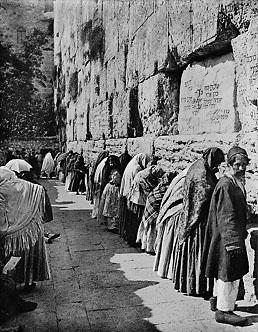
Wailing Wall, Jerusalem, early 20th century

The Big Guy of the three consecutive Jewish holy days is the last, the Tenth of Tevet. It is a day of fasting.

The Tenth of Tevet marks the first day of the siege of Jerusalem in 589 BC by the Babylonian king Nebuchadnezzar (630-562 BC). The city would fall thirty months later in 587. It was actually the third time in as many decades that Jerusalem had faced the Babylonians.

The first was in 606 BC by King Nabopolassar; the second around 597 BC by his son, the new king, Nebuchadnezzar, and finally eight years later by Nebuchadnezzar again. This time Nebuchadnezzar was feeling less charitable toward the city’s residents. After the city’s walls were breached, Solomon’s Temple was destroyed, Jerusalem was razed to the ground, and its remaining inhabitants were exiled.

This date is among the most tragic in all of Jewish history and yet, as Rabbi Yaakov Asher Sinclair points out, “on the tenth of Tevet itself, ostensibly, nothing really tragic happened. No wall was breached. No one died. Not a shot was fired. Only the siege was begun.” However the day marked the beginning of the end. The diaspora that would define the shape of Judaism for millennia.

The 10th of Tevet has also been chosen by some as a symbolic anniversary date of the millions who died in the Holocaust, whose dates of death may not be known.

In March of 2003, as the U.S. prepared for war, stories circulated about Saddam Hussein comparing himself to the ancient biblical king Nebuchadnezzar. And an evangelical minister stated in his sermon that Nebuchadnezzar was one of “the world’s greatest terrorists, maybe even higher than Bin Laden or Hitler…” Yet in Iraq he is considered a national hero. How is this dichotomy possible?

Nebuchadnezzar’s reign lasted 45 years, during which time Babylonia was at the peak of its power. He wrested his father’s territory from the Assyrians, halted Egyptian dominance, and defended the empire from Persian invaders. Under his rule Babylon grew to be the largest and most glorified city in the world with a defensive wall that stretched 56 miles. The metropolis boasted hundreds of towers, including the massive ziggurat we know as the “Tower of Babel” and the Great Temple of Marduk which held a 25 ton golden statue of Baal. His most innovative creation may have been the Hanging Gardens of Babylon. One of the Seven Wonders of the Ancient World, the Gardens were irrigated by a series of hydraulic pumps. According to legend the Gardens were built to cheer up Amytis, Nebuchadnezzar’s wife, who was homesick for her native land of Midea.

It would be like a single President ruling America from FDR through the Reagan years, taking the country from depression to superpower and defeating both Germany and the USSR in the process–not to mention overthrowing a few Central American republics along the way. So it is not difficult to see how he could be regarded as a national hero to one people, even though he brought about the near annihilation of his enemies.

The strange truth is, though Baghdad sits near what was once Babylon, the ancient civilization bears little resemblance to Iraq. To the Judeans Babylonia symbolized the boundless superpower. An ostentatious empire governed by decadence, arrogance and amorality.

Its leader was the son of the former leader Nabopolassar. Both father and son waged large military campaigns in the Middle East. And during their reign Babylonia won out over its enemies as the world’s single superpower.

So how can two societies with such conflicting memories of the same events ever find a common ground?

The answer may come in the shape of a figure who arrived on the scene an estimated 1500 years before Nebuchadnezzar: Abraham. Abraham (Ibrahim in Islam) is the father from which all three religions derive. He is the first monotheist. But his story is for another day…

Mother of All Sermons

Tenth of Tevet

Myanmar Independence

January 4

It is not power that corrupts but fear. — Aung San Suu Kyi

The people of Myanmar–formerly Burma–are in a difficult spot while celebrating January 4, the anniversary of their independence. The public secretly reveres the country’s national hero, but cannot utter his name outdoors.

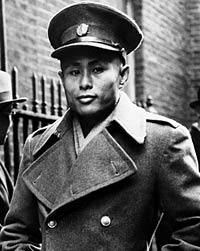
The main force behind Burma’s independence was Aung San. During World War II Aung San was Commander of the Burma Defense Army. He opposed British rule in Burma and saw an alliance with Japan as the way to independence. However, San soon saw that the thin veneer of independence achieved from the British was a sham. For the nation was now under the thumb of the more-controlling Japanese.

Aung San founded the Anti-Fascist Organization in Burma, and led the Burma National Army with the help of the British against the Japanese, whom they ultimately defeated.

Aung San
Aung San

In 1947 Aung San negotiated the “Aung San-Attlee Agreement” with the British, which guaranteed Burma’s independence the following year.
Aung San would not live to see the free Burma. He was assassinated along with six other Councillors at an Executive Council meeting in July 1947. He was 32.

Aung San’s daughter, Aung San Suu Kyi, is and has been for twenty years, an outspoken critic of the current Burmese (Myanmar) government.

Suu Kyi was 2 years old when her father died and Burma gained its independence. She lived most of the next 40 years in peace and quiet. At 43 she was “leading a quiet life in England as a housewife and academic.”
http://www.webcom.com/hrin/magazine/jan97/burma.html

She returned to Burma to care for her mother who was gravely ill at the time. A month before her visit in 1988, riot police shot and killed 200 demonstrators, mostly students. In August they killed close to 3,000.

I could not, as my father’s daughter, remain indifferent to all that is going on.

— Aung San Suu Kyi

Martial law was declared in 1989. Ang San Suu Kyi became head of the opposition party, the National League for Democracy. Due to her rising popularity she was placed under house arrest. She would not see her children in 2 1/2 years.

Aung San Suu Kyi should have taken office when her party won the national election in 1990. However, surprised by their overwhelming loss, the military junta refused to acknowledge the election.

According to the BBC, Suu Kyi “has spent more than 11 of the past 18 years in some form of detention under Burma’s military regime.”

As a result “Aung San’s name has been dropped from official speeches. His boyish face has disappeared from Burmese bank notes. His grave has been closed to the public for years.” — time.com

In 1991 Aung San Suu Kyi won the Nobel Peace Prize while under house arrest. When she was released in 1995, she was told if she left the country she could not return. Thus she did not leave even when her husband in London was diagnosed with prostate cancer in 1997. She never saw him again. He died in 1999.

She was placed under house arrest again in 2000, where she has remained for most of the past decade.

The irony of imprisoning the daughter of the father of national independence has not been lost on the military junta. Its military chief Than Shwe has called for a “discipline-flourishing democratic state.”

Whether Aung San Suu Kyi will, unlike her father, live to see the promise land, a democratic Burma, remains to be seen. She still fervently clings to a non-violent approach to regime change, despite knowing that peaceful change may take longer. She believes it is a precedent that must be set.

Update: Aung San Suu Kyi was released from house arrest on November 13, 2010.

St. Genevieve

January 3

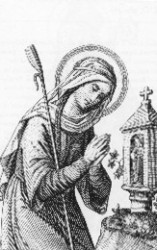
St. Genevieve of Paris

Today is St. Genevieve’s feast day. She’s honored as the Patron Saint of Paris.

St. Genevieve became a nun at the tender age of 15 and devoted the rest of her life—another 65 years—to Christ. The secret of her longevity may have been her diet. She didn’t eat much more than barley bread and beans, and according to her biography, only twice a week, Sundays and Thursdays. She loosened this restriction at the age of 50 at the request of some bishops.

When Huns Attack

During the Hun invasion of what’s now France in 451, St. Genevieve’s prayers were believed to have prevented the Huns from attacking Paris; they headed toward Orleans instead. (Notice Genevieve is not the patron saint of Orleans…)

St. Genevieve
St. Genevieve

The following decade, during the lengthy Childeric siege on the city, Genevieve sneaked through a blockade to bring back much-needed grain to Paris’s starving citizens.

Death did not stop Genevieve from performing miracles. Parisians held a procession of her relics during the deadly plague of 1129 which killed 14,000 people. Spread of the disease ceased almost immediately, and many who were sick were reported to have healed upon touching her relics.

St. Genevieve’s saint day is January 3, but for centuries Parisians celebrated the anniversary of that first procession–November 26, 1129–with another procession in her honor.

Berchtold’s Day – Switzerland

January 2

Berne Coat of Arms

We made it to day 2 of the new year and the Swiss are already celebrating their second holiday.

Berchold’s Day, January 2, is named after Duke Berchtold V of Zahringen who founded the capital city of Switzerland in 1191.

Local legend goes that Bertchtold announced he’d name his future city after the first animal he slay on his hunting trip. He scored a bear, and thus the city is called Berne. (Good thing he didn’t kill a donkey.)

A duller theory is he named it “in memory of Dietrich of Berne (Verona), a favourite hero of Alamannic poetry.” (Names and Their Histories, Isaac Taylor, 1856″)

The Great Bear Hunt

St. Brechtold’s Day is celebrated mostly in the area around Berne. Though the confederacy of Switzerland is 700 years old, each region has maintained their own culture and identity. Switzerland’s central location in Western Europe makes it the “melting pot” of very white people: French, German, Italian, and Swiss. So I guess it’s more of an assorted cheese wheel of cultures, since it hasn’t really melted yet.

According to sacred-texts.com:

…the second day of January is devoted to gay neighborhood parties in which nuts play an important part.

You know, I’m not even going to quote you the rest of that.

Okay, yes I am.

In early autumn children begin hoarding supplies of nuts for Berchtold’s Day, when they have “nut feasts.” Nut eating and nut games, followed by singing and folk dancing…One favorite stunt of the boys and girls is to make “hocks.”

Hocks are made up of five nuts—a pyramid with four nuts on the bottom and one on top—and apparently they’re harder to construct than you’d think. We don’t know why nuts are involved. Officeholidays.com theorizes that Berchtold really killed a squirrel.

Whatever the reason, there’s no better way to usher in the New Year than by breaking out some nuts, build those pyramidal hocks, and sing the national song of Switzerland:

O Great Berchtold
You killed a bear
You founded Berne
We stack nuts in your honor.

— Ancient Swiss Canto*

Photos of Berchtoldstag Parade

[*Ok, just to clarify, this is a made-up song, not the Swiss anthem. — Ed.]

Tweeda Newa Jaar – South Africa

January 2

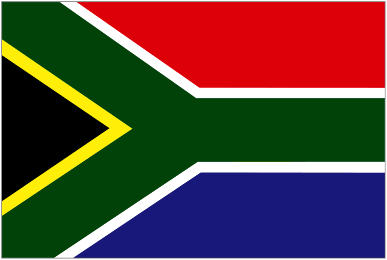
flag_south_africa

In Cape Town one day isn’t enough time to celebrate the New Year. So residents celebrate Tweede Nuwa Jaar, “Second New Year.”

On this day thousands line up along the streets to watch, or participate in, one of the most fascinating New Year’s celebrations in the world. The world-famous Coon Carnival.

Regarding the name, says one participant:

“The Americans come and they don’t want us to use the word Coon because it’s derogatory for the people. Here Coon is not derogatory in our sense. For us the minute you talk Coon, he sees New Year day, he sees satin and the eyes and mouth with circles in white, the rest of the face in black, like the American minstrels.”

Yes, on this day Cape Town musical groups called troupes or kaapse klopse don colorful uniforms inspired by American minstrels of the previous century. They paint their faces bright white and march down the Bo-Kaap part of the city. It has been called “a riot of color and sound” and, though it has no equal, might be compared in feel to the Mardi Gras celebrations in Brazil.

The celebration has been shunned by some members of the upper echelon, who prefer the more refined Malay Choirs and Christmas Bands. But in 1996 when Nelson Mandela put on the outfit of a minstrel troupe to open the Carnival, the traditional march outgrew its working class roots and gained a little more acceptance among the intellectual elite.

Denis-Constant Martin writes in Coon Carnival: New Year in Cape Town

“To the sounds of wind instruments, ghoemas, and tambourines, they march, dance and sing along Darling Street, past the Grand Parade, into Adderley Street, up Wale Street, into Chiappini Street, then Somerset Road and to Green Point where they go into the stadium for the second round of competitions.”

These troupes are from different parts of the city, and can number over a thousand members. To become part of a troupe all you need’s a uniform. You can beg or buy them from the group captain or bargain with him for a price. Indeed that’s how the groups make their money, from the sale of uniforms. Without a uniform, you’re not in the band, period.

The colorful outfits change each year and were inspired by the American minstrels who visited Cape Town in the mid to late 1800’s. They would smear burnt cork on their face to simulate “black face.” Locals imitated the outlandish dress, hat, and umbrella, but reversed the make-up to wear “white face” and the carnival was born.

The significance of January 2nd is that it was the one day of the year slaves were given holiday. Today the parade is an expression of the joy of life, of victory over the struggle of slavery and then apartheid, and a symbol of freedom and independence.

With the popularization of the carnival though, residents are concerned about the ideals the parade represents. Writes Joel Pollak

There is a widespread fear that organizing the Coon Carnival to appeal to foreign tourists and commercial sponsors would mean taking it away from the local communities that have kept it alive for over a hundred years, in effect reserving the best seats for tourists just as they were once reserved for whites at the segregated stadiums.

Time will see what’s in store next for the Minstrel Carnival, as city officials call it now.

O-Shogatsu: Japanese New Year

January 1

Countries all around the world celebrate New Year’s Day. But nowhere do they celebrate it like they do in Japan. Think Christmas on steroids, and you’re halfway there.

Shogatsu, named after the first month of the Japanese calendar, lasts three full days. It’s the biggest holiday of the year, barnone.

The Japanese hold special “bonekai” New Year’s parties, or “year-forgetting” parties. (These differ from American New Year’s parties where attendees hope to forget what they did at the party the next morning.)

At the end of the year, Japanese wish each other “Yoi otoshi o omukae kudasai!” which means “I wish you will have a good new year.” But if that’s too much you can just say “Yoi otoshi o!

Businesses close down for at least three days as well as schools. The rituals and activities associated with the festival however can carry on for over a week. Every “first” of the New Year must be handled with great care. It’s believed that the way in which events unfold the first time will be representative of how they will occur throughout the year—from the first sunrise (Hatsuhinode) to the first temple visit (Hatsumode), to the first tea ceremony (Hatsugama).

Japan used to celebrate its new year during the Chinese lunar new year in late January or early February, but the country adopted the Gregorian calendar during the Meiji Restoration of the 1870s. So the Shogatsu traditions are hundreds of years old even if the January 1 date is not.

Yoi otoshi o!

Shogatsu photos