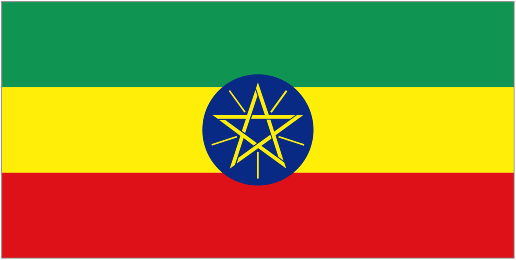
Haile Selassie I – Rasta’s Ras

July 23


Today Rastas around the world praise His Imperial Majesty Haile Selassie I — who was born this day in 1892, and who led Ethiopia through most of the 20th Century, until his death in 1975.

“Haile Selassie” means “Power of the Trinity”. He was born Tafari Makonnen, the son of an Ethiopian governor and former general, who led troops to victory at the Battle of Adowa in the 1899 Italo-Ethiopian War. After the deaths of his father and brother, the teenage Makonnen became governor in 1911. Then Regent of Ethiopia in 1916, and Emperor in 1930.

In the Rastafarian movement, Haile Selassie is considered to have been a living incarnation of God. His many titles, such as Lion of Judah and “Jah” (from the Hebrew Yahweh), refer to this.

The word Rastafarian itself comes from Haile Selassie’s title Ras, Ethiopian for ‘Prince’, literally, ‘Head’.

In North America and Europe, Haile Selassie’s fame spread via reggae music and Rasta culture. Bob Marley is often pictured wearing the late Emperor’s ring…
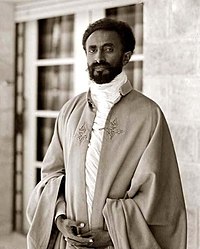
Emperor of Ethiopia
His Imperial Majesty Haile Selassie I: Emperor of Ethiopia

Marley’s song “War” quotes Haile Selassie’s 1963 address to the United Nations…

That until the philosophy which holds one race superior and another inferior is finally and permanently discredited and abandoned; That until there are no longer first-class and second class citizens of any nation; That until the color of a man’s skin is of no more significance than the color of his eyes; That until the basic human rights are equally guaranteed to all without regard to race; That until that day, the dream of lasting peace and world citizenship and the rule of international morality will remain but a fleeting illusion, to be pursued but never attained;

And until the ignoble and unhappy regimes that hold our brothers in Angola, in Mozambique and in South Africa in subhuman bondage have been toppled and destroyed; Until bigotry and prejudice and malicious and inhuman self-interest have been replaced by understanding and tolerance and good-will; Until all Africans stand and speak as free beings, equal in the eyes of all men, as they are in the eyes of Heaven; Until that day, the African continent will not know peace. We Africans will fight, if necessary, and we know that we shall win, as we are confident in the victory of good over evil.

In that speech Haile Selassie also alluded to an address he delivered 27 years earlier to the UN’s forerunner, the defunct League of Nations. It would be remembered as the most moving and prophetic speech in that bodies’ history.

In 1935 Fascist dictator Benito Mussolini was determined to conquer Ethiopia to resurrect the glory of the former Roman Empire. Just as Selassie’s father fought against Italy in 1899, Selassie himself now found himself facing a first-world power with far greater resources, manpower, and technology.

The Emperor’s speech began…

“I, Haile Selassie I, Emperor of Ethiopia, am here today to claim that justice which is due to my people, and the assistance promised to it eight months ago, when fifty nations asserted that aggression had been committed in violation of international treaties.

“There is no precedent for a Head of State himself speaking in this assembly. But..there has never before been an example of any Government proceeding to the systematic extermination of a nation by barbarous means, in violation of the most solemn promises made by the nations of the earth that there should not be used against innocent human beings the terrible poison of harmful gases.”
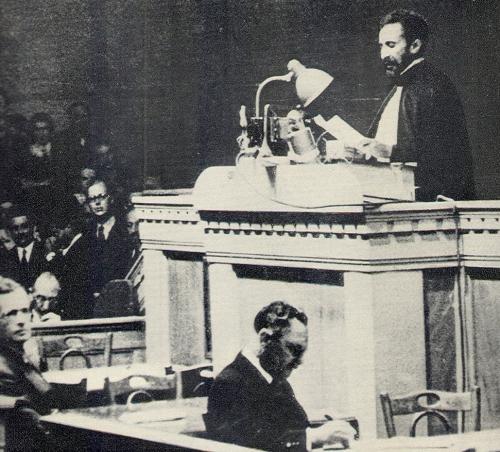
Haile Selassie addresses the League of Nations, 1936

After describing the heinous mustard gas attacks on his people–poisons that had been banned by the League of Nations, the Emperor appealed to the nations that had guaranteed Ethiopia its security…

“In October 1935, the 52 nations who are listening to me today gave me an assurance that the aggressor would not triumph, that the resources of the Covenant would be employed in order to ensure the reign of right and the failure of violence.

“I ask the fifty-two nations not to forget today the policy upon which they embarked eight months ago, and on faith of which I directed the resistance of my people against the aggressor whom they had denounced to the world. Despite the inferiority of my weapons, the complete lack of aircraft, artillery, munitions, hospital services, my confidence in the League was absolute. I thought it to be impossible that fifty-two nations, including the most powerful in the world, should be successfully opposed by a single aggressor. Counting on the faith due to treaties, I had made no preparation for war, and that is the case with certain small countries in Europe.

“…It is not merely a question of the settlement of Italian aggression. It is collective security: it is the very existence of the League of Nations…God and history will remember your judgment.”

His predictions were spot on. Mussolini’s actions–and the League of Nations’ impotence–inspired Adolf Hitler to expand his own German empire. And the League continued to appease the dictators at the expense of the smaller countries of Europe until a full-scale world war was unavoidable.

Haile Selassie’s 1936 speech to the League of Nations

Haile Selassie’s 1963 speech to the UN

www.rastaseed.com


Bookmark and Share

Belgium’s National Holiday

July 21


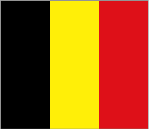
Belgium’s National Holiday on July 21st isn’t celebrated with quite the pomp and circumstance as other July National Days, such as Bastille Day or American Independence, but the celebration is growing.

The country’s still essentially split in two, with the Flemish community in the northern part and the French community in the South. In fact each group has its own holiday–the Flemish celebrate their holiday on July 11th, the French on September 27th.

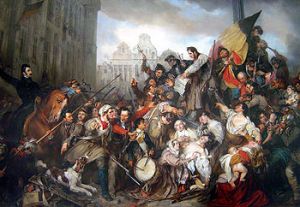
Belgium was once the southern province of the United Kingdom of the Netherlands. The French-Catholic community wasn’t too happy with the Dutch Protestant government up in Holland, particularly with the king, William I. Also, the French region was undergoing difficult economic times, while the civil service and parliamentary system favored the Dutch.

On August 25, 1830, a riot broke out in Brussels after (I’m not making this up) a particularly rousing performance of the opera La Muette de Portici. Yes, and they say today’s movies & music incite violence. Well, at least they don’t lead to full scale revolution. Few could have anticipated the riot would have created an independent Belgium, but the king failed to quell the rebellion, or to reach any sort of agreement with the people.

Episode of the Belgian Revolution, 1834, Egide Charles Gustave Wappers

The United Kingdom of the Netherlands was dissolved in December at the London Conference, in February the Belgians drew up a new constitution, and in June they chose Prince Leopold of Saxe-Coburg to be their new king.

Belgium’s National Holiday marks the anniversary of Leopold I taking the oath in 1831 to become the country’s first monarch, the moment seen as the true inception of Belgium’s independence.

Belgians Mark National Holiday

Día del Amigo – Argentina, Uruguay

July 20

Día del Amigo has become a Christmas holiday without the gifts or family members. It has spread such that it no longer covers only friends, but anyone who walks by.

Ya Dimos, Marcelo Gantman

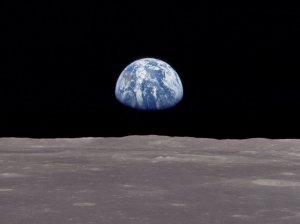
Earthrise

In Argentina and Uruguay July 20th is Día del Amigo, Friend Day. It’s not a public holiday, but more in the vein of Valentine’s Day—just a day for old friends to get together or strangers to get to know each other. It was promoted by Dr. Enrique Ernesto Febbraro, a professor of psychology, music history and dentistry, who was inspired by the feeling of global communion that swept the world as millions of folks all over the planet tuned in to watch or hear about the lunar moon landing on July 20, 1969.

Writes California blogger Disco Shawn upon visiting Argentina:

My first thought was to dismiss the whole thing as some sort of Hallmark holiday [but] …Apparently Febbraro’s efforts have paid off, as many Buenos Aires restaurants have been booked solid for a week or more. In 2005 part of the Argentinian cellular network crashed on Día del Amigo under the strain of so many people calling and texting their friends and loved ones.

This year is the 40th anniversary of the Lunar Moon Landing by Neil Armstrong, Buzz Aldrin, and that other guy. For that reason, scientists have also proclaimed July 20th Moon Day. Moon Day hasn’t made as deep an impact as Earth Day yet, but if South America keeps up Día del Amigo, July 20th may give April 22nd some competition.

“To see the Earth as it truly is, small and blue and beautiful in that eternal silence where it floats, is to see ourselves as riders on the Earth together, brothers on that bright loveliness in the eternal cold—brothers who know now that they are truly brothers.” — Archibald MacLeish

Día del Amigo is not to be confused with International Friendship Day, which was proclaimed in 1935 as the first Sunday in August, and which to the best of my knowledge nobody really celebrates.

El único momento de la vida en que me siento yo mismo es cuando estoy con mis amigos. — Gabriel García Márquez

The Man Behind Friend Day

Colombia – Independence Day

July 20

Colombia has two Independence Days…

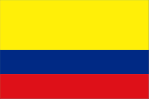
Colombia declared its independence from Spain on this day (July 20) in 1810. Back then the country had to wait nine years to see its dream come to fruition—Spain finally met defeat on August 7, 1819 at the Battle of Boyacá—but now Colombians need only wait two weeks after Independence Day for August 7th to roll around, so they can celebrate all over again.

Colombia is home to the second largest Spanish speaking population in the world after Mexico. Colombia produces 12% of all the world’s coffee, and 95% of the world’s emeralds. It’s the size of France, Spain and Portugal put together, and it’s the only South American nation with coasts on both the Atlantic and Pacific.

Despite being one of the three most bio-diverse countries on the planet, Colombia has had to work hard to combat its dangerous image on the nightly news.

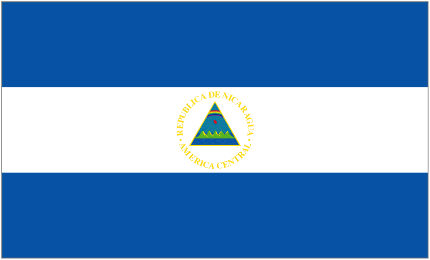
Liberation Day – Nicaragua

July 19

Nicaragua has been the focus of U.S. foreign policy more than most Americans realize.

In the 1850’s, the country was invaded and briefly ruled by a U.S. lawyer-doctor-journalist named William Walker.

At the turn of the 20th century, the country was the proposed site of the canal connecting the Atlantic to the Pacific, until Congress opted for Panama.

During the 1920’s and ’30’s, the U.S. Marines occupied Nicaragua making it “safe for democracy” (i.e., “business interests”).

But the United States’ most enduring impact on Nicaragua (outside of Mickey Mouse and Coca-Cola) may have been the support of the Somoza dynasty which ruled the country either directly or indirectly from the 1930’s through the 1970’s.

The final Somoza was President Anastasio Sonoza Debayle, whose mishandling of Nicaraguan finances in the 1970’s, and particularly after the 1972 earthquake, infuriated the Nicaraguan public. The socialist Sandinista Liberation Front (named for Augusto César Sandino) gained popularity as a militant opposition movement against Somoza’s government.

The revolution killed approximately 50,000 Nicaraguans and climaxed in 1979, by which time Somoza had lost U.S. support and the Sandinistas had gained control of most of the country outside of the capital Managua. Somoza fled to Miami on July 17, which is celebrated in Nicaragua as “Día de la Alegría”.

Two days later the Sandinistas took power.

On July 19, 2009 the country celebrates the 30th anniversary of that takeover, alternately known as Liberation Day and Sandinista Day.

Ironically, the celebrations come as the opposition accuses Sandinista leader Ortega – who lost power in 1990 but returned 17 years later – of promoting “a new family dictatorship” in Nicaragua, currently the second-poorest country in Latin America…

For writer Sergio Ramirez… “[Ortega] wasted the opportunity that history put in his hands, to use his leadership to transform Nicaragua socially and to provide it with better democratic institutions… What there is now is a populist government with a conduct that is confusing in many aspects, that has a demagogic left-wing discourse and a right-wing behaviour in economic policy…”

Sandinistas Celebrate 30th Anniversary of Revolution

As Valdivia, another revolutionary, put it…

“We were idealistic people. We were in love with the revolution… But we don’t see now that it was worth it. … The cost in human life, in destruction of property, was a lot higher than the benefit.”

Quoted by Matt O’Brien, Revolutionaries Live With Pride and Regret

But for the most part, Nicaraguans celebrate Liberation Day with parades, fireworks, and official ceremonies. Many still remember—or were victims themselves—of the violence, censorship and corruption that characterized much of the 20th century.

Nelson Mandela’s Birthday

July 18 (not an official holiday in South Africa)

“We must accept the fact that in our country we cannot win one single victory of political freedom without overcoming a desperate resistance on the part of the Government, and that victory will not come of itself but only as a result of a bitter struggle by the oppressed people for the overthrow of racial discrimination…

The theory that we can sit with folded arms and wait for a future parliament to legislate for the ‘essential dignity of every human being irrespective of race, colour, or creed’ is crass perversion of elementary principles of political struggle.”

The Shifting Sands of Illusion, Nelson Mandela, June 1953

Mandela’s story is legendary, not only for the 27 years he spent in prison, but for the reasons he arrived there and for his singular journey since.

Mandela was arrested on Sunday, August 5, 1962 for speaking against the government in public and leaving the country illegally, for which he was sentenced for five years.

“While serving this sentence, he was tried again for more serious charged connected with his leadership of the armed resistance group, Umkhonto we Sizwe. He and his colleagues were convicted of terrorism, narrowly escaping execution, receiving life sentences instead.”

Nelson Mandela: the Early Life of Rolihlahla Madiba, by Jean Guiloineau and Joseph Rowe

Terrorism? Yes, in a post-9-11 world, heads of state downplay that for nearly three decades Nobel Peace Prize Laureate Nelson Mandela had been deemed a terrorist by the apartheid “justice” system.

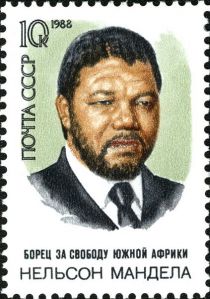
Nelson Mandela stamp, Soviet Union, 1988

During his imprisonment the island on which Mandela was held—Robben Island—became known as “Mandela University.” The political prisoner educated other inmates who then continued the struggle against racism outside the prison walls.

“Did they imagine we might forget him and his companions if they banished him to this island? And did they imagine we could forget the misery of our lives?”

A Pilgrimage to the Isle of Makana, from Call Me Not a Man, by Mtutuzeli Matshoba

The famous cry “Free Nelson Mandela” really meant “Free South Africa”. On February 11, 1990, the first half of that long sought prize came to pass. Since 1966, not so much as a photograph had been taken of Mandela. His release was broadcast around the world.

After the country’s first truly-democratic elections in 1994, Mandela became South Africa’s first black President.

Youtube: Free Nelson Mandela

Freedom, however, is not a moment but a journey. As late as 2008, due to red tape and lack of oversight, Mandela and other members of the African National Congress were still on the U.S. terrorist watch list.

“In the 1970s and ’80s, the ANC was officially designated a terrorist group by [South Africa’s] ruling white minority. Other countries, including the United States, followed suit.” — USA Today 4/30/08

“It is frankly a rather embarrassing matter that I still have to waive in…the great leader, Nelson Mandela.” — Secretary of State, Condoleezza Rice

Mandela and the ANC were removed from the list by a special bill signed by President Bush in July 2008, just prior to Mandela’s 90th birthday.

In South Africa, celebrants “thank Madiba” (Mandela’s honorary title) on July 18th with acts of charity and good deeds, from cleaning cemeteries to painting hospitals.

Meanwhile, in the country of Ghana…

President John Evans Atta Mills on Friday called on Ghanaians to observe Saturday, July 18, 2009 as Nelson Mandela International Day to commemorate his leading role in Africa’s liberation struggle… “The day is Mr. Nelson Mandela’s birthday and those observing this day are required to contribute 67 minutes of their time to the service of their communities in recognition of the 67 years Nelson Mandela has spent in serving humanity.”

Ghana News Agency, July 17, 2009

1961 Nelson Mandela Interview

Romanov Holiday?

July 17

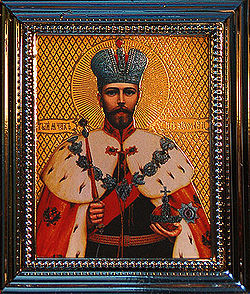
Tsar Nicholas II

It’s not an official holiday yet, but with the Russian Orthodox Church’s beatification of the last Russian Tsar and his family in 2000, the Romanovs do have their own saint day—July 17—the anniversary of the day they were executed in 1918.

Nicholas II, the last Russian Tsar, is a touchy subject in the former Soviet Union. He and his family met a horrifying end at the hands of revolutionaries who banned all religion in Russia except worship of the state. But Russians also recall that Nicholas’s decisions wrought unrecoverable damage to one of the strongest empires on earth.

Nicholas’ reign was troubled from the get-go. Four days after his coronation in 1896, a panic during his banquet festivities in Moscow resulted in the trampling-to-death of nearly 1,400 celebrants. Though not the Tsar’s fault, Nicholas’ decision to attend a ball at the French Embassy that night anyway did not win kudos from the Russian people.

The following decade saw the tragic massacre known as Bloody Sunday, where striking workers and their families hoping to bring a petition to Nicholas II in St. Petersburg were instead gunned down by police. Public reaction to Bloody Sunday led the Tsar to allocate power to the political body known as the Duma.

But the end of his reign must be attributed to his refusal to pull out of World War I, even when his country was on the verge of total political and economic collapse. Mass mutinies led Nicholas to suspend the Duma, but members of the Duma and the Soviet, as well as leading generals, demanded Nicholas’s abdication. By 1917, the Tsar’s most loyal troops were lying under the sod of western battlefields; he abdicated in March.

Russia’s short-lived democratic government shielded the Romanovs in St. Petersburg, but during the October Revolution, that government was ousted by the Bolsheviks. The Bolsheviks wanted to leave no chance that Russia would return to the old aristocratic system. On July 17, 1918, the Bolsheviks gunned down Nicholas and the entire royal family in a cellar in St. Petersberg, including his wife Alexandra, their four daughters, and their 14 year-old son Alexei.

The Romanov Royal Family

On July 17, 1998, eighty years to the day after their deaths, the royal family was interred in St. Peter and Paul Cathedral in St. Petersburg. They’re considered saints after the 2000 beatification, but not martyrs. To be a martyr of the Church, one’s death must be a direct result of one’s Christian faith. The Romanovs are honored instead as “Passion bearers”—those who met death in a Christ-like way.

Defenders of the Motherland Day

Obon – Japan

July or August
July 13-15 (Gregorian calendar)
15th day of 7th month (lunar calendar)

“In the time of Shaka; one of his fellows Mokuren saw the image of his dead mother suffering in hell. Mokuren was desperate to relieve her pain and asked Shaka for help. Shaka answered, “On 15th of July, provide a big feast for the past seven generations of dead.”‘— Japan 101

OK, Buddha may not have actually said “15th of July”, since he lived 300 years before Julius Caesar. But he did say “15th day of the seventh month.” Whether that’s according to the lunar or solar calendar depends on who you ask.

In the lunar calendar the Festival of Obon—the Japanese festival of the dead—tends to fall in August. But in Tokyo and the east of Japan, many temples observe Obon according to the solar calendar—on July 13th through the 15th. The result is that anywhere you look between mid-July and August there’s bound to be Obon festivities happening somewhere.

Obon is one of the most important holidays in the Japanese calendar, second only to New Year’s Day in most communities. Japanese usually return home to be with their families during the Obon season to carry on a tradition that has been celebrated for over 500 years in Japan.

Families enjoy time together, partake in Obon rituals and tidy up the graves of their ancestors.

obon_albuquerqe_bridge
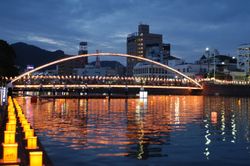
Lantern floating ritual, 2004

One tradition is to release floating paper lanterns on the water on the last night of Obon, in order to guide the departed spirits to the after world.

Another is the age-old Bon Odori, or Bon Dance, which emulates the dance of joy and gratitude that Mokuren did when his mother was released from hell.

Obon is a shortened form of the word urabon’e, which means “hanging upside-down and suffering.” The purpose of Obon is relieve the suffering of the Urabon’e.