Scrapbooking Day

May 3

Stop all the clocks, log out of AIM
Sign off of scrabble, don’t start a new game
Shut the TV, the laundry will wait
Ignore the doorbell and lock the front gate
Silence the mobile, put the iPad away.
Today is National Scrapbooking Day.

Words are inadequate when describing to an NSB (Non-ScrapBooker) the maniacal frenzy with which SBs subscribe to their passion.

Most people (outside of Utah) go about their normal day completely oblivious to the enormity and severity of this growing cult. Its followers are young and old. From every state and every province. From families rich and poor, and all walks of life.  Two generalizations you can make about the scrapbooker: she is almost always female, and usually a mother.

‘Kara’ of Non-Scrapbookers Anonymous confesses:

I am a failure as a mom…I have a lot of friends who scrapbook and an overzealous sister-in-law who is convinced she can convert me into being a scrapbooker. But, I have no desire…

‘Kerrie’ of Feminist Mormon Housewives writes:

I feel like a complete outsider…I’m not feminine or crafty. I installed a light in the kitchen and rewired two switches today, which seems more practical and sensible to me than spending $30 and four hours making two scrapbook pages.

We’re not just talking about scrapbooking stores and scrapbooking books. There are scrapbooking seminars, scrapbooking conferences, scrapbooking chat rooms, scrapbooking tours, and yes, scrapbooking cruises. The cruises alone are becoming an industry in themselves, with trips to Alaska, Mexico, the Caribbean, and the Mediterranean.

The good news about scrapbooking is that it is rarely fatal. The bad news is that there is no known cure. And that family members, however resistant, can fall victim to ‘second-hand scrapbooking.’

Dan‘ writes:

I am an unwilling participant in this scrapbooking cult because I am [my wife] Kelly’s better half. She drags me to her events so I can do all the “manly” things…carrying bags, putting together decorations, carrying bags, getting food when “my girls” are hungry, and setting up tables.

That was the last anyone ever heard from Dan.

I can personally attest to the extent of this growing epidemic. The last time I drove through Utah, I stopped in a small town–if you can call it that–that had nothing but a gas station and a scrapbooking store.

And also by virtue of the fact that I have a mother QSB (Queen ScrapBooker) who routinely inducts her sons’ significant others into this cult. (The Scrapbooking cult operates much like Facebook Vampires, where you get points for how many you infect.)

The Church of Latter-Day Saints receives credit (or the blame) for spearheading the modern scrapbooking craze. “BYU scientists have overwhelmingly concluded that scrapbooking is hard-coded into every LDS mothers genetic makeup.” (Husbands Unite, 2008.) But scrapbooking is anything but modern or new. America’s greatest author Mark Twain himself was an avid scrapbooker. In 1872 he even patented a “self-pasting” scrapbook. 13 years later, while Twain had earned $200,000 from his written books, he had made $50,000 just from the scrapbook. (St. Louis Dispatch, 6/8/1885).

In 1884 the Norristown Herald went so far as to exclaim, “No library is complete without the Bible, Shakespeare, and Mark Twain’s Scrap Book.”

Of course part of its success may be due to Twain’s marketing genius:

“I hereby certify that during many years I was afflicted with cramps in my limbs, indigestion, salt rheum, enlargement of the liver, & periodical attacks of inflammatory rheumatism complicated with St. Vitus’s dance, my sufferings being so great that for months at a time I was unable to stand upon my feet without assistance, or speak the truth with it. But as soon as I had invented my Self-Pasting Scrap Book & begun to use it in my own family, all these infirmities disappeared.

“In disseminating this universal healer among the world’s afflicted, you are doing a noble work, & sincerely hope you will get your reward–partly in the sweet consciousness of doing good, but the bulk of it in cash.

Very Truly Yours

Mark Twain


Happy Scrapbooking Day.

Not that you need an excuse.

Scrapbooking Has Moved On

Mark Twain’s Most Profitable Book?

Dos de Mayo Uprising

May 2

Goya's "Dos de Mayo, 1808"

“The population of Madrid, led astray, has given itself to revolt and murder. French blood has flowed. It demands vengeance…”

— Joaquim Murat, 1808

Guerrilla warfare. To any kid who’s failed a spelling bee because of one of the most misspelled words in the English language, you’re in good company. Before learning the proper spelling, I too assumed it was war that took place deep in the African jungle.

The term ‘guerrilla warfare’ is used to describe tactics adopted by small militias and individual fighters, often in Third World countries, to engage larger occupying forces in small skirmishes rather than large battles. It comes from the Spanish word “guerra”, meaning war. And though guerrilla warfare has been a key component in dozens of South American conflicts over the last century, the term guerrilla hails from the other side of the Atlantic, from a conflict that began 200 years ago in Madrid.

In 1807 Napoleon signed an alliance treaty with Spain, which effectively split the country of Portugal between Spain and France. Portugal was taken without hardly firing a shot.

The following February, however, Napoleon turned on his Spanish ally. (A history lesson not lost on Hitler.) Napoleon didn’t even need to invade Spain; for the country was already inundated with French troops who had crossed the border under the pretense of invading Portugal. Meanwhile, Spain’s troops were scattered from Denmark to Portugal, many of them on loan to Napoleon. Spain was, militarily speaking, screwed.

Add to the plot a cast of wacky feuding royals (In March, Prince Ferdinand overthrew his father King Charles IV with the support of a discontented Spanish public) and you have the makings of a full-on Peninsular War.

Napoleon ingeniously played the Spanish royal pair against each other, calling father Charles and son Ferdinand up to French Bayonne for a little ‘mediation‘. [pronounced: ‘im·pri′son·mènt’]

Come Leap Day, French troops entered Barcelona–by pretending to be a convoy of wounded–(and you wonder why the Spanish don’t trust the French?)–and took the city. The French general Murat entered Madrid the following month.

Joaquim "I'm Too Sexy For My Haircut" Murat

About this time the Madrilenos began thinking maybe their beef was not with either of their kings, but with the French. Napoleon ordered the remainder of the Spanish royal family, including Charles’ 25 year-old daughter Maria Louisa, her uncle Don Antonio, and her little brother, the preteen Francisco de Paula, to join them in French Bayonne for a little more ‘mediation’.

The following morning had been fixed for the departure of the Queen of Etruria [Maria Louisa] and the Infante D. Francisco de Paula, and many persons, chiefly women, collected before the Palace to see them off…and some of the populace” were “determined that the last of the royal family should not be taken from them without resistance...” History of the Peninsular War (Southey)

An armed riot broke out, and Murat’s forces fired on the crowd. Soon, street fighting erupted through Madrid, focusing around the palace and the Puerta del Sol.

For a short time the Madrilenos pushed back the surprised French guards, but Murat sent in reinforcements, and quashed the outgunned Spanish rebels by nightfall.

Goya's The Third of May, 1808

On May 3, hundreds of Spanish rebels were executed by firing squad. News of the mass killings spread throughout Spain and the Spanish resistance was born. Guerrillas, referring to ‘little wars’ and the soldiers who fought them, changed the course of the Napoleonic era, not by defeating the French in large, decisive battles, but by engaging them in a steady stream of small attacks over thousands of square miles.

In February Napoleon had bragged he could take Spain with 12,000 men. He did take Spain, but he had to divert 160,000 of his troops from other battles to do it.

Napoleon called the guerrillas his ‘Spanish ulcer’. In 1813 British, Portuguese, and Spanish forces expelled French troops from the Iberian peninsula for good.

Mayday Mayday

May 1

I was taught in elementary school that we didn’t celebrate May Day anymore because it was a Communist holiday.

Not only was this a lame excuse not to celebrate a holiday, it also wasn’t true.

In ancient and medieval Europe, seasons were determined not by equinoxes and solstices, but by the days that fell directly in between, known as “cross-quarter days.” The first cross-quarter day of the year is Groundhog Day or Candlemas, between winter solstice and spring equinox. The second is today, May Day, which once marked the beginning of summer.

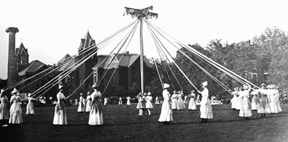
May Day traditions such as creating floral wreaths date back to the Romans and Celts (Beltane), and survived well into the 20th century, including dancing around the Maypole and crowning a ‘May Queen.’

Mizzou, Missouri, 1911

In the 19th century May Day became a standard date for workers to re-negotiate contracts with employers. One reason may be because it was one of the few days off workers had that wasn’t a Sunday (church day) or a religious holiday. Thus, as communities got together to celebrate, the workers–usually the fathers of the family–could also unite for better wages or working conditions.

Over time May Day was adopted by (or hijacked by, depending on your politics) communist, socialist and labor groups. May Day fell out of favor in the U.S. where the first of May is celebrated with other, more patriotic holidays, including:

  • Law Day
  • Loyalty Day
  • National Day of Prayer (1st Thursday in May)

and the more casual

  • Lei Day.

Lei Day is, believe it or not, the oldest of those four holidays. It’s the Hawaiian version of May Day, dating to the 1920s. Loyalty Day, Law Day, and National Day of Prayer were officiated in the 1950s under Presidents Truman and Eisenhower.

In the United States, Labor Day is celebrated on the first Monday in September.

Even though May Day was seen as a communist import in America, it was in Chicago, Illinois, that May Day gained notoriety as a day for workers and eventually became the international holiday known as Labour Day.

Oh, and the distress call ‘Mayday! Mayday!‘ has nothing to do with the holiday. It’s from the French venez m’aider, meaning ‘come help me.’

Labour Day

May 1

In the mid-1800s May 1 was the de facto date for labor groups to re-negotiate rates with employers, precisely because May 1 marked the beginning of the summer. Workers were in greater demand in summer than in the winter months, which gave them more bargaining power. Also, the traditional holiday May Day was one of the few days workers had off that wasn’t spent at church.

As societies became more industrialized, May Day workers’ gatherings increased in number and intensity.

The first of two major Chicago strikes occurred on May 1, 1867. Labor unions in Chicago had been able to get an ‘eight-hour day’ bill passed in the Illinois state legislature, but couldn’t get it enforced. They declared a strike on May 1; the strike collapsed within a week.

In 1884, the newly formed Federation of Organized Trades and Labor Unions (later the AFL) declared that an 8-hour workday would take effect on May 1, 1886, with or without government legislation. The implication being that any district where this law was not implemented would be effectively shut down.

On May Day, 1886, over a quarter million workers walked off the job across the United States—40,000 in Chicago alone. Over the next few days the Chicago numbers rose to 100,000.

On May 3, police shot and killed two strikers when a scuffle broke out at the McCormick Reaper Works between strikers and “scabs” coming to replace them.

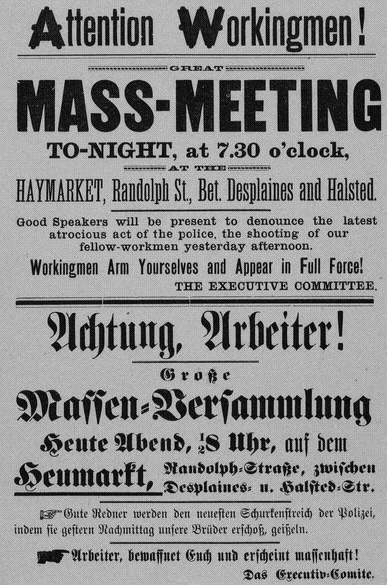
Anarchists organized a rally the following day. Relations were already tense between the police and the strikers, and flyers asked workers to “arm yourselves and appear in full force.”

Miraculously the Haymarket rally was peaceful right up until the end. The mayor had even gone home from the rally, sensing no danger from the dwindling crowd.

At 10:30 in the evening the last speaker finished his speech to a crowd of about 300.  Suddenly, as the police moved in to disperse the demonstrators, a homemade bomb was hurled into a throng of officers. The blast and the ensuing violence killed 7 officers and wounded another 60. Police fired into the crowd after the blast, killing an unknown number of demonstrators.

The Haymarket tragedy resulted in the execution of 4 anarchist leaders and a wide-spread government crackdown on not only extremists, but on unions and the labor movement in general. The government’s reaction to Haymarket became a rallying point for unions and socialist organizations in Europe and Asia as well as North America.

The first international labor strike for the eight-hour day occurred on May 1, 1890 partly in tribute to the Haymarket tragedy. As mentioned before, outside the U.S., May Day is called Labour Day or International Workers’ Day.

May Day violence continues to this day. A peaceful immigration demonstration in Los Angeles on May 1, 2007, ended with police firing rubber bullets at demonstrators. (News footage of the event resulted in the retraining of the LAPD to handle crowd control events through the extraction of individual agitators instead.)

In 2008, all ports on the West Coast came to a halt on May Day when the International Longshoremen and Warehouse Union went on strike to protest the war in Iraq. Demonstrations in Germany and Turkey ended in unexpected violence.

Witches Night – Walpurgisnacht

April 30

Now to the Brocken the witches ride;
the stubble is gold and the corn is green;
There is the carnival crew to be seen,
And Squire Urianus will come to preside.
So over the valleys our company floats,
with witches a-farting on stinking old goats.

Johann Wolfgang von Goethe, Faust

Exactly six months before Halloween, the Germans and Scandinavians celebrate Walpurgis Night, May-Eve, Beltane, or Hexennacht, aka Witches’ Night.

According to legend, on the last night of April, witches would meet at Hexentazplatz (Witches’ Dancing Place, conveniently named in case you got lost and had to ask a tourist) near the town of Thale in northern Germany. From there they would fly upon broomsticks to the highest point in the Harz Mountains, a summit called “The Brocken.”

At the Brocken there they would dance with the devil, a horned he-goat demon named Lord Urian, who would grant them mystical powers…for a price. Scarier than even the orgiastic rituals of Walpurgis Night, is the unholy marriage of Google-translation and the German language in describing this event:

“On the chunk of dance legend after all witches in a large circle around the fire and then the devil kiss the butt. Then you can have with the devil marry and receive from him magic powers.”

Don’t be Frightened!

OK, be a little frightened. For centuries, tales spread of sordid revels atop the Harz Mountains. To this day, the Brocken is haunted by the spirits of angry tourists who felt cheated having yet to encounter a single supernatural event.

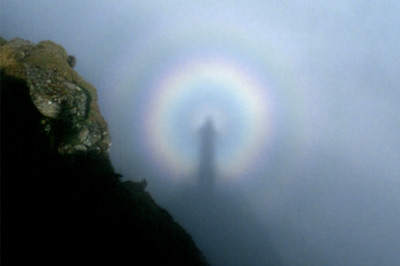
There are many reasons this mountaintop became synonymous with the dark legends of Deutschland. Its inaccessible height and remote location for one—okay, that’s two actually. Also, the region wasn’t settled until after 1000 AD. (That’s the German equivalent of 1950 in America.) And perhaps most important, the Brocken is the site of an unusual and eerie optical illusion known as the Brockengenspenst, or the “Brocken spector.”

“As the sun sinks, the shadow of a walker cast from a ridge becomes magnified and an enormous silhouette appears on low-lying clouds or mist banks below the mountain. Although it’s only a shadow, the distant “specter” appears to be walking at the same pace, doggedly tracking the observer’s path.”

— Season of the Witch – Walpurgisnacht in Germany’s Harz Mountains

In other words, in the centuries before the meteorological sciences, many a Brocken hiker were spooked by their own shadows. At least one visitor was literally frightened to death.

Germany may not have been the birthplace of the witch, but it did propagate the image of the witch as we know it today, through its literature, legends, and its ‘litigation’:

“Between 1623 and 1633, the prince-bishops of two Bavarian towns, Wƒrzburg and Bamburg, ordered the burning of at least fifteen hundred “witches” between them. The victims of Wƒrzburg’s bishop included his own nephew, nineteen priests, and a child aged seven. One reason why medieval Germany developed an obsession with stamping out “witchcraft” may lie in the food that was being eaten. If the weather is warm and damp, rye (then a staple crop) can produce a poisonous fungus called ergot. Hallucinations, fits, pinpricking sensations, muscle spasms: the symptoms of ergotism are similar to the effects of LSD, which itself is derived from ergot.”

Witches of the Harz Mountains

Walpurgis got its name from an 8th century saint. Walpurgis had nothing to do with witches, but April 30 was her feast day. In the Church’s effort to Christianize Germany’s tenacious pagan roots, they made Walpurgis Night about Walpurgis’ fight with the dark forces of paganism.

Yet still the pagan rituals continue to this day…

Walpurgis Night, the time is right
The ancient powers awake.
So dance and sing, around the ring
And Beltane magic make.

Doreen Valiente, Witchcraft for Tomorrow

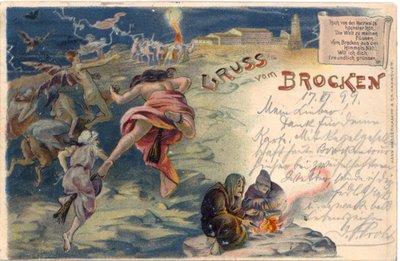
Brocken postcard

Brocken “Money” – a tourist gimmick from the 1920s

Brocken postcard collection from the late 19th/early 20th century.


Everybody Dance Now – International Dance Day

April 29

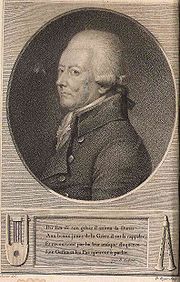
Today’s International Dance Day, which is celebrated on April 29, believe it or not, because of this guy.

Stuffy as he looks, Jean-Georges Noverre could apparently cut a rug in his day. He began dancing professionally at age 16 and wrote his first ballet at 20. He danced in Paris, London, Vienna and Strasbourg, and was head of the Paris Opera Ballet until his boss, Marie Antoinette, lost her own head. Noverre was allowed to keep his, but the French Revolution ended his career and reduced him to poverty.

When times were good he hung with the likes of Mozart, Voltaire, and Frederick the Great. His ideas revolutionized ballet. He believed a dancer’s personality is part of performance, rather than the one-size-fits-all training technique commonly taught. He believed all dances and movements must be integrated into the story, character and theme, and did away with superfluous numbers.

Criticizing the masks traditionally worn in Paris ballet that hid dancers’ genuine expressions, he wrote, “Destroy the masks and we shall gain a soul.”

So tonight, put on your red shoes, your dance shoes, your boogie shoes, turn on the red light, get down, make love, let it all hang out, and shake it like a polaroid picture.

No mask necessary.

Workers Memorial Day

April 28

Today is a National Day of Mourning in Canada. Not for those killed in wars or natural disasters, but for those who made the fatal mistake of showing up to work.

Internationally the day is known as Workers Memorial Day. The date April 28 was chosen because it’s the anniversary of Canada’s Workmen’s Compensation Act, passed in 1914, which created the predecessor of today’s Workplace Safety & Insurance Board.

A random sampling of Canadians found that most had never heard of the National Day of Mourning, an effort by the Canadian Labour Congress to spread awareness of workplace safety. However, spokesperson Terry O’Connor believes the lack of safe working conditions is a growing problem in Canada.

“Canada continues to have one of the highest workplace fatality rates of any Organization of Economic Co-operation and Development country…In 2006, the Association of Workers’ Compensation Boards of Canada reported 976 workplace fatalities in Canada, compared to 805 workplace fatalities in 1996 — an 18 per cent increase in a 10-year period.”

South of the border, the US Bureau of Labor Statistics reports that fatal accidents on the job have declined since 1994 by 14%, while the number of people in the workforce has increased by the same amount. The most dangerous jobs in North America?

  • 10. Agricultural workers
  • 9. Truck Drivers/Drivers
  • 8. Roofers
  • 7. Electrical power line repairers
  • 6. Farmers & Ranchers
  • 5. Refuse collectors/recyclers
  • 4. Steel workers
  • 3. Loggers
  • 2. Pilots
  • And #1?

Fishermen.

Yes, that crab you bite into comes a steep price, and we’re not just talking money. The occupational-fatality rate for commercial fishing is over 20 times the national average.

17 Minutes That Changed America

Overall North American working conditions have greatly improved since Upton Sinclair wrote his scathing look at America’s meatpacking industry in The Jungle over 100 years ago. His aim was to raise awareness of the plight of exploited workers, many of them women and children in dangerous conditions for long hours and for the lowest of wages.

But the reading public cared more about what was going into their hot dogs (hint: you thought soylent green was nasty?…) than for the workers’ plight. When foreign sales of American meat products declined by 50%, Washington established the Food and Drug Administration to improve the food industry’s appalling standards.

It would take 146 deaths in a single day to spark outcry for legislation that would improve workplace safety.

The Triangle Shirtwaist Company, the “largest blouse-making operation in New York,” was located on Washington Place and Greene Street in Manhattan’s Lower East Side.

Each day 500 workers, mostly young immigrant girls, crowded into the factory. At 4:40 pm on March 25, a bin under a wooden desk on the eighth floor caught fire (most likely from a tossed cigarette).

When workers first spotted the flame they tried to put it out with water, but the scraps of cotton fabric in the bin—more flammable than paper—turned the flame into a conflagration within seconds. Panic struck the workers, and…

“those clustered at the Greene Street partition stampeded into the small opening, pushing and shouting and wrestling toward the stairway. Behind them, others in the factory saw this pileup and ran toward the opposite corner of the room, where they bottlenecked at the Washington Place elevators…”

One worker on the 8th floor managed to reach the secretary and swicthboard operator on the 10th floor via telephone.

Most of the tenth floor executive staff escaped by climbing onto the roof and into a taller adjacent building. But when the switchboard operator left her post, there was no way to call and warn the 9th floor workers, since all calls had to be routed through the 10th floor.

Of the 146 victims, 140 worked on the ninth floor.

Fire blocked the stairwell. The one flimsy fire escape collapsed. The owners had locked the ninth floor doors from the outside to make sure the girls didn’t steal.

The doors opened inward, so by the time they were unlocked, the doors were impossible to open because of the weight of dozens of screaming employees crushed against them, trying to escape.

The fire hoses on the top floors lacked adequate water pressure. The weight of escapees in the elevator immobilized the unit. One girl survived by jumping down the elevator shaft, landing atop the elevator on its last trip.

Over fifty workers jumped out the windows of the 9th floor rather than be consumed by fire. When the last one jumped to her death it was 4:57.

These tragic seventeen minutes–and the furor that followed–laid the foundation for sweeping changes in the labor movement that continue to protect workers to this day.

Below is a list of those killed in the Triangle Shirtwaist Fire in 1911. It was compiled by David Von Drehle, author of Triangle: The Fire That Changed America.

  • Lizzie Adler, 24
  • Anna Altman, 16
  • Anna Ardito, 25
  • Rosie Bassino, 31
  • Vincenza Bellota, 16
  • Ignazia Bellotta,
  • Vincenza Benenti, 22
  • Essie Bernsetin, 19
  • Jacob Bernstein, 28
  • Morris Bernstein, 19
  • Gussie Bierman, 22
  • Abraham Binevitz, 20
  • Rosie Brenman
  • Surka (Sarah) Brenman
  • Ida Brodsky, 16
  • Sarah Brodsky, 16
  • Ida (Ada) Brooks, 18
  • Laura Brunette, 17
  • Frances Caputto, 17
  • Josephine Carlisi, 31
  • Albina Caruso, 20
  • Josie Castello, 21
  • Rosie Cirrito, 18
  • Anna Cohen, 25
  • Antonia (Annie) Colletti, 30
  • Dora Dochman, 19
  • Kalman Downic, 24
  • Celia Eisenberg, 17
  • Rebecca Feibisch, 17 or 18
  • Yetta Fichtenhultz, 18
  • Daisy Lopez Fitze, 24
  • Tina Frank, 17
  • Rosie Freedman, 18
  • Molly Gerstein, 17
  • Celina Gettlin, 17
  • Esther Goldstein, 20
  • Lena Goldstein, 23
  • Mary Goldstein, 18
  • Yetta Goldstein, 20
  • Irene Grameatassio, 24
  • Bertha Greb, 25
  • Dinah Greenberg, 18
  • Rachel Grossman, 17
  • Rosie Grosso, 16
  • Esther Harris, 21
  • Mary Herman, 40
  • Esther Hochfield, 22
  • Fannie Hollander, 18
  • Pauline Horowitz, 19
  • Ida Jakofsky, 18
  • Augusta (Tessie) Kaplan, 18
  • Becky Kappelman, 18
  • Ida Kenowitz, 18
  • Becky Kessler, 19
  • Jacob Klein, 28
  • Bertha Kuhler, 20
  • Tillie Kupfersmith, 16
  • Sarah Kupla, 16
  • Benjamin (Benny) Kuritz, 19
  • Annie L’Abbato, 16
  • Fannie Lansner, 21
  • Mary Laventhal, 22
  • Jennie Lederman, 20
  • Nettie Lefkowitz, 23
  • Max Lehrer, 22
  • Sam Lehrer, 19
  • Kate Leone, 14
  • Rosie Lermarck, 19
  • Jennie Levin, 19
  • Pauline Levine, 19
  • Catherine Maltese, mother of Lucy & Sara
  • Lucia (Lucy) Maltese, 20
  • Rosaria (Sara) Maltese, 14
  • Maria Manara, 27
  • Bertha Manders, 22
  • Rose Manofsky, 22
  • Michela (Mechi) Marciano, 20
  • Yetta Meyers, 19
  • Bettina Miale, 18
  • Frances Miale, 21
  • Gaetana Midolo, 16
  • Becky Nebrerer, 19
  • Annie Nicholas, 18
  • Nicolina Nicolosci, 21 or 22
  • Annie Novobritsky, 20
  • Sadie Nussbaum, 18
  • Julia Oberstein, 19
  • Rose Oringer, 20
  • Becky Ostrowsky, 20
  • Carrie Ozzo, 22
  • Annie Pack, 18
  • Providencia Panno, 43
  • Antonietta Pasqualicca, 16
  • Ida Pearl, 20
  • Jennie Pildescu, 1
  • Millie Prato, 21
  • Becky Reivers, 19
  • Emma Rootstein
  • Israel Rosen, 17
  • Julia Rosen, 35, mother of Israel
  • Louis Rosen, 38
  • Yetta Rosenbaum, 22
  • Jennie Rosenberg, 21
  • Gussie Rosenfeld, 22
  • Nettie Rosenthal, 21
  • Theodore (Teddy) Rothner, 22
  • Sarah Sabasowitz, 17
  • Serephina (Sara) Saracino, 25
  • Teraphen (Tessie) Saracino, 20
  • Gussie Schiffman, 18
  • Theresa (Rose) Schmidt, 32
  • Ethel Schneider, 30
  • Violet Schochep, 21
  • Margaret Schwart, 24
  • Jacob Selzer, 33
  • Annie Semmilo, 30
  • Rosie Shapiro, 17
  • Beryl (Ben) Sklaver, 25
  • Rosie Sorkin, 18
  • Gussie Spunt, 19
  • Annie Starr, 30
  • Jennie Stellino, 16
  • Jennie Stern, 18
  • Jennie Stiglitz, 22
  • Samuel Tabick, 18
  • Clotilde Terdanova, 22
  • Isabella Tortorella, 17
  • Mary Ullo, 26
  • Meyer Utal, 23
  • Freda Velakowsky, 20
  • Bessie Viviano, 15
  • Rose Weiner, 23
  • Celia (Sally) Weintraub, 17
  • Dora Welfowitz, 21
  • Joseph Wilson, 21
  • Tessie Wisner, 21
  • Sonia Wisotsky, 17
  • Bertha Wondross, 18

A covered pier had to be converted to a makeshift morgue to make room for the bodies.

The factory’s owners were charged with manslaughter.

And were acquitted.

Freedom Day – South Africa

April 27

Today is Freedom Day in South Africa, a country that doesn’t take freedom for granted. Freedom Day celebrates South Africa’s first democratic elections, held on this day in 1994.

Voting began on April 26, for the elderly, the ill, and pregnant women. The general election was held from April 27 to April 29, and was open to all South Africans 18 and older, regardless of race. Prior to the election, non-whites had limited voting rights. Under the apartheid system that ruled the country since 1948, voting was essentially restricted to white South Africans.

That’s not to say there were free elections before 1948. The Dutch East India Company established the first “refreshment station” on the Cape in 1652. In the 19th century, British settlers arrived in increasing numbers, and black rights gradually eroded.  Blacks and Indians were excluded from government in 1910, when the Union of South Africa was formed. Later laws required black South Africans to carry special passbooks and banned them from owning property outside of certains “reserves”. These reserves made up only 13% of the land area of South Africa, despite the fact that blacks made up an overwhelming majority of South Africa’s population.

After the National Party came to power in 1948, several laws restricted rights even further: the Prohibition of Mixed Marriages Act of 1949, the Immorality Act of 1950, the Population Registration Act, and the Group Areas Act, which forced black South Africans to move out of neighborhoods that were designated as “white only”.  Future laws segregated virtually every aspect of South African life, from elementary schools to swimming pools.

Signs of Apartheid - Durban Beach, 1989
Sign of Apartheid, 1989

No one event brought about the end of Apartheid. The struggle combined international pressure from both governments and corporations, economic sanctions, internal boycotts, and other forms of resistance. Apartheid laws fell one by one, the African National Congress was reinstated as a legal organization, and in 1990 Nelson Mandela was released from prison.

Mandela became the first black President of South Africa after the election of 1994. He was inaugurated on May 10. Every year since, South Africa has celebrated April 27 as Freedom Day.

This year’s Freedom Day celebrations “happen on the eve of the biggest sporting event, the 2010 FIFA Soccer World Cup, which will for the first time take place on African soil.” — Gauteng province to host the Freedom Day national celebrations

[For Americans: Soccer is a big sport in much of the world outside the States. Much like basketball except it’s played outdoors on grass and players can’t use their hands.] Like many new holidays, traditions are still being formed:

“The only thing I’m not sure about is how we are supposed to celebrate Freedom Day. I know and respect everything associated with the day but for me it is just a public holiday where I chill and do whatever. On the odd occassion, I will watch SABC 2 to hear and see what rallies are happening…”

Celebrating Freedom Day – www.justcurious.co.za

Others call April 27 “unFreedom Day”, using the holiday to comment on the sharp divide between the rich and poor still all-too evident in South Africa.

“There are many in South Africa who feel that Freedom Day is a cruel joke which attempts to gloss over the true social concerns of citizens. Abahlali baseMjondolo, which means “shack dwellers” in isiZulu, is an intellectual movement formed in early 2005 in Durban, South Africa. To counteract Freedom Day, a day that actually reminds the poor in South Africa just how un-free they are, Abahlali spread the realities of UnFreedom Day through educational discussions, meetings and creative expression in films and music. UnFreedom Day has also begun to take on a positive meaning, a reminder of just how strong and united the movement has become.”

Alex J. Hyatt – unFreedom Day in South Africa

Freedom Day: 27 April

South Africa Split on Freedom Day