Passover, Part 2

Where we last left off, six plagues had devastated Egypt, dealing mainly with water, animals, and disease.

The third of the three plague trilogies moves to the meteorological arena and has its most damaging effects on agriculture:

#7: Hailstorm of fire.

Described as fiery hail in the Bible, it’s also interpreted to mean lightning and hail. This hailstorm which was said to be so violent it would kill any person or animal left outdoors. The Bible makes an unusual parenthetical here (such as this one) to explain how the early crops of flax and barley were destroyed while the wheat and spelt, which were still in the ground, were unaffected.

#8: Locusts.

To the modern urbanite this sounds to be a plague of inconvenience. Who wants to scrub dead grasshoppers off your windshield every time you get gas? But to an agrarian society whose water, fish, livestock, and half their crops depleted, this was the kiss of death. To give you an idea of the damage locusts can do, a swarm of locusts in Ethiopia in 1958 cost the country 167,000 tons of grain—enough to feed a million people for a year. (The Desert Locust in Africa and Western Asia)

#9: 3 Days of Darkness.

In modern times, explosions from crashing meteors such as Tunguska 1908, and volcanic eruptions such as Tambora 1815, sent out ash particles that covered the earth’s atmosphere for months. (1815 was called the Year Without Summer.) Exodus doesn’t give much to go on, other than the strange weather pattern of the previous two plagues.

All this said there really is no explanation for the deadliest of the plagues, number 10 in which

…I will pass through the land of Egypt this night, and will smite all the firstborn in the land of Egypt, both man and beast; and against all the gods of Egypt I will execute judgment. — God, Exodus 12

No known plague or disease makes any distinction as to birth order.

One theory is that the “first-borns” that were killed originally referred to the first-born crops, not the people. And that may make sense if, for nothing else, the events in the story of Exodus are not mentioned in any ancient Egyptian text of the supposed time. You would think a massive slave revolt and exodus, unprecedented horrors, plagues, and the killing of the first-born in every house would have at least garnered a footnote on a papyrus scroll. But nope.

The real miracle of Passover may be that it is one of the oldest continuously observed holidays ever. On Passover Jews gather around the table, and the youngest asks the elders “Why is this night different from all other nights.” The story of the Exodus is retold, and Jews continue to follow the instructions laid down in Exodus.

And this day shall be unto you for a memorial, and you shall keep it a feast to the Lord throughout your generations…Seven days shall you eat unleavened bread…

Jews eat matzoh during Passover in memory of their ancestors who left Egypt without time to bake their bread, which hardened in the hot sun on their backs.

Though Abraham the monotheist is considered the father of the Judeo-Christian religions, long before Moses walked the earth, the moment the Hebrews left Egypt is considered to be the beginning of codified Judaism as it is recognized today. (Note: It was a Passover meal that Jesus and the disciples observed over a thousand years later during the Last Supper.)

After escaping Egypt and crossing the Red Sea, the Jews spent 40 years roaming the desert for their homeland. Proof that even then Judaism, like Christianity and Islam, was a patriarchal society.

No one asked directions.

Landing of the 33 Patriots – Uruguay

April 19

Flag of the 33 Orientales

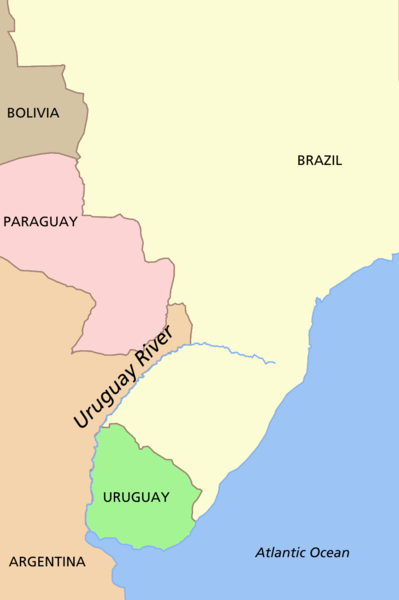
April 19 is the anniversary of the “Landing of the 33 Patriots” in Uruguay, also known as the Treinta y Tres Orientales, though it’s safe to say none of the 33 “Orientals” ever set foot in Asia. They were called ‘Orientales‘ because Uruguay was known as the Banda Oriental, or the “Eastern Bank” of the Rio de la Plata, the western shore being Argentina.

In a span of less than ten years—1807 to 1816—the Banda Oriental and its capital city of Montevideo were occupied by the English, retaken by the Spanish, and invaded by the Portuguese.

In 1816 Portuguese Brazil took Banda Oriental from the north, ousting the province’s hero Jose Gervasio Artigas in 1820 and forcing him into exile in Paraguay. The Banda Oriental became a province of Brazil, which achieved independence from Portugal in 1822.

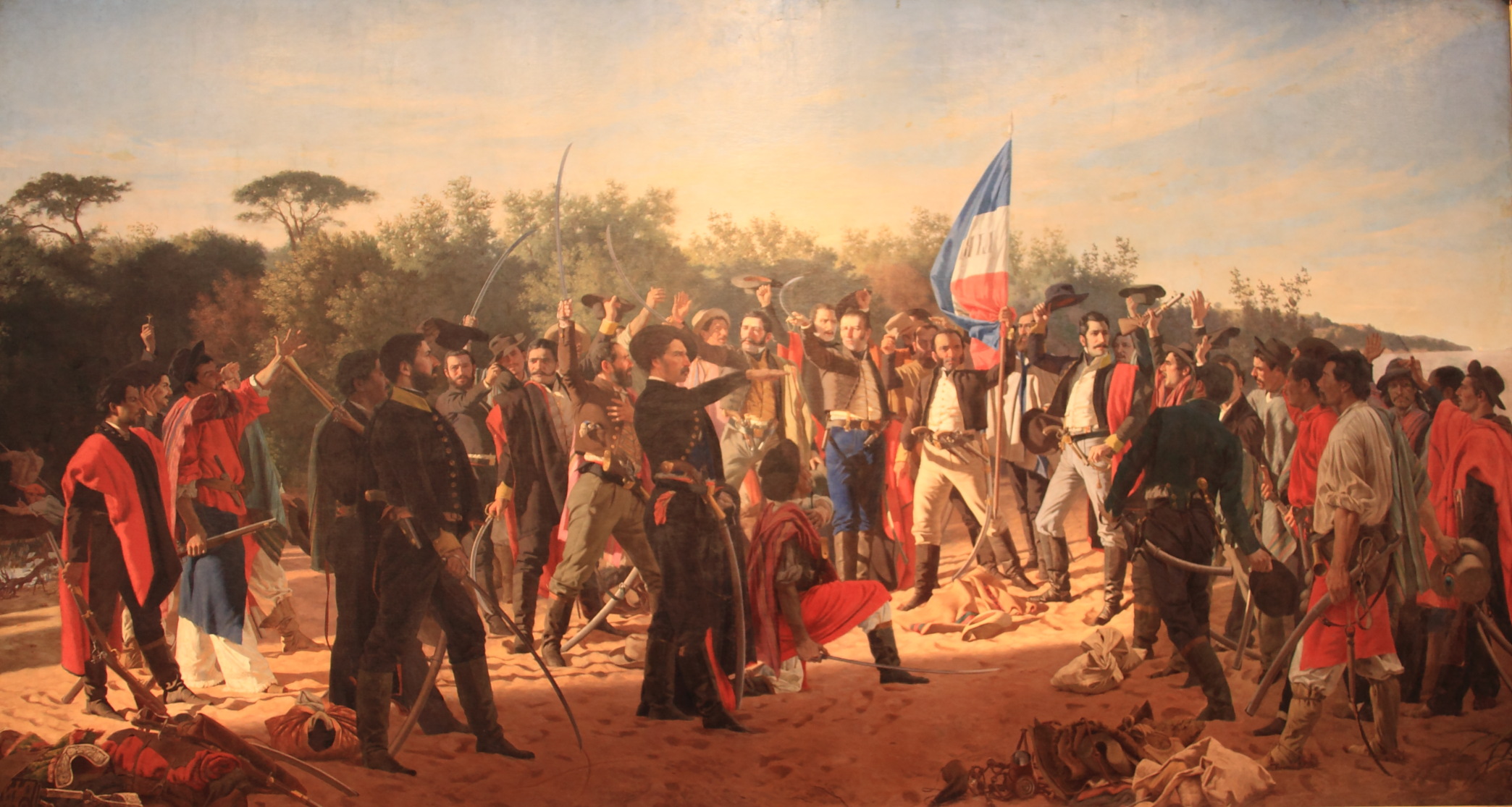
In 1825 a group of exiled Uruguayan fighters called the 33 Orientals returned from Buenos Aires. They were led by Juan Antonio Lavalleja, who had fought with the exiled Artigas. The 33 Orientals secretly crossed the Plata River, landing on the Eastern Bank on April 19. There they planted what would be known as the flag of the 33 Orientals and took an oath to kick the Brazilian government out of Uruguay.

Oath of the 33 Orientals - Juan Manuel Blanes

Four months later, on August 25, 1825, Uruguay officially declared its independence from Brazil. After 500 days of fighting (the Argentina-Brazil War), Brazil recognized Uruguay’s independence in 1828.

Landing of the 33 Orientals

Zimbabwe Independence Day

April 18


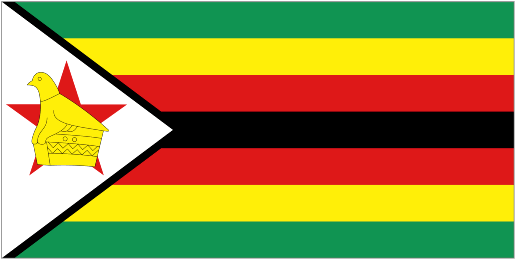
Happy Independence Day, Zimbabwe!

Okay, well, maybe not so happy.

A quick scan of the blogosphere headlines reveals:

and my favorite:

According to the first article,

“Independence followed a seven-year war between nationalist blacks and the white-minority regime that left 27,000 people dead. Robert Mugabe was sworn in as president in 1980 and has maintained his grip on power ever since.”

Louise Dunne, Radio Netherlands Worldwide

“The first decade, 1980 to 1990 was superb for everyone, there was an independence euphoria, things were moving. Then 1990 to 2000, people started looking at what they had actually achieved from independence, scrutinising things like corruption. And then after the land reform in 2000, things just went down”.

Charles Rukuni, Zimbabwe journalist

Zimbabwe is a land-locked African nation sandwiched between Zambia, Botswana, Mozambique, and South Africa.

Zimbabwe was once called Rhodesia, named after the British dude ‘Cecil’.  According to “Disability, Liberation, and Development” by Peter Coleridge…

“The Rhodesian colonial system was geared primarily for the benefit of a white minority for whom ‘the whole economic system on the farms as well as in the mines, rested on a cheap and plentiful supply of native labour.'”

Sadly, as the above quote suggests, they didn’t even know how to spell labor. Education was a big problem back then, and the disparity was rampant. Rhodesia spent ten times as many education dollars on whites than on blacks.

Fortunately, after gaining independence, the government poured vast resourced into the education system, allocating “22 per cent of its budget to education, which it declared to be the birthright of every Zimbabwean. (This compares with an education budget of around 2 per cent in Britain in the same period.)

The school population more than tripled between 1979 and 1989. Sounds like a great idea, except, as Coleridge points out, “the downside of educating so many people so suddenly is that there are very few jobs.

In other words, you pretty much need a Ph.D. to work at Coco’s now.

Zimbabwe also suffers from hyperinflation. It made news in early 2009 when the government printed what may be the world’s first $100 trillion bills. A 1 with 14 zeroes in case you were wondering.

Don't spend it all at once

But if you find one on the street, don’t go on a spending spree. It was worth about $30. Shortly thereafter, the government changed the currency system by removing 12 zeroes from the dollar, so that $1 trillion now equalled $1 Zimbabwean. Though it saved a lot of zeroes, it was a moot point, as Zimbabweans stopped accepting/using the ZD and now use foreign currencies for transactions.

Some blame President Robert Mugabe for the country’s problems, but to be fair, he has only been in charge of the country for the past three decades.

President Mugabe’s life is the stuff of legend. Born in 1924, he was a leader of the independence movement. He spent 11 years in prison for speaking out against the colonial government, during which time he earned three degrees, including a law degree. After independence, in which he played an instrumental part, he was elected the country’s first Prime Minister, and later President.

Since then however, his critics insist his reign has exhibited symptoms of Saturday Night Live skit syndrome. A good idea gone on about 20 years too long.

“On this day I am hoping for change, especially for the president…He is not going to go on and on. The talks must end now so we can vote.”

— Fanuel Chikwakwaire, Zimbabwe citizen (Mugabe rejects violence as Zimbabwe celebrates Independence)

Ellis Island Family History Day

April 17

Emigrants Arriving at Ellis Island

On Thursday evening, December 31, 1891, the S.S. Nevada arrived in New York Harbor. Among its passengers were 14 year-old Annie Moore of Cork County, Ireland, and her two younger brothers, Anthony and Phillip. They had sailed to America to join their parents in New York City’s Lower East Side.

On the morning of January 1, 1892, Annie’s 15th birthday, a barge transported the three Moores and the 145 other steerage passengers to a brand new federal immigration center called Ellis Island, where the rosy-cheeked Annie became the first immigrant of the twelve million who would enter the United States through its doors.

“As soon as the gangplank was run ashore, Annie tripped across it and was hurried into the big building that almost covers the entire island. By a prearranged plan she was escorted to a registry desk which was temporarily occupied by Mr. Charles M. Hendley…” “Landed on Ellis Island” NY Times 1/2/1892 (pdf)

Over 100 million Americans — roughly a third of the U.S. population — can trace their roots back to the immigrants of Ellis Island, starting with Annie Moore.

That first day, Ellis Island welcomed three steamships and 700 passengers. Nothing to compare with the thousands who would soon be entering the country through the island each day.

April 17 (Ellis Island Family History Day) marks the anniversary of the date in 1907 when more immigrants passed through Ellis Island than on any other day: 11,747, more than twice the usual number. 1907 alone saw the arrival of over a million immigrants.

Though the first immigrants were Irish, about half of all those who passed through Ellis Island in its heyday were of German descent.

The “Statue of Liberty Enlightening the World” (the statue’s official name) was completed four year prior to Ellis Island’s opening. The statue was the first glimpse of America for the millions of immigrants who sailed into New York Harbor on the way to Ellis Island between 1892 and 1924. After 1924, quotas and restrictions greatly reduced emigration to America. Still, Ellis Island served as an entry point for war refugees and displaced persons until its closure in 1954.

The Island reopened as a museum in 1990 which is now run by the National Park Service as part of the Statue of LIberty National Monument.

It generally took arrivals three to five hours to go through the immigration process, longer for those suspected of or diagnosed as being ill. Hopefuls had to pass literacy tests and “examinations as to moral and physical fitness.” (NYTimes 6/27/1920)

About 2% (250,000) were sent back to their home countries on account of incurable illnesses. For curable illnesses, Ellis Island was the site of the one of the largest public healthcare operations in early 20th century America. The medical complex occupied 22 buildings, and in 1914 alone it treated over 10,000 patients from 75 countries.

The first Ellis Island Family History Day was observed in 2001. The holiday has been officiated via proclamations by state governors.

The Ellis Island Immigration Museum has received 20 million visitors since its opening in 1990, more than the number of immigrants it naturalized during its 62-year career.

Famous immigrants who entered through Ellis Island:

  • comedian Bob Hope
  • actor Cary Grant
  • songwriter Irving Berlin
  • author Isaac Asimov
  • Supreme Court Justice Felix Frankfurter
  • Father Flanagan

More Annie Moore – ellisisland.org

Ellis Island’s Forgotten Hospital

America At Last! Ilona’s Arrival at Ellis Island, 1909 – 100 Years in America

Mahavira Jayanti

April 16, 2011
March 28, 2010
April 11, 2009

I say with conviction that the doctrine for which the name of Lord Mahavir is glorified nowadays is the doctrine of Ahimsa. If anyone has practiced to the fullest extent and has propagated most the doctrine of Ahimsa, it was Lord Mahavira.

Mahatma Gandhi

Today is Mahavira Jayanti, in honor of the birthday of Lord Mahavira, who spread the Jainism religion and philosophy in India in the 6th century B.C. The holy day falls on the 13th day of Chaitra. The date varies in the Gregorian Calendar.

Mahavira was the last of the 24 Tirthankars, or “ford makers,” whose teachings form the basis of Jain Dharma, and he is one of only two for which we have concrete records of their lives.

Jainism is one of the oldest religions in the world, influencing both Hindusim and Buddhism. Jainism stresses self-control, non-violence, ascetic living, and the the divine potential in every soul. Jainists are noted for their high level of literacy throughout history. They are also known for their vast libraries going back to antiquity.

Jainism does not revolve around any one prophet or God but around the central tenant that God is an amalgamation of the qualities within each and every soul that are pure and divine.

Mahavira was a title meaning “Great Hero.” Maharvira was born to King Siddhartha and Queen Trishala in the kingdom of ancient Vaishali, in what is now Northeast India. His name, Prince Varhaman (Varhaman meant “increasing”) is believed to refer to how all good things in nature flourished prior to his birth. Of course, if he was born in April, that’s no real shocker.

What was surprising was that at age 30 the wealthy, priveleged Prince suddenly renounced his family, his inheritance, and all his worldly possessions to live an ascetic life and to devote his life to the spiritual and achieving enlightenment, or Keval Gyan.

Throughout the remainder of his life he traveled across India, with no possessions, often without even footwear or clothing, and preached the principles of Jainism to the people of India.

At one point he was said to have amassed nearly half a million followers. His teaching solidified the shape of Jainism that would persist for over 2500 years. He died at the old age of 72, the last of the Jain prophets.

Though far more people practice Buddhism and Hinduism, Jainism is still one of the most populous religions of the world, with over 4 million followers.

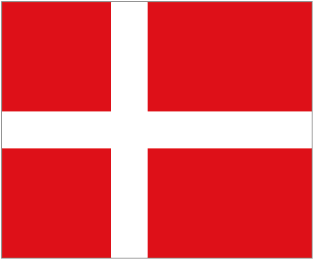
Queen Margrethe II’s Birthday – Denmark

April 16

On April 9, 1940 Nazi Germany overran the virtually defenseless nation of Denmark on its way to invading Norway that same day. Germany’s reason was strategic. Germany was dependent on Norway’s natural resources for arms and materials. Its official justification was more altruistic: to “protect” Denmark from potential Franco-British invasion.

Danish King Christian X was told that, if Denmark didn’t capitulate, the German Luftwaffe would decimate the capital. The King reluctantly agreed.

Christian X, Sept. 26, 1940, his 70th birthday

Denmark’s cooperation with Germany had its advantages. Only a hundred Danish Jews perished at Nazi hands during World War II. When Hitler ordered Denmark’s Jews rounded up and sent to concentration camps, Danes smuggled 8000 to safety in Sweden. The King was once quoted as saying that if Denmark’s Jews were forced to wear yellow stars (for identification), then he and the Danes would all wear yellow stars. (The Nazis never enforced the policy.)

A week after the invasion, the King’s son, Crown-Prince Frederik and his wife gave birth to baby girl. Though the birth brought a ray of hope to one of Denmark’s darkest hours, no one imagined she might be queen, and that one day the country would celebrate her birthday as a holiday. For the Danish throne always passed to a male. Even if the king had no sons, the crown would go to a male relative.

But eight years after the war, when Princess Margrethe was 13, the Constitutional Act of 1953 amended the rule of royal primogeniture, allowing the first-born daughter to inherit the throne if the king had no son. Even then no one could be sure Margrethe would be queen, or that King Frederik IX wouldn’t have a son.

On January 15, 1972, the day after the death of her father, the 31 year-old princess became the Queen of Denmark, the first Queen Regent since 1412.

Queen Margaret I had ruled first on behalf of her underage son Oluf back in the 1370’s. When Oluf died unexpectedly in 1387 at age 17, Margaret became Queen Regent. During her 25 year reign, Margaret unified Denmark, Norway, and Sweden. Apparently this made the men-folk look bad, so they didn’t allow another woman to take the helm for 550 years.

Queen Margrethe II
Queen Margrethe II

Though not quite as powerful as her namesake—the power of the Danish monarch waned significantly in the 19th and 20th centuries—Queen Margrethe II is the undisputed head of the oldest consecutive royal line of monarchs in Europe. Consisting of 50 kings and 2 queens, the Danish royal line dates back to Gorm the Old and the Viking days over 1000 years ago.

Other memorable Danish Kings include:

  • Harald Bluetooth
  • Sweyn Forkbeard
  • Canute the Great
  • Magnus the Good
  • and Valdemar the Victorious

Father Damien: Patron Saint of Outcasts

April 15

Here it’s been over a year and we’ve yet to celebrate any holidays devoted to Belgians. Today, April 15, ends all that. No, the Belgians didn’t invent taxes, but they did produce a priest by the name of Father Damien, and not the demon-exorcising priest of horror movie fame.

Our Father Damien was a very real, breathing human being from Flemish Brabant. He was born in 1840 and became a Picpus Brother in the Congregation of the Sacred Hearts of Jesus and Mary in 1860. In 1864 he was sent to the far off Kingdom of Hawaii where he served on the island of Oahu. And it’s in Hawaii, not in Belgium, that people celebrate Father Damien Day.

Our Lady of Peace, Molokai, Hawaii

In the mid-18th century Hawaii underwent a horrible epidemic of several diseases, brought to the islands by foreigners—diseases to which the Hawaiian islanders had no immunities. Chief among these illnesses was the devastating and very contagious disease of leprosy.

King Kamehameha V established a colony on the island of Molokai where all those suffering from leprosy were quarantined. “Kalaupapa” was designed by necessity to be a self-sustaining colony, for few healthy people would go near it. However, because of the debilitating effects of leprosy, many of the inhabitants had difficulty farming and fending for themselves, and word spread of a Lord of the Rings society—wait, no—Lord of the Flies society developing there. (More anarchy, less hobbits.) The Church knew a priest should be sent to the island, but also knew such an assignment would effectively be a death sentence because of contagious nature of the disease.

In 1873 the 33 year-old Father Damien asked to be transfered to Kalaupapa and be priest to the lepers. There, Father Damien did more than pray:

“He washed their bodies, bandaged their wounds, tidied their rooms and made them as comfortable as possible. He encouraged those who were well to work alongside him by building cottages, coffins, a rectory, an orphanage for the children and repairing the road. He also taught them to farm, play musical instruments, and sing…Even before he was diagnosed as having leprosy he used the term “we lepers” in his sermons for he wished to identify with them as a means of bring them to Christ.” — Cathedral of Our Lady of Peace

Father Damien felt the first symptoms of leprosy in 1884. He continued working with the people of Kalaupapa another five years. As word spread of his deeds across the Christian world, much-needed donations and supplies finally flowed into the colony.

Father Damien died on April 15, 1889.

Despite all his deeds, Father Damien was not your steroetypical hero. He was derided by his detractors as “a coarse, dirty man, head-strong and bigoted.” (Reverend C.M.Hyde, 8/2/1889) In short, they say, he was no saint.

However, this October those detractors will be proven wrong. On October 11, 2009, 120 years after his death, Father Damien will officially become a saint in the Roman Catholic Church. He is the patron of those with leprosy and HIV/AIDS, and of ‘outcasts’.

Father Damien
Father Damien (1840-1889)

Tax Day: Know Your 16th Amendment Rights

April 15

Beware the Ides of April.

Okay, actually, technically, April 15th isn’t the Ides; April 13 is.

But the 15th of April is a day all Americans dread. It is, of course, Kim Il-Sung’s birthday. This guy was leader of North Korea from the time Truman was President all the way through to the Clinton Administration, and transformed North Korea into the thriving open-minded society it is today.

Ahem.

In addition to that, it’s Tax Day. That means if you’re headed to the post office—forget it, you should’ve left yesterday.

And if you’re filing online today expect DSL gridlock well through midnight.

You’ll be glad to know you’re following in a well-established American tradition.

The first U.S. income tax was levied in 1861 to help finance the Civil War. It taxed 3% of net incomes over a whopping $600 a year. The income tax was dismantled eleven years later.

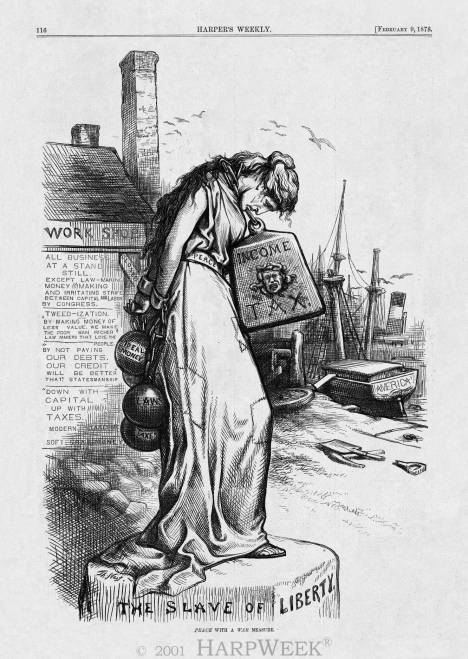
Harper’s ran this prophetic cartoon in 1878 during one of several proposals to reinstate the income tax:

The Ron Paul Revolution of 1878

Income taxes were intermittently levied over the next three decades until the 1894 Wilson-Gorman Tariff Act attempted to claim a 2% tax on incomes over $4000. Opponents declared the act “unDemocratic, inquisitorial, and wrong in principle.” And the Supreme Court agreed, declaring the federal income tax unconstitutional.

Then came good ol’ Amendment 16:

“The Congress shall have power to lay and collect taxes on incomes, from whatever source derived, without appointment among the several States, and without regard to any census or enumeration.”

ie. Yours is Mine.

Yes, you have no 16th Amendment rights.

It took over two years (from 1911-1913) for the amendment to rack up the required 2/3’s majority–from 36 of the 48 states, and finally passed in 1913.

So whatever your taxes amount to, you can’t blame Connecticut, Florida, Rhode Island, Utah, Pennsylvania or Virginia. They’re the only states (of the 48 at the time) that never ratified the amendment.

Oh and what was state #36?

New Mexico.

Yeah, and New Mexico was not a state until 1912. Thanks New Mexico, thanks for your brilliant contribution. Really, we’re not bitter.

Can we get a recount?