Two American Heroes: MacDonald & Hostos

January 11

Okay, here I’m using ‘American’ in its broader sense. A Chilean once told me how he didn’t like the word ‘American’ or ‘America’ referring to one country. America stretches from the Arctic to Tierra del Fuego and encompasses two continents, he reminded me. Why let one country hijack the name? I suppose it’s because it’s shorter than saying ‘United States citizen’.

Today is the birthday of (North) American hero John A. MacDonald, the first Prime Minister of Canada and an unabashed drunkard.

But my Canadian sources tell me no one in Canada knows or cares.

So instead let’s look south to the island of Puerto Rico to celebrate the birthday in 1839 of another American hero, a man called “the Citizen of the Americas”: Eugenio Maria de Hostos.

Eugenio Maria de Hostos

[observed 2nd Monday in January]

Hostos is considered one of the great modern thinkers of education. He wrote scores of books and hundreds of essays in numerous disciplines, from the most revered discourse on Hamlet in the Spanish language, to La Peregrinación de Bayoán, his 1863 novel promoting Cuban independence. His seminal works on education preceded those of John Dewey by two decades, and…

“…Although Hostos did not conduct rigorous experimental research pertaining to the mind and its development, his encyclopaedic knowledge of philosophy, linguistics, psychology, sociology, history and other disciplines gave him a coherent conceptualization and an operational model of mind.”

Angel Villarini Jusino & Carlos Antonio Torre
Fifty Major Thinkers on Education
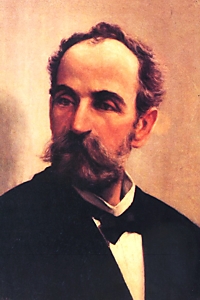
Eugenio Maria de Hostos

Hostos was born in Mayaguez, Puerto Rico in 1839, the year Spanish poet Salas Quiroga magnanimously declared, “Puerto Rico is the corpse of a society that hasn’t been born.

From inauspicious beginnings, Hostos went on to attend secondary training at the University of Bilbao, Spain, and law school at Central University in Madrid. There he joined the Spanish republican movement, protesting government restraints on basic freedoms, but he was disillusioned in 1869 when the creators of the new Spanish constitution dashed all hopes for an independent Puerto Rico.

Hostos then sailed to New York City, where he became a Cuban revolutionary 90 years before Che made it hip. In those days Cuban revolutionaries fought for independence from Spain rather than U.S. imperialism. Hostos believed that a free Cuba would lead to a free Puerto Rico, and a “Federated Antillean Republic”, composed of Cuba, Puerto Rico, and the Dominican Republic.

Hostos trekked across the Americas speaking on this and other various causes:

In Chile, he lobbied successfully for the education of women.

In Argentina, he helped establish a trans-Andean railroad.

In the Dominican Republic he founded the first Teacher’s College.

In Cuba, he hastened the abolition of slavery.

And wherever he traveled he espoused the basic rights of all peoples and the importance of progressive education throughout the Americas as both a means and an end.

In order for humans to be humans, that is, worthy of realizing their life goals, nature bestowed them with awareness of herself, the ability to know their own origins, their own strengths and frailties, their own transcendence and interdependence, their rights and obligations, their own freedom and responsibilities, the capability for self-improvement and for self-enobling of their ideal existence.

Eugenio Maria de Hostos (1839-1903)

However, Hostos was gravely disappointed when in 1898 the United States annexed Puerto Rico and Cuba from Spain, rather than granting them independence.

Hostos died in the Dominican Republic in 1903.

Cuba won its independence from the United States 18 months before Hostos’s death. Hostos requested that his remains be transfered back to Puerto Rico only when his homeland gained its independence. Needless to say, Hostos has been resting in the Dominican Republic’s National Pantheon for a hundred years and counting.

For the centennial of his birth, the 8th International Conference of America bestowed upon Hostos the title “El Cuidadano de las Americas”: Citizen of the Americas.

Gentlemen, I don’t have to tell you who I am. I am an American. I have the honor of being a Puerto Rican and a federalist. Being a colonial, a product of the colonial despotism, and hindered by it in my feelings, thoughts and actions, I took vengeance upon it by imagining a definitive form of liberty and I conceived a confederation of ideas, given the impossibility of a political confederation. I am a federalist because I am American, because I am a colonial – because I am Puerto Rican.

Eugenio Maria de Hostos, speech at the Madrid Ateneo, 1868

Puerto Rico celebrates Hostos’s Birthday on the second Monday of January.

Hostos statue, San Juan, Puerto Rico
Hostos statue, San Juan, Puerto Rico © Kurt

References:

Eugenio Maria de Hostos: After One Hundred Years, by Muna Lee, from A Pan-American Life (2004)

Eugenio Maria de Hostos, by Angel Villarini Jusino & Carlos Antonio Torre, from Fifty Major Thinkers on Education (2001)

Works by Hostos, Hostos Community College
Birthday of the King: Elvis

January 8

The Mississippi Delta was shining
Like a National guitar,
I am following the river
Down the highway
Through the cradle of the civil war,

I’m going to Graceland, Graceland
In Memphis Tennessee…
…I’ve reason to believe
We both will be received
In Graceland

Paul Simon, Graceland

Today is the birthday of the King of Rock ‘n’ Roll Elvis Presley. Though not an official holiday in any nation, it is observed throughout the world.

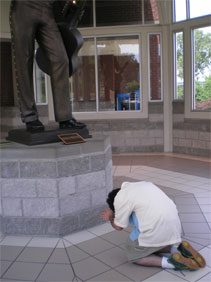
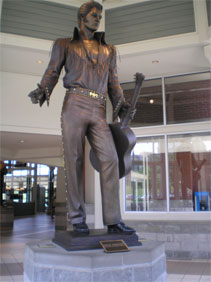
Elvis statue Elvis worshipper

(Above: the author praises the King in Memphis, Tennessee)

The focal point of the celebration is Graceland, Elvis’s former home in Memphis, Tennessee. Festivities begin each year with a gospel tribute at the Gates of Graceland at midnight.

Graceland was not named by Elvis, but by the original owner S.E. Toof after his daughter Grace.

Elvis Presley was born in Tupelo, Mississippi. At age 13 the Presley family moved to Memphis, Tennessee, where Elvis lived for most of his life.

In 1957 the 22 year-old superstar purchased the Graceland mansion in Memphis. He was proud to move his parents into it, a long way from the two-room house where Elvis was raised. His mother Gladys died the following year.

Graceland living room

Early viewers of Elvis’s concerts, such as rock legend Roy Orbison, cite his instinct and incredible energy as a performer as separating him from the artists before him. It is difficult to convey the novelty of Elvis after the half-century of imitations and changes that followed. Various morality groups assailed him for his “vulgar” and “obscene” music and movements on stage.

His discoverer, Sam Phillipsof Sun Studios, said Elvis “put every ounce of emotion…into every song, almost as if he was incapable of holding back.”

When Elvis first entered the Sun Studios, receptionist Marion Keisker asked him who he sounded like. He is reported to have said “I don’t sound like nobody.”

While this was true in mainstream radio, Elvis was heavily influenced by the black gospel singers he had seen at Memphis’ Ellis Auditorium and black blues performers in the clubs along Beale Street.

Stories make it sound like Elvis walked into Sun Studios and the rest is history, but in fact, after his first recording in 1953, Elvis politely hassled Sam Phillips for a year—while working as a truck driver—before Sam teamed him up with bassist Bill Black and guitarist Scotty Moore. The three recorded a high-energy version of black R&B artist Arthur Crudup’s “That’s All Right, Mama” in July and the single was released that month. Some white disc jockeys refused to play Elvis’ music at first, believing Elvis was black.

In January 1956 RCA released Heartbreak Hotel, co-written by a part-time Florida schoolteacher Mae Boren Axton, who was inspired by the newspaper epitaph of a suicide victim: “I walk a lonely street.”

Heartbreak Hotel slowly and steadily climbed the charts, entering at #1 68 in March, and making its way to #1 in May.

Elvis the #1 Hits: The Secret History of the Classics

Though Graceland is considered the musical Mecca for Elvis fans, do not miss Sun Studios just to the east on Union Avenue, for a more in-depth historically revealing tour about Elvis and Memphis music history.

Epiphany, Day of the Kings

January 6

Every child knows that at one point Christmas had twelve days. The song says so. “On the twelfth day of Christmas, my true love gave to me…

But this begs two questions:

First, what kind of sicko sends their true love sends 23 birds, 50 assorted pipers, drummers, milk maids, ladies and leapin’ lords, five rings and a pear tree, and doesn’t include one vacuum?

And second, what happened to the other eleven days? What kind of cruel world advertises the twelve days of Christmas to its children and gives them only one? “Sorry kids, we just couldn’t afford the first 11 days this year. If only you’d been born last century.”

The truth is…

The Truth

Actually December 25th is the first day of Christmas, not the last.

In the modern world of Christmas so much energy is focused on preparing exclusively for the first day that by the time the 26th rolls around many people are simply Christmas’d out.

But for much of Christian history, the twelve days began on the night of December 25th and ended the day of January 6th. (…though the calendar varies for different Churches. Christmas in the Russian Orthodox Church, for example, doesn’t fall until January 7th.)

Today we tend to mark our holidays by calendar day–midnight to midnight–but these holidays were traditionally celebrated sunset to sunset. The famed “Twelfth Night” actually falls on the evening of January 5th, though calendars mark the Epiphany as January 6th.

The Epiphany

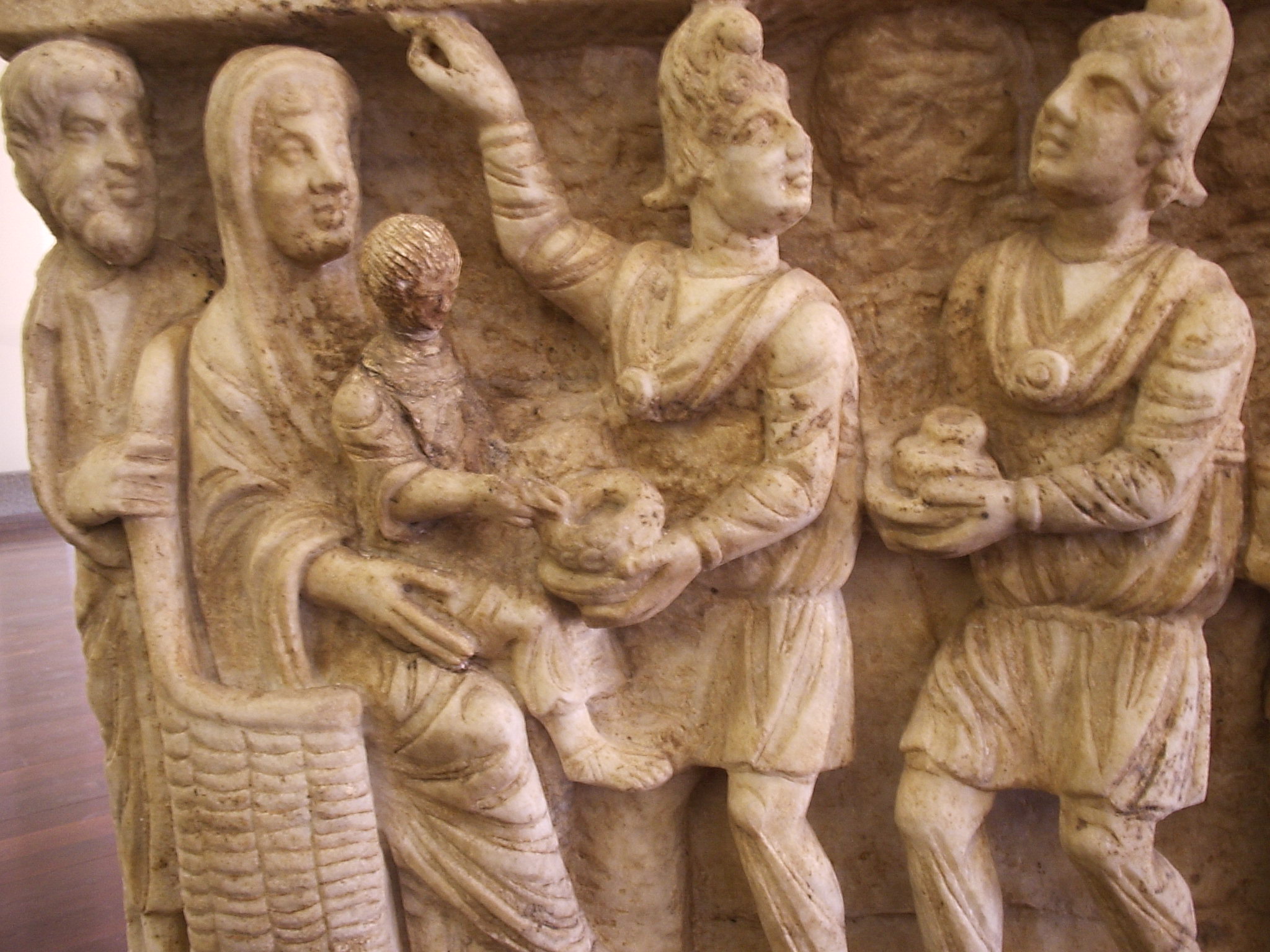
The Epiphany literally means ‘manifestation’ and marks the day the Three Wise Men, or Magi, encountered the Virgin Mary and the Baby Jesus.

There are different theories as to the details surrounding the Magi mentioned in the Gospels. In fact no number is specified in the Bible, but the number three may have originated due to the three gifts bestowed upon Christ: gold, myrrh and frankincense. Matthew does not give clues to their origin, nationality, religion, or ethnicity either except to say they came “from the East” to Jerusalem. Hence they are referred to as the Three Kings of the Orient, although their rank is also supposition

The three differing places of origin may have developed as a way of demonstrating the diversity of Christ’s influence.

The names attributed to the Magi vary from place to place. We can trace the names Gaspar (or Caspar), Melchior, and Balthasar to a 6th century Greek text]

One theory for their origin is that they were Zoroastrians. Zoroastrianism was one of the most common religions of Persia at the time, and its priests were astrologers, who were revered for their knowledge of the night sky.

The Magi bestowed three gifts that represent:

  • Gold – royalty, for kings
  • Frankincense – piety, for priests
  • Myrrh – suffering, or painful death

which led to the Virgin Mary’s famous quip: “So which one of you Wise Guys brought the Myrrh?”

Over the next two millennia many European traditions associated with the winter solstice merged with the twelve days of Christmas. For example, on Twelfth Night roles were often reversed, such as master and servant, a tradition stemming from the Roman Saturnalia.
So enjoy this the twelfth and last day of Christmas. And whatever you do, don’t give a baby myrrh. That’s just rude.

http://www.biblegateway.com/passage/?book_id=47&chapter=2&version=31

http://www.novareinna.com/festive/twelfth.html

http://en.bibleinfo.com/questions/question.html?id=761

http://www.spcm.org/Journal/spip.php?breve6085

http://en.wikipedia.org/wiki/Biblical_Magi

http://en.wikipedia.org/wiki/Twelve_Days_of_Christmas

http://www.turkishdailynews.com.tr/article.php?enewsid=92855

http://www.cnn.com/2004/WORLD/europe/02/10/uk.magi.reut/index.html

http://www.snopes.com/holidays/christmas/3wisemen.asp

Myanmar Independence

January 4

It is not power that corrupts but fear. — Aung San Suu Kyi

The people of Myanmar–formerly Burma–are in a difficult spot while celebrating January 4, the anniversary of their independence. The public secretly reveres the country’s national hero, but cannot utter his name outdoors.

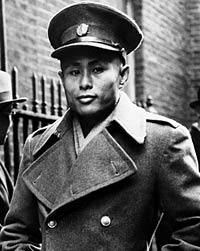
The main force behind Burma’s independence was Aung San. During World War II Aung San was Commander of the Burma Defense Army. He opposed British rule in Burma and saw an alliance with Japan as the way to independence. However, San soon saw that the thin veneer of independence achieved from the British was a sham. For the nation was now under the thumb of the more-controlling Japanese.

Aung San founded the Anti-Fascist Organization in Burma, and led the Burma National Army with the help of the British against the Japanese, whom they ultimately defeated.

Aung San
Aung San

In 1947 Aung San negotiated the “Aung San-Attlee Agreement” with the British, which guaranteed Burma’s independence the following year.
Aung San would not live to see the free Burma. He was assassinated along with six other Councillors at an Executive Council meeting in July 1947. He was 32.

Aung San’s daughter, Aung San Suu Kyi, is and has been for twenty years, an outspoken critic of the current Burmese (Myanmar) government.

Suu Kyi was 2 years old when her father died and Burma gained its independence. She lived most of the next 40 years in peace and quiet. At 43 she was “leading a quiet life in England as a housewife and academic.”
http://www.webcom.com/hrin/magazine/jan97/burma.html

She returned to Burma to care for her mother who was gravely ill at the time. A month before her visit in 1988, riot police shot and killed 200 demonstrators, mostly students. In August they killed close to 3,000.

I could not, as my father’s daughter, remain indifferent to all that is going on.

— Aung San Suu Kyi

Martial law was declared in 1989. Ang San Suu Kyi became head of the opposition party, the National League for Democracy. Due to her rising popularity she was placed under house arrest. She would not see her children in 2 1/2 years.

Aung San Suu Kyi should have taken office when her party won the national election in 1990. However, surprised by their overwhelming loss, the military junta refused to acknowledge the election.

According to the BBC, Suu Kyi “has spent more than 11 of the past 18 years in some form of detention under Burma’s military regime.”

As a result “Aung San’s name has been dropped from official speeches. His boyish face has disappeared from Burmese bank notes. His grave has been closed to the public for years.” — time.com

In 1991 Aung San Suu Kyi won the Nobel Peace Prize while under house arrest. When she was released in 1995, she was told if she left the country she could not return. Thus she did not leave even when her husband in London was diagnosed with prostate cancer in 1997. She never saw him again. He died in 1999.

She was placed under house arrest again in 2000, where she has remained for most of the past decade.

The irony of imprisoning the daughter of the father of national independence has not been lost on the military junta. Its military chief Than Shwe has called for a “discipline-flourishing democratic state.”

Whether Aung San Suu Kyi will, unlike her father, live to see the promise land, a democratic Burma, remains to be seen. She still fervently clings to a non-violent approach to regime change, despite knowing that peaceful change may take longer. She believes it is a precedent that must be set.

Update: Aung San Suu Kyi was released from house arrest on November 13, 2010.

St. Genevieve

January 3

St. Genevieve of Paris

Today is St. Genevieve’s feast day. She’s honored as the Patron Saint of Paris.

St. Genevieve became a nun at the tender age of 15 and devoted the rest of her life—another 65 years—to Christ. The secret of her longevity may have been her diet. She didn’t eat much more than barley bread and beans, and according to her biography, only twice a week, Sundays and Thursdays. She loosened this restriction at the age of 50 at the request of some bishops.

When Huns Attack

During the Hun invasion of what’s now France in 451, St. Genevieve’s prayers were believed to have prevented the Huns from attacking Paris; they headed toward Orleans instead. (Notice Genevieve is not the patron saint of Orleans…)

St. Genevieve
St. Genevieve

The following decade, during the lengthy Childeric siege on the city, Genevieve sneaked through a blockade to bring back much-needed grain to Paris’s starving citizens.

Death did not stop Genevieve from performing miracles. Parisians held a procession of her relics during the deadly plague of 1129 which killed 14,000 people. Spread of the disease ceased almost immediately, and many who were sick were reported to have healed upon touching her relics.

St. Genevieve’s saint day is January 3, but for centuries Parisians celebrated the anniversary of that first procession–November 26, 1129–with another procession in her honor.

Berchtold’s Day – Switzerland

January 2

Berne Coat of Arms

We made it to day 2 of the new year and the Swiss are already celebrating their second holiday.

Berchold’s Day, January 2, is named after Duke Berchtold V of Zahringen who founded the capital city of Switzerland in 1191.

Local legend goes that Bertchtold announced he’d name his future city after the first animal he slay on his hunting trip. He scored a bear, and thus the city is called Berne. (Good thing he didn’t kill a donkey.)

A duller theory is he named it “in memory of Dietrich of Berne (Verona), a favourite hero of Alamannic poetry.” (Names and Their Histories, Isaac Taylor, 1856″)

The Great Bear Hunt

St. Brechtold’s Day is celebrated mostly in the area around Berne. Though the confederacy of Switzerland is 700 years old, each region has maintained their own culture and identity. Switzerland’s central location in Western Europe makes it the “melting pot” of very white people: French, German, Italian, and Swiss. So I guess it’s more of an assorted cheese wheel of cultures, since it hasn’t really melted yet.

According to sacred-texts.com:

…the second day of January is devoted to gay neighborhood parties in which nuts play an important part.

You know, I’m not even going to quote you the rest of that.

Okay, yes I am.

In early autumn children begin hoarding supplies of nuts for Berchtold’s Day, when they have “nut feasts.” Nut eating and nut games, followed by singing and folk dancing…One favorite stunt of the boys and girls is to make “hocks.”

Hocks are made up of five nuts—a pyramid with four nuts on the bottom and one on top—and apparently they’re harder to construct than you’d think. We don’t know why nuts are involved. Officeholidays.com theorizes that Berchtold really killed a squirrel.

Whatever the reason, there’s no better way to usher in the New Year than by breaking out some nuts, build those pyramidal hocks, and sing the national song of Switzerland:

O Great Berchtold
You killed a bear
You founded Berne
We stack nuts in your honor.

— Ancient Swiss Canto*

Photos of Berchtoldstag Parade

[*Ok, just to clarify, this is a made-up song, not the Swiss anthem. — Ed.]

Tweeda Newa Jaar – South Africa

January 2

flag_south_africa

In Cape Town one day isn’t enough time to celebrate the New Year. So residents celebrate Tweede Nuwa Jaar, “Second New Year.”

On this day thousands line up along the streets to watch, or participate in, one of the most fascinating New Year’s celebrations in the world. The world-famous Coon Carnival.

Regarding the name, says one participant:

“The Americans come and they don’t want us to use the word Coon because it’s derogatory for the people. Here Coon is not derogatory in our sense. For us the minute you talk Coon, he sees New Year day, he sees satin and the eyes and mouth with circles in white, the rest of the face in black, like the American minstrels.”

Yes, on this day Cape Town musical groups called troupes or kaapse klopse don colorful uniforms inspired by American minstrels of the previous century. They paint their faces bright white and march down the Bo-Kaap part of the city. It has been called “a riot of color and sound” and, though it has no equal, might be compared in feel to the Mardi Gras celebrations in Brazil.

The celebration has been shunned by some members of the upper echelon, who prefer the more refined Malay Choirs and Christmas Bands. But in 1996 when Nelson Mandela put on the outfit of a minstrel troupe to open the Carnival, the traditional march outgrew its working class roots and gained a little more acceptance among the intellectual elite.

Denis-Constant Martin writes in Coon Carnival: New Year in Cape Town

“To the sounds of wind instruments, ghoemas, and tambourines, they march, dance and sing along Darling Street, past the Grand Parade, into Adderley Street, up Wale Street, into Chiappini Street, then Somerset Road and to Green Point where they go into the stadium for the second round of competitions.”

These troupes are from different parts of the city, and can number over a thousand members. To become part of a troupe all you need’s a uniform. You can beg or buy them from the group captain or bargain with him for a price. Indeed that’s how the groups make their money, from the sale of uniforms. Without a uniform, you’re not in the band, period.

The colorful outfits change each year and were inspired by the American minstrels who visited Cape Town in the mid to late 1800’s. They would smear burnt cork on their face to simulate “black face.” Locals imitated the outlandish dress, hat, and umbrella, but reversed the make-up to wear “white face” and the carnival was born.

The significance of January 2nd is that it was the one day of the year slaves were given holiday. Today the parade is an expression of the joy of life, of victory over the struggle of slavery and then apartheid, and a symbol of freedom and independence.

With the popularization of the carnival though, residents are concerned about the ideals the parade represents. Writes Joel Pollak

There is a widespread fear that organizing the Coon Carnival to appeal to foreign tourists and commercial sponsors would mean taking it away from the local communities that have kept it alive for over a hundred years, in effect reserving the best seats for tourists just as they were once reserved for whites at the segregated stadiums.

Time will see what’s in store next for the Minstrel Carnival, as city officials call it now.

O-Shogatsu: Japanese New Year

January 1

Countries all around the world celebrate New Year’s Day. But nowhere do they celebrate it like they do in Japan. Think Christmas on steroids, and you’re halfway there.

Shogatsu, named after the first month of the Japanese calendar, lasts three full days. It’s the biggest holiday of the year, barnone.

The Japanese hold special “bonekai” New Year’s parties, or “year-forgetting” parties. (These differ from American New Year’s parties where attendees hope to forget what they did at the party the next morning.)

At the end of the year, Japanese wish each other “Yoi otoshi o omukae kudasai!” which means “I wish you will have a good new year.” But if that’s too much you can just say “Yoi otoshi o!

Businesses close down for at least three days as well as schools. The rituals and activities associated with the festival however can carry on for over a week. Every “first” of the New Year must be handled with great care. It’s believed that the way in which events unfold the first time will be representative of how they will occur throughout the year—from the first sunrise (Hatsuhinode) to the first temple visit (Hatsumode), to the first tea ceremony (Hatsugama).

Japan used to celebrate its new year during the Chinese lunar new year in late January or early February, but the country adopted the Gregorian calendar during the Meiji Restoration of the 1870s. So the Shogatsu traditions are hundreds of years old even if the January 1 date is not.

Yoi otoshi o!

Shogatsu photos