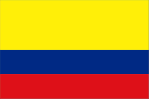
Colombia declared its independence from Spain on this day (July 20) in 1810. Back then the country had to wait nine years to see its dream come to fruition—Spain finally met defeat on August 7, 1819 at the Battle of Boyacá—but now Colombians need only wait two weeks after Independence Day for August 7th to roll around, so they can celebrate all over again.
Colombia is home to the second largest Spanish speaking population in the world after Mexico. Colombia produces 12% of all the world’s coffee, and 95% of the world’s emeralds. It’s the size of France, Spain and Portugal put together, and it’s the only South American nation with coasts on both the Atlantic and Pacific.
Despite being one of the three most bio-diverse countries on the planet, Colombia has had to work hard to combat its dangerous image on the nightly news.
“We must accept the fact that in our country we cannot win one single victory of political freedom without overcoming a desperate resistance on the part of the Government, and that victory will not come of itself but only as a result of a bitter struggle by the oppressed people for the overthrow of racial discrimination…
The theory that we can sit with folded arms and wait for a future parliament to legislate for the ‘essential dignity of every human being irrespective of race, colour, or creed’ is crass perversion of elementary principles of political struggle.”
Mandela’s story is legendary, not only for the 27 years he spent in prison, but for the reasons he arrived there and for his singular journey since.
Mandela was arrested on Sunday, August 5, 1962 for speaking against the government in public and leaving the country illegally, for which he was sentenced for five years.
“While serving this sentence, he was tried again for more serious charged connected with his leadership of the armed resistance group, Umkhonto we Sizwe. He and his colleagues were convicted of terrorism, narrowly escaping execution, receiving life sentences instead.”
Terrorism? Yes, in a post-9-11 world, heads of state downplay that for nearly three decades Nobel Peace Prize Laureate Nelson Mandela had been deemed a terrorist by the apartheid “justice” system.
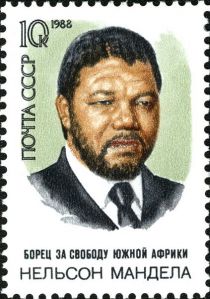
Nelson Mandela stamp, Soviet Union, 1988
During his imprisonment the island on which Mandela was held—Robben Island—became known as “Mandela University.” The political prisoner educated other inmates who then continued the struggle against racism outside the prison walls.
“Did they imagine we might forget him and his companions if they banished him to this island? And did they imagine we could forget the misery of our lives?”
The famous cry “Free Nelson Mandela” really meant “Free South Africa”. On February 11, 1990, the first half of that long sought prize came to pass. Since 1966, not so much as a photograph had been taken of Mandela. His release was broadcast around the world.
After the country’s first truly-democratic elections in 1994, Mandela became South Africa’s first black President.
Freedom, however, is not a moment but a journey. As late as 2008, due to red tape and lack of oversight, Mandela and other members of the African National Congress were still on the U.S. terrorist watch list.
“In the 1970s and ’80s, the ANC was officially designated a terrorist group by [South Africa’s] ruling white minority. Other countries, including the United States, followed suit.” — USA Today 4/30/08
“It is frankly a rather embarrassing matter that I still have to waive in…the great leader, Nelson Mandela.” — Secretary of State, Condoleezza Rice
Mandela and the ANC were removed from the list by a special bill signed by President Bush in July 2008, just prior to Mandela’s 90th birthday.
In South Africa, celebrants “thank Madiba” (Mandela’s honorary title) on July 18th with acts of charity and good deeds, from cleaning cemeteries to painting hospitals.
Meanwhile, in the country of Ghana…
President John Evans Atta Mills on Friday called on Ghanaians to observe Saturday, July 18, 2009 as Nelson Mandela International Day to commemorate his leading role in Africa’s liberation struggle… “The day is Mr. Nelson Mandela’s birthday and those observing this day are required to contribute 67 minutes of their time to the service of their communities in recognition of the 67 years Nelson Mandela has spent in serving humanity.”
As a child, I asked my father, “When was the French Revolution?”
He said, “It began in 1789.”
I asked, “When did it end?”
He said, “It’s still going on.”
* * *
Known as “Bastille Day” in English, Fete de la Federation (Holiday of the Federation) is one of the world’s most famous national holidays, but it’s more commonly known as le Quatorze Juillet (July 14).
The Fete de la Federation commemorates the storming of the Bastille on July 14, 1789. Located in the heart of Paris, the fortress was built during the Hundred Years War as the Bastion de Saint-Antoine. After the war, kings used the Bastion to hold the “evildoers”, such as con-men, embezzlers, political prisoners and Protestants.
Over the centuries the large, imposing Bastille prison became the very symbol of the tyrannical monarchy.
The Bastille
By 1789 France was in deep financial doodoo, in part from supporting the American War of Independence. King Louis XVI took the desperate step of calling together a body known as the Estates-General–a gathering of members of the clergy, nobles, and “everybody else”–to help solve the crisis. The Third Estate (the “everybody else” contingent) represented 97% of France’s population (Nobles and Clergy made up the other 3%) but could easily be outvoted by the other two Estates, as had happened the last time the Estates-General convened, in 1614.
“Since 1614, the economic power of the Third Estate had increased dramatically; in 1788, the popular call was to double the number of the representatives from the Third Estate so that they’d have equal voting power in comparison with the other two estates…TheParlement of Paris conceded the doubling question…but then declared that all voting would be done by individual Estates, that is, each Estate would get one vote.”
“Revolution & Tragedies in France”
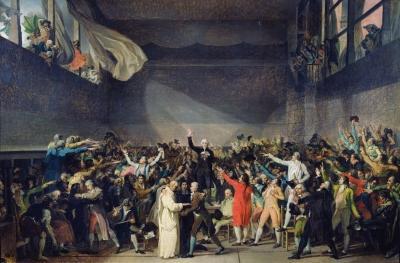
Needless to say, this didn’t enthuse the Third Estate, which walked out of the meeting en masse and formed the National Assembly, joined by sympathetic clergymen and nobles. On June 19, 1789, the king locked and forbade entry to the meeting place of the newly-formed National Assembly, the Salle de Etats. Not easily dissuaded, the Assembly met on a nearby Tennis Court to take what became known as the Tennis Court Oath. Fearing that King Louis XVI would shut them out of the their new meeting place, members of the National Assembly vowed that they would not disband until they had created a Constitution for a new France, based on the principle that the government serve the people.
The Tennis Court Oath
Tensions in Paris grew as King Louis filled the capital with Swiss and German soldiers, who were less sympathetic to the French populace than native-born soldiers. The final straw was not a shot or a massacre, but the king’s dismissal of his Finance Minister Jacques Necker. Necker had been instrumental in calling together the Estates-General, in doubling the membership of the Third Estate, and in involving the public in the financial affairs of the nation. The already discontented public saw his dismissal as an attack on their cause, and they feared King Louis XVI’s next step would be the dissolution of the National Assembly.
On July 12, thousands of Parisians marched onto the Palais Royal where a journalist and lawyer by the name of Camille Desmoulins jumped up on a table outside a cafe by the garden and was said to have yelled,
“Citizens, there is no time to lose; the dismissal of Necker is the knell of Saint Bartholomew for patriots! This very night all the Swiss and German battalions will leave the Champ de Mars to massacre us all; one resource is left; to take arms!”
In recent years, the debate about whether the besiegers of the Bastille sought to free political prisoners, or to take the weapons stored there, has favored the latter. There were only seven prisoners in the Bastille at the time of the siege. After a violent clash between the angry armed crowds outside the Bastille and the forces that guarded it, the crowds stormed the fortress, freed the prisoners, took the munitions, and reportedly decapitated the Bastille’s governor and placed his head on a spike.
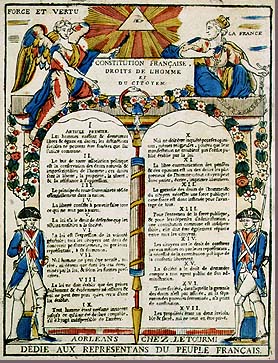
The 500 year-old symbol of French royal tyranny had come to an end; the following month the National Constituent Assembly gave birth to the Declaration of the Rights of Man and Citizen. A document which declared equality not only for all French citizens, but for all men, for all time.
Exactly one year after the storming of the Bastille, Paris hosted the first Fete de la Federation in memory of the event. Hundreds of thousands or spectators gathered around the Champ de Mars to watch soldiers and national guardsmen of France’s 83 departments march, after which King Louis gave an oath to uphold the new Constitution. He would lose his head two and a half years later.
There, over there…beyond those hills
Lies there, they say, Miloš’s grave.
There my soul eternal peace shall gain,
When the Serb is no more a slave.
Onamo, ‘namo, by Nikola I of Montenegro
The Montenegrin state goes back some thousand years, but the incarnation that we know today didn’t come about until June 3, 2006, making it one of the youngest nations of the world.
Montenegro continues to celebrate its national day on July 13th, in accordance with legislation passed in 2004. July 13th is the anniversary of two major events in Montenegrin history.
Russo-Turkish War, 1877
Following the last Russo-Turkish War (1877-1878) the Treaty of San Stefano capitalized on Russian gains in the Balkans. The treaty guaranteed autonomy for an enlarged Bulgaria under Russian protection after 500 years of Ottoman control. (March 3 is still celebrated as Bulgaria’s National Day.) It also established the free states of Montenegro and its Balkan neighbors, which had also been under Ottoman control.
The rest of Europe got antsy watching the Russian bear cast its influence south-westward. Wanting to get in on the action, they persuaded Russia and the Ottoman Empire to take part in another map-altering treaty at the Congress of Berlin in June-July of 1878.
The Congress subdued Russian influence and pan-Slavic nationalism, in favor of the Austro-Hungarian Empire and Britain. It also recognized the independence of Romania, Serbia, and Montenegro.
The independence of Montenegro is recognized by the Sublime Porte and by all those of the High Contracting Parties who had not hitherto admitted it. — Treaty of Berlin of 1878
Some sixty-odd years later, July 13th played another pivotal role in Montenegrin history. On this day in 1941, Montenegrin partisans rose up in revolt against Italian forces occupying Yugoslavia during World War II.
“As a result of the collapse of the Yugoslav army in April 1941, the population in Montenegro had a plentiful supply of arms and ammunition, far more than any other area of Yugoslavaia. Montenegro also had many officers from the former Yugoslav army, men of Montenegrin birth who had been released from the prisoner-of-war camps and had returned to Montenegro. Most importantly, it had a strong Communist Party organization.”
Germany’s invasion of Russia Russia on June 22, 1941 (Operation Barbarossa) changed the resistance movement overnight. Italy attempted to emphasize its dynastic connections with Montenegro, but their choice for puppet regent—the grandson of Montenegro’s first and last king Nikola I (r: 1910-1918)—refused to cooperate.
On July 12th, Italy nullified Montenegro’s union with Serbia. The following day the Communists launched a hastily-planned revolt across Montenegro, approximately 30,000 strong. The Italians eventually put down the uprising, but not without having to allocate extensive resources and men to the tiny state. Instead of installing a regent, Italy declared martial law. The Montenegro Partisans continued fighting throughout the war, first against Italy and then against Germany when Italy surrendered in 1943.
Montenegro became part of a reunified Yugoslavia after World War II. It remained partnered with Serbia after the dissolution of Yugoslavia until 2006, when the population voted 55% to 45% in favor of separation.
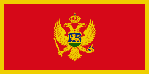
The flag of Montenegro was also adopted on July 13th, 2004, based on the design of Nikola I.
This week thousands of Mongolians gather to celebrate Revolution Day, July 11, and to compete in Mongolia’s biggest festival: Eriin Gurvan Naadam, or the Three Games of Men.
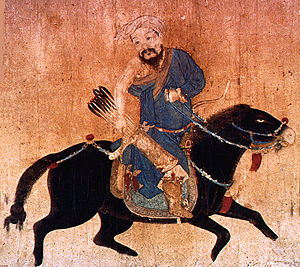
The “Three Manly Sports” as they’re called, are: Archery, Wrestling, and Horseback-riding. (Sorry guys, for whatever reason Ultimate Frisbee didn’t make the cut.)
“For 2,000 years, these three sports were not just entertainment, but a vital part of military training for the nomadic tribes of the steppes between Siberia and China.” — Christian Roy, Traditional Festivals
Naadam 2006
Around a thousand years ago the three activities merged into the Naadam Festival. The historic games were a rite of strength and courage among the region’s nomadic warriors. In the 13th century Genghis Khan and grandson Kublai incorporated Naadam into the political ceremony of the newly unified nation.
The festival began to be celebrated every third year under the religious leader Zanabazar in 1641. In the 20th century the government moved the annual celebration to July 11 to commemorate the Mongolian Revolution of 1921.
Naadam means “to play.” Day One of the three-day festival begins with the Mongolian President’s inaugural speech and the impressive opening ceremonies, followed by archery and wrestling in Ulaanbaatar Stadium. The wrestling bouts are a sight to behold. According to journalist Ron Gluckman,
“The field is empty when the national anthem is chanted by the crowd. Then, without warning, hundreds of men suddenly toss aside robes, and scream madly as they bound down into the arena, stripped down to little more than leather boxing shorts.” — The Alternative Olympics
A wrestler is out the moment his elbow or knee hits the ground. Two full days of intensive bouts whittles the playing field down from 512 wrestlers to just two. There’s no division by size—the smallest wrestler can prove himself against the largest. Legend has it that a woman won one year, which is why the men now wear revealing tops. Wrestling is the only one of the three ‘manly’ sports in which women aren’t allowed to compete.
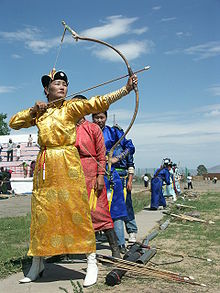
Women's archery, Naadam, 2005
The archery competition involves Mongolia’s weapon of choice since the 12th century. The arrows are made of willow, vulture feathers, and bone, and bows are strung with bull tendons. Mongolians are proud to point out that their ancestors perfected the bow as a weapon, and that even back in 1224 AD, according to the ancient Stone of Genghis Khan, a Mongolian archer named Yesunke hit a target 536 meters away in a competition organized by Genghis himself.
Mongolians learn to ride horses before they can walk. According to the UB Post, back in the day the Naadam races included up to 45,000 jockeys. The races take place out on the open steppes. Children as young as 6 compete, as well as women, who often do so in stiletto heels. (Mongolian women love their stiletto heels. Even the policewomen wear them.) Finishing first in the race is no small honor. The winner gets to bow before the President of Mongolia.
After hundreds of years, Naadam is still a vital part of Mongolia’s national heritage. For three days, beginning on Mongolia’s national day, Mongolians celebrate mastery of the three skills that allowed a group of horsemen to conquer much of two continents.
7/11 might be a more appropriate day to extol the virtues of poetry, but as it is, we’ll celebrate on 7/10, the birthday of poet, journalist, and author Edmund Clerihew Bentley, who created the most venerated form of poetry in all the English language: the Clerihew.
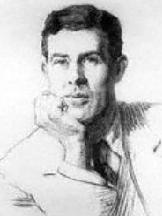
Edmund Clerihew Bentley
The Clerihew is a four-line verse where the end of the first line, or more often the full first line, is the subject’s name. Clerihews have an AABB rhyme scheme and meter is of secondary (or no) importance:
Even Steven
Will be leavin’
To get mugged in Chicago
After watching Dr. Zhivago
— the author, age 11
According to Steven Gale’s Encyclopedia of British Humorists, Clerihew composed the first such poem as a 16 year-old student in science class, in honor of a British chemist.
Sir Humphry Davy
Was not fond of gravy.
He lived in the odium
Of having discovered sodium.
Evidently the poem was a big hit with his fellow students, for he never stopped writing them. He published his first collection in his 1905 classic, Biography for Beginners. Other favorite clerihews include:
Sir Christopher Wren
Said, “I am going to dine with some men.
If anyone calls,
Say I am designing St Paul’s.
And from the Boston Globe’s Clerihew contest:
Edmund C. Bentley
Wrote intently,
But would now be anonymous
Were it not for the verse form for which his middle name is eponymous.
Clerihew was also a mystery author. He wrote one of the great detective stories of the early 20th century, Trent’s Last Case.
“Cupples, I have absolutely nothing left to say, except this: you have beaten me. I drink your health in a spirit of self- abasement. And you shall pay for the dinner.” — Trent’s Last Case, 1913
It wasn’t Trent’s Last Case. Bentley wrote two sequels, Trent Intervenes and Trent’s Own Case.
So before you go off and celebrate Clerihew Day with the reverence it deserves, remember,
Edmund Bentley
Evidently
Was born in the U.K.
On Clerihew Day
In the two decades between 1804 and 1824 the Spain lost an area of land in Latin America nearly 20 times its own size.
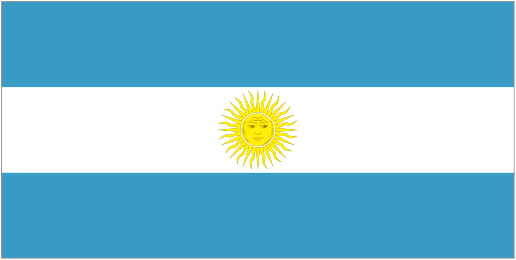
One of Spain’s largest provinces was Viceroyalty of the Rio de la Plata, which encompassed what is now Argentina, Bolivia, Paraguay, and Uruguay. The Rio de la Plata (River of Silver) is the widest estuary in the world, forming the border between Argentina and Uruguay. Like the river, Argentina itself is named for the precious metal once so prevalent on its shores. Tierra Argentina is Latin for “Land of Silver”.
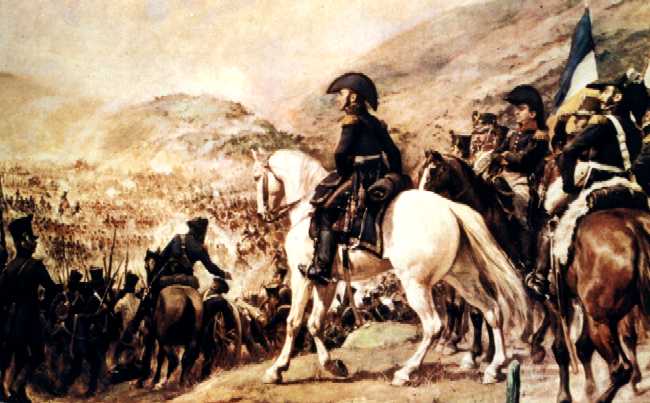
As Spain pushed French invaders out of its own borders, liberadores Simón Bolívar and José de San Martín sought to do the same to the Spanish in South America.Bolívar fought the Spanish in the north of the continent while San Martín gathered and led the rebel armies in the south. Between 1813 and 1824 SanMartín’s armies repelled royalist forces from Argentina, Chile, Peru, and Ecuador. He became known as the liberator of Chile, the Protector of Peru, and the national hero of Argentina, which honors him with his own holiday on August 17, the anniversary of his death.
San Martin crosses the Andes
Argentina’s national day doesn’t celebrate one of San Martín’s decisive battles, but the adoption of the 1816 Acta de Independencia by the Congress at Tucuman. After Napoleon’s exile to Elba in 1814, the Spanish were able to turn their full attention to the rebelling colonies overseas. In the Spring of 1816 representatives from towns throughout the Rio de la Plata gathered in San Miguel de Tucuman to discuss their political fate. Tucuman in Northern Argentina was chosen for its central location and also to downplay the resentment other territories felt toward the centralist, urban Buenos Aires. The Congress met in the home of the Bazan family, now the Casa Historica de la Independencia museum.
Casa de Tuchman
The Congress was unable to come up with a satisfactory answer for what form a future government would take. But on July 9, when the question of Independence arose…
“At once, animated by a holy love of justice, each and every delegate successively announced his spontaneous decision in favor of the independence of the country, signing in consequence the following declaration.
“We, the representatives of the United Provinces of South America, assembled in a general congress, invoking the God who presides over the universe, in the name and by the authority of the people whom we represent, and proclaiming to heaven and to all nations and peoples of the earth the justice of our intentions, declare solemnly to the world that the unanimous wish of these provinces is to sever the oppressive bonds which connect them with the kings of Spain, to recover the rights of which were deprived, and to assume the exalted position of a nation free and independent of Ferdinand VII, of his successors and of the metropolis of Spain.
San Martín pledged to support the Acta de Independencia the following month. He marched his troops over the Andes, joined forces with the Chileans, and defeated the Spanish forces there in 1818, effectively ending Spanish occupation in the southern half of South America.
“Russia’s First Lady, Svetlana Medvedeva, is chairing a comittee to celebrate July 8th as a Russian “anti-Valentine’s Day”, with emphasis on family, mariage and long-term faithfulness, rather than what she (and many in Russia) considers the shallowness of Saint-Valentine’s celebration of short-term infatuation.
“If this year’s first July 8 celebration of SS. Piotr and Fevronia (two 13th century Russian Orthodox Saints who were married and buried in the same coffin) is a success, Mrs. Medvedev has promised to make it an official public holiday in Russia.”