Turkey – Youth and Sports Day

May 19

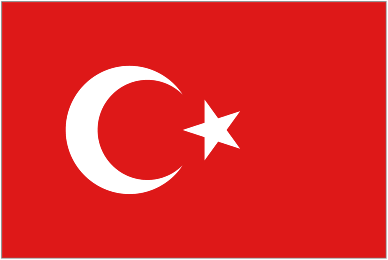
Four of Turkey’s national holidays stem from the Turkish War for Independence (1919-1923). Youth and Sports Day commemorates the beginning of the Turkish War for Independence on May 19, 1919.

*  *  *

After World War I, the Ottoman Empire found itself under the influence of Western powers. Sultan Mehmed VI appointed Mustafa Kemal, a general and hero of WWI, to oversee demobilization of army divisions. However, concerned about foreign dismemberment of the Ottoman Empire, Mustafa Kemal took a ferry from Istanbul to Samsun on the main Turkish peninsula on May 19, 1919 to rally support for a unified, independent Turkey. His landing is considered the beginning of the Turkish War of Independence.

In Ankara the following year, Mustafa Kemal convened the first Turkish Grand National Assembly. In 1921 and 1922 he defeated the Greek army at the battles of Sakarya and Dumlupinar, and he refused to sign any treaty that undermined Turkish sovereignty. The Treaty of Lausanne recognized Turkey’s independence in 1923 and Mustafa Kemal became the country’s first president in October of that year. He remained in power until his death in 1938.

Mustafa Kemal established Youth and Sports Day during his presidency; however, since his death, Turks have observed it more as “Commemoration of Ataturk.”

Ataturk is Mustafa Kemal’s honorary title. It means “Father of the Turks.”

Mustafa Kemal Ataturk, Basra, 1924

Flag Day – Haiti

May 18

Today is Flag Day in Haiti. Flag Day is a major holiday for Haitians both in Haiti and overseas. On this day (May 18) in 1803, Haitian leaders of the revolution (Petion and Dessalines) in the city of Archahaine removed the center column of the French flag to create the red and blue symbol of Haitian independence.

The design was turned on its side the following year when Haiti won its independence to create the horizontally stripped flag Haiti has today. Between 1964 and 1986 Haiti used a red and black flag. The flag was returned to red and blue following the fall of the Duvalier regime.

Despite being enemies during the 1790s and early 1800’s, the Haitian struggle for independence embraced many of the same ideals of the French Revolution—Liberty, Equality, and Fraternity—making the French flag an appropriate basis for the burgeoning nation’s symbol.

May is also Haitian Heritage Month for Haitians in the United States. It marks several important Haitian holidays and milestones, including the May 20th birthday of Haiti’s national hero, slave-turned-general Toussaint L’Ouverture.

According to haitianheritagemonth.net May is Haitian Heritage Month…

“To remember the unity reached by the Black and Mulatto officers at their historic congress on May 15-18, 1803 to fight together against slavery in the French colony of St. Domingue, and for its independence, which they proclaimed on January 1, 1804.

To celebrate the creation of the blue and red Haitian flag on May 18, 1803.

To honor Haitian General Toussaint Louverture who was born on May 20 1743.

To celebrate Haitian achievements and contributions across the globe.

To raise awareness and understanding about Haitian culture and traditions.

To strengthen the self-esteem of Haitian/Haitian American youth.
To honor Haitian tradition of celebrating:

  • The month of May as Mary’s, the mother of Jesus (Haitian Catholics)
  • May 1st as Labor and Agriculture Day
  • May 17 as Teacher’s Day
  • May 18 as University Day
  • Last Sunday of May as Mother’s Day”

Constitution Day – Norway

May 17


In 1814 the four-century union between Denmark and Norway abruptly ended when Denmark was forced to cede Norway to Sweden following the Napoleonic Wars. Norway also lost what had once been its own. Iceland and Greenland, settled by the Norse in the 9th and 10th centuries, would remain in Denmark’s possession.

With the emergence of a national ‘farm culture’ in Norway, and a growing awareness of the French and American Revolutions, a movement for Norwegian sovereignty gained momentum. Crown Prince Christian Frederik assembled a congress of Norwegian leaders in Eidsvoll to draft a Norwegian Constitution, which was signed on May 17, 1814. To this day Norway celebrates May 17, Constitution Day, as its most important national holiday.

The road to independence was not that easy though. The Swedes attacked Norway in July (The last war the Swedes have ever fought) leading to a ceasefire agreement in August. The treaty establish a ‘personal union’ with Sweden, in which Norway recognized the authority of the Swedish King.

Ninety years later the Norwegian parliament declared its independence as a constitutional monarchy, backed by a united populace, and the Swedish parliament voted to accept the dissolution a few months later.

It wasn’t until 1991 that Harald V, the present King of Norway, became the first native-born Norwegian monarch since Queen Margaret’s 17 year-old son King Olaf died in 1387.

http://www.norway.org/culture/May+17/

http://www.norway.org/culture/heritage/nationalday.htm

At 16 I traveled to Norway as a foreign exchange student. Aside from a week in Canada, I had never left the United States. Before I left, a friend from Spain made fun of me for wanting to go to Norway. He assured me I would be surrounded by cows.

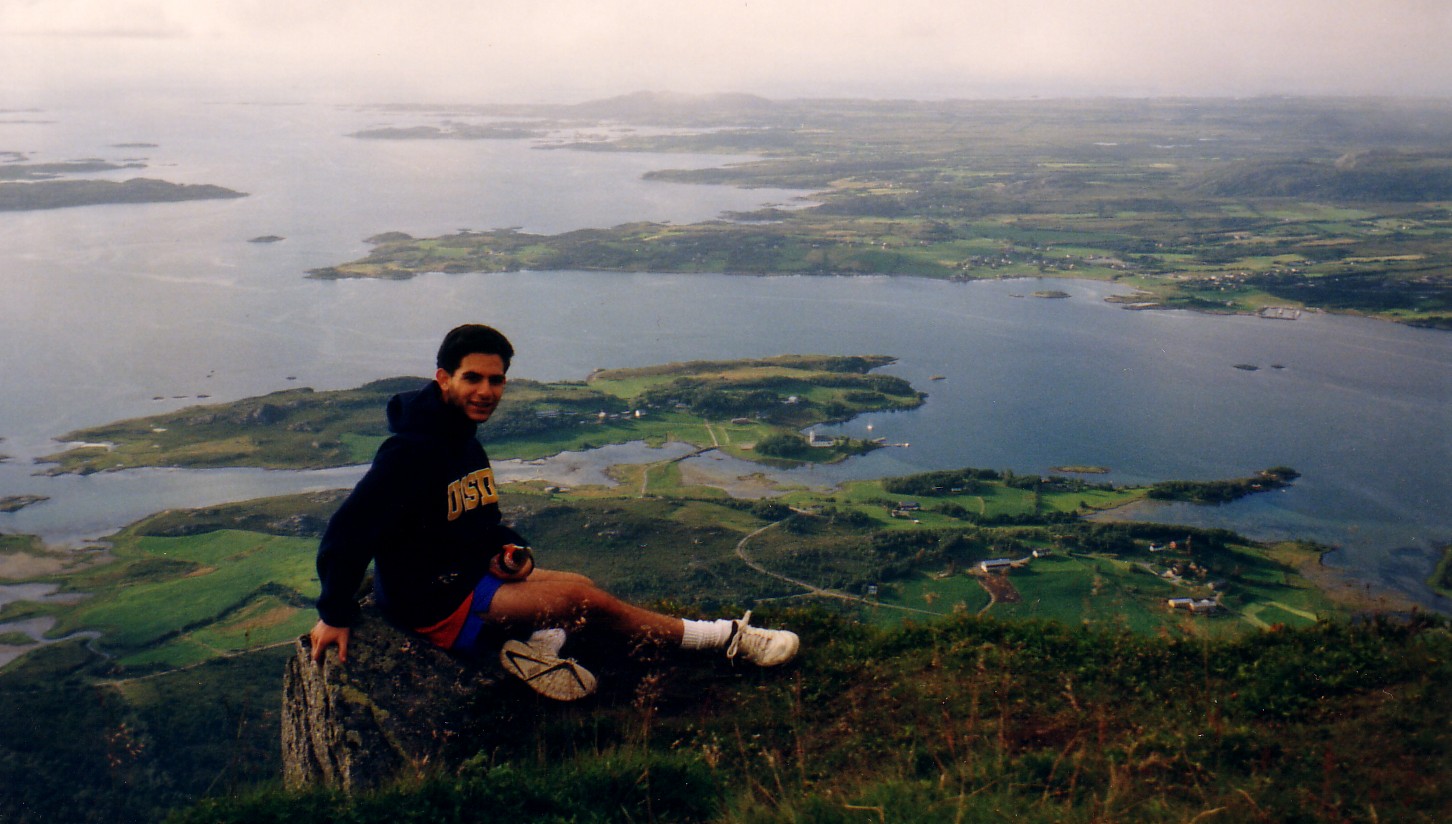
I stayed in a tiny sea-side town (they’re just about all sea-side, or fjord-side, towns) near Molde, between Bergen and Trondheim. The town’s population was smaller than my high school back in the States. I remember my host family’s TV. It had one TV station, and it went off the air each night to be replaced by a static signal. The signal was more intriguing to me than the actual programming. I had never seen dead air:

Norwegian television

Traveling from Long Beach, California (alma mater of Snoop Dogg) to Elnesvågen, Norway was a shock. I had always been taught I lived in the greatest country on earth, yet here I was in a near social utopia. A land where crime had, relatively speaking, disappeared and poverty was a non-issue. Norway was years ahead of us even in issues like gender equality. And it didn’t hurt that the Norwegian landscape was pristine and picture perfect. I still believe it’s one of the most beautiful countries in the world.


One week my host siblings took me in a tiny motorboat to an island off the coast, named Bjornsund. There we caught crabs (the edible kind) and had to pump our own water. It was like traveling to another world, another century.

Of all my travels since, perhaps none has affected me like that first journey to Norway. It showed me that there are alternative ways of living, of governing. That the wide divide between rich and poor and the persistence of crime are not absolutes. Yes, the tax rate was high, but Norwegians got a lot in return, health care included.

The question was–I could never be sure–was the U.S. behind Norway, or was Norway behind the U.S.?

I mean, hopefully it was the former. That America was on the path to making equality a reality instead of a mantra. That by emulating countries like Norway we would reduce crime, improve our social services, and increase our standard of living for all citizens.

But more and more I feared it was the other way around. As Norway dealt with new immigration from other parts of Europe and the Middle East, for example, I could see the beginnings of racism where homogeneity had long been the norm. Was Norway ahead of the world, our was it destined to lose its sense of community and follow in the footsteps of other modern countries plagued by urban violence and disparity in the mass media-crazed 21st century?

I returned six years later to Norway, to that same house with the one TV station. It was still too early to tell what was in store for Norway’s social future. But I did notice that my host family in Elnesvågen now had 200 channels.

There was another way Norway affected me. Just as my Spanish friend predicted, the house I lived in was sandwiched between two farms. Being a city boy I couldn’t help but notice the ever-present aroma of cow manure. Though I eventually got used to it, the memories of that summer were woven indelibly into my olfactory lobes.

To this day, when we pass a farm on the highway and smell the fertilizer, others may plug their noses.

I close my eyes, and remember Norway. (-;

Vartdal med Vartdalsfjorden, Ørsta, Norge; by Andreas Vartdal


Vesak – Buddha’s Birthday

May 10/17, 2011

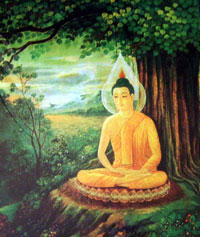
It’s often called Buddha Day, or Buddha’s Birthday, but it’s far more than that. Vesak is a celebration of Buddha’s birth, his life, his path to Enlightenment, and his final reaching of Nirvana.

Around 563 BC, in the foothills the Himalaya, the pregnant wife of a wealthy prince left her home to deliver her baby in her father’s kingdom, as was the tradition. But along the way she stopped in a garden and beneath the shade of a sal tree, she gave birth to the boy Siddhartha. This park, on what is now the border of India and Nepal, is called Lumbini, Sanskrit for “the lovely”.


His mother died immediately after his birth. Despite the loss of his mother, his father the prince went to great trouble to shield him from all human misery and ugliness. He was given everything he could want, and was kept a safe distance from the suffering of the outside world.

“I was delicate, most delicate, supremely delicate. Lotus pools were made for me at my father’s house solely for my use; in one blue lotuses flowered, in another white, and in another red…My turban, tunic, lower garments and cloak were all of Benares cloth. A white sunshade was held over me day and night so that I would not be troubled by cold or heat, dust or grit or dew.”

At age 29 Siddhartha chose to venture outside the castle property to meet his subjects beyond. Before the excursion his father secretly ordered every sick, homeless, and old person in the village to be removed from his son’s view. But on his journey, Siddhartha chanced upon an elderly man–the first of Siddhartha’s Four Encounters.
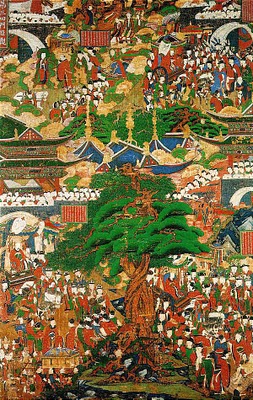
Intrigued and disturbed by the sight of the old man, he planned subsequent trips to explore life outside the carefully-orchestrated castle. For the first time, Siddhartha witnessed disease in the form of a severely ill man. On his third trip he saw death in the form of a corpse. His charioteer gave him a crash-course in life’s harsh reality: all grow older, grow sicker, and die.

Trying to make sense of the desperation, Siddhartha made his fourth encounter–with a man who at once seemed to have the answers of the world and yet owns nothing. He’s an ascetic.

Siddhartha chose to flee from his father’s kingdom. He renounced his father’s materialism and his worldly connections–leaving his wife and their newborn son–to learn the ways of asceticism.

Siddhartha became a common street beggar for his sustenance, but he was easily recognized as the wealthy prince. He traveled further, studying under two ascetic masters, one after the other, but was ultimately unfulfilled with each of their teachings.

With five companions he took asceticism to a new level, reducing his food intake to little more a nut or leaf per day. For six years he lived the life of an ascetic.
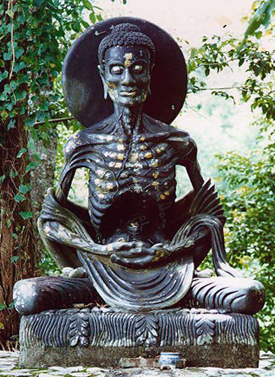
“My body reached a state of extreme emaciation. Because of eating so little my limbs became like the jointed stems of creepers or bamboo; my backside became like a buffalo’s hoof…”

In the end, he was so weak, he nearly drowned in a river while trying to wash.

Lying there he heard a boat pass, with two musicians on board. One told another, inspecting his instrument, “If you tighten the string too tight it will snap, but if it is too loose, it will not play.”

Siddhartha realized that neither extreme asceticism nor materialism is the path to enlightenment. He recalled falling into a meditative state as a child, as close as he’d ever been to Enlightenment. In order for his mind to reach such a state again, he must nourish the body. His five companions desert him, convinced that Siddhartha has lost his willpower. But at that moment a young girl named Sujata arrived and offers him milk-rice.

Sitting beneath a pipal tree, Siddhartha made a solemn vow:

Let only skin, sinew and bone remain, let the flesh and blood dry in my body, but I will not give up this seat without attaining complete awakening.

After 49 days of meditation Siddhartha reached Englightenment. From that moment on he became Buddha, or the ‘Awakened One’.

Buddha spent the rest of his forty-five years passing on wisdom to his disciples, including the Noble Truths and the 5 Precepts, before reaching the final state of Nirvana, when his soul left his body.

Buddha’s 5 Just Say No’s

Just Say No to:

Killing
Stealing
Sexual misconduct
Lying
Drugs (intoxicants)

Buddha also rejected the ways of the caste system, as well as religious ritual for ritual’s sake.

Vesak comes from the word Vaishakha, the second month of the Hindu calendar. Buddha’s ‘Birthday’ is celebrated on the full moon of Vesak, usually in May.

It is not a holiday of wild abandon, but of joy, introspection, and spiritual exploration.

“The Buddha showed us that advancement in this world and the next could be achieved by appreciating what is good. The policy of the government is to steer the country to the correct path by adhering to the Dhamma. In doing so our responsibility is to tolerate other opinions and act with loving kindness.

As the Buddha has taught: “Be alert; do not idle. Follow the law of virtue. He who is virtuous lives happily both in this world and the next

— President of Sri Lanka, Vesak Day message, 2008

In the Buddha’s footsteps…

http://orias.berkeley.edu/visuals/buddha/LIFE.html#garden%20of

http://www.festivalsofindia.in/budhpurnima/

http://www.colombopage.com/archive_08/May18154105JV.html

 

San Isidro – Spain

May 15


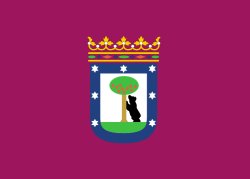
Just when Madrid sobers up from back-to-back celebrations of Labor Day and Dos de Mayo, it pulls out all the stops for the week-long celebration of San Isidro.

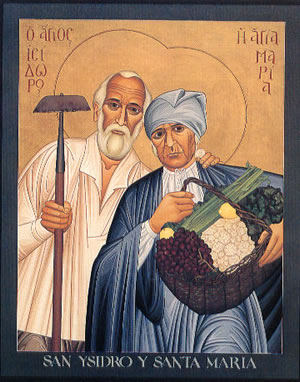
San Isidro (1070-1130) is Madrid’s patron saint, whose feast day falls on May 15.

A simple farm worker, Isidro never had much money, never led a diocese or congregation, never fought in a war, and was not martyred or notably persecuted for his faith. Nor was his wife Santa Maria de la Cabeza (Saint Mary of the Head). And yet Maria and Isidro are among the few husband-and-wife teams to be canonized in 2000 years of Christendom. (Though it did take 500 years for the Pope to do so.)

[Iberian Gothic? 12th century saints Ysidro & Maria reincarnated]

The couple lived in poverty for most of their lives, but they were known for their generosity, giving more to the poor than they kept for themselves. Stories of Isidro’s miracles, like the materialization of food and water for the hungry, are reminiscent of Jesus feeding the masses with a single loaf of bread. According to legend, one day Isidro’s scythe struck the earth, and a spring burst forth with enough water to sustain the whole city.

In the 900 years since Isidro and Maria walked the earth, farmers have called on them for relief in times of drought.

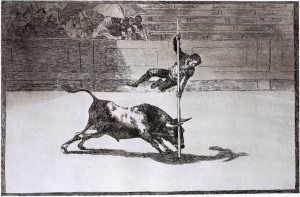
The holiday also marks the beginning of bullfighting season. Spanish bullfighting traces its roots back to Mithras, imported from the Middle East either through Rome or North Africa.

“The killing of the sacred bull (tauromachy) is the essential central iconic act of Mithras, which was commemorated in the mithraeum wherever Roman soldiers were stationed. Many of the oldest bullrings in Spain are located on the sites of, or adjacent to the locations of temples to Mithras.”

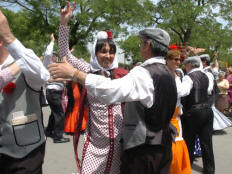
If you’re with PETA, and bullfighting doesn’t do it for you, concerts and dancing fill the streets the whole week. Parks are converted into open-air verbenas, where celebrants wear traditional attire: chulos and majos for the guys, chulapas and majas for the ladies.

Chulo is a derogatory term sometimes applied by other Spaniards to the inhabitants of Madrid. It means arrogant. But the Madrilenos take it in stride. Dressed in chulo and chulapa costumes, performers live up to their name in a stylized dance of exaggerated arrogance.

Strange that a holiday in honor of a man so down-to-earth would be celebrated by imbibing vast quantities of alcohol and performing dances that exude arrogance.  But as the Spanish say…

Cada uno en su casa, y Dios en la de todos.

San Isidro and Santa Maria

San Isidro in Madrid

San Isidro the Laborer: A Worker’s Life Anchored in Christ

Madrid’s Festival of San Isidro

St. Isidore: the Patron Saint of Farmers

Independence Day – Paraguay

May 15

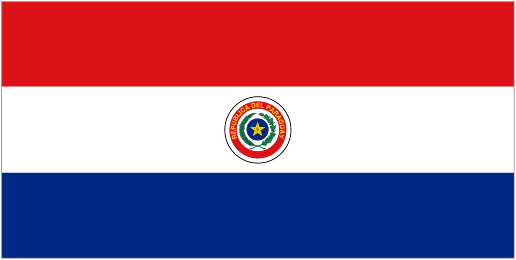
Today, May 15, is Paraguay’s Independence Day.

The Rio Paraguay winds across 1500 miles of Brazil, Paraguay and Argentina. Its both the source and outlet for the Pantanal wetlands, the largest tropical wetlands in the world, and, due to its Amazonian neighbor, one of the most overlooked.

The river divides Paraguay in half, giving the country it’s name and its lifeblood. Paraguay is a landlocked country, one of only two in South America. Like the Pantanal wetlands, Paraguay has been overlooked by the world in favor of its larger and more accessible neighbors like Brazil, Peru, and Argentina.

The first European to reach the Paraguay River (and live to tell the tale) was Alejo Garcia. After being shipwrecked on the coast of Brazil he lived for 8 years with a tribe who told him of a great “White King” out West on a mountain of silver. Garcia traveled inland to what is now Paraguay, where he recruited 2000 Guarani to fight who would turn out to be the Incas. They stole vast amounts of gold and silver from the Empire, but Garcia was killed on the way back to Brazil.

Word of the city of silver and gold intrigued the Spanish, who initially took interest in Paraguay as a centerpoint of their South American empire. But interest in the area around Asuncion soon waned in favor of Lima and Buenos Aires.

“Madrid preferred to avoid the intricacies and the expense of governing and defending a remote colony that had shown early promise but ultimately proved to have dubious value.”

Map of Paraguay

The settlers elected the Basque Domingo Martinez de Irala governor of the colony. Irala was considered a humane leader and a tough governor, who gained the respect of both the natives and the colonists. But he conceded to settlers’ demands for the parceling of land and conscripted Indian labor to the settlers, a system which eventually degenerated into near-slavery conditions.

Elsewhere in South America this system yielded profits for the Spanish government. But Paraguay was not a farming society like Peru. The Guarani were hunter/gatherers, not farmers.

Friction increased between the descendants of the settlers and the Spanish government. Spain’s economic policies and consistent downgrading of Paraguay’s importance deepened the colony’s impoverishment. In 1617 when the colony was split into two–Asuncion and Buenos Aires–Paraguay lost control of the throughway to the Atlantic via the Rio de la Plata.

There was also friction between the landowning Mestizos and the Jesuit missionaries. For 150 years the Jesuits organized the Indians to block the attempts at forced labor. In the 1720s the Paraguayans rebelled against pro-Jesuit Spanish leaders, and the Jesuits were eventually expelled.

To the Paraguayans, the final blow came in 1776 when Spain officially put Paraguay under control of Buenos Aires and Argentina.

The Napoleonic Wars hit Spain hard in 1808. Spain lost the ability to control its colonies, and in 1810 Argentina overthrew the Spanish government in Buenos Aires. The Paraguayans followed suit on May 14, 1811 with a coup that overthrew the Spanish governor and affirmed the separation between Paraguay and Argentina.

The following day the new government elected its first president, 45 year-old Gaspar Rodriguez de Francia.

Cultures of the World: Paraguay

Paraguay: Independence and Dictatorship

Paraguay Chooses Between Firsts

South American Travels, by Henry Stephens, 1915

Liberia – Unification Day

May 14

We here in the United States get cranky at our politicians for the slightest misstep, like plunging our country into bankruptcy or sending our children into misguided opportunistic wars.

Yet our stalwart Liberian cousins put up with 14 years of civil war before finally giving their leaders the boot in 2005. The rallying cry of the president to-be?

“All the men have failed Liberia. Let’s try a woman this time!”

In November 2005 the Liberians elected Ellen Johnson Sirleaf to the highest office in the country, becoming Africa’s first elected woman head of state.

President Sirleaf declared:

“My administration shall thus endeavor to give Liberian women prominence in all affairs of our country…. We will also try to provide economic programs that enable Liberian women — particuarly our market women — to assume their proper place in our economic process.”

Americans may not know it, but the U.S. has played a pivotal role in Liberian history over the past two centuries, unparalleled in transAtlantic history. Back in 1817 the American Colonization Society purchased land in on the West African coast to emigrate freed African-American men, women and children. The motives for doing so were as different as the Society’s members, which included abolitionists and slave owners. Some saw emigration as the road to freedom for African Americans; others saw it as an alternative to integration in order to maintain a homogenous white state.

According to From Plantation to Ghetto:

“In the main, free blacks were suspicious of the motives of the American Colonization Society and strongly opposed it.”

Over 3,000 free blacks met in Philadelphia to protest the Society in the year of its founding.

However, over the next 40 years the well-funded ACS “repatriated” 13,000 African Americans to live in Liberia.

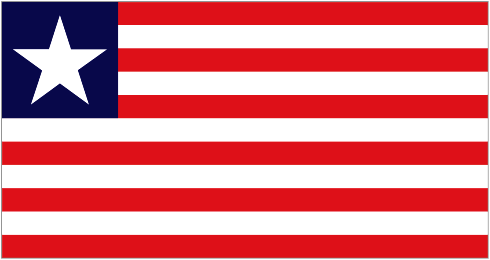
The Society’s involvement in Liberia lessened after 1847 when the Americo-Liberians (those who emigrated from the U.S.) declared Liberia an independent nation. Americo-Liberians modeled Liberia after the U.S. in a number of ways. The name Liberia itself means “Land of the Free.” Its capital is Monrovia, named for President James Monroe. Its flag, government and constitution are modeled on that of the U.S. It became the first African republic in 1847, though the U.S. didn’t recognize its independence until 1862.

Liberia received monetary support from the United States over the years. Despite the fact that Americo-Liberians constituted a small minority of the population, the “Americans” as they were called, controlled the government and dominated the African population for the next 150 years.

“That is, because they were not regarded as citizens in in America, they too, did not recognize the indigenous inhabitants as citizens of the new Republic.” — Unification and Integration in Retrospect – Sehgran K. Gomah

In fact, as late as the 1930’s, the League of Nations censured the Liberian government for the forced labor of its indigenous population. Even after the abolishment of forced labor, indigenous Liberians remained disenfranchised second-class citizens until 1951. President William V.S. Tubman was a major proponent of integration and unification during his 28 years as President (1943-1971). Under his leadership, the government declared May 14 National Unification Day (during the 1959/1960 legislative session) to celebrate the integration of American and indigenous Liberians.

President Sirleaf reinvigorated National Unification (and Integration) Day in 2007, calling on Liberians work together to heal the wounds of a decade and a half of civil war.

“In November 2005, Liberian women strapped their babies on their backs and flocked to voting tables all across their war-racked country to elect Ellen Johnson Sirleaf as Africa’s first female president. It was a seminal moment in the political history of not just Liberia but the entire continent, where patriarchal rule has long dominated, leaving African women on the sidelines to fetch water, carry logs, tend farms, sell market wares and bear the children of their rapists, while their menfolk launched one pointless war after another.”
Madame President, NY Times, by Helene Cooper, May 15, 2009

The Liberian Civil War of the 1990’s and 2000’s took nearly 300,000 lives.

Lemuralia: Malicious Girls Marry in May

May 13

When midnight comes and drops silence for sleep,
and dogs and dappled birds are hushed,
The man who remembers the ancient rite
and fears the gods, rises up (barefoot)
And makes a thumb sign between his closed fingers
to avoid some ghostly wraith in the quiet.
When he has washed his hands clean with fountain water,
he turns around after taking black beans,
Glances away and throws, saying: ‘These I release;
I redeem me and mine with these beans.’

— Ovid’s Fasti

The head of the Roman household would, according to Ovid, perform this rite nine times and then, after rinsing his hands, would shout, “Leave, ancestral spirits!” another nine times, purifying his house of those departed whose souls refuse to rest. (The Japanese still observe a similar bean-throwing tradition during the Shinto lunar new year, Setsubun.)

The Roman superstition that Ovid describes was once a public festival known as the Feast of Lemuria, or Lemuralia, decreed by Rome’s co-founder Romulus.

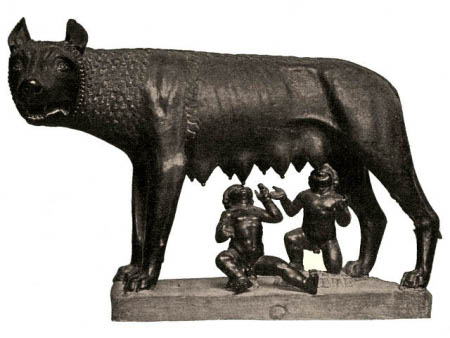
She-wolf suckles Romulus & Remus

Romulus and Remus were twin sons of Mars, god of war, who were nursed by a she-wolf in the wild. They wanted to build a great city, but couldn’t agree on the location. Romulus preferred Palatine Hill, Remus preferred Aventine Hill. They each built their own city. When Remus mocked Romulus by jumping over the wall meant to protect his, Romulus slew Remus in a fit of rage.

Guilt-ridden, Romulus was haunted by Remus’s ghost, who asked to be remembered on this day.

Lemuralia, says Ovid, is a corruption of Remus (Maybe Remuralia was too hard to pronounce?):

Over a long time the rough letter became smooth
at the beginning of the whole name.
Soon they also called the silent souls lemures…
The ancients shut temples on those days, as you now
see them closed in the season of the dead.
The same times are unfit for a widow’s marriage
or virgin’s. No girls who wed then live long…
Folk say: “Malicious girls marry in May.”

Around 610, Pope Boniface IV declared May 13 “All Saints Day”, in honor of all martyred. All Saints Day was later moved to November 1, coinciding with regional harvest festivals remembering the spirits of the dead.