St. Ignatius of Loyola

July 31

ALMOST 500 years ago in the Basque country in the north of Spain, a young man sat in bed recovering from a long and brutal operation. Inigo, an officer in the Spanish army, had been struck during a French siege by a small cannonball which had shattered one leg and severely wounded the other.

After 15 days, doctors…

decided that the leg ought to be broken again and the bones reset because they had been badly set the first time or had been broken on the road…This butchery was done again; during it…he never spoke a word nor showed any sign or pain other than to clench his fists… — Culture and Belief in Society, David Englander & Rosemary O’Day

But as he healed, one of the bones remained on top of the other, shortening his leg. A self-admittedly vain Inigo didn’t want to live life deformed. He opted to to undergo a third operation to fix it, even though it would be the longest and most painful, as the bone had already healed.

Having cut into the flesh and sawed off the projecting bone, the surgeons set themselves to the task of reducing the shortness of the leg…and continually stretching it by means of mechanical devices, which for several days on end cause him great torture. — Saint Ignatius Loyola: the Pilgrim Years, James Brodrick

In recovery Inigo asked for some books to occupy him. All they had to read were two books, De Vita Christi (Life of Christ) by Ludolph of Saxony and a book on the lives of the Saints, both in Castilian.
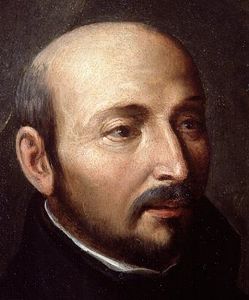
St. Ignatius of Loyola

(On a personal note, I was once stuck in a laundromat for three hours where the only book I could find was “The Valley of the Dolls.” We are glad that was not the case with Inigo, because) After reading these tomes and healing from his operation, he tossed aside three decades of vanity and materialism, to found the Society of Jesus, the Jesuits.

It didn’t happen overnight. It began with a competitive pursuit of “besting” the saints, to be more ascetic than this one or to fast more stringently than another. But each exercise and pilgrimage slowly transformed his faith. He spent several months living in a cave. He begged his way across Europe to Jerusalem. He preached on the streets of Barcelona. He was interrogated during the Inquisition, and briefly incarcerated in Salamanca.

About what do you preach?” Loyola was once asked.

He replied, “We do not preach, we speak to a few in a friendly manner about the things of God, just as one does after dinner with those who invite us.

He left his troubles (and his name) in Spain to study at the University of Paris. There ‘Ignatius’ of Loyola met six other like-minded men who formed Societas Iesu–the Society of Jesus. In August 1534 the men made a vow–to live in poverty and chastity, to devote themselves to missionary work and other good deeds, and to serve the Pope.

St. Ignatius de Loyola

By the time of Ignatius’s (Inigo’s) death, on this day in 1556, the Society of Jesus (Jesuits) had spread to three continents, where they operated dozens of schools. They made enemies among colonial powers while defending the the rights and lives of indigenous inhabitants of North and South America.

With over 18,000 members in 112 nations, the Jesuits are the largest male religious order of the Roman Catholic Church. Millions more have been educated at Jesuit schools and universities.

Prayer of Saint Ignatius Loyola
Teach us, Good Lord,
To Serve Thee as Thou deservest;
To give and not to count the cost;
To fight and not to heed the wounds;
To labor and not to ask for any reward,
save that of knowing that we do Thy will.
Through Jesus Christ Our Lord, Amen.
http://www.pray-as-you-go.or

The Way of Saint James – Spain

July 25

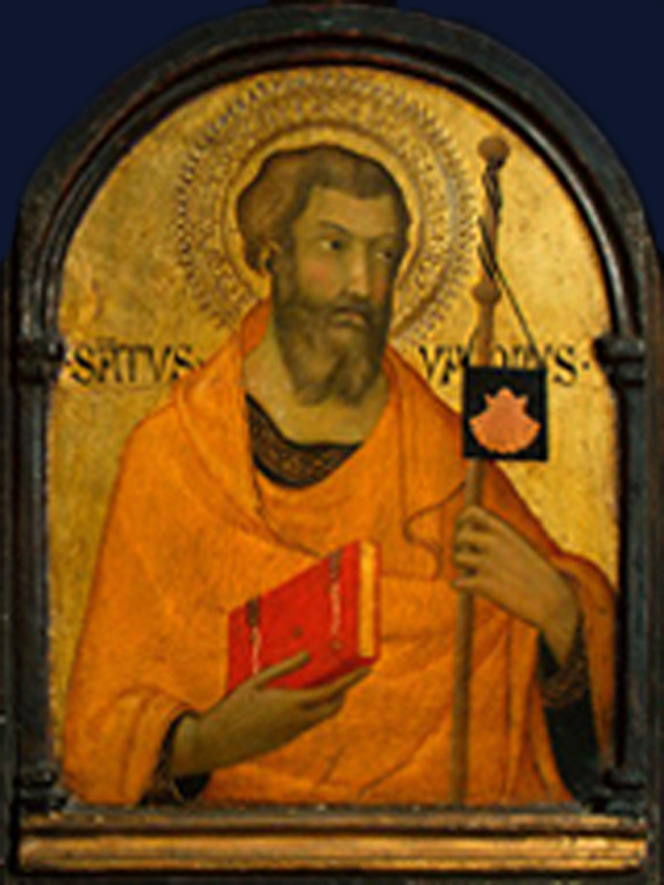
Saint James

July 25th is the feast day of St. James.

James and his brother John, sons of Zebedee, were two of Jesus’s twelve Apostles. After Jesus’s crucifixion, James took the Gospel westward to unchartered territories—Iberia—and never looked back. Oh wait, he did look back, unfortunately. After receiving a vision of the Virgin Mary, James returned to Judea where he was beheaded by King Herod Agrippa I in 44 AD.

But that’s not the end of James’s story. No, James’s hagiographers tells how James’s followers risked their lives to bring James’s body back to Iberia. They witnessed several miracles on the way, eventually laying his relics to rest at the edge of the western world: Santiago de Compostela in Northern Spain.

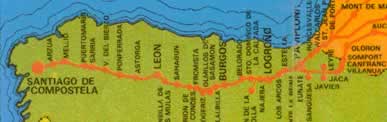
Santiago de Compostela is the destination for thousands of pilgrims who make the journey to St. James’s resting place each year. The route is known as Camino de Santiago, or the Way of Saint James.

El Camino Frances, Spain

The most commonly traveled route is the Camino Frances. It starts somewhere north of the border in the French Pyrenees near St Jean Pied de Port. The trail winds 780 kilometers westward across Northern Spain to Santiago de Compostela, though many pilgrims continue a little further west to Cape Finisterre on the Atlantic. Finisterre comes from the Latin for “land’s end”.

The cape was once believed to be the end of the world.

On foot the pilgrimage takes about a month of walking. Peripatetic veterans recommend walking from 6am to 1pm. There are plenty of towns to stop in along the way, and such a schedule figures in nicely with the Spanish siesta, falling around 2pm each day.

The numbers of pilgrims have skyrocketed since the 1980s, when only a few thousand travelers would make the journey each year. These days that number is in the hundreds of thousands. Religious devotion varies among trekkers.

“Modern Pilgrimages seems to be a lot less about religion and more about peace, finding something in their life, a time to think, and for some a challenge…

“I did not set out on a Spiritual or religious journey – but it ended being that way…”

http://www.caminodesantiago.me.uk/camino-frances/

All about El Camino de Santiago

Haile Selassie I – Rasta’s Ras

July 23


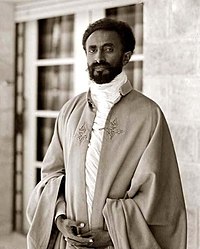
Today Rastas around the world praise His Imperial Majesty Haile Selassie I — who was born this day in 1892, and who led Ethiopia through most of the 20th Century, until his death in 1975.

“Haile Selassie” means “Power of the Trinity”. He was born Tafari Makonnen, the son of an Ethiopian governor and former general, who led troops to victory at the Battle of Adowa in the 1899 Italo-Ethiopian War. After the deaths of his father and brother, the teenage Makonnen became governor in 1911. Then Regent of Ethiopia in 1916, and Emperor in 1930.

In the Rastafarian movement, Haile Selassie is considered to have been a living incarnation of God. His many titles, such as Lion of Judah and “Jah” (from the Hebrew Yahweh), refer to this.

The word Rastafarian itself comes from Haile Selassie’s title Ras, Ethiopian for ‘Prince’, literally, ‘Head’.

In North America and Europe, Haile Selassie’s fame spread via reggae music and Rasta culture. Bob Marley is often pictured wearing the late Emperor’s ring…

Emperor of Ethiopia
His Imperial Majesty Haile Selassie I: Emperor of Ethiopia

Marley’s song “War” quotes Haile Selassie’s 1963 address to the United Nations…

That until the philosophy which holds one race superior and another inferior is finally and permanently discredited and abandoned; That until there are no longer first-class and second class citizens of any nation; That until the color of a man’s skin is of no more significance than the color of his eyes; That until the basic human rights are equally guaranteed to all without regard to race; That until that day, the dream of lasting peace and world citizenship and the rule of international morality will remain but a fleeting illusion, to be pursued but never attained;

And until the ignoble and unhappy regimes that hold our brothers in Angola, in Mozambique and in South Africa in subhuman bondage have been toppled and destroyed; Until bigotry and prejudice and malicious and inhuman self-interest have been replaced by understanding and tolerance and good-will; Until all Africans stand and speak as free beings, equal in the eyes of all men, as they are in the eyes of Heaven; Until that day, the African continent will not know peace. We Africans will fight, if necessary, and we know that we shall win, as we are confident in the victory of good over evil.

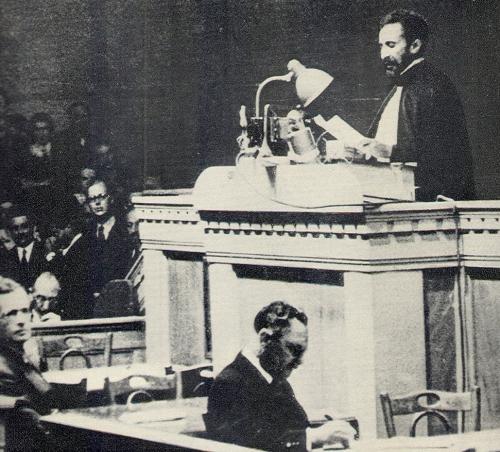
In that speech Haile Selassie also alluded to an address he delivered 27 years earlier to the UN’s forerunner, the defunct League of Nations. It would be remembered as the most moving and prophetic speech in that bodies’ history.

In 1935 Fascist dictator Benito Mussolini was determined to conquer Ethiopia to resurrect the glory of the former Roman Empire. Just as Selassie’s father fought against Italy in 1899, Selassie himself now found himself facing a first-world power with far greater resources, manpower, and technology.

The Emperor’s speech began…

“I, Haile Selassie I, Emperor of Ethiopia, am here today to claim that justice which is due to my people, and the assistance promised to it eight months ago, when fifty nations asserted that aggression had been committed in violation of international treaties.

“There is no precedent for a Head of State himself speaking in this assembly. But..there has never before been an example of any Government proceeding to the systematic extermination of a nation by barbarous means, in violation of the most solemn promises made by the nations of the earth that there should not be used against innocent human beings the terrible poison of harmful gases.”

Haile Selassie addresses the League of Nations, 1936

After describing the heinous mustard gas attacks on his people–poisons that had been banned by the League of Nations, the Emperor appealed to the nations that had guaranteed Ethiopia its security…

“In October 1935, the 52 nations who are listening to me today gave me an assurance that the aggressor would not triumph, that the resources of the Covenant would be employed in order to ensure the reign of right and the failure of violence.

“I ask the fifty-two nations not to forget today the policy upon which they embarked eight months ago, and on faith of which I directed the resistance of my people against the aggressor whom they had denounced to the world. Despite the inferiority of my weapons, the complete lack of aircraft, artillery, munitions, hospital services, my confidence in the League was absolute. I thought it to be impossible that fifty-two nations, including the most powerful in the world, should be successfully opposed by a single aggressor. Counting on the faith due to treaties, I had made no preparation for war, and that is the case with certain small countries in Europe.

“…It is not merely a question of the settlement of Italian aggression. It is collective security: it is the very existence of the League of Nations…God and history will remember your judgment.”

His predictions were spot on. Mussolini’s actions–and the League of Nations’ impotence–inspired Adolf Hitler to expand his own German empire. And the League continued to appease the dictators at the expense of the smaller countries of Europe until a full-scale world war was unavoidable.

Haile Selassie’s 1936 speech to the League of Nations

Haile Selassie’s 1963 speech to the UN

www.rastaseed.com


Bookmark and Share

Romanov Holiday?

July 17

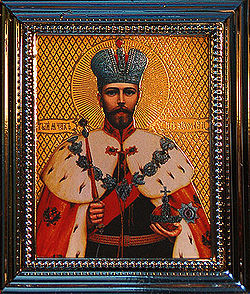
Tsar Nicholas II

It’s not an official holiday yet, but with the Russian Orthodox Church’s beatification of the last Russian Tsar and his family in 2000, the Romanovs do have their own saint day—July 17—the anniversary of the day they were executed in 1918.

Nicholas II, the last Russian Tsar, is a touchy subject in the former Soviet Union. He and his family met a horrifying end at the hands of revolutionaries who banned all religion in Russia except worship of the state. But Russians also recall that Nicholas’s decisions wrought unrecoverable damage to one of the strongest empires on earth.

Nicholas’ reign was troubled from the get-go. Four days after his coronation in 1896, a panic during his banquet festivities in Moscow resulted in the trampling-to-death of nearly 1,400 celebrants. Though not the Tsar’s fault, Nicholas’ decision to attend a ball at the French Embassy that night anyway did not win kudos from the Russian people.

The following decade saw the tragic massacre known as Bloody Sunday, where striking workers and their families hoping to bring a petition to Nicholas II in St. Petersburg were instead gunned down by police. Public reaction to Bloody Sunday led the Tsar to allocate power to the political body known as the Duma.

But the end of his reign must be attributed to his refusal to pull out of World War I, even when his country was on the verge of total political and economic collapse. Mass mutinies led Nicholas to suspend the Duma, but members of the Duma and the Soviet, as well as leading generals, demanded Nicholas’s abdication. By 1917, the Tsar’s most loyal troops were lying under the sod of western battlefields; he abdicated in March.

Russia’s short-lived democratic government shielded the Romanovs in St. Petersburg, but during the October Revolution, that government was ousted by the Bolsheviks. The Bolsheviks wanted to leave no chance that Russia would return to the old aristocratic system. On July 17, 1918, the Bolsheviks gunned down Nicholas and the entire royal family in a cellar in St. Petersberg, including his wife Alexandra, their four daughters, and their 14 year-old son Alexei.

The Romanov Royal Family

On July 17, 1998, eighty years to the day after their deaths, the royal family was interred in St. Peter and Paul Cathedral in St. Petersburg. They’re considered saints after the 2000 beatification, but not martyrs. To be a martyr of the Church, one’s death must be a direct result of one’s Christian faith. The Romanovs are honored instead as “Passion bearers”—those who met death in a Christ-like way.

Defenders of the Motherland Day

Our Lady of Mount Carmel

July 16

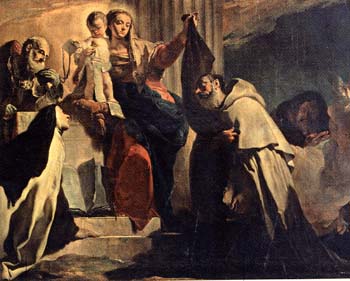
Our Lady of Mt. Carmel gives Scapular to St. Simon Stock

Now therefore send, and gather to me all Israel unto mount Carmel, and the prophets of Baal four hundred and fifty, and the prophets of the Asherah four hundred, that eat at Jezebel’s table.

1 Kings 18:19

What are Carmelites? Was Clint Eastwood their mayor? Are they responsible for my favorite Frappuccino toppings?

No, the Carmelites are named for Mount Carmel in Israel, a peak considered sacred to Jews, Muslims, Christians, and Bahais.

Mt. Carmel is mentioned prominently in the Old Testament, including the Book of Kings, wherein Elijah challenges the prophets of Baal and Asherah to light a fire atop the mountain.

Nearly two-thousand years later, according to hagiographers, a French Crusader by the name of Berthold founded a monastic order on Mount Carmel—on the site of Elijah’s Cave—after receiving a vision from Christ. St. Berthold remained in charge of the monastery until his death in 1195.

The most famed leader of the Order of the Brothers of Our Lady of Mount Carmel, or the Carmelites, may have been an English hermit named Simon Stock. During Stock’s tenure as prior, the Carmelite Order was in danger of being suppressed.

Oppressed by the Saracens, the monks slowly emigrated to Europe. During the night preceding the sixteenth of July, 1225, the Blessed Virgin is said to have commanded Pope Honorius III to approve the foundation.

— carlosechevarria.blogspot.com

The legend goes that on July 16th, 1251, St. Simon Stock had a vision of the Virgin Mary who presented him with a sacred scapular and a promise of protection for those who wore it.

“Take, beloved son, this scapular of thine order as a badge of my confraternity and for thee and all Carmelites a special sign of grace; whoever dies in this garment, will not suffer everlasting fire. It is the sign of salvation, a safeguard in dangers, a pledge of peace and of the covenant.”

— The Blessed Virgin Mary to St. Simon Stock, Cambridge, England

The Order was not suppressed, and in fact grew in prominence over the next several hundred years, even splitting off into different branches.

Today the special scapular is a defining vestige of the Carmelites, and they celebrate the anniversary of the apparition of the Virigin Mary—Our Lady of Mount Carmel—on July 16th every year.

In observation of the 750th anniversary, to be celebrated on July 16, Pope John Paul II has written a special letter to the Carmelites, saying: “I also carry the scapular on my heart… for the love that it nutures toward the common Heavenly mother, whose protection is continually springing forth.”

VIA Inside the Vatican Newsflash: John Paul II and the Brown Scapular , by John Drogin

Young Pope John Paul II (Karol Wojtyla) with Scapular
Young Pope John Paul II (Karol Wojtyla) with Scapular around his neck

Mount Carmel – Bibleplaces.com

Mary and Carmelite Spirituality, another viewpoint

Martydom of the Bab

July 9

After informing Mulla Husayn of his divinity, an event known as the Declaration of the Báb, Husayn introduced the Báb to his doubting companions. Upon meeting the Báb, his companions grew to believe in his authenticity. The first 18 believers of the Báb were known as the 18 Living Letters. They spread news of the Báb’s arrival across Persia.

But as the circle of believers grew, so did the animosity and persecution against the Báb and his followers. Religious leaders had the Báb arrested and tried for his claims of divinity and for undermining Islamic law.

By this time the Báb had written numerous books and treatises which would become the foundation of the Bahai Faith.

The Báb and his follower Muhammad Ali were scheduled for execution by firing squad on July 9, 1850.

Both men were bound by ropes prior to the execution. The order was given to fire. When the smoke cleared, Muhammad Ali was found unharmed, as if the bullets had only broken his ropes. And the Báb had disappeared.

The Báb was found unharmed in another part of the barracks. He was quoted as saying, “I have finished My conversation with Siyyid Husayn. Now you may proceed to fulfil your intention.

He was marched back to the firing squad and promptly executed again, this time for good.

He was 30 years old.

The Bab is one of the two divine messengers of God of the Baha’i Faith. He foretold the coming of the religion’s great prophet Baha’u’llah.

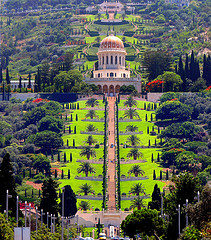
Shrine of the Báb
Shrine of the Báb

Happy Birthday Dalai Lama!

July 6

He was born this day in 1935, the fifth of 16 children, nine of whom survived to adulthood. He has spent five of his seven decades as Tibetan Buddhism’s spiritual leader outside his homeland.

China invaded Tibet in 1950. The Dalai Lama escaped from Tibet in 1959 during the March 10 uprising, in which followers gathered outside his palace to prevent the People’s Liberation Army from kidnapping him. The Dalai Lama fled the country to avoid potential violence.

Currently, the Dalai Lama’s envoys are in China seeking a diplomatic resolution to the Tibetan conflict.

Jan Hus – Czech Republic

July 6

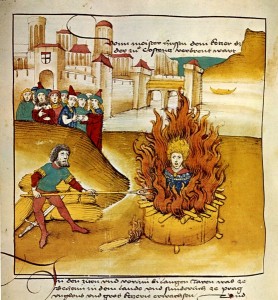
It’s a busy week in the Czech Republic, where inhabitants celebrate not one, but two public holidays in honor of not two, but three prominent theologians. Yesterday Czechs and Slovaks alike honored the Saints Cyril and Methodius, and today Czechs recall national hero Jan Hus, the forerunner of Protestant Reformation who was burnt at the stake on this day in 1415.

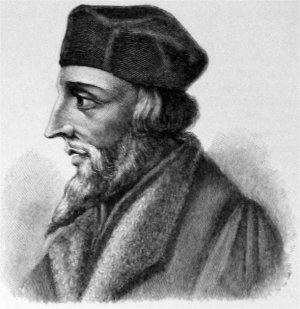
Statue of Jan Hus in Prague

The late 14th century was not the best of times for the Papacy. Having just returned from 70 years in France, later called the “Babylonian captivity” of the Papacy, French cardinals were eager to elect another French Pope. Riotous Roman crowds had another idea. Under duress the cardinals elected a Neapolitan to the Papacy in 1378, then hightailed it back to France to elect the “real” French Pope. Of course both Popes retained the title, and governments around Europe were forced to declare allegiance to one or the other.

Jan Hus grew up in Bohemia during this tumultuous epoch. He studied at the recently-established University of Prague, becoming a professor of theology in 1398, a priest at Bethlehem Chapel two years later, and eventually rector of the University.

Hus was an outspoken proponent of church reform. At this time the Church owned nearly half the land in Bohemia, yet taxed the poor rampantly. Hus spoke out against abuses in the church, including the widespread indulgence system which undermined the sanctity of Christian piety. He supported the preaching and reading of the Bible in common languages, and he opposed the recent doctrine of Papal infallibilit. Most controversially, Hus made the ‘heretical’ claim that the final authority of Christian Law lay not with pope, but with the Bible.

In 1409, in an attempt to end the papal Schism, bishops at the Council of Pisa elected a third Pope (Alexander “the Antipope” V) to replace the other two. However, rather than resolve the Schism, this only resulted in three concurrent Popes.

Jan Hus and his supporter King Wenceslaus declared allegiance to the third Pope, but when Alexander V’s successor issued a new wave of indulgences to raise money for a war against the King of Naples, Hus proclaimed that no pope or bishop had the right to take up the sword in the name of the Church. In rallying his followers against the indulgences, he also lost the support of King Wenceslaus who was sharing in the profits.

In 1414 Hus was asked to journey to Council of Constance (which sought to end the Schism once and for all), to which he was assured safe conduct by the Emperor of Luxembourg. When he arrived he found himself put on trial by the Council and imprisoned in Gottlieben Castle in chains. The bishops had convinced the Emperor that promises of safe conduct did not apply to heretics.

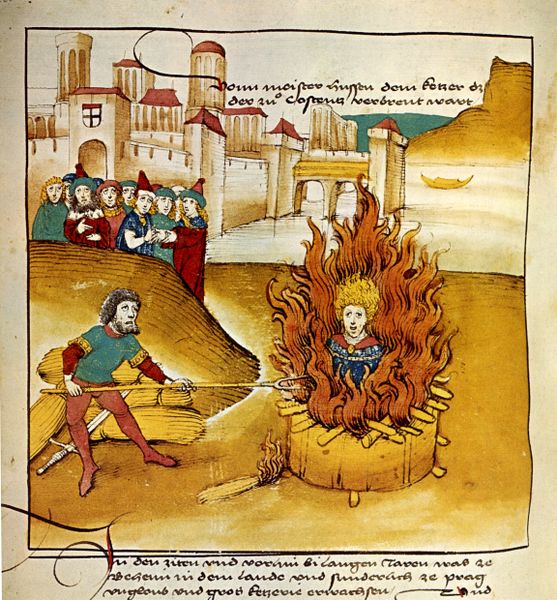
Hus was given many chances to recant his writings. He deplored false interpretations of his works, but stated he could not renounce beliefs unless they could be proven untrue by the words of the Holy Scripture. He was condemned to death in July 1415. Just before his execution he declared,

God is my witness that I have never taught that of which I have been accused by false witnesses. In the truth of the Gospel which I have written, taught, and preached I will die to-day with gladness.

Hus was also said to have uttered a prediction that in 100 years a man would come whose calls for reform could not be ignored, foreshadowing Martin Luther and the Protestant Revolution.

Spiezer Chronik's depiction of the death of Jan Hus, 1485

Hussitism and the Heritage of Jan Hus

John Huss, Priest and Martyr

John Hus: English Bible History

Jan Hus: Final Declaration