And God maketh the beast of the earth after its kind, and the cattle after their kind, and every creeping thing of the ground after its kind, and God seeth that it was good.
— Genesis 1:25
Before there was Doctor Dolittle, there was St. Anthony Abad, patron saint of the animal kingdom.
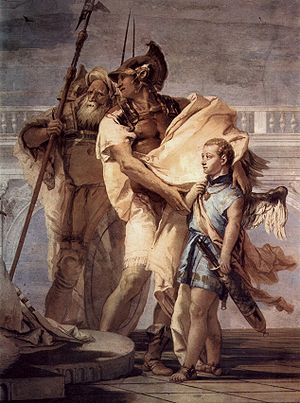
St. Anthony the Hermit, or St. Anthony the Great, was born in Egypt in 251 AD and lived to be 105. At age 34, he relinquished all his wealth and headed into the desert to be alone with God and meditate on Christ. He spent twenty years in isolation living in an abandoned Roman fort on a mountain by the Nile. The devil tormented him with images of animals attacking him, but Anthony never gave in.
Later in life, according to legend, various animals helped guide Anthony on his travels, including a wolf and a raven. Once a dog attacked his enemy. Once he cured a pig from illness. He’s often pictured wandering the wilderness with a pig by his side.
Anthony’s other claim to fame was his fight against the followers of Arian Christianity in the late 3rd and early 4th centuries. Arias was an Egyptian Christian who taught that, while Jesus was divine, he was not the same as God. The Council of Nicea declared Arian Christianity heretical in 325 AD.
Blessings of pets and livestock are common, but not limited to Latin and Hispanic cultures. The biggest ceremonies occur on the Sundays nearest the feast days of St. Francis of Assisi (October 4) and St. Anthony the Hermit (January 17).
St. Anthony died on January 17, celebrated as his spiritual birth in Heaven.
Even now I remember being caught up in the moment, feeling inexplicably happy when my doggie received her very own blessing from the priest. When all is said and done, it was a remarkable experience, a chance to share our love for our beloved pets, and to renew our commitment to protecting and respecting all of God’s creatures.
Misery is expected to peak today, the third Monday in January being the “most depressing day” of the year.
[Note: you can say things like “is expected to” if one person expects it to be true.]
That one person is Cliff Arnalls of Wales, who created the formula to determine the worst day of the year.
[Note: if I can find someone who agrees with him, I can write: “Researchers agree…”]
The equation is:
[W + (D-d)] x TQ
divided by
M x NA
whereby…
D = debt
d = amount of January pay check
T = time since Christmas
Q = amount time since failure to quit bad habit
M = motivational levels
NA = the need to take action
(The BBC describes Cliff as a part-time tutor at University of Cardiff in Wales, although one week later MSNBC promoted him to Dr. Arnall, a psychologist specializing in seasonal disorders. Apparently American educational standards are more lax.)
Even though the shortest day of the year is December 21st, the weather continues getting colder throughout the month of January. In fact, in ancient Rome the calendar year originally started in March and ended in December. The months of January and February were just one big amorphous clump of days, as the calendar was used mainly for agricultural purposes and was based on lunar cycles rather than solar. In the 700s BC January and February were “created” to fill in the gap.
By a couple weeks into the new year the energy of the holidays has long dissipated, folks have failed all or most of their resolutions, and their bank accounts are still empty.
The airlines, however, recognize the date as the time when people are most likely to book a vacation.
“People feel bleak when they have nothing planned, but once they book a holiday they have a goal, they work toward having time off and a relaxing period,” — spokesperson for Porter Novelli, the PR agency for Sky Travel.
I’m buying into the vacation-booking theory, since my folks just booked their vacation last night.
Tips for making it through Blue Monday:
“Have a party and celebrate” – Jack Gilbert, Ontario, Canada
“Exercise and bibliotherapy” — Dr. Alan Cohen, Royal College of General Practioners
“Watch the film ‘The Sound of Music'” — Ketan Shah, Harrow, England
“Move to New Zealand…It’s summer!” – Oliver, Auckland, New Zealand
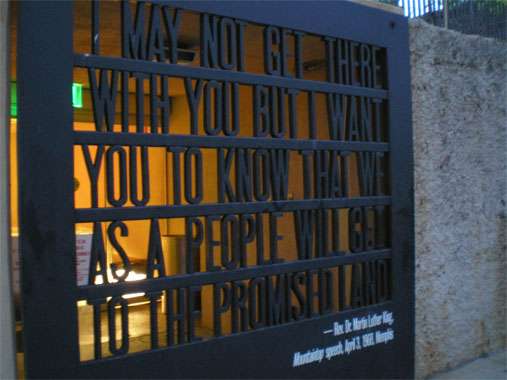
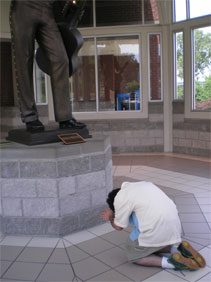
Across from the Lorraine Motel, now the National Civil Rights Museum, Memphis, Tennessee
The above quote was from his Mountaintop speech, given one day before his assassination in Memphis, Tennessee.
Today we remember, not his tragic death, but his remarkable life.
In the early 1980’s, Martin Luther King Day was a holiday in several states, but there was debate about whether King ‘deserved’ a federal holiday. After all only one other American had been so honored. George Washington.
[Abraham Lincoln’s birthday is not a federal holiday. There was a movement to rename Washington’s Birthday ‘Presidents Day’ but according to the Federal Government it is still celebrated as Washington’s Birthday. Lincoln’s Birthday is celebrated at the state level, as is the name ‘Presidents Day.’]
Then-Senator Barack Obama pointed out in his speech for the MLK Memorial ground-breaking that:
“Dr. Martin Luther King Jr. was not a president of the United States–at no time in his life did he hold public office. He was not a hero of foreign wars. He never had much money, and while he lived he was reviled at least as much as he was celebrated.
Martin Luther King Jr.’s path differs from Washington’s in many respects; however, his life is consistent with the lives of those who have been honored via holidays throughout the world over the past three thousand years.
Martin Luther King was the unofficial spiritual leader of a large, underrepresented minority, suffering from great, long-lasting injustice.
Against incredible odds he successfully challenged and helped to change the unjust laws and practices of a powerful nation.
In the process he was prosecuted and imprisoned by that nation’s government.
He traveled great distances to deliver 2,500 speeches.
His words reached hundreds of millions of people.
He made it known through his words and proved through his actions that the values for which he lived outweighed the sacrifices he would have to make fighting for them, even if this meant death. (He had received countless death threats before his assassination.)
He was struck down during the height of his leadership, while fighting for those values and leading his people to freedom.
And he left behind a large body of written and–thanks to the advent of television–spoken work that explains his political, spiritual and moral belief system for future generations.
Former Ambassador to the UN Andrew Young was with King in Memphis, Tennessee the day he died. Young reflects on the events that led up to King’s famed: “Letter from a Birmingham Jail.”
“There had been 60 unsolved bombings in Birmingham, Alabama. There were people being beaten up on the street for no good reason. Martin said, “We’ve got to take on Birmingham.” A group of black leaders came to meet with him to call off the demonstrations because we had several hundred people in jail, and we didn’t have bond money to bail them out. They were asking him to stop the demonstration and to leave town and go around speaking to try to raise money to get these people out. He got up and went into the next room and in about five minutes, he came back with his overalls on, and he said, “I’m sorry, ladies and gentlemen, I know you mean well, but I cannot leave with these people in jail. The only thing I can do is go join them.”
It was in that jail cell that Martin Luther King penned a letter, started in the margins of an old newspaper, and continued on scraps of paper. It is now one of the most powerful documents of the Civil Rights era and a manifesto of civil disobedience.
Observed 3rd Monday in January (January 16, 2012; January 21, 2013)
Martin Luther King Jr. was born on January 15, 1929. His birthday is observed in the United States on the third Monday in January.
Calling Dr. Martin Luther King Jr.’s address to the American people on August 28, 1963 the “I Cash a Check” speech may not have resonated as well as “I Have a Dream.” But that’s what it was.
One hundred years after the Emancipation Proclamation, a quarter million African-Americans and Civil Rights supporters gathered at the nation’s capital to demonstrate that the end of slavery had not translated to the promise of freedom, or the unalienable rights propounded in the nation’s founding document. As the 34 year-old Baptist minister explained:
“In a sense we have come to our nation’s capital to cash a check. When the architects of our republic wrote the magnificent words of the Constitution and the Declaration of Independence, they were signing a promissory note to which every American was to fall heir. This note was a promise that all men, yes, black men as well as white men, would be guaranteed the unalienable rights of life, liberty, and the pursuit of happiness.
“It is obvious today that America has defaulted on this promissory note insofar as her citizens of color are concerned. Instead of honoring this sacred obligation, America has given the Negro people a bad check, a check which has come back marked “insufficient funds.” But we refuse to believe that the bank of justice is bankrupt. We refuse to believe that there are insufficient funds in the great vaults of opportunity of this nation.”
Tomorrow, even though the actions, events, and policies of the last several years have conspired to nearly bankrupt our American economy, millions of Americans will gather in Washington again to see a segment of that check cashed, a small portion of that dream realized, as the nation swears in its first African-American President.
Barack Obama was a Senator, not even a presidential candidate, when he spoke at the groundbreaking ceremony for the Martin Luther King National Memorial in 2006. On a cold November morning he told the crowd:
“Unlike the others commemorated in this place, Dr. Martin Luther King Jr. was not a president of the United States – at no time in his life did he hold public office. He was not a hero of foreign wars. He never had much money, and while he lived he was reviled at least as much as he was celebrated.
“By his own accounts, he was a man frequently racked with doubt, a man not without flaws, a man who, like Moses before him, more than once questioned why he had been chosen for so arduous a task – the task of leading a people to freedom, the task of healing the festering wounds of a nation’s original sin.
“And yet lead a nation he did. Through words he gave voice to the voiceless. Through deeds he gave courage to the faint of heart. By dint of vision, and determination, and most of all faith in the redeeming power of love, he endured the humiliation of arrest, the loneliness of a prison cell, the constant threats to his life, until he finally inspired a nation to transform itself, and begin to live up to the meaning of its creed…
“In the Book of Micah, Chapter 6, verse 8, the prophet says that God has already told us what is good. “What doth the Lord require of thee, the verse tells us, but to do justly, and to love mercy, and to walk humbly with thy God?”
“The man we honor today did what God required. In the end, that is what I will tell my daughters…I will tell them that this man gave his life serving others. I will tell them that this man tried to love somebody. I will tell them that because he did these things, they live today with the freedom God intended, their citizenship unquestioned, their dreams unbounded.”
In his last speech over 40 years ago in Memphis, Tennessee, King alluded to the journey of Moses and the Hebrew slaves who escaped from bondage in Egypt, only to wander for 40 years in the desert.
After four decades, God called to Moses and told him to stand on the mountaintop, to look over the land God would bestow on the Israelites. Then the Lord said to him, “This is the land I promised on oath to Abraham, Isaac and Jacob when I said, ‘I will give it to your descendants.’ I have let you see it with your eyes, but you will not cross over into it.” [Deuteronomy 34:4]
King concluded his final speech with:
“Like anybody, I would like to live a long life. Longevity has its place. But I’m not concerned about that now. I just want to do God’s will. And He’s allowed me to go up to the mountain. And I’ve looked over. And I’ve seen the Promised Land. I may not get there with you. But I want you to know tonight, that we, as a people, will get to the promised land.”
Over three hundred years ago the tenth and last (human) Guru of the Sikhs led his army in an historic battle against the Mughal Emperor.
But today’s holiday, Maghi Mela, actually honors the 40 followers who deserted the Guru before the fight.
At the Battle of Anandpur, Guru Gobind Singh’s men were besieged by the Mughal army. The Mughal Empire covered over 3 million square kilometers and had a population of over 120 million people.
Forty of the Guru’s men deserted him at Anandpur. Guru Gobind Singh had to retreat from Anandpur and most of his army was destroyed in the attack that followed.
When the 40 deserters returned home, their wives and families shunned them for desertion. Ashamed, the men–led by warrior woman Mai Bhago–decided to set back out to join their badly-outnumbered Guru, now in Khidrana Ki Dhab.
As the Mughal army approached Gobind Singh’s camp, they encountered the 40 former deserters. In the Battle of Muktsar all 40 warriors were killed, but the Mughal army met such heavy casualties they were forced to retreat.
Guru Gobind Singh post-humously forgave the former deserters and granted them eternal Chali Mukte–liberation from the cycle of death and rebirth and all human suffering. The site became known as Muktsar, the “tank of salvation.”
The Guru died less than three years later, but outlived his nemesis, the Sultan Aurangzeb. Aurangzeb had beheaded Gobind Singh’s father, the previous Guru, 30 years earlier for refusing to convert to Islam.
Both Gobind Singh and Aurangzeb were the last of their kinds.
The Mughal Empire declined after Aurangzeb’s death. He had ruled for half a century and was considered the last great Mughal ruler. He was succeeded by Bahadur Shah I, who reached a brief alliance with the Gobind Singh before the Guru’s death.
Guru Gobind Singh meanwhile declared that he would be succeeded not by a person, but by the Sikh holy book, Guru Granth Sahib, the writings of the ten Gurus of Sikhism. By taking the revolutionary step, Gobind Singh made the Guru immortal. Henceforth Sikhism could be guided by eternal principles instead of dependent on a mortal leader.
The site of the famous battle at Muktsar is now the centerpoint of Maghi Mela, the January 13 remembrance of the 40 Immortals.
Muktsar, site of the famous battle
In the 20th century the Sikh people have faced new, yet similar challenges. According to a 1994 study the Sikh people only make up less than 2% of the Indian population but account for 20% of the Indian Army’s officers, and 10-15% of all ranks.
Yet in 1984 a controversial Indian military operation, code-named Bluestar, killed the Sikh extremist leader Jarnail Singh Bhindranwale and hundreds of his followers, who had declared an independent Sikh state. In retaliation two of Prime Minister Indira Gandhi’s Sikh bodyguards assassinated her. This in turn led to the Anti-Sikh Riots which killed 3,000 Sikhs in New Delhi alone.
In North America Sikhs have been mistaken for Muslims because of their tradition dress, turban, and beards, in the wake of the 9/11 attacks. Four days after 9/11 a Sikh gas station owner in Mesa, Arizona (Balbir Singh Sodhi) was gunned down as he helped a landscaper plant flowers around his Chevron station. The racist murderer claimed to have killed Sodhi because of his turban “in retaliation” for the attacks.
If you’re like everyone I know, you had a baby this Fall.
But if you (or your loved one) are still expecting, you might want to give a shout out to Carmenta today, the Roman Goddess of Prophecy, Protectress of women in childbirth, and an early symbol of women’s lib.
Today marks the first day of Carmentalia, the Roman festival in her honor, observed by the women of ancient Rome.
This corresponds in name to the Latin Carmenta or Carmentis, of whom Preller says: The Goddess of Birth, Carmenta, was so zealously worshipped near the Porta Carmentalis, which was named from her, that there was a Flamen Carmentalis, and two calendar days, the eleventh and fifteenth of January, called the Carmentalia, devoted to her worship. These were among the most distinguished festivals of the Roman matrons. Etruscan Roman Remains<
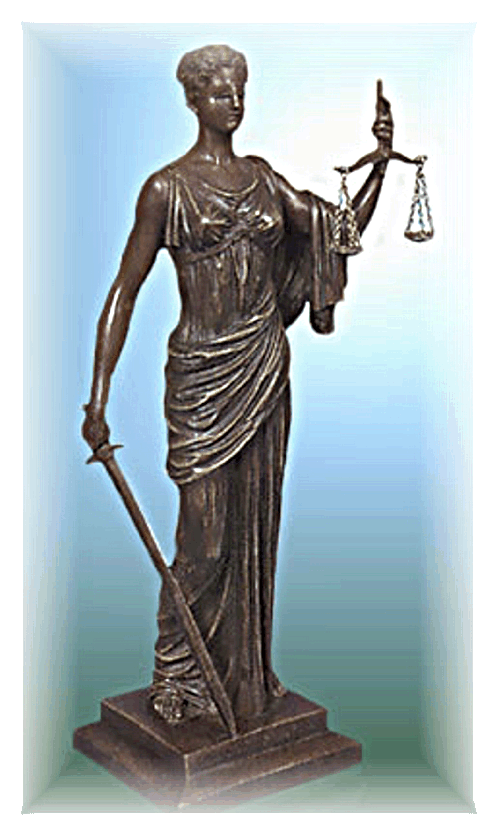
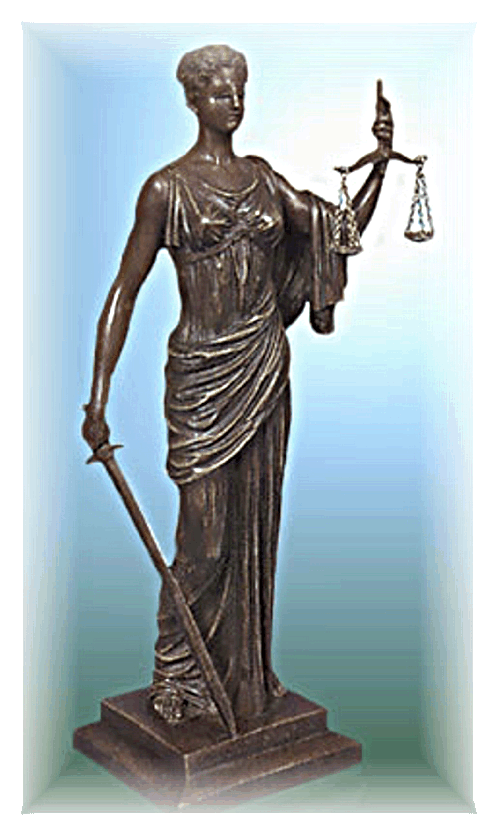
She also bears much in common with Themis (below), the Greek Goddess of divine law and wisdom.
According to Ovid, she traveled from Greece to Italy with her son Evander, where Evander founded the city of Pallantium. Pallantium was named after their Greek hometown of Pallantium, Aracadia, and was one of the 7 hills that later became Rome.
Carmenta was famous for chanting her prophecies in verse. Her Greek name was Nicostrate, but when she arrived in Italy, the locals called the singing woman Carmenta, for the Latin ‘carmina’, or ‘song’.
Another explanation holds the opposite: Carmenta predated the Latin word for song, and ‘carmina’ derived from the prophetess’s name.
‘Mente’ meant ‘wise’ or ‘mind’. Car-menta could have meant ‘Car the Wise’. Or as Plutarch suggests, ‘Out of the Mind’, because she acted crazy.
She was associated with artistic and technological innovation and is co-credited for inventing the Latin alphabet (with Al Gore and her son Evander.) There is little evidence to support this, but Latin was indeed based on a Greek variant.
According to Virgil she used her powers of prophesy to choose the best site of the future Rome on which to establish her son. Once she even foretold Hercules the fate that awaited him.
How she came to be the Goddess of Childbirth is unclear. The women’s cult that grew around her was said to have predated Rome. However, Plutarch’s and Ovid’s description of the origin of her temple is more about contraception (and possibly abortion) than fertility.
During the Second Punic War (215 BC) the Roman Senate restricted the rights of women to ride in carriages or to wear certain clothing. This was an attempt to save resources such as horses, fabrics, and gold for the war effort.
But when the war ended, these rights were not reinstated.
The women of Rome banded together and protested, the Lysistrata way. They refused to conceive children. (You can work out the details.) According to Plutrach they:
“kept their husbands at a distance until the husbands changed their minds and made the concession to them.”
After the laws were revoked, the women had numerous prodigy, and built the Temple of Carmenta in her honor.
At the temple the Goddess Carmenta could be invoked with one of two carmentes, lesser goddesses of childbirth, and Porrima–literally, “feet first” and “head first”. Possibly referring to which way the baby was delivered. It can also be read as “looking backward” and “looking forward,” citing Carmenta’s ability to tell the future.
View from Palatine Hill
All forms of animal skin were banned in her temple. This meant no shoes, no leather, and no animal sacrifice:
For on the day they had received life, they did not want to deprive another life.” –Varro, Cens. 2.2
The Carmentalia festival was unique in that it was celebrated on two separate dates, four days apart. (The second date was on January 15th.)
[The reason for this is uncertain. One theory is that it was originally on the 11th and 13th, but the 13th was the Ides of January. Or, as mentioned earlier, the Romans didn’t have anything better to do in the middle of January.]
On the anniversary of the murder of Raud the Strong in Norway, Panama’s Martyrs Day remembers a tragedy half a world away and a thousand years later. The oppressors this time? The good ol’ U.S. of A.*
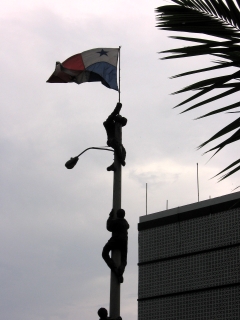
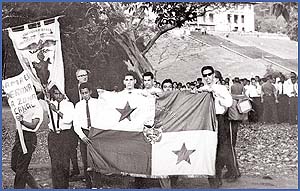
On January 9th, 1964 two-hundred Panamanian high school students marched to Balboa High School in the U.S. Canal Zone to raise the Panamanian flag in what was expected to be a peaceful protest.
By the end of that day, twenty-two Panamanians lay dead, and the city was in chaos.
Tensions had increased over the early 1960’s between Panamanians and “Zonians,” the term used to refer to the highly patriotic group of U.S. citizens and supporters residing in the Canal Zone. The clash of identities and national pride was symbolized by an ongoing debate about flying the US and Panamanian flags at public institutions within the Canal Zone.
“In 1960, after a series of riots in Panama, President Eisenhower ordered that Panama’s flag should fly side by side with the Stars and Stripes at the U.S. Canal Zone building.”Life Magazine
Other sources point out it was actually Kennedy’s decision to fly the Panamanian flag with the U.S. flag throughout the Canal Zone. However, this policy had not been carried out at the time of Kennedy’s assassination in November 1963.
The patriotism of the Zonians was fueled by the recent assassination and by a Molotov cocktail attack on the U.S. Embassy in Panama City the month before.
The chief architect of the Panama Canal Company was suing to prevent the flying of the Panamanian flag at his site, and a temporary compromise was imposed–that satisfied no one and angered everyone. The compromise was to fly no flag, either U.S. or Panamanian at sites in the Canal Zone.
On January 7th Zonian students at Balboa High School in the Canal Zone protested this compromise by raising the U.S. flag at the school. Officials took down the flag, but the students walked out of class to raise it again and posted their own guards to prevent its removal.
On January 9th a group of 150-200 students from the Panamanian Instituto Nacional (high school) marched from Panama proper to Balboa High to raise a Panamanian flag in protest.
The were met by a large crowd of Zonian students, adults, and police at the high school. The situation worsened as the Zonian students refused to allow the Panamanians access to the flag pole and sang the
An altercation between Panamians and Zonians broke out in which the Panamanian flag was torn. This particular flag had a historical significance; it had been used in 1947 to protest the Filos-Hines Treaty.
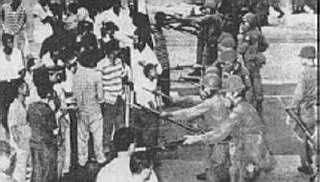
“As word of the Balboa flag desecration incident spread, angry crowds formed along the border between Panama City and the Canal Zone. At several points demonstrators stormed into the zone, planting Panamanian flags. Canal Zone police tear gassed them. Rocks were thrown, causing minor injuries to several of the cops. The police opened fire.” — Eric Jackson
The first person killed was Ascanio Arosemena, a 20 year-old college student, who had not participated in the demonstrated, but was on his way to a movie when he came upon the scene. A photo (below) shows him helping to evacuate an injured student moments before he was shot in the back.
Angry Panamanians demonstrators set fire to Canal Zone cars, shops, and buildings, tore down sections of the “fence of shame” separating the Canal Zone, and used Molotov cocktails on the house of the US District Judge. Police initially used tear gas to stop the crowds. Then bullets.
When the onslaught was over, 22 Panamanians lay dead. Six of the them had been trapped when the American Airlines building was set on fire. One victim was an 18 month-old baby girl killed by excessive tear gas. Hundreds were wounded.
U.S. Army officials insisted bullets were never directly fired into the crowd, but one source says claims the military expended 450 .30 caliber rifle rounds, close to a thousand rounds of birdshot, and over 7,000 tear gas canisters.
By 8pm the pandemonium had spread throughout the country including the city of Colon, where riots broke out and three U.S. soldiers were killed.
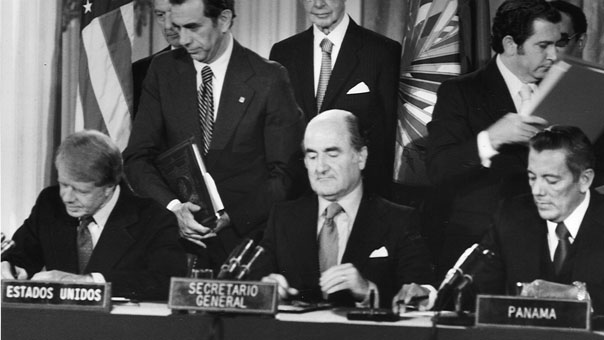
Panama broke off relations with the United States, and the U.S. action and policy toward Panama was multi-laterally condemned by France, Great Britain, the Soviet Union and China. The tragedy of January 9, 1964 had long-lasting repercussions which paved the way for the 1977 treaty that transfered the Canal Zone to Panama in 1999.
[Another factor that fueled the conflict: President Lyndon Johnson’s notion that Communist agents were inciting the unrest in Panama–as opposed to it being an authentic expression of anger against U.S. policy in the region. Members of Panama’s leftist party were indeed involved in demonstrations, but not in the mayhem that followed.]
It seems remarkable and tragic that a debate over a flag would, within hours lead to a confrontation so bloody.
Statue in memory of 22 Panamanians who died in the fight
But such devotion to the symbolic value of a nation’s flag is echoed in the national anthems of countries across the world. The United States’ own national anthem doesn’t ask about democracy, peace, the President, free markets, or American government. It simply asks “…does that star-spangled banner yet wave…O’er the land of the free and the home of the brave?”
The Mississippi Delta was shining
Like a National guitar,
I am following the river
Down the highway
Through the cradle of the civil war,
I’m going to Graceland, Graceland
In Memphis Tennessee…
…I’ve reason to believe
We both will be received
In Graceland
Paul Simon, Graceland
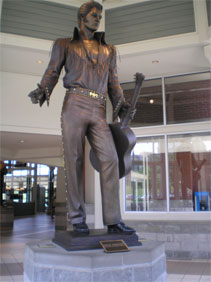
Today is the birthday of the King of Rock ‘n’ Roll Elvis Presley. Though not an official holiday in any nation, it is observed throughout the world.
(Above: the author praises the King in Memphis, Tennessee)
The focal point of the celebration is Graceland, Elvis’s former home in Memphis, Tennessee. Festivities begin each year with a gospel tribute at the Gates of Graceland at midnight.
Graceland was not named by Elvis, but by the original owner S.E. Toof after his daughter Grace.
Elvis Presley was born in Tupelo, Mississippi. At age 13 the Presley family moved to Memphis, Tennessee, where Elvis lived for most of his life.
In 1957 the 22 year-old superstar purchased the Graceland mansion in Memphis. He was proud to move his parents into it, a long way from the two-room house where Elvis was raised. His mother Gladys died the following year.
Early viewers of Elvis’s concerts, such as rock legend Roy Orbison, cite his instinct and incredible energy as a performer as separating him from the artists before him. It is difficult to convey the novelty of Elvis after the half-century of imitations and changes that followed. Various morality groups assailed him for his “vulgar” and “obscene” music and movements on stage.
His discoverer, Sam Phillipsof Sun Studios, said Elvis “put every ounce of emotion…into every song, almost as if he was incapable of holding back.”
When Elvis first entered the Sun Studios, receptionist Marion Keisker asked him who he sounded like. He is reported to have said “I don’t sound like nobody.”
While this was true in mainstream radio, Elvis was heavily influenced by the black gospel singers he had seen at Memphis’ Ellis Auditorium and black blues performers in the clubs along Beale Street.
Stories make it sound like Elvis walked into Sun Studios and the rest is history, but in fact, after his first recording in 1953, Elvis politely hassled Sam Phillips for a year—while working as a truck driver—before Sam teamed him up with bassist Bill Black and guitarist Scotty Moore. The three recorded a high-energy version of black R&B artist Arthur Crudup’s “That’s All Right, Mama” in July and the single was released that month. Some white disc jockeys refused to play Elvis’ music at first, believing Elvis was black.
In January 1956 RCA released Heartbreak Hotel, co-written by a part-time Florida schoolteacher Mae Boren Axton, who was inspired by the newspaper epitaph of a suicide victim: “I walk a lonely street.”
Heartbreak Hotel slowly and steadily climbed the charts, entering at #1 68 in March, and making its way to #1 in May.
Though Graceland is considered the musical Mecca for Elvis fans, do not miss Sun Studios just to the east on Union Avenue, for a more in-depth historically revealing tour about Elvis and Memphis music history.