Jose Rizal Day

December 30

Polyglot:

1. A person having a speaking, reading, or writing knowledge of several languages.
2. A book, especially a Bible, containing several versions of the the same text in different languages.
3. A mixture or confusion of languages.

Today the people of the Philippines mourn the death and celebrate the life of their national hero Jose Rizal.

“I die without seeing the sun rise on my country. You who are to see the dawn, welcome it, and do not forget those who fell during the night.”

This eerily self-fulfilling prophecy was spoken not by Rizal, but by Elias, a character in Rizal’s great novel Noli Me Tangere, written almost a full decade before Rizal’s own execution.

Rizal wrote Noli Me Tangere (literally, “Touch Me Not”) at age 25. By that time Rizal had earned his Bachelor’s degree (at 16) in the Philippines; he had studied medicine at the University of Santo Thomas, but after witnessing discrimination against Filipino students, he sailed to Spain to complete his studies at the University of Madrid; he specialized in ophthalmology, due to his mother’s worsening blindness; and he earned a second doctorate at the University of Heidelberg.

I spend half of the day in the study of German,” Rizal wrote, “and the other half, in the diseases of the eye. Twice a week, I go to the bierbrauerie, or beerhall, to speak German with my student friends.

Rizal spoke at least a dozen languages–some sources say 22–including, Spanish, French, Latin, Greek, German, Portuguese, Italian, English, Dutch, Japanese. He translated works from Arabic, Swedish, Russian, Chinese, Greek, Hebrew, and Sanskrit into his native tongue of Tagalog. While in Germany, he was a member of the Anthropological Society of Berlin, for which he delivered a presentation in German on the structure and use of Tagalog.

But it was his novel Noli Me Tangere that would earn him fame in the Philippines and infamy in Spain.
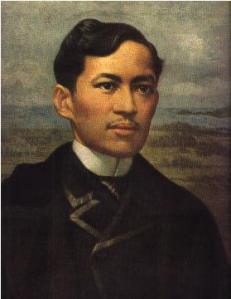
Jose Rizal (Museum of California History)

Noli Me Tangere exposed the hypocrisy of the Spanish clergy in the Philippines and the injustices committed against native Filipinos. And his follow-up non-fiction work demonstrated that contrary to 300 years of colonialist teachings the Filipino people had been an accomplished nation before the Spanish set foot in the country. That in fact, colonization had resulted in a ‘retrogression’.

In response to Noli Me Tangere, clergy members circulated pamplets warning Catholics that reading the novel was equivalent to “committing mortal sin.”

The book was banned in many parts, and one anonymous “Friar” wrote to Rizal, “How ungrateful you are…If you, or for that matter all your men, think you have a grievance, then challenge us and we shall pick up the gauntlet, for we are not cowards like you, which is not to say that a hidden hand will not put an end to your life.

Rather than give in to harassment, Rizal followed it up with a sequel, El Filibusterismo. Rizal’s novels became a rallying point for nationalists in the Philippines. In Spain he continued to fight for equal rights and representation for his countrymen. Rizal returned to the Philippines in 1892. After a rebellion broke out, Rizal was arrested and sent into 4 years of exile.

While in exile in Dapitan he managed a hospital, provided services to the poor, taught language classes, and worked with soldiers to improve the area’s irrigation and agriculture.

In 1896 the Philippines Revolution broke out. Though Rizal emphasized non-violence in his works, he was again imprisoned, and this time sentenced to execution.

Just before his death, Rizal wrote his final poem, which he ‘smuggled’ out to his sister by hiding it in the stove in his cell. The poem has no title, but is often called “Mi ultimo adios”…My last good-bye.

“My idolized country, sorrow of my sorrows,
Beloved Filipinas, hear my last good-bye.
There I leave you all, my parents, my loves.
I’ll go where there are no slaves, hangmen nor oppressors,
Where faith doesn’t kill, where the one who reigns is God.”

–from Mi ultimo adios

He was executed by firing squad at 7:03 am on December 30, 1896, and buried without a coffin.

Rizal Monument, Manila; photo © Carlito Scholz

His tragic death only strengthened Filipino resolve for self-determination.

In April 1898, the fight for independence, led by Andres Bonifacio and Emilio Aguinaldo, received a boost from an unexpected party: the United States. The Spanish-American War, which had begun in Cuba, soon stretched to all of Spain’s remaining Pacific territories.

That summer the Philippines Army, headed by Aguinaldo, defeated Spanish troops, and handed over 15,000 Spanish prisoners to U.S. forces, along with valuable intelligence. Aguinaldo declared the Philippines an independent nation on June 12, 1898.

The Philippines soon found they had rid themselves of a demon only to make a deal with the devil. In defeat Spain ‘ceded’ the Philippines to the U.S., which immediately rejected Philippine independence. Whereas the Spanish had sought to bring Catholicism to the Philippines, the U.S. sought to bring “freedom” and “civilization”. The war that followed, the U.S.’s first overseas experiment in nation-building, took the lives of over a quarter million Filipinos (a low estimate), the overwhelming majority of them civilians. Disease and famine were a prime cause of civilian deaths. But torture, mass executions, internment camps, village-buring, and other atrocities against civilians were also staples of the war.
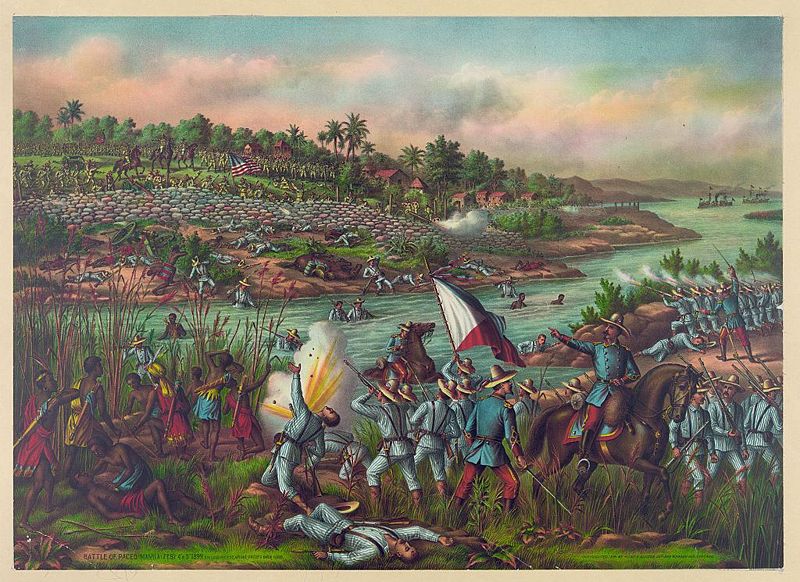
Battle of Paceo, Philippine-American War

The war officially ended in 1902, but fighting continued until 1913. English, spoken by a minority of Filipinos, was declared the official language.

The Philippines would not see independence until after World War II, fifty years after the death of Jose Rizal. Through that time and even to the present, Rizal and his writings continue to symbolize the Filipino spirit and their long fight for equality and self-determination.


Our Mother Tongue

The Tagalog language’s akin to Latin,
To English, Spanish, angelical tongue;
For God who knows how to look after us
This language He bestowed us upon.

As others, our language is the same
With alphabet and letters of its own,
It was lost because a storm did destroy
On the lake the bangka in years bygone.

Jose Rizal, age 8 (originally in Tagalog)
Jose Rizal Website

The Philippine-American War

Lessons from the Philippines “Insurrection”

George Washington’s Christmas Gift

December 23

Washington resigns as General

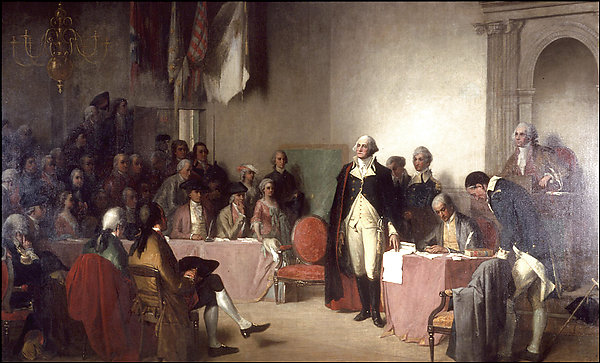
On this day in 1783, the most powerful man in the Western Hemisphere, the Commander-in-Chief of the Army of the United States who had achieved independence from Britain, the world’s strongest superpower, voluntarily surrendered his sword and his title to the Continental Congress in Annapolis, Maryland. He returned to his home in Mount Vernon, Virginia, expecting to live a quiet farm life.

His plans were derailed a few years later when he was elected to serve as President of the 1787 Constitutional Convention in Philadelphia.

Maryland to Unveil Washington’s Resignation Speech
George Washington’s Resignation Speech – 7MB file

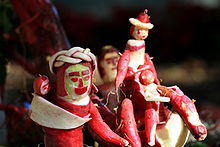
Night of the Radish

Forget everything you know about radishes.

Night of the Radishes is one of the most unique holidays in the Western hemisphere.  It has been celebrated in Oaxaca for hundreds of years, but only became an official holiday in 1897.

Radishes are actually native to China, and were brought to the New World by Spanish explorers in the 1500’s. Two friars encouraged the the townspeople of Oaxaca to cultivate the radishes, and it is believed one of the friars suggested they carve and display the radishes to encourage the locals to buy their produce.

Night of the Radishes

Festivus: a Holiday for the Rest of Us

December 23

On December 18, 1997 Frank Costanza (Jerry Stiller) introduced the TV-watching world to a new holiday tradition. In the Seinfeld episode “The Strike” George’s father explains to Cosmo Kramer how years earlier, fed up with the commercialization of Christmas, he conceived of the new holiday:

“Many Christmases ago, I went to buy a doll for my son. I reached for the last one they had, but so did another man. As I rained blows upon him, I realized there had to be another way.”

Frank summed up the holiday in a simple catch-phrase: “A Festivus…for the rest of us.”

Over a decade later Festivus has exploded into an international–well, okay, national–phenomenon. According to the Big Book of Girl Stuff:

“Festivus was intended to be a holiday that required no shopping. The only Festivus decoration is a bare metal pole, which can be stuck in a pot or hung from the ceiling.”

Festivus Poles

Another Festivus tradition is the “Airing of Grievances” during which family members announce how disappointed they have been in one another over the past year.

As far as cultural anthropologists have deduced, the holiday was invented by the father of Seinfeld screenwriter Dan O’Keefe in the 1960s, although the younger O’Keefe altered the holiday for the Seinfeld version. The original Festivus for example was held anytime from December to May. The modern incarnation is celebrated on December 23, halfway between Winter Solstice and Christmas.

But these days Festivus has competition for the December 23 spot. A holiday known as HumanLight is also celebrated on the 23rd. HumanLight is a non-denominational festival that makes no reference to the divine or supernatural. It was started by a Humanist organization in Verona, New Jersey in 2001. Its purpose: to provide a non-religious alternative to Christmas, Hanukkah, and other December celebrations.

It’s unlikely the December 23rd date was chosen to oust Festivus, but Festivus participants will gladly take on the challenge. You see, the final activity of Festivus is known as “Feats of Strength”: no Festivus party is declared over until someone can successfully pin the host’s head to the ground.

So have a great Festivus, and if you’re throwing a party, consider plush carpeting.

Yalda: Rebirth of the Sun

(usually) December 21

Creation! Before the light of creation dazzled chaos,
Love was created — that set creation on fire…

— Hafez

On the longest night of the year Iranians around the world celebrate Yalda. It means “rebirth”, referring to the rebirth of the sun. Today is also the first day of the month of Dey.

The history of this celebration goes back almost to the dawn of civilization itself, when the ancient Aryan tribes of the central Asian steppes worshipped the sun as the source of life.

As these tribes migrated to Persia–as well as to parts of India, Europe and the Far East–they took their traditions to a new latitude. The sun-as-benefactor was a notably different view than those held by cultures of the Arabian desert, who were bombarded with the sun’s heat and thus envisioned hell to be a place of fire and flame.

yalda_sun_night

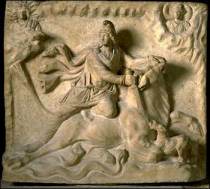
The concept of the sun god Mithra solidified in what is now Iran. Thousands of years before Christ and Mohammad, Persians worshipped Mithra and held fire in great esteem as a representation of the sun’s incarnation on earth. Many Iranians still celebrate Nooruz (the Spring equinox) by jumping over fire, a practice that caused religious leaders to arrest hundreds of participants as recently as 2001. According to scholar Esmail Nooriala:

It is not an act of worshipping fire. You make a fire from bundles of thistles and thorns, then jump over them with joy and enthusiasm. You become mixed with an element of nature, dance with its flames and absorb its kind of warmth. You do not think of an abstract God who is sitting on a thrown somewhere in Heaven and expects you to suppress your joy and behave in his ever lasting and expanding presence.

As Rome moved eastward to Persia, and as Persian soldiers were captured and brought back to Rome, a curious cultural exchange occurred. The Roman army–and with it a good segment of the Roman population–were exposed to and absorbed the ideas of Persian Mithriasm. At one point the worship of Mithra reached all the way from Spain to India, although the practices in the Roman Mithraism, such as bull-related rituals and imagery, bore little in common with the Mithraism of Persia.

Persia experienced a long, slow conversion from natural pantheistic religion to abstract monotheism.

Followers of Zoroaster, believed to be the first monotheistic religion, exalted Ahura Mazda as the one true divinity. Mithraism and Zoroastrianism coexisted in Persia for over a millennia, often melding and merging. It wasn’t until Roman Empire adopted Christianity as the official religion that the Persian Empire–which had rejected the idea of a state religion for over a thousand years–sought to increase its power by institutionalizing Zoroastrianism.

During the Arab invasion from the West 1400 years ago, Islam replaced Zoroastrianism as the religion of Persia. But Persians maintained their local languages, customs and many of their traditions.

The reemergence of Yalda is a relatively recent phenomenon. It has occurred mostly in the past 25 years, since the Iranian Revolution of 1979. Many Iranians, both in Iran and abroad, seek to reconnect with thousands of years of tradition and history.

These traditions include the celebration of the birth of Mithra, observed on the winter solstice. Just as the darkest hour is before dawn, the sun god is reborn precisely during the year’s longest night.

On this night many Iranians gather together, enjoy nuts and fruits of the season–pomegranate chief among them–and recite the poems of great Iranian writers like Hafez…

At dusk I woke with all my cares vanished:
in that pitch black of night I drank from the water of life.
Enraptured with the glow of the inner light:
I drank of that cup of light, glorified in nature.
What a glorious morning, what a glorious night!

— Hafez

Everyone
whether he be drunk or sober
seeks the beloved.
Every place
whether it be mosque or synagogue
is the house of love.

— Hafez

Merry Yalda by Esmail Nooriala

Happy Yalda, Yuletide, Mithrakana

The Poems of Hafez

Winter Solstice & Yule Festival

December 21

All the Feasts of Heathendom…

“Among all feasts of heathendom, Yule-festival is most important, it being the anticipation of the celebration of winter solstice.”

–Karl Weinhold, Christmas Games and Songs from Southern Germany and Silesia

And of all the annual celebrations on earth there is none older and more universal than the celebration of the Winter Solstice.

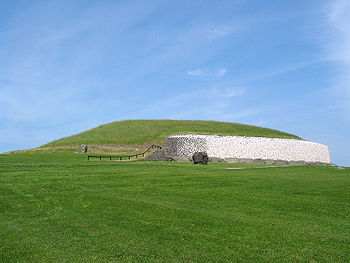
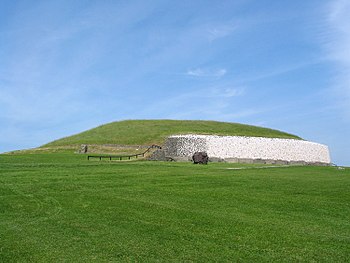
Many of the world’s oldest monuments, which for years baffled anthropologists and archeologists, are now believed to have functioned as massive calendars that predicted the winter and summer solstices with astonishing accuracy. From Newgrange in Ireland and Stonehenge in England, both of which predate the Druids, to the Chankillo towers in Peru built 1700 years before the Incas, to the 365-day calendar used by the ancient Egyptians. All of these calendars were used to make sense of and to find meaning and patterns in an otherwise mysterious and unpredictable world.

Newgrange, Ireland
Newgrange, Ireland

The word “Yule” used in Germanic and Norse countries comes from “yula” meaning wheel, referring to the cycling of the seasons and the wheel of time. The term predates Christianity, but today yule-tide greetings are synonymous with the Christmas season.

The word Solstice comes from the Latin words “sol”, or “sun,” and “sistere”, meaning “to stand still.” The Solstice is the moment at which the sun stands still. Winter Solstice marks the longest night and shortest day of the year, and it usually falls on December 21 or 22. From that night on forward the ancients knew–or prayed–that the days would grow longer and warmer, providing for sufficient harvest and plenitude the following year.

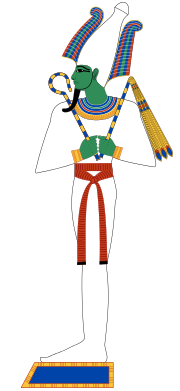
As early as 2400 BC the ancient Egyptians worshipped Osiris, the god of death, life and fertility Osiris during the solstice. It was the day on which he was said to have been entombed and reborn. This tradition was echoed in later Greek ceremonies paying homage to Dionysus.

Osiris
Osiris

The ancient Romans celebrated the solstice with a week-long festival called Saturnalia, honoring Saturn, the god of agriculture. The symbols they used included holly and wreaths, and it was a time of exchanging gifts.

The Druids called this time Alban Arthan, the Light of Winter. Although it has also gained the interpretation Light of Arthur by the poets, harkening to the legendary king who was associated with the sun and believed to have been born on the Winter Solstice.

In the Norse lands on Yule’s Eve a boar was sacrificed and its meat used for the holy feast. Those who could not afford to do so, broke a boar-shaped loaf of bread in its place.

So have a great Yulstice! Yule be glad you did!

Winter Solstice

Midwinter’s Day

Yule

Alban Arthan

Urs of Rumi

December 17

Everything you see has its roots in the unseen world.
The forms may change, yet the essence remains the same.
Every wonderful sight will vanish, every sweet word will fade,
But do not be disheartened,
The source they come from is eternal, growing,
Branching out, giving new life and new joy.
Why do you weep?
The source is within you
And this whole world is springing up from it.”

December 17 is the Urs of Mawlana Jalal ad-Din Muhammad Balhi, or as he’s known affectionately in the West, Rumi, master Persian poet and proto-founder of the Sufi Order of the Whirling Dervishes.

Rumi

Urs refers to the death of a Sufi saint, but it comes from the Arabic word for “wedding” and literally means “nuptial” or “bride’s night”. In Sufism, death is viewed not as a tragedy but as a joyous union of the soul with God.

Thus, rather than mourn the anniversary of Rumi’s death, his followers celebrate jubilantly.

Rumi was born in what is now Afghanistan in 1207 AD. When he was a boy, his family headed west during the Mongol invasions. He spent much of his life in the Rum area of Asia Minor (now Turkey) which is how he earned his nickname Rumi. At age 25, he became head of a madrasah, inheriting the post from his father.

Rumi’s poems speak to the oneness of the universe, a central component of Sufism, although they touch on many topics…

Once you think of me
Dead and gone
You will make up with me
You will miss me
You may even adore me
Why be a worshiper of the dead
Think of me as a goner
Come and make up now…

Rumi’s works and philosophy were spread by his followers and his son Sultan Walad, who founded the Order of Mawlawi Sufis, aka the Whirling Dervishes, the order that brought new meaning to the term “poetry in motion”

In Sufism, a branch of spiritual philosophy stemming from the Sunni tradition, one does not learn the deeper truths of God from books but from direct experience. To become a dervish, one must train for years under a master, then spend years humbly serving society.

The goal is to reach a state of fitra: separation from one’s ego to become one with Divine Unity.

Mawlana Jalal ad-Din Muhammad Balhi finally reached that long-awaited union 801 years ago today. Today his Urs is celebrated not just in Persia but by Sufis and poetry-lovers around the world.

If you bake bread with the wheat that grows on my grave
you’ll become drunk with joy and
even the oven will recite ecstatic poems.
If you come to pay your respects
even my gravestone will invite you to dance
so don’t come without your drum.
Don’t be sad. You have come to Gods feast.
Even death cannot stop my yearning
for the sweet kiss of my love.
Tear my shroud and wear it as a shirt,
the door will open and you’ll hear
the music of your soul fill the air.
I am created from the ecstasy of love and
when I die, my essence will be released
like the scent of crushed rose petals.
My soul wants to leap and join
the towering soul of Shams.

– Ghazal (Ode) 683
Translated by Azima Melita Kolin
and Maryam Mafi
“Rumi: Hidden Music”
HarperCollins Publishers Ltd, 2001

Zamenhof Tago!

December 15

Originally celebrated as Zamenhof Day, Esperanto Day is the birthday of Esperanto founder L.L. Zamenhof. He would be 149 today.

The son of a German teacher, Zamenhof was born in Bialystok, Russia, in what is now Poland. He spoke all three of those languages as a child, and studied Greek, Latin, Hebrew and French. He grew up to be a doctor, but had an incredible ability to pick up languages. During his formative years in Poland, conflicts in Eastern Europe led Zamenhof to believe that much of the world’s violence could be stemmed by a common language. Zamenhof set out to create an international language, easy to learn, simple to use, that could unite the world’s speakers for the first time since the Tower of Babel.

In 1887 he published a booklet of the rules of “An International Language” using the pseudonym Dr. Esperanto (one who hopes).

Ludoviki Lazaro "Dr. Esperanto" Zamenhof

The pseudonym became synonymous with the language, and Esperanto was born. It was an uphill battle promoting his language. At the first Esperanto congress in 1905 in Boulogne-sur-Mer, France, Zamenhof stated:

And now for the first time the dream of thousands of years begins to be realized. In this small French seaside town I have met men from the most varied countries and nations, and they meet each other not as deaf-mutes, but they understand one another and speak to one another as brothers, as members of one nation.

One common criticism of Esperanto is that English has become the default “international language”. However, we forget how many languages have attained that position during the peak of their mother country, only to ebb away. The Romans, the Spanish and Portuguese, and the French empires once could say the same.

After the First World War delegates from Europe, South America, Africa, and Asia submitted a proposal that the League of Nations: to make Esperanto the working language of the league. Ten voted for the proposal, one against…

The French delegate, Gabriel Hanotaux, argued that French was and should continue to be the language of international affairs. It didn’t work out that way. Because of Hanotaux’s objection, the League of Nations failed, and the world plunged into the Second World War.

Okay, maybe the chain of cause-and-effect wasn’t that drastic, but the twentieth century proved that the ability to communicate was of paramount importance to international peace and stability.

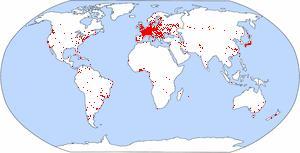
Today France is the leading host country of Esperanto’s Pasporta Servo, where Esperanto speakers can travel the globe practically for free, lodging at the homes of Esperanto hosts in 92 countries. The Pasporta Servo is actually a major incentive for young people to learn Esperanto, which can be learned in a fraction of the time of other languages.

Pasporta Servo host map
Pasporta Servo hosts

Of course with the growing popularity of sites like Babelfish, and increasingly accurate voice-recognition software, it may be that one day everything we say will be instantly translated into whatever language the listener desires.

But until that day…mi provas lerni Esperanton.

Esperanto FAQs