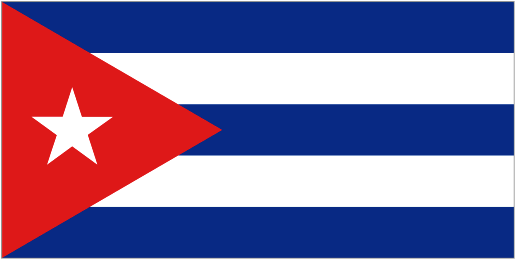
Just like the child born on Christmas, Cuba gets the short end of the stick when it comes to celebrating its “Triumph of the Revolution”. That’s because on January 1 the rest of the world is busy celebrating New Year’s. To the Cubans, the world is celebrating with them. It’s all a matter of perspective.
This small island 90 miles to the south of Florida has been the focal point of the struggle between capitalism and socialism in the Western hemisphere for half a century.
On this day in 1959, U.S.-backed President Fulgencia Batista fled the country after his troops faced a disastrous defeat at the hands of Ernesto “Che” Guevara’s and Camilo Cienfuegos’s rag-tag guerrilla armies. This allowed former baseball player and enemy-of-the-state Fidel Castro to assume power of the country, a position he held onto with an iron grip until February 2008. Suffering from an undisclosed illness, Castro turned power over to his brother, Raul Castro. By that time Fidel Castro had become one of the longest reigning rulers in the history of the Western hemisphere.
Cuba has spent the past 50 years defying world expectations. First in 1959, and again in the 1990s, when its sugar-daddy—the Soviet Union—collapsed. But Cuba outlived its supporter, and subsisted without its aid.
That’s not to say the country has flourished economically, or that its one-party government permits basic freedoms. But its people–at home and abroad–understand how to live each day.
It’s illegal for United States citizens to visit Cuba, part of the economic embargo the U.S. has placed on Cuba for over 4 decades. But many Americans do visit the island via other countries. Cuban officials just know not to stamp their passports.
Tonight as you count down to midnight, if you’re wondering why we picked such a completely random date to celebrate as the New Year—neither solstice nor equinox nor anniversary—take a moment to thank the folks of Segeda, Spain, a town that stood near present-day Zaragoza.
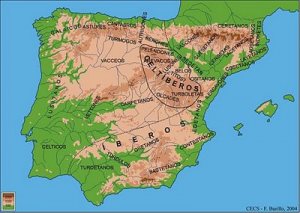
Celtiberia
Up until the 2nd century B.C., the Roman civic calendar began in mid-March, around the spring equinox and the beginning of the planting season; officials convened in Rome on the full moon (Ides) of that month.
The number of the year was determined by which consuls were in office that term. e.g., the “8th year of the term of Glutimus Maximus”. [We use a similar system today in the West, though we don’t generally say it’s the “2009th year of Our Lord Jesus Christ” (2009 Anno Domini Nostri Jesu Christi). We just say 2009 A.D.]
Around 154 BC. the Romans were extending their empire westward into Spain, which was then inhabited by the Celtiberians. That year the Celtiberians of Segeda, having no respect for the Roman civic calendar, inconveniently rebelled while the government was not in session.
Rather than waiting until March to respond, the Romans called an “emergency session of Congress”, so to speak, in January, in order to appoint Quintus Filvius Nobilior as consul to deal with the western territories. His mission: go to Spain and kick some Celtiberian butt.
Filvius wasn’t very successful. In fact, it would be a hundred years before the peninsula was fully subdued.
But the January tradition stuck.
Most folks continued to celebrate the New Year in March as they always had. (Persians still do celebrate Norouz on the spring equinox.) But over the centuries the Julian calendar–implemented by Julius Caesar–replaced the older agrarian traditions.
15 centuries later Pope Gregory XIII overhauled the calendar to correct the 11 extra leap days that had misaligned the Julian calendar from the solstice. Northern Europe was the last to adopt the new “Gregorian” system. Britain, and by extension, the American colonies, only did so in 1752. Before that, most of us still considered March to be the start of the New Year. March 25 to be exact–believed to be the anniversary of the conception of Christ back in 1 A.D.
So had the folks of Segeda just been a little more patient and waited a couple of months to rebel, we might still be celebrating New Year’s in March.
But as it is, we toast a cup ‘o’ kindness on December 31, to days of Auld Lang Syne, and to the Celtiberians who made this night possible.
1. A person having a speaking, reading, or writing knowledge of several languages.
2. A book, especially a Bible, containing several versions of the the same text in different languages.
3. A mixture or confusion of languages.
Today the people of the Philippines mourn the death and celebrate the life of their national hero Jose Rizal.
“I die without seeing the sun rise on my country. You who are to see the dawn, welcome it, and do not forget those who fell during the night.”
This eerily self-fulfilling prophecy was spoken not by Rizal, but by Elias, a character in Rizal’s great novel Noli Me Tangere, written almost a full decade before Rizal’s own execution.
Rizal wrote Noli Me Tangere (literally, “Touch Me Not”) at age 25. By that time Rizal had earned his Bachelor’s degree (at 16) in the Philippines; he had studied medicine at the University of Santo Thomas, but after witnessing discrimination against Filipino students, he sailed to Spain to complete his studies at the University of Madrid; he specialized in ophthalmology, due to his mother’s worsening blindness; and he earned a second doctorate at the University of Heidelberg.
“I spend half of the day in the study of German,” Rizal wrote, “and the other half, in the diseases of the eye. Twice a week, I go to the bierbrauerie, or beerhall, to speak German with my student friends.”
Rizal spoke at least a dozen languages–some sources say 22–including, Spanish, French, Latin, Greek, German, Portuguese, Italian, English, Dutch, Japanese. He translated works from Arabic, Swedish, Russian, Chinese, Greek, Hebrew, and Sanskrit into his native tongue of Tagalog. While in Germany, he was a member of the Anthropological Society of Berlin, for which he delivered a presentation in German on the structure and use of Tagalog.
But it was his novel Noli Me Tangere that would earn him fame in the Philippines and infamy in Spain.
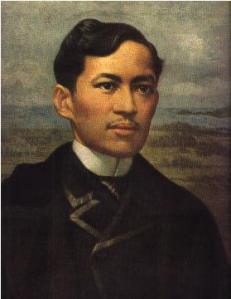
Jose Rizal (Museum of California History)
Noli Me Tangere exposed the hypocrisy of the Spanish clergy in the Philippines and the injustices committed against native Filipinos. And his follow-up non-fiction work demonstrated that contrary to 300 years of colonialist teachings the Filipino people had been an accomplished nation before the Spanish set foot in the country. That in fact, colonization had resulted in a ‘retrogression’.
In response to Noli Me Tangere, clergy members circulated pamplets warning Catholics that reading the novel was equivalent to “committing mortal sin.”
The book was banned in many parts, and one anonymous “Friar” wrote to Rizal, “How ungrateful you are…If you, or for that matter all your men, think you have a grievance, then challenge us and we shall pick up the gauntlet, for we are not cowards like you, which is not to say that a hidden hand will not put an end to your life.”
Rather than give in to harassment, Rizal followed it up with a sequel, El Filibusterismo. Rizal’s novels became a rallying point for nationalists in the Philippines. In Spain he continued to fight for equal rights and representation for his countrymen. Rizal returned to the Philippines in 1892. After a rebellion broke out, Rizal was arrested and sent into 4 years of exile.
While in exile in Dapitan he managed a hospital, provided services to the poor, taught language classes, and worked with soldiers to improve the area’s irrigation and agriculture.
In 1896 the Philippines Revolution broke out. Though Rizal emphasized non-violence in his works, he was again imprisoned, and this time sentenced to execution.
Just before his death, Rizal wrote his final poem, which he ‘smuggled’ out to his sister by hiding it in the stove in his cell. The poem has no title, but is often called “Mi ultimo adios”…My last good-bye.
“My idolized country, sorrow of my sorrows,
Beloved Filipinas, hear my last good-bye.
There I leave you all, my parents, my loves.
I’ll go where there are no slaves, hangmen nor oppressors,
Where faith doesn’t kill, where the one who reigns is God.”
–from Mi ultimo adios
He was executed by firing squad at 7:03 am on December 30, 1896, and buried without a coffin.
His tragic death only strengthened Filipino resolve for self-determination.
In April 1898, the fight for independence, led by Andres Bonifacio and Emilio Aguinaldo, received a boost from an unexpected party: the United States. The Spanish-American War, which had begun in Cuba, soon stretched to all of Spain’s remaining Pacific territories.
That summer the Philippines Army, headed by Aguinaldo, defeated Spanish troops, and handed over 15,000 Spanish prisoners to U.S. forces, along with valuable intelligence. Aguinaldo declared the Philippines an independent nation on June 12, 1898.
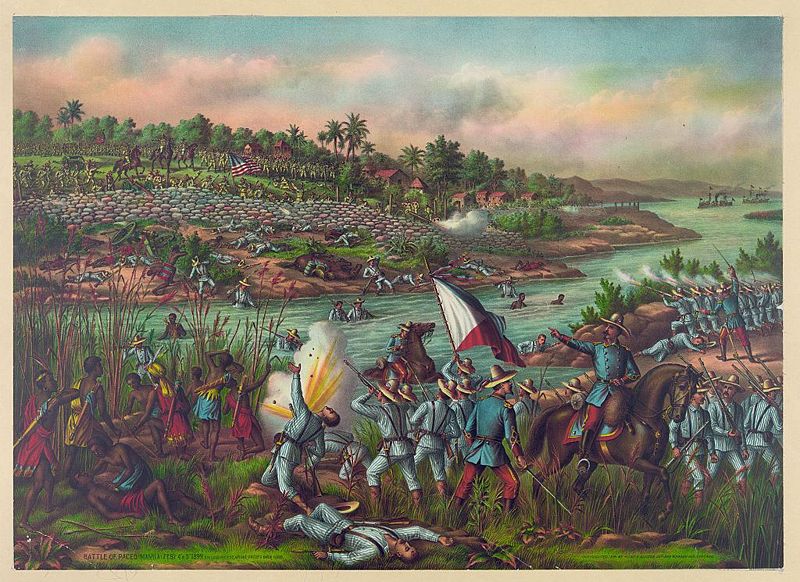
The Philippines soon found they had rid themselves of a demon only to make a deal with the devil. In defeat Spain ‘ceded’ the Philippines to the U.S., which immediately rejected Philippine independence. Whereas the Spanish had sought to bring Catholicism to the Philippines, the U.S. sought to bring “freedom” and “civilization”. The war that followed, the U.S.’s first overseas experiment in nation-building, took the lives of over a quarter million Filipinos (a low estimate), the overwhelming majority of them civilians. Disease and famine were a prime cause of civilian deaths. But torture, mass executions, internment camps, village-buring, and other atrocities against civilians were also staples of the war.
Battle of Paceo, Philippine-American War
The war officially ended in 1902, but fighting continued until 1913. English, spoken by a minority of Filipinos, was declared the official language.
The Philippines would not see independence until after World War II, fifty years after the death of Jose Rizal. Through that time and even to the present, Rizal and his writings continue to symbolize the Filipino spirit and their long fight for equality and self-determination.
Our Mother Tongue
The Tagalog language’s akin to Latin,
To English, Spanish, angelical tongue;
For God who knows how to look after us
This language He bestowed us upon.
As others, our language is the same
With alphabet and letters of its own,
It was lost because a storm did destroy
On the lake the bangka in years bygone.
December 28th and 29th are the 3rd and 4th days of Kwanzaa. The themes of these days are Ujima (Collective Work and Responsibility) and Ujamaa (Cooperative Economics). On the surface these do not sound like the general feel-good (or feel-bad) sentiments that accompany most holidays. For the record, other days of the celebration include themes such as Unity, Purpose, and Faith–themes more consistent with older holidays. Ujima and Ujamaa may be overshadowed by these more traditional holiday themes, but all are equally important.
Umoja, or Unity, is the first step, asking the community to recognize itself as a united group.
Kujchagulia, Self-determination, asks the African-American community to define itself and its future on its own terms rather than through the eyes of others.
Ujima and Ujamaa are the nuts and bolts of the operation. They require not just talk but actual tangible steps to achieve.
One man who did just that was Muhammad Nassardeen. His organization Recycling Black Dollars was an effort to keep the money of the African-American community within the community. White neighborhoods recycle dollars 5 times. Latino communities recycle dollars 3 times. And Asian-American communities as much as nine times. But Nassardeen found that the African-American community recycled the average dollar less than 1 time.
By creating and encouraging businesses and organizations, including local churches, to bank and buy within the Los Angeles African-American community Nassardeen helped to increase the wealth of the community substantially.
Unfortunately Nassardeen died in October 2007 of a heart attack. But his contributions to Cooperative Economics are remembered this Kwanzaa in the city where Kwanzaa first greeted the world.
Today former Prime Minister of Pakistan Benazir Bhutto was killed by a suicide attacker in Rawalpindi where she was attending a campaign rally. Bhutto was waving to the crowd from the sunroof of her vehicle after the rally when she was struck down by an attacker who fired shots and then set off an explosive devise. Over 20 spectators were killed.
As the government and press squabble over who was behind it and the cause of her death (by bullet, shrapnel, or by her hitting her head on the sun roof, as the government insists) and who was behind it, Zoroastrians remember the slaying of another leader.
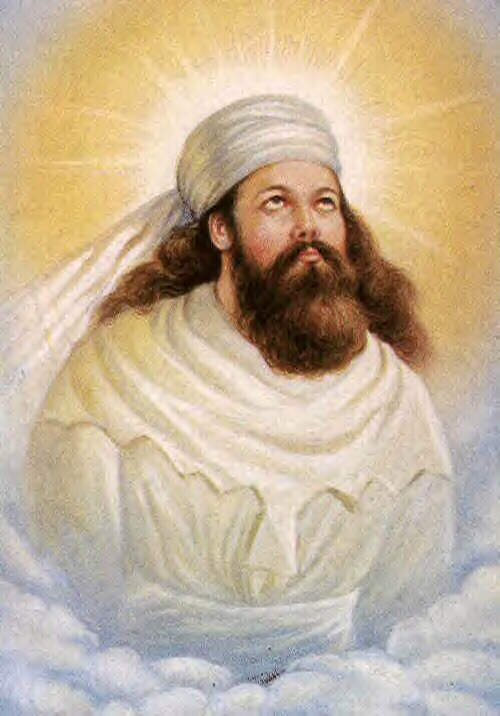
Zarathustra, the founder of Zoroastrianism, once the dominant religion of Persia, was killed just three hundred miles to the northwest in Balkh, Afghanistan.
Zarathustra, or Zoroaster as he was known to the Greeks, lived in the region of Iran and Afghanistan around 1100 BC.
He spread the idea of monotheism long before Muhammad, Buddha, or Jesus walked the earth. He may have even predated Moses.
His philosophies regarding the continuing struggle of good versus evil, and the judgment of humans at the end of their life, is thought to have inspired numerous religions including Judaism, Christianity, Islam, and Buddhism.
It is a common misconception that the Zoroastrians worship fire. They see fire and light as symbols of God. Zoroaster believed God–Ahura Mazda–communicated with humans through three things: Good Thoughts, Good Words, and Good Deeds. But that God gave man free will to decide whether to follow these three, or to give in to evil
Once the predominant religion of what is now Iran, Zoroastrianism is now practiced by a scant 200,000 or less people, mostly in Iran and India. Zoroastrians do not accept converts. One must be born into the religion, which is one of the reasons their numbers are scarce.
One famous twentieth-century Zoroastrian was Freddie Mercury, the voice and genius behind the rock group Queen, who wrote the famous Bohemian Rhapsody:
“Goodbye everybody, I’ve got to go
Gotta leave you all behind and face the truth…”
The West is familiar with Zarathustra mainly from a scattering of cultural references.
Frederich Neitzsche wrote Thus Spoke Zarathustra using a fictionalized version of the prophet who bears little resemblance to the actual man.
Richard Strauss then composed a majestic orchestral piece of the same name. This piece was then used by Stanley Kubrick in what has been called “the greatest movie opening ever” in “2001: A Space Odyssey.”
In the opening the moon, Earth, and sun align. The choice of music is appropriate as Zoroastrians were keen astronomers for their time, charting the movements of the sun, moon and stars. (Astrophysicist Grant Mathews believes the three wise men in the Bible who spotted the star of Bethlehem were actually Zoroastrians tracking an unusual alignment of the planets in 6BC.) However, the Zoroastrians do not believe in reincarnation, a theme suggested by the film’s end.
Similar to Benizar Bhutto, Zoroaster was struck down by an assassin while on the alter, according to the Shahnama–the massive 10th century national epic of Persia.
God makes three requests of his children: Do the best you can, where you are, with what you have now.
— African-American Proverb
Originally intended as an Afrocentric alternative to Western holidays in the United States, Kwanzaa is now celebrated by people of African heritage in Europe and the Caribbean as well as by millions in Africa itself. The term Kwanzaa comes from the Kiswahili phrase “ya kwanzaa” meaning “first fruits.” The name refers to the ageless African tradition of harvesting the first fruits of the season. According to afriqueonline.com, “Kwanzaa is a time of year for black people to come together to celebrate the fruits of our labor during the past year.”
Other names you might hear today:
Mishumaa saba: the seven candles.
Nia: purpose
And perhaps most important: Nguzo Saba.
Nguzo Saba means Seven Principles, or Seven Reasons. The week-long celebration of Kwanzaa emphasizes one of the seven principles each day.
Umoja – Unity – Dec. 26
Kujichagulia – Self-Determination – Dec. 27
Ujima – Collective Work and Responsibility – Dec. 28
Ujamaa – Cooperative Economics – Dec. 29
Nia – Purpose – Dec. 30
Kuumba – Creativity – Dec. 31
Imani – Faith – Jan. 1
The Nguzo Saba are the “minimum set of values African Americans need to rescue and reconstruct their lives in their own image and interest and build and sustain an Afrocentric family, community and culture.” — Kwanzaa founder Maulana Karenga
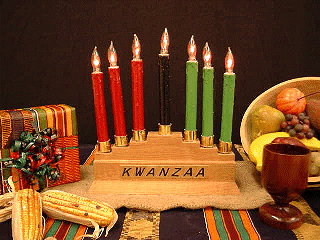
The Kinara (candleholder) symbolizes African ancestors; The Mishumaa Saba (7 candles) symbolize the 7 Principles
Umoja
On the first day of Kwanzaa African-Americans celebrate Umoja, or “unity”. It is the foundation of the seven Nguzo. Politicians often call upon “unity” as a slogan in the national arena, yet the concept of unity is overlooked within our communities and within the family.
Unity of the family is the building block of Umoja. It means unity of father and mother as role models for their children, and respect for one’s elders. Karenga notes that in many Western societies the elderly have been cast aside “leaving them with only failing memories.” African communities utilize the experience of their elders as judges and conflict resolvers. Their participation benefits both the society as a whole and the elders themselves.
A central purpose of Kwanzaa is to teach the younger generation about traditions that were passed down by Africans for countless generations, but were violently torn away during the slave trade and slavery. Marcus Garvey wrote:
A people without knowledge of their past history, origin and culture is like a tree without roots.
Umoja extends from family to community, from community to nation, and from nation to race. Applying the concept of umoja to the entire race is a difficult challenge. The African continent is home to over 50 nations. Each of these nations has not only its own ethnic identity, but several, often competing identities. And attempting to apply umoja to the entire continent and to all those descended from it is nothing less miraculous than uniting the entire planet.
But the principle of umoja is a practice as well as a principle. And the practice of umoja begins at home, one family at a time.
Tomorrow we celebrate the principle and the practice of Kujichagulia: Self-Determination…
“In London and other places, St. Stephen’s Day, or the 26th of December, is familiarly known as Boxing-day, from its being the occasion on which those annual guerdons known as Christmas-boxes are solicited and collected…
As a child I thought it odd that the British, so seemingly refined (compared to us their American cousins), would dedicate the day after Christmas to such a brutal and pugilistic sport. Yet there it was on the calendar: “Boxing Day – UK”.
Apparently the holiday has very little to do with the sport, but everything to do with gift-giving. And no, it’s not about boxing up all the gifts you don’t want so you can return them to the store either.
According to The Book of Days (1882)…
“The institution of Christmas-boxes is evidently akin to that of New-year’s gifts, and, like it, has descended to us from the times of the ancient Romans, who, at the season of the Saturnalia, practised universally the custom of giving and receiving presents. The fathers of the church denounced, on the ground of its pagan origin, the observance of such a usage by the Christians; but their anathemas had little practical effect, and in process of time, the custom of Christmas-boxes and New-year’s gifts, like others adopted from the heathen, attained the position of a universally recognised institution. The church herself has even got the credit of originating the practice of Christmas-boxes…
“…Christmas-boxes are still regularly expected by the postman, the lamplighter, the dustman, and generally by all those functionaries who render services to the public at large, without receiving payment therefor from any particular individual. There is also a very general custom at the Christmas season, of masters presenting their clerks, apprentices, and other employes, with little gifts, either in money or kind.
“St. Stephen’s Day, or the 26th of December, being the customary day for the claimants of Christmas-boxes going their rounds, it has received popularly the designation of Boxing-day.”
Boxing-night was a night of much joy and revelry. The Book of Days goes on to tell us that “the theatres are almost universally crowded to the ceiling on Boxing-night” as the pockets of the working class are stuffed with recently received year-end bonuses.
You can also find some packed pubs and bars on Boxing Day, as celebrants, having spent 24-48 hours with family, join their friends to bid a fond farewell to the Christmas season, if not the Christmas spirit.
[Of course , Boxing Day is actually only the second day of the twelve days of Christmas, so the season doesn’t technically end until Epiphany on January 6.]
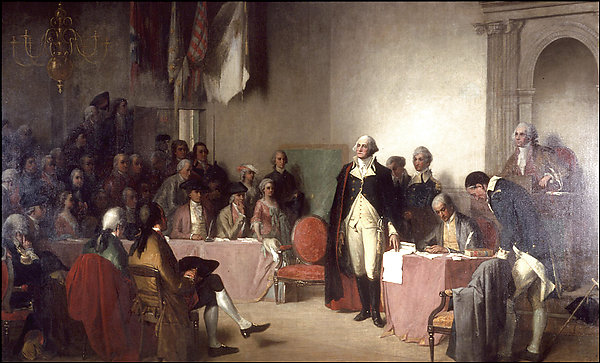
On this day in 1783, the most powerful man in the Western Hemisphere, the Commander-in-Chief of the Army of the United States who had achieved independence from Britain, the world’s strongest superpower, voluntarily surrendered his sword and his title to the Continental Congress in Annapolis, Maryland. He returned to his home in Mount Vernon, Virginia, expecting to live a quiet farm life.
His plans were derailed a few years later when he was elected to serve as President of the 1787 Constitutional Convention in Philadelphia.