Victory in Europe Day

May 8 (May 9 in Russia)

It’s been a while since the Europeans have really gone at each other, outside of a football match. Which is a good thing, because when they do go at it, they tend to bring the rest of the world with them.

Such was the case in 1939.

Following Germany’s invasion of Poland on September 1, 1939, Britain’s (and France’s) entry into the war on Poland’s behalf guaranteed that the Commonwealth would follow, including lands as distant as Canada, Australia, and India.

The territorial possessions of Britain, France, Germany, and Belgium in Africa ensured that the African continent too would become one vast battlefield.

And Germany’s alliance with Japan eventually drew the United States into the war in Asia and the Pacific. Even more than first, the second conflagration earned the title World War.

Australia recruitment poster, 1940

The tragedy of September 1, 1939 was matched only by the exuberance of May 8th, 1945. To this day, May 8th is remembered in much of Europe and the world as Victory Day, or Victory in Europe Day. [It was already May 9th in the Soviet Union by the time news of peace hit there.]

The Allies invaded German-occupied France on June 6, 1944, a date immortalized as D-Day. Paris was liberated on August 25 of that year. Allied forces pushed their way toward the German interior over the next seven months—the U.K., U.S., and France from the West, Russia from East. It wasn’t until April 30, 1945, with the Russians on the outskirts of Berlin, that the once-invincible Hitler committed suicide in a bunker in Berlin.

A week later, German General Alfred Jodl signed the “instrument of surrender”. The following day, May 8, the German government ratified the surrender, ending the brutal six-year war that had devastated Europe.
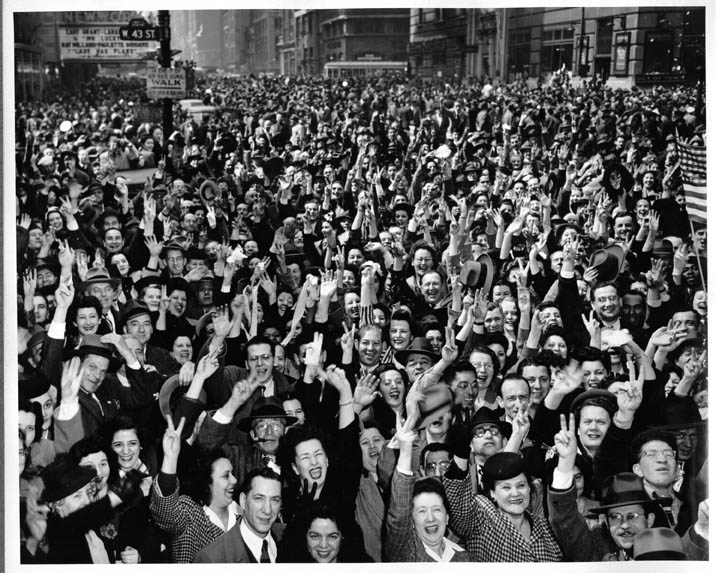
V-E Day, Times Square, New York City, May 8, 1945

British Prime Minister Winston Churchill addressed his people with the following…

“The German war is therefore at an end. After years of intense preparation, Germany hurled herself on Poland at the beginning of September, 1939; and, in pursuance of our guarantee to Poland and in agreement with the French Republic, Great Britain, the British Empire and Commonwealth of Nations, declared war upon this foul aggression. After gallant France had been struck down we, from this Island and from our united Empire, maintained the struggle single-handed for a whole year until we were joined by the military might of Soviet Russia, and later by the overwhelming power and resources of the United States of America.

“Finally almost the whole world was combined against the evil-doers, who are now prostrate before us. Our gratitude to our splendid Allies goes forth from all our hearts in this Island and throughout the British Empire.

“We may allow ourselves a brief period of rejoicing; but let us not forget for a moment the toil and efforts that lie ahead…”

Winston Churchill, May 8, 1945

Churchill was referring not to the reconstruction of Britain and Europe—a task that would take over a decade and consume resources on a scale never before seen—but to the continuing war with Japan.

The war in the Pacific only came to a close after the detonation of two atomic bombs on a civilian population.

In 1945: The War that Never Ended, Gregor Dallas writes that:

“I personally do not know a single Frenchman who can remember the day the war officially ended in Europe. But they all remember D-Day. And their parents remember—often with tears in their eyes—the day the Great War ended, 11 November 1918…Despite all the propaganda, most Frenchmen did not consider 1945 a ‘victory’…

Dallas suggests, that despite remembrances and images of V-E Day celebrations, for the average person, be they in France, England, the United States or elsewhere, May 8 passed much as other days. The end of the war was a series of events, and ‘Victory Day’ was not as a defining a moment as history recalls…

“For the vast majority of Europeans, all this talk about VE-Days’, ‘VJ-Days’ and ‘V-Days’ was a matter of argument for politicians and, later, historians. The ‘day the war ended’ was the day the bombing stopped, the fighting ended, a loved one came home; or the day one realized the people one most cherished would never be seen again…” (Dallas)

The Day the War Ended: May 8, 1945, by Martin Gilbert
World War II Chronicles: From D-Day to V-Day, by Julie Klam

V-E Day in Canada — CBC

DeGaulle’s V-E Day Speech to the French People

Radio Day – Russia

May 7

radio (adj.): (1) of, relating to, or operated by radiant energy; (2) of or relating to electric currents or phenomena (as electromagnetic radiation) of frequencies between about 3000 hertz and 300 gigahertz. — Webster’s Dictionary

I turn the switch and check the number
I leave it on when in bed I slumber
I hear the rhythms of the music
I buy the product and never use it
I hear the talking of the DJ
Can’t understand just what does he say?

— Wall of Voodoo, “Mexican Radio

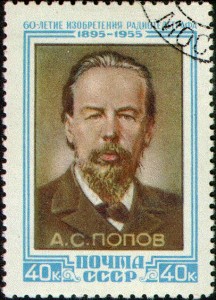
Alexander Popov (1859-1906)

In the 1940s and ’50s, the Soviet Union established May 7 as Radio, Television, and Communication Workers Day. Today the Russians know it as Radio Day, a commemoration of an event that occurred on May 7, 1895…

“It was on this date that [Alexander] Popov read a paper in the Physics Department of the Russian Physical and Chemical Society entitled, On the Relation of Metal Powders to Electric Oscillations.

“Alexander Popov: Inventor of Radio”, by M. Radovsky

Don’t you wish you could’ve been a fly on that wall?

Apparently, this was like being at opening night of Star Wars. Or maybe more akin to catching an Offspring concert back when they were playing coffee houses.

Either way, Popov’s demonstration of the practical application of electromagnetic signals at the Physics Department’s monthly meeting rocked the house, as evidenced by the official meeting minutes:

“A.S. Popov reported On the Relationship of Metal Powders to Electric Oscilliations… Utilizing the high sensitivity of metal powders to extremely weak electric oscillations, the speaker constructed an instrument designed to indicate rapid oscillations of atmospheric electricity.” — May 7, 1895

Say what you will, the Physics Department of the Russian Physical and Chemical Society knew how to party.

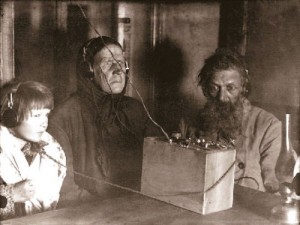
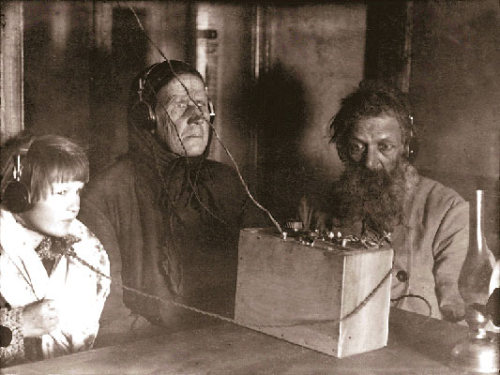
Russian family listens to early radio

+  +  +

In Russia, it is a well established fact that Popov invented the radio. That ‘fact’ is, shall we say, less established in the West, where inventors like Guglielmo Marconi and Nikola Tesla got the credit, and more importantly, the patents.

Ultimately, the creation and application of radio technology was made possible by the combined efforts of several scientists who each added vital pieces to the puzzle that would soon change the face of civilization. In 1898, Tesla showed off a radio-controlled boat in Madison Square Garden. In 1899, Marconi sent a wireless signal across the English Channel. Sir Oliver Lodge and Heinrich Hertz also made significant contributions. And in 1906 Reginald Fessenden conducted the first music/entertainment broadcast.

And, as they say, the rest was hysteria.

Just 16 years later, the New Republic predicted…

“There will be only one orchestra left on earth, giving nightly worldwide concerts; when all universities will be combined into one super-institution, conducting courses by radio for students in Zanzibar, Kamchatka and Oskaloose; when, instead of newspapers, trained orators will dictate the news of the world day and night, and the bedtime story will be told every evening from Paris to the sleepy children of a weary world; when every person will be instantly accessible day or night to all the bores he knows, and will know them all: when the last vestiges of privacy, solitude and contemplation will have vanished into limbo.”

— “The Ether Will Now Oblige” Bruce Bliven, The New Republic, Feb. 1922

Within a few decades of Popov’s first demonstration, parents were already complaining about kids’ brains rotting away from listening to too much radio.

A 1930’s New York Times article describes the general sentiment of an Atlantic City Teachers Association meeting…

“The task of teaching young radio listeners to discriminate and interpret is one of the new responsibilities thrust on the school room by radio’s increasing popularity among children, according to I. Keith Tyler…

“‘Boys and girls are now listening to the radio more than two hours a day,’ he said. ‘Their attitudes are being affected, their tastes altered and their understanding of life developed by this experience with the radio. We must develop their abilities to discriminate and interpret. Our loudspeakers pour out a withering barrage of political, economic, and social propoganda; a flood of verbose sales talk and great quatities of mediocre clap-trap.'” — New York Times, November 1938

So kids, the next time your parents complain about you wasting all your waking hours addicted to mindless drivel spewed by wireless devices, tell them their folks were doing it too! And bonus points for using the phrase “great qualities of mediocre clap-trap“.

As for the next wave of the future, a radio with moving pictures that premiered at the 1939 World’s Fair, the Times didn’t have high hopes for it:

“The problem with television is that people must sit and keep their eyes glued to the screen; the average American family hasn’t time for it. Therefore the showmen are convinced that for this reason, if no other, television will never be a serious competitor of broadcasting.” — New York Times editorial, 1939 [Futuring: the Exploration of the Future]

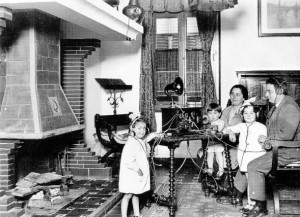
Spanish family listens to radio

Etymology:

The scientific breakthrough was originally known as “wireless telegraphy” and “wireless telephony”. Then “radio-telegraphy” and “radio-telephony”, referring to radiating energy (see definition above) like the prefix in radioactivity, and by 1906 the Telegraph Age reported:

“…the British post office…has adopted the word ‘radio’ as the designation for a wireless telegram.” — Telegraph Age, April 1906 (earlyradiohistory.us)

Indistinguishable From Magic – cityofsound.com

History of Radio — Who Invented the Radio?

Kentucky Derby

1st Saturday in May

…it’s a run for the roses
as fast as you can.
Your fate is delivered,
your moment’s at hand.
It’s the chance of a lifetime
in a lifetime of chance
And it’s high time you joined
in the dance.

Run For the Roses, Dan Fogelberg

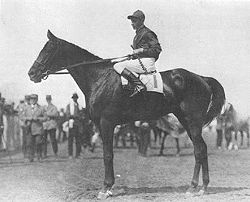
Exterminator, winner of the 1918 Kentucky Derby

On the first Saturday in May, the eyes of the country are on a bunch of three year olds. For roughly two minutes.

Since 1875 the Kentucky Derby has showcased the fastest three year-old thoroughbred horses in the country. The Bluegrass region of Kentucky became known for American horse breeding back in the 18th century. Meriwether Lewis Clark Jr. conceived of the race after witnessing the Derbies of England and France on a European tour in the 1860s.

The Kentucky Derby is the first of the races that make up the U.S. Triple Crown, the other two being the Preakness Stakes and the Belmont Stakes. Eleven horses have won all three races of the Triple Crown. The first was Sir Barton in 1919. The last was Affirmed in 1978.

The Derby is often called the “Run for the Roses” because the winner receives 554 roses, not to mention a hefty cash prize.

Only three horses have run the 2.5 km Kentucky Derby in under two minutes. The most recent was Monarchos in 2001 at 1:59.97. The previous sub-two minute finisher was Sham, who completed the 2.5 km race in 1:59 and 4/5s seconds. (They didn’t time the race to hundredths of a second back in 1973.) Despite being the second fastest horse in Kentucky Derby history, Sham didn’t win the race.

Sham was racing against Secretariat, the horse ranked by ESPN as one of the greatest athletes of the 20th century. 1973 was the year Secretariat set the Kentucky Derby record that still stands to this day: 1:59 and 2/5’s seconds, barely edging out Sham in a race considered by many fans to be the greatest in the history of the sport.

Amazingly, Secretariat started out the 99th Kentucky Derby dead last. In fact, for much of the race, you can’t even see him in the TV footage. But he made a move unparalleled in Triple Crown history. He ran each length of the race faster than the last, overcoming his challengers one by one until finally beating out Sham.

After the Kentucky Derby, Secretariat went on to win the Preakness Stakes and the Belmont Stakes, and hence the U.S. Triple Crown, breaking a record at Belmont (2:24) that also still stands, and is the fastest race time ever recorded for 1 & 1/2 miles on dirt. His margin of victory in the Belmont Stakes (31 lengths) remains the largest cushion in Grade 1 stakes history.

Every year Derby fans wait to see if someone will match or even break Secretariat’s record. It hasn’t happened in the past 35 years, but it’s led at least one site to proclaim:

THE #1 RULE OF HORSERACING: NEVER INSERT SECRETARIAT’S NAME IN THE SAME SENTENCE WITH THE DERBY WINNER UNTIL AT LEAST TWO MORE RACES HAVE BEEN RUN. —http://www.angelfire.com/ky/secretariatfan/

This year [2009] the favorite is I Want Revenge at 3:1.
Update: I Want Revenge was removed from the race this morning on account of a “hot spot” (suspected wound) on his leg. Apparently, revenge will have to wait.

published May 2, 2009

Day of Hıdırellez

May 6

Hidrellez

The Day of Hıdırellez (Ruz-ı Hızır) tip-toes across national borders, stretches its limbs across feuding religions, and dances from one culture to another borrowing steps from each it passes.

The ancient spring festival is celebrated from Turkey to the Balkans. The word Hıdırellez itself is a mixed-up amalgamation of the names of the two well-traveled yet elusive prophets it recalls: Hızır and Ilyas (Elijah).

Hızır (Al-Khidr) means, literally, “the green one.” No, he’s not green, but he represents the spring and summertime. Or more accurately, the season lasting from May 6 to November 8 known as Hızır günleri, or “days of Hızır.” Hızır watches over and protect his followers, and is responsible for the growth of crops. Pictured with a long white beard and large white turban…

Hızır walks the earth with more men than any other Moslem immortal…Hızır is the last-minute rescuer from disaster, a deus ex machina, when all other assistance, natural and supernatural, has failed.

Walker & Uysal, An Ancient God in Modern Turkey

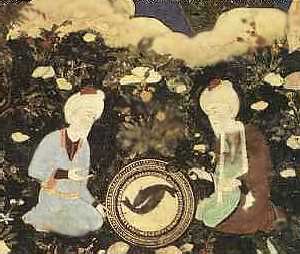
Hizir kicks it with Alexander the Great

The other season of the Turkish folk calendar lasts from November 8 to May 6. It’s called Kasım günleri, roughly “Days of November”. On May 6 Hızır reaches out his hand to grasp that of his colleague Ilyas, aka Elijah, a prophet from the Qur’an, the New Testament, and the Old Testament.

If you make a wish on Hıdırellez night…

“…it will come true if one just remains alert enough to glimpse the embrace of the star-Lords Hizir and Ilyas in the sky.

— G.W.Trompf

Before Islam, Christianity, and maybe even the Greeks, Hızır was an ancient pagan spring deity, symbolizing water and growth. He gained immortality by drinking of the Spring of Life.

In the Qur’an, Hızır guides the prophet Moses on his journey. He tells Moses he can come along, as long as Moses promises not to talk. After the duo make a safe passage on a friendly ship, Hizir damages the ship, making it unseaworthy. Moses breaks his promise and chastises Hizir for doing such a thing. Later, Hizir and Moses are denied shelter in a town. Leaving, Hizir pauses to mend a crack in the city wall. Again Moses breaks his promise, this time to chide Hizir for rewarding an enemy. Hizir explains his actions. Soon, he explains, there will be a war, and the king will conscript all seaworthy ships, which is why he temporarily damaged the good captain’s ship. As for the wall, he explains a good man hid his money in the wall before he died. Hizir mended the wall keep the treasure protected for the man’s orphan children.

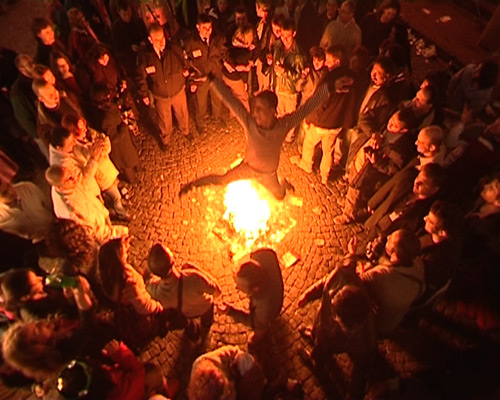
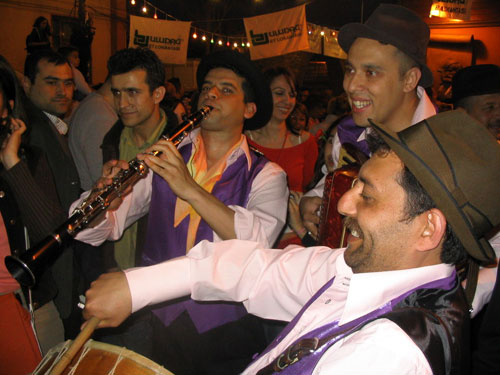
Hızır is the patron saint of travelers, which is why the Roma (Gypsies) revere him. It is they who helped to spread this spring festival from Anatolia to the Balkans (or vice-versa) and beyond. Today Hıdırellez is celebrated with plenty of live music, dancing, picnics and outdoor entertainment into the night.

“Jumping over a bonfire, something that is also seen during Nevruz celebrations, is significant in that fire is seen as a cleansing force, and so leaping over flames on Hıdırellez is also believed to be one way to wash away bad spirits and enter into the new season with a cleansed being.

— Julia Konmaz

Other traditions include the making of yogurt. And the “play of the wish.”

Everybody throws a sign into the pot holding water…sweet basil, mint, ‘mantuvar’ flower in addition to usually ring, earring, etc. The pot is covered with a cloth on the eve of Hıdırellez and placed under a rosewood.

The next day, girls stand by as one-by-one their items are drawn from the pot. Whichever song is sung when each girl’s item is removed, dictates what the year has in store for her. Song themes range anywhere from ‘love’ to ‘living abroad.’

So this Hıdırellez make a wish! And watch the skies…

Hızır Arrives with Drops from Heaven

Ahirkapi Hidirellez Festival

Cinco de Mayo

May 5

Today we celebrate Mexican Independence Day!

Wait, no. That’s September 16.

Today we celebrate the birthday of Benito Juarez!

Uh, no, that’s March 21.

Constitution Day?

February 5.

Revolution Day?

November 20.

Flag Day?

February 24.

So what the heck is Cinco de Mayo!?

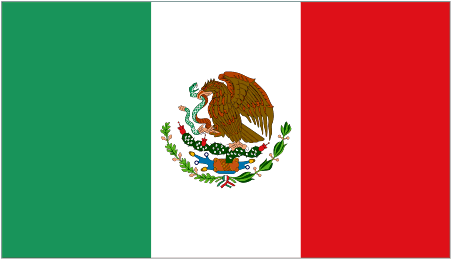
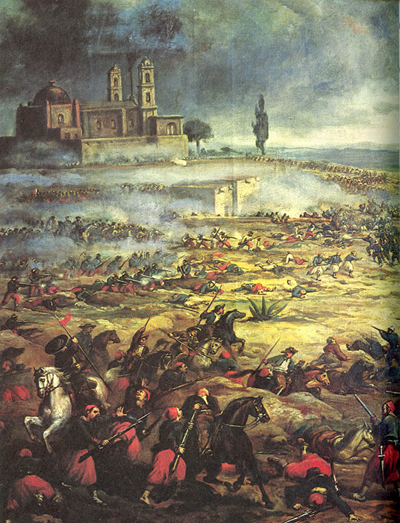
Cinco de Mayo commemorates the Mexican victory over French forces at the Battle of Puebla in 1862. Which is when Mexico kicked their French booty all the way back to Paris.

Actually, no. Though the French lost the battle, they conquered Mexico City a year later and installed a puppet dictatorship under this Austrian dude:

Maximilian I

So remind me, why on earth do we celebrate Cinco de Mayo like it’s the Mexican 4th of July?

Well, first of all, the Mexicans don’t. Only the Americans do, and the people of Puebla, Mexico. Mexican banks are open today, as are schools, government buildings and just about everything else. There are no ad campaign blitzes featuring Corona, and no parades outside of Puebla. The reason Cinco de Mayo is celebrated so vigorously in El Norte is one of North America’s greatest mysteries.

Though not strategically significant, the Battle of Puebla was a powerful symbolic victory for Mexico in the 1860s. The Mexican-American War in the 1840s and the Mexican Civil War a decade later bankrupted the country. To get Mexico back on its feet, President Benito Juarez declared a two-year moratorium on payment of foreign debts. Creditors England, Spain and France did not take the news well. They decided to get back their money the old-fashioned way: they invaded.

Juarez was able to reach agreements with Spain and England, which went on their merry way, but France had other plans. Napoleon III wanted to rule Mexico by proxy, perhaps to make up for that teensy land sale known as the Louisiana Purchase.

The overconfident French army set out for the Mexican capital assured of an easy victory. 6,500 well-trained French troops met up with under 4,500 ill-equipped Mexican troops under General Ignacio Zaragoza near the city of Puebla. The French were so certain of their success, they attacked Zaragoza’s forces at their strongest point. The result was catastrophic. Zaragoza’s troops suffered minimal losses while inflicting heavy casualties on the French, even chasing them in retreat.

The battle provided a much needed boost to Mexican patriotism and morale by proving that a nation still on training wheels could defeat a European power with one of the strongest armies in the world.

The victory was short lived. After hearing of Puebla, Napoleon III diverted almost 30,000 troops to Mexico. Maximilian entered Mexico City the following year and was crowned Emperor.

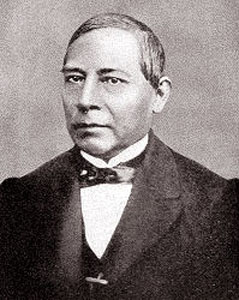
The reason the holiday is so important to Chicanos in the United States may be because the war against the French represented the first collaboration between Mexico and the U.S. since the Mexican-American War. Mexican-American societies from Texas to California supported their former homeland with volunteers, money, and supplies. The Vienna-born Emperor Maximilian was ousted in 1867, and Benito Juarez, the Zapateco Amerindian peasant-turned-priest-turned-lawyer-turned-President, became leader of Mexico once more. But that’s a story for another day.

Benito Juarez


Greenery Day – Japan

May 4

A small cloud has fallen
The white mist hits the ground
My lungs comfort me with joy.

Green Day, by Green Day

Ok, the above’s not a Japanese haiku, nor is about today’s holiday. (It bears more in common with one that takes place on 4/20) But today is “Midori no Hi”—literally Green Day, or Greenery Day. Midori means Green—hence the green, melon-based liqueur—and Hi means Day.

Greenery Day (Midori no Hi) originated from the celebration of the birthday of the late Emperor Hirohito, who reigned for most of the 20th century. In Japan, he’s known as the “Showa” Emperor. Showa means harmony, or enlightened peace, or the “search for balance between two different, often opposing elements”. (It is also a Japanese glove company.)

In Japan, the reigning Emperor’s birthday is a national holiday; after the Showa Emperor died in 1989, the Japanese people wanted to continue celebrating his birthday (April 29). They chose the name Greenery Day after the late Emperor’s love of nature. Between 1989 and 2006, Greenery Day was celebrated on April 29.

Beginning in 2007, the Japanese government renamed April 29 “Showa no Hi” (Showa Day) to formally honor the late Emperor, and moved Greenery Day to May 4.

Why May 4?

May 4 was already a holiday (and no we’re not talking about Star Wars Day). May 4 falls between two major holidays, Constitution Day and Children’s Day. And in Japan, any day that falls between two holidays is a holiday itself. [My kind of country. –Ed.] Besides, Greenery Day sounds better than Generic National Holiday.

Falling in the middle of Spring, Greenery Day is a time to commune with nature and enjoy the outdoors.

Showa Day, Constitution Day, Greenery Day, and Children’s Day make up what’s known as Golden Week in Japan. (Technically, Showa Day is an independent holiday, not part of Golden Week, but we’re not technical here.) Golden Week is one of, if not the biggest week for travel in the Japanese calendar. It makes American Thanksgiving look like a Wednesday in February. So if you’re traveling in Japan this week, hopefully you made all your arrangements in the Bronze Age.

Midori no Hi — Transparent Language Japanese blog

Showa Day holiday — hoofin.wordpress.com

Constitution Day – Japan & Poland

May 3

May 3 is Constitution Day in two countries on opposite sides of the globe.

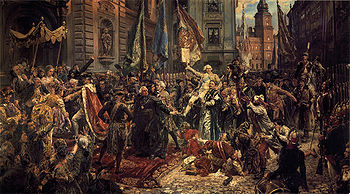
May 3 Constitution, by Jan Matejko, 1891

Poland’s most recent constitution dates only to 1997, but it stems from the Constitution of May 3, 1791, one of the oldest codified constitutions in the world. Only the Constitution of the United States is older. [The Constitution of San Marino dates to 1600, but apparently is not codified enough to compete with the big boys. — Ed.]

The 1997 Constitution was a response to Poland’s changing position in the world, from a one-party socialist state under the control of its powerful neighbor, the Soviet Union, to a multi-party independent state.

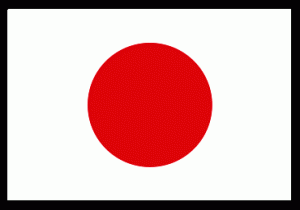
The Japanese Constitution was put into effect on May 3, 1947. Its creation dealt with Japan’s changing role in the world after World War II. The Constitution altered not only the government—a government in which the Emperor would have less say in matters of state—but also the Japanese way of life. The Constitution protects standard basic freedoms, such as freedom of speech, freedom of the press, and freedom of religion, but goes one step further. Article 19, for example, proclaims:

“Freedom of thought and conscience shall not be violated.”

One of the most long-reaching impacts of the Constitution is Article 9, which deals with the renunciation of warfare:

“Aspiring sincerely to an international peace based on justice and order, the Japanese people forever renounce war as a sovereign right of the nation and the threat or use of force as means of settling international disputes. In order to accomplish the aim of the preceding paragraph, land, sea, and air forces, as well as other war potential, will never be maintained. The right of belligerency of the state will not be recognized.”

So you’re probably thinking, No military? I could go over there with a dinghy and a BB gun and take over the country!

You would be met with a surprisingly powerful defense force. Japan still maintains its ability to defend its homeland, and…

“By 1990 estimates of Japan’s defense budget were that it was either the third or fourth largest in the world and Japan’s SDF was a high technology fighting force.”

The Rule of Law in Japan — Carl F. Goodman

Japan’s Constitution Day falls right in the middle of “Golden Week”, a congruence of four holidays, beginning with Showa Day (April 29) and ending with Children’s Day (May 5).

Japan’s Commission on the Constitution — the Final Report, 1980