Every day of the Catholic calendar honors at least one Saint.
But for all those Saints who just weren’t saintly enough to get their own day, there’s All Saints Day.
Okay, not exactly.
Medieval liturgists traced All Saints Day in the Catholic Church to the consecration of the Pantheon, originally a pagan temple built by Emperor Hadrian around 125 AD. The Pantheon honored the Roman, well, Pantheon (literally, “All Gods”.)
On May 13, 609 or 610, the Pantheon was consecrated by Pope Boniface IV in the name of the Virgin Mary and All Martyrs. The date, May 13, may harken back to the old festival Lemuralia, during which Romans remembered the dead and cast out restless spirits.
In the 730s Pope Gregory III dedicated a chapel at St. Peters Basilica on November 1 and declared it an annual holy day. The chapel housed the relics “of the holy apostles and of all saints, martyrs and confessors, of all the just made perfect who are at rest throughout the world.”
St. Peters Basilica is believed to be the burial place of Saint Peter himself. This, the most famous place of worship in Christendom was built beside the “Circus” of Caligula, where the Emperor Nero organized mass executions of Christians beginning in 65 AD.
St. Peter was crucified there (upside-down) at the site in 67 AD. Today the Vatican City’s Colonnade surrounds what was once the notorious Circus, its center marked by an enormous Obelisk brought to Rome after the conquest of Egypt.
Some historians attribute the November 1 date to the church’s desire to supplant regional harvest festival holidays devoted to the dead, such as the Celtic Samhain.
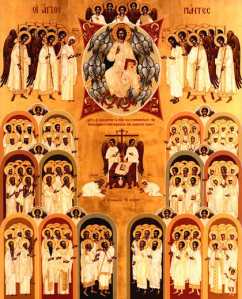
Today All Saints Day glorifies the memory of those souls, known and unknown, who have found a place in heaven.
For all those stuck in Purgatory, there’s All Souls Day…
Pagan: “a follower of a rustic or provincial religion”
from the Latin pagus, meaning a rural district.
The word “pagan” goes all the way back to the Greek root pagos meaning “that which is fixed”. “Fixed” as in “staying in position”, not like, your dog.
After crossing the Adriatic, the Romans used the word pagus to refer to a rural district. Pagan came to mean “country-dweller”.
Under Constantine, Christianity was not only tolerated, the religion replaced paganism throughout the Empire, with a top-down implementation. [For a more scholarly discussion, see the deleted “Storm” scene from X-Men 1.]
Long after Europe had converted to Christianity, some country-dwellers continued to worship their local and regional deities and observe the seasonal rituals of their ancestors to ensure prosperous harvests. Eventually the name for country-dweller became synonymous for followers of the old religions.
+ + +
What makes Halloween so special among American holidays is that it appears to harken back to its pagan roots without the veneer of a Christian holiday, like Easter and Christmas. While Celtic and Germanic traditions such as Walpurgis Night (Witches Night) and Beltane (May Day) have all but died out, Halloween is among the most widely celebrated holidays in the U.S.
And while several national holidays (such as Memorial Day, St. Patrick’s Day, and Labor Day) are celebrated with parades, sports events, or barbecues, Halloween has several holiday-specific traditions that are celebrated at no other time of the year. This puts it in a small class of holidays that include Christmas, Easter, Thanksgiving, New Year’s, and Independence Day. Yet unlike the above holidays, Halloween is not recognized by the U.S. government. Nobody gets the day off. And still Halloween captivates the country at large and is becoming increasingly popular in Europe. This may be why Halloween has been singled out as contrary to the teachings of Christianity by some sects.
In truth, the holiday owes as much to traditions picked up during the celebrations of the ‘All Saint’s Day’ as to its pagan past. An observer of the Celtic holiday Samhain would hardly recognize the holiday today. Samhain was a cross-quarter day (directly between the equinox and solstice) when the Celts would practice acts of divination—predicting the future.
Some historians believe it was also a day to commemorate the dead, which is why the Pope moved All Saints’ Day–originally May 13–to November 1 to compete with the age-old local pagan traditions.
German and Irish immigrants brought their harvest traditions with them to America in the 19th century, such as the good old pagan bonfire on All Hallow’s Eve.
Hallowe’en masquerade parties were fashionable in Victorian America at the end of the 19th century. By the 20th century, the holiday belonged to the kids.
Which came first, the trick or the treat?
The British tradition of playing pranks on one’s neighbors on the night before Guy Fawkes Day (instituted 1606) traversed the Atlantic, taking hold on All Hallow’s Eve. On the nights leading up to All Soul’s Day, youths would take gates off their hinges, soap up neighbors’ windows, and create all-around havoc and mischief. (Now October 30 is known as Mischief Night). Today kids are much less prone to pull pranks on Halloween, but are more than happy to receive their sugar-coated pay-off.
Halloween is at once a caricature of traditions of rustic peoples, as seen through the eyes of their former enemies, and a wholly unique celebration, that has picked up its own imagery and rituals throughout the centuries.
October 28, 2010 marks the 1698th anniversary of the Battle of Milvian Bridge, a battle of two Emperors that changed the course of history.
Maxentius and Constantine were brothers-in-law, both had valid claims to the throne thanks to Diocletian’s division of the Empire in 306, and both their fathers had been previous Emperors. In fact, Maxentius’s father had committed suicide after a failed rebellion against Constantine.
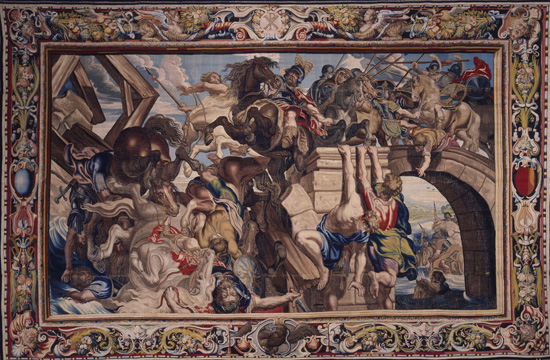
In 312 A.D. Maxentius held Rome; Constantine held the north. Hearing of Maxentius’s claim, Constantine gathered his army and headed south, encountering Maxentius’s troops at the Milvian Bridge just outside Rome. The actual Milvian bridge was not functional, perhaps purposefully destroyed by Maxentius in preparation for the expected attack. But Maxentius made a grave tactical error. He used a makeshift pontoon bridge to transport his troops to the other side of the Tiber, and placed them too close to the riverbank.
Battle of the Milvian Bridge
Constantine, a 40 year-old veteran of campaigns against the Franks and Gauls, forced Maxentius’s army against the river, allowing them only one means of escape: the bridge. During the retreat, the bridge collapsed, and the portion of Maxentius’s troops stranded on the north side were slaughtered or taken prisoner.
Maxentius supposedly drown in the river. His body was found, decapitated, and paraded through Rome the following day.
It is said Constantine had a vision the night before of the sign of the cross, and the words “In this sign, you shall conquer.”
Constantine’s victory over Maxentius was later seen as a victory of the Christian god over the Roman pagan deities. Constantine became the first Christian Emperor, reversed the ruthless persecution of Christians that had dominated the reign of Diocletian, and implemented a policy of religious tolerance throughout the Empire.
Though not an official holiday, many Christian sects observe the anniversary of Milvian Bridge on October 28 in memory of the historic turning point of early Christianity.
“Since the light of intelligence (Varhamana Mahavira) is gone,
let us make an illumination of the material matter.”
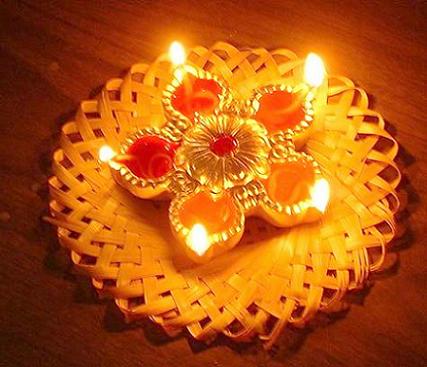
On the darkest evening in the month of Ashvin (October/November), Hindus around the world fill the night with candles, lamps and firecrackers to celebrate the Festival of Lights known as Diwali.
Diwali, or Deepavali, means literally, a row of lamps. Deep meaning lamp or light, avali meaning array.)
These lights are ubiquitous during Diwali, symbolizing the victory of Inner Light over Darkness.
The third and most auspicious day of the five-day celebration falls on the new moon of the month of Ashvin.
The legends that different regions cite as the origin of Diwali are too various to recount them all.
In the north of India, Hindus celebrate Diwali as the return of the ancient King Rama to his home in Ayodhya after 14 years in exile. The Prince Rama had been forced into exile by his stepmother, Queen Keykayee, who wanted her own son to inherit the throne.
In exile, Rama’s wife Sita was abducted by the ten-headed demon Ravana, who took her back to his kingdom in Sri Lanka. Rama built a bridge from the tip of India to Sri Lanka, slayed Ravana, and returned with his wife to their homeland. The people of Ayodhya were so anxious for his return, lamps were lit all across the nation to welcome him home.
In the South, Hindus recall the defeat of the powerful Narakasura by Lord Krishna and his wife Sathyabhama, as recorded in the Puranas.
Diwali is associated with the rice harvest. One of the most popular Diwali treats is a pounded semi-cooked rice dish known as Poha.
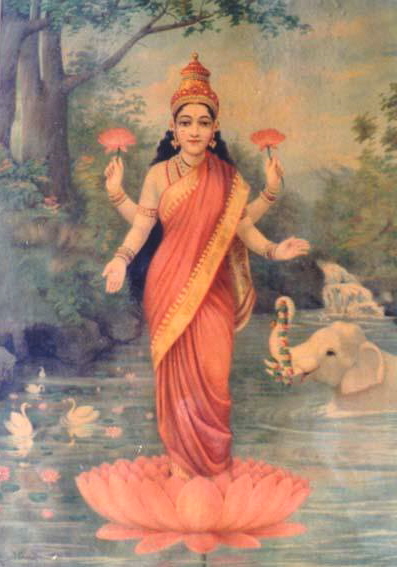
The second and third days are traditional times to invoke the goddess Lakshmi, Vishnu’s consort and the goddess of light, beauty, and prosperity. Women sweep and clean the house to allow Lakshmi a clear path of access. One staple of Diwali is the lighting of firecrackers, but Hindus are careful not to do so during aarti, (ie. invoking the goddess). For Lakshmi prefers tranquility and peace, so a small bell works better than the a loud clap preferred by other gods.
Lakshmi, Goddess of Good Fortune
Diwali is considered the New Year and one of the holiest days in the Jain religion. It’s known as Maharvira Nirvana, in honor of the moment the great Mahavira reached Nirvana at age 71.
Celebrants take ritual oil-baths during the festival, symbolic of the cleansing of the soul, in the hopes of a prosperous new year.
“…On this day of Dipavali we worship the Supreme God who is the source of all conceivable virtues, goodness and prosperity, which is symbolised in illumination, lighting and worship in the form of Arati and gay joyous attitude and feeling in every respect.”
The Torah is comprised of the first five books of the Bible, also known as the Pentateuch. Portions are read in the synagogue throughout the year, from the first chapter of Genesis (“In the beginning, God created the heavens and the earth”) to the last chapter of Deuteronomy (“The Death of Moses”).
Genesis
In Hebrew it’s called Bereshit, or “In the Beginning.”
Genesis is the “fun” book. Nearly all the Sunday school stories of the Torah hail from Genesis. This includes Adam and Eve, Noah, Abraham (the patriarch of Islam, Judaism, and Christianity) and Abe’s male line: his son Isaac, grandson Jacob, and great-grandson Joseph (the one with the amazing technicolor dreamcoat, if you’re into that kind of thing.)
Exodus
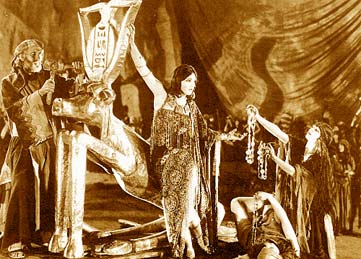
In Hebrew it’s Shemot, or “Names.” But the Greeks added some pizzaz. The Exodus tells the story of Charlton Heston, or “Moses”, in Egypt. It includes the Ten Plagues, the parting of the Red Sea, and the Ten Commandments, which God gave Moses to civilize the ancient Hebrews when they were cow-worshippers in the desert. (And which Cecil B. DeMille reintroduced to Americans when they were flappers in ’20s.)
DeMille's "Ten Commandments", 1923 version
Leviticus
The Levites were one of the twelve tribes of Israel, descended from Jacob. In Hebrew the book is Viyakra, “He Called”.
If you’ve ever read the Bible cover to cover (you have way too much free time on your hands, and) you know that Leviticus is where it starts to get wild, if not repetitive. Here, God gives one of his many gentle yet firm encouragements to follow his commands:
27 ” ‘If in spite of this you still do not listen to me but continue to be hostile toward me, 28 then in my anger I will be hostile toward you, and I myself will punish you for your sins seven times over. 29 You will eat the flesh of your sons and the flesh of your daughters. 30 I will destroy your high places, cut down your incense altars and pile your dead bodies on the lifeless forms of your idols, and I will abhor you. 31 I will turn your cities into ruins and lay waste your sanctuaries, and I will take no delight in the pleasing aroma of your offerings. 32 I will lay waste the land, so that your enemies who live there will be appalled. 33 I will scatter you among the nations and will draw out my sword and pursue you. Your land will be laid waste, and your cities will lie in ruins.
Leviticus 26
Leviticus also the book that gives us the legal precedent behind California Propositions:
Thou shall not lie with a man as thou lies with a woman.
Leviticus 18:22
Numbers
In the Hebrew: Bamidbar, “In the Wilderness…”
Don’t let the Hebrew fool you. The name “Numbers” is more representative of how exciting it is. Numbers contains detailed census information about the twelve tribes during the forty years in the desert. But Numbers is also the source of alien-conspiracy theories since time immemorial:
15 On the day the tabernacle, the Tent of the Testimony, was set up, the cloud covered it. From evening till morning the cloud above the tabernacle looked like fire… 17 Whenever the cloud lifted from above the Tent, the Israelites set out; wherever the cloud settled, the Israelites encamped… 21 Whether by day or by night, whenever the cloud lifted, they set out. 22 Whether the cloud stayed over the tabernacle for two days or a month or a year, the Israelites would remain in camp and not set out.
Numbers 9:15
Deuteronomy
Finally we get to Deuteronomy, or “Second Law.” A look back on the Laws of Moses before his death. In Hebrew it’s Devarim: “Things.”
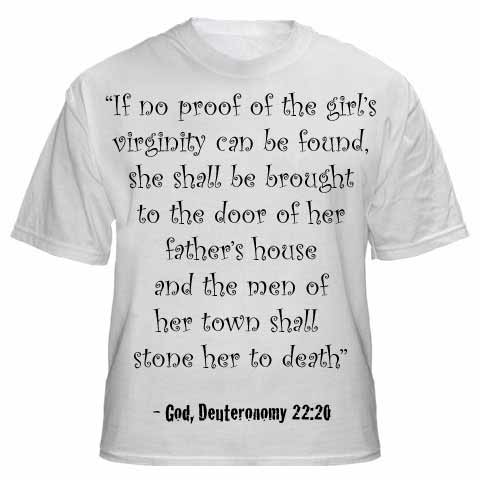
Although t-shirts today proudly proclaim the wisdom of Leviticus 18:22, fewer espouse the need to follow to the letter of the law Deuteronomy 22:
13 If a man takes a wife and, after lying with her, dislikes her 14 and slanders her and gives her a bad name, saying, “I married this woman, but when I approached her, I did not find proof of her virginity,” 15 then the girl’s father and mother shall bring proof that she was a virgin to the town elders at the gate… Then her parents shall display the cloth before the elders of the town, 18 and the elders shall take the man and punish him. 19 They shall fine him a hundred shekels of silver…
20 If, however, the charge is true and no proof of the girl’s virginity can be found, 21 she shall be brought to the door of her father’s house and there the men of her town shall stone her to death…
Although that would make a catchy t-shirt!
All told, the Hebrew Bible contains not ten but 613 Commandments. That’s right, Christians have it easy. Try remembering all these puppies.
Deuteronomy and the Torah end with the death of Moses, Judaism’s greatest prophet.
No one has ever shown the mighty power or performed the awesome deeds that Moses did in the sight of all Israel.
Today followers of the Baha’i Faith celebrate the Birth of the Báb, the Faith’s founder and one its two great modern Prophets.
Báb means “The Gate”. The Báb was born on October 20, 1819, and no, he wasn’t born “The Báb.” He was born Siyyad Muhammad Ali in Shiraz, Persia, and was raised by his uncle after his father’s death. He worked in the family trading house.
Around the time of his birth, a movement developed among the dominant group of Shi’a Muslims known as Twelvers. Twelvers live by the Qur’an and Muhammad’s teachings as do all Muslims. But they also follow the teachings of the eleven great Imams, successors of Muhammad, beginning with Ali ibn Abu Talib (600-661 C.E.) and ending with Hassan ibn Ali (846-874 C.E.)
So why are they Twelvers if there are only 11 Imams?
The Twelfth Imam was the son of Hassan ibn Ali. He was about 4 years old at the time of his father’s death in the 9th century. Twelvers believe the boy was taken into hiding at that time, and would return when the time is right to save mankind. He is known as the Qa’im, the Shi’a Messiah.
The Báb grew up at a time when Shi’a clerics were preaching about the Qa’im’s imminent return to Persia.
Unlike Christianity’s Jesus, little is known about the circumstances of the Báb’s birth. But we do know that on May 23, 1844, at age 24, he first made his divinity known to a Twelver named Mulla Husayn in what is celebrated by followers of the Baha’i Faith as The Declaration of the Báb.
“If in coming face to face with God we accept Him in our lives, then we are converting. We become a better Hindu, a better Muslim, a better Catholic, a better whatever we are…
“What approach would I use? For me, naturally, it would be a Catholic one…What God is in your mind you must accept. But I cannot prevent myself from trying to give you what I have…”
Mother Teresa
Agnes Gonxha Bojaxhiu was born in Skopje, Albania (now Macedonia) between the Ilinden anti-Ottoman Uprising and the outbreak of the First World War.
At age 8, her father died. At 18, she moved to Ireland to join the Sisters of Loreto, with whom she began her monastic training in India the following year. Agnes chose the name Teresa, after Teresa of France, the patron saint of missionaries who died in 1897 at age 24.
Sister Teresa taught students at the Loreto convent school in Calcutta for several years. On September 10, 1946, on her annual retreat to Darjeeling, she felt the call of God, telling her to work not within the confines of the school, but among the sick and poor of the streets.
She exchanged her convent habit for a simple cotton chira, became an Indian citizen, and continued to help the poorest of the poor for nearly 50 years. She established the Missionaries of Charity in 1950 to help “the hungry, the naked, the homeless, the crippled, the blind, the lepers, all those people who feel unwanted, unloved, uncared for throughout society…”
The Missionaries currently operate over 600 missions in 123 countries.
I don’t think there is anyone else who needs God’s help and grace more than I do…I need His help twenty-four hours a day. And if days were longer, I would need even more of it.
Mother Teresa
Today, Mother Teresa’s homeland of Albania honors her with a national holiday. October 19 is the anniversary of the day in 2003 that she was beatified by the Vatican.
“Christ will not ask how much we did but how much love we put into what we did.”
Mother Teresa
“Do not imagine that love to be true must be extraordinary. No, what we need in our love is the continuity to love the One we love.”
In the month of Tishri, Jewish holidays go from one extreme to the other. The month begins with the spirited Rosh Hashanah (Jewish New Year) to Yom Kippur (Day of Atonement), the most solemn fasting day in the Hebrew calendar. But on the 15th of the Tishri, celebrants are encouraged to eat, drink and be merry for Sukkot, the Feast of the Tabernacles.
Sukkah means ‘booth’ or ‘hut’. It refers to a temporary shelter like the kind the ancient Hebrews built during their 40 years wandering the desert. The festival of Sukkot lasts for seven days.
“Beginning with the fifteenth day of the seventh month, after you have gathered the crops of the land, celebrate the festival to the Lord for seven days…On the first day you are to take choice fruit from the trees, and palm fronds, leafy branches and poplars, and rejoice before the Lord your God…This is to be a lasting ordinance for the generations to come…Live in booths for seven days…so your descendants will know that I had the Israelites live in booths when I brought them out of Egypt.”
There are all sorts of rules describing how to make one. For instance, you need to be able to see the stars from inside. We tried finding a Sukkah on Shopzilla, but all we got was this.
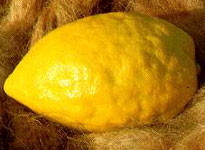
One of the main traditions of Sukkot is the waving of the ‘Four Species’; two branches (myrtle and willow), a palm frond, and an etrog (a type of lemon). The four elements of nature are bundled together and waved as shown here.
Many Americans, upon seeing a decorated sukkah for the first time, remark on how much the sukkah (and the holiday generally) reminds them of Thanksgiving. This may not be entirely coincidental…The pilgrims were deeply religious people. When they were trying to find a way to express their thanks for their survival and for the harvest, they looked to the Bible for an appropriate way of celebrating and found Sukkot.