Happy (Old) New Year!

January 14

Happy New Year!

It’s January 1 in the Orthodox Calendar, observed by Orthodox Churches in Russia, Macedonia, Serbia, and many of the former Soviet Republics, including Ukraine, Armenia, Belarus, and the one that’s all consonants. (Kryrrrgyztyrgystan)

So is Russia two weeks behind the times? Do they feel the need to have the last word on New Year’s Eve parties? Or does being torn between two New Year’s dates simply give them the chance to party for two full weeks?…(which the Russian winter could definitely use.)

Russian New Year

The story goes that up until the late tenth century, much of Russia and Byzantium celebrated the New Year during the spring equinox. That changed in 988 AD when Basil the “Bulgar-slayer” Porphyrogenitus* introduced the Byzantine Calendar to the Eastern Roman Empire.

Basil II
Basil II

The Byzantine Calendar was like the Julian Calendar except it began on September 1, and its “Year One” was 5509 BC—the year historians calculated as the creation of the world (Anno Mundi) according to genealogies of the Bible, from Adam to Jesus.

It took roughly four centuries for the “September 1st” New Year to make its way into the heart of Russia. And just when the Russians were getting used to that, Peter the Great switched to the Julian Calendar, moving New Year’s to January 1 in 1700 AD.

It was only a matter of 50 years until all of Protestant Europe stopped using the Julian Calendar altogether, in favor of the Catholic Europe’s Gregorian Calendar, leaving Russia and the Orthodox Church out in the cold.

So for the next two-hundred years, even though Russia celebrated New Year’s on January 1st according to their calendar, their entire calendar was about 11-13 days behind the rest of the West. (Which is why the Russian October Revolution took place in November.)

It wasn’t until 1918 that Lenin finally moved Russia to the Gregorian calendar.

But the Soviet Union couldn’t let sleeping dogs lie. During the 1930s they declared war on the number 7, dividing months into five six-day weeks. Fortunately, this decade-long practical joke on the Russian people ended in June 1940.
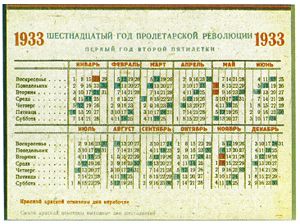
Soviet Calendar of 1933

These days, when it comes to the Old Calendar vs. the New Calendar, the Russians have tossed aside their austere ways and say, “Why choose? Have both!”

Most New Year celebrations happen on December 31st, but the holiday season continues until January 14. It’s a day of nostalgia, called Old New Year, a more sedate version of New New Year, often spent with family and watching the 1975 classic “Irony of Fate”, the Russian “It’s a Wonderful Life.”

"Irony of Fate" poster

Julian Day

Today we also celebrate day 2,454,846 in the Julian Day system—the number of days that have passed since noon, Greenwich Mean Time, January 1, 4713 BC. The Julian Day system was developed by Joseph Scalizer in 1582, and is used mainly by astronomers and people with way too much time on their hands.

*Basil’s title Porphyrogenitus means “born in the purple”. The title was bestowed at birth upon children who were (1) born to a reigning Emperor and Empress of the Byzantine Empire, and (2) born in the free-standing Porphyry (purple) Chamber in the Great Palace of Constantinople. (That’s why there’s less Porphygenituses than Smiths.)
Russian New Year

Happy Old New Year

Russian Orthodox Calendar

Arba’een – Iraq

Date varies. January 14, 2012

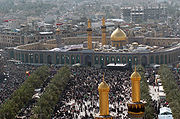
Shia Muslims finish the trek to Hussein Mosque in Karbala

This week an estimated 9 million people gathered in the city of Karbala to remember the death of Imam Hussein, grandson of the Prophet Muhammad and one of the holiest figures of Islam since its founder.

Forty days ago Shiite Muslims began a period of remembrance for the third Imam, who was killed in the Battle of Karbala in 680 CE.

After being released from captivity, surviving followers of Imam Hussein

“headed towards Karbala so that they could revisit the graves of their loved ones and bury the heads of the Martyrs with the bodies. They arrived at the site of the graves and the battle of Karbala on the twentieth of Safar, or forty days after the martyrdom of Imam Hussein and his followers.”
http://www.shirazi.org.uk/ashura.htm

Arba’een means 40. It’s a sacred length of time in Islam.

The Qu’ran recalls the story Moses (Musa) and his forty nights away from the people to hear the word of God. [2:51]  Muhammad said,

“Whoever dedicates himself to God for forty days, will find springs of wisdom sprout out of his heart and flow on his tongue.”

The holiday this year appears to be remarkably free of violence, considering the 9 million visitors that streamed from all parts of the country. In 2004 simultaneous bombings targeted pilgrims observing Arba’een; the attacks killed 170.

“I came to Karbala with my family and children after walking for 12 days,” says one pilgrim from Basra, “We were not afraid of terrorists…We have been taking risks and if we die we will be martyrs.”

Karbala Crowded With 9 Million Pilgrims
Why 40 Days of Mourning Arbaeen of Iman Hussein?

Maghi – Festival of the 40 Immortals – Sikhism

January 13

sikh

Over three hundred years ago the tenth and last (human) Guru of the Sikhs led his army in an historic battle against the Mughal Emperor.

But today’s holiday, Maghi Mela, actually honors the 40 followers who deserted the Guru before the fight.

At the Battle of Anandpur, Guru Gobind Singh’s men were besieged by the Mughal army. The Mughal Empire covered over 3 million square kilometers and had a population of over 120 million people.

Forty of the Guru’s men deserted him at Anandpur. Guru Gobind Singh had to retreat from Anandpur and most of his army was destroyed in the attack that followed.

When the 40 deserters returned home, their wives and families shunned them for desertion. Ashamed, the men–led by warrior woman Mai Bhago–decided to set back out to join their badly-outnumbered Guru, now in Khidrana Ki Dhab.

As the Mughal army approached Gobind Singh’s camp, they encountered the 40 former deserters. In the Battle of Muktsar all 40 warriors were killed, but the Mughal army met such heavy casualties they were forced to retreat.

Guru Gobind Singh

Guru Gobind Singh post-humously forgave the former deserters and granted them eternal Chali Mukte–liberation from the cycle of death and rebirth and all human suffering. The site became known as Muktsar, the “tank of salvation.”

The Guru died less than three years later, but outlived his nemesis, the Sultan Aurangzeb. Aurangzeb had beheaded Gobind Singh’s father, the previous Guru, 30 years earlier for refusing to convert to Islam.

Both Gobind Singh and Aurangzeb were the last of their kinds.

The Mughal Empire declined after Aurangzeb’s death. He had ruled for half a century and was considered the last great Mughal ruler. He was succeeded by Bahadur Shah I, who reached a brief alliance with the Gobind Singh before the Guru’s death.

Guru Gobind Singh meanwhile declared that he would be succeeded not by a person, but by the Sikh holy book, Guru Granth Sahib, the writings of the ten Gurus of Sikhism. By taking the revolutionary step, Gobind Singh made the Guru immortal. Henceforth Sikhism could be guided by eternal principles instead of dependent on a mortal leader.

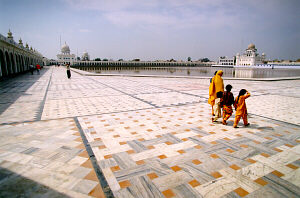
The site of the famous battle at Muktsar is now the centerpoint of Maghi Mela, the January 13 remembrance of the 40 Immortals.

Muktsar, site of the famous battle

In the 20th century the Sikh people have faced new, yet similar challenges. According to a 1994 study the Sikh people only make up less than 2% of the Indian population but account for 20% of the Indian Army’s officers, and 10-15% of all ranks.

Yet in 1984 a controversial Indian military operation, code-named Bluestar, killed the Sikh extremist leader Jarnail Singh Bhindranwale and hundreds of his followers, who had declared an independent Sikh state. In retaliation two of Prime Minister Indira Gandhi’s Sikh bodyguards assassinated her. This in turn led to the Anti-Sikh Riots which killed 3,000 Sikhs in New Delhi alone.

In North America Sikhs have been mistaken for Muslims because of their tradition dress, turban, and beards, in the wake of the 9/11 attacks. Four days after 9/11 a Sikh gas station owner in Mesa, Arizona (Balbir Singh Sodhi) was gunned down as he helped a landscaper plant flowers around his Chevron station. The racist murderer claimed to have killed Sodhi because of his turban “in retaliation” for the attacks.

http://www.mrsikhnet.com/index.php/tag/sikh-stories/

http://www.sikhs.org/gurdwaras/guru10-22a.htm

Carmenta – Roman Sex Goddess

January 11

If you’re like everyone I know, you had a baby this Fall.

But if you (or your loved one) are still expecting, you might want to give a shout out to Carmenta today, the Roman Goddess of Prophecy, Protectress of women in childbirth, and an early symbol of women’s lib.

Today marks the first day of Carmentalia, the Roman festival in her honor, observed by the women of ancient Rome.

This corresponds in name to the Latin Carmenta or Carmentis, of whom Preller says: The Goddess of Birth, Carmenta, was so zealously worshipped near the Porta Carmentalis, which was named from her, that there was a Flamen Carmentalis, and two calendar days, the eleventh and fifteenth of January, called the Carmentalia, devoted to her worship. These were among the most distinguished festivals of the Roman matrons. Etruscan Roman Remains<

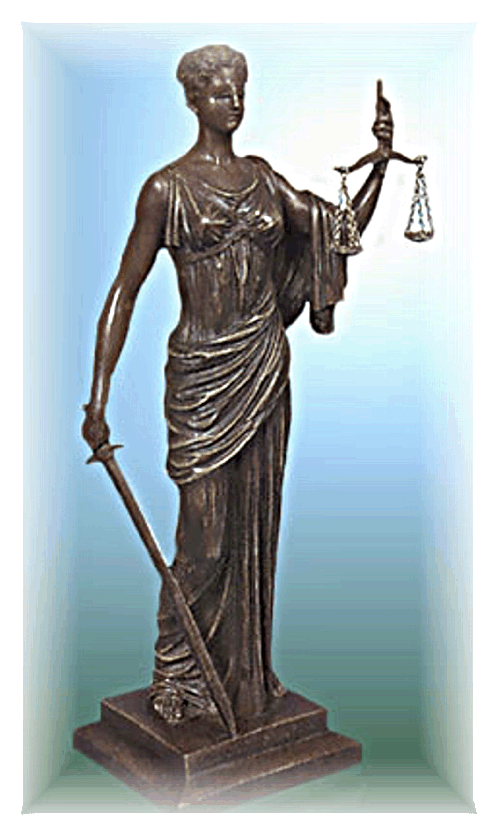
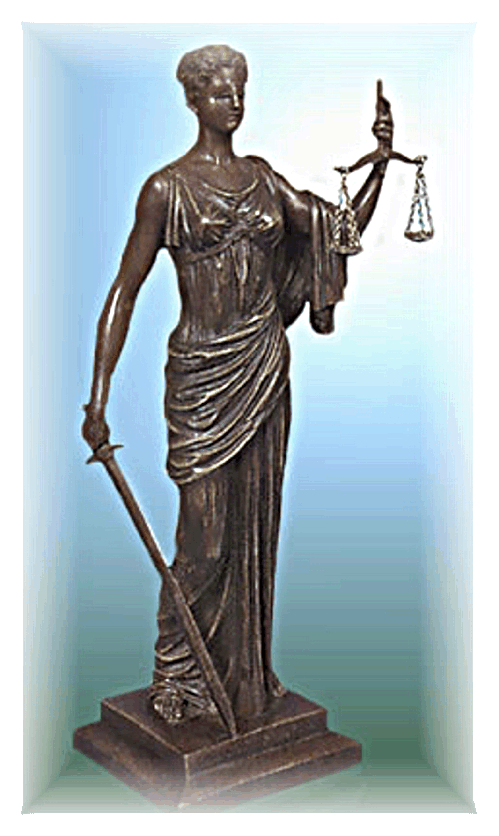
She also bears much in common with Themis (below), the Greek Goddess of divine law and wisdom.

According to Ovid, she traveled from Greece to Italy with her son Evander, where Evander founded the city of Pallantium. Pallantium was named after their Greek hometown of Pallantium, Aracadia, and was one of the 7 hills that later became Rome.
Carmenta was famous for chanting her prophecies in verse. Her Greek name was Nicostrate, but when she arrived in Italy, the locals called the singing woman Carmenta, for the Latin ‘carmina’, or ‘song’.

Another explanation holds the opposite: Carmenta predated the Latin word for song, and ‘carmina’ derived from the prophetess’s name.
‘Mente’ meant ‘wise’ or ‘mind’. Car-menta could have meant ‘Car the Wise’. Or as Plutarch suggests, ‘Out of the Mind’, because she acted crazy.
She was associated with artistic and technological innovation and is co-credited for inventing the Latin alphabet (with Al Gore and her son Evander.) There is little evidence to support this, but Latin was indeed based on a Greek variant.

According to Virgil she used her powers of prophesy to choose the best site of the future Rome on which to establish her son. Once she even foretold Hercules the fate that awaited him.

How she came to be the Goddess of Childbirth is unclear. The women’s cult that grew around her was said to have predated Rome. However, Plutarch’s and Ovid’s description of the origin of her temple is more about contraception (and possibly abortion) than fertility.

During the Second Punic War (215 BC) the Roman Senate restricted the rights of women to ride in carriages or to wear certain clothing. This was an attempt to save resources such as horses, fabrics, and gold for the war effort.

But when the war ended, these rights were not reinstated.
The women of Rome banded together and protested, the Lysistrata way. They refused to conceive children. (You can work out the details.) According to Plutrach they:

“kept their husbands at a distance until the husbands changed their minds and made the concession to them.”

After the laws were revoked, the women had numerous prodigy, and built the Temple of Carmenta in her honor.

At the temple the Goddess Carmenta could be invoked with one of two carmentes, lesser goddesses of childbirth, and Porrima–literally, “feet first” and “head first”. Possibly referring to which way the baby was delivered. It can also be read as “looking backward” and “looking forward,” citing Carmenta’s ability to tell the future.

View from Palatine Hill

All forms of animal skin were banned in her temple. This meant no shoes, no leather, and no animal sacrifice:

For on the day they had received life, they did not want to deprive another life.” –Varro, Cens. 2.2

The Carmentalia festival was unique in that it was celebrated on two separate dates, four days apart. (The second date was on January 15th.)

[The reason for this is uncertain. One theory is that it was originally on the 11th and 13th, but the 13th was the Ides of January. Or, as mentioned earlier, the Romans didn’t have anything better to do in the middle of January.]

References:

http://www.novaroma.org/nr/Carmentis

http://www.novaroma.org/nr/Carmentalia

Wiccan Spell-a-Day book

Carmentalia

Dictionary of Greek and Roman Antiquities

[originally written January 2008]

Voodoo Day!

January 10

Today the people of Benin celebrate the ancient religion of their ancestors, Vodun (Voodoo), in a festival known as Traditional Day, or Vodun Day.

Vodun is a religion of West Africa, and may be one of the oldest religions in the world. It traces its roots to the religious practices of the Yoruba peoples of Dahomey, around what is now Benin, Togo, and Nigeria about 6,000 years ago.

Variants of Vodun spread to the Americas through Haiti and the West Indies during the slave trade of the 17th and 18th centuries. Haitians continued to observe Vodun religious practices in the early 19th century despite the Christianization of Haiti and the Caribbean by the Roman Catholic church.

voodoo_11

Vodun’s reputation in the West was not enhanced by books like Sir Spenser St. John’s Haiti or the Black Republic (1884) which detailed erroneous accounts of human sacrifice and cannibalism, descriptions extracted from Haitian priests under torture. By the 1930s Hollywood had cemented this image of African “Voodoo” in the mind of the movie-going public, an image the religion never fully shook off.

Vodun means “spirit”. In Benin, Vodun recognizes a supreme deity as well a pantheon of saint-like spirits, each of whom is associated with a specific attribute (forests, storms, the sea, war, etc…). Spirits may change from region to region.

Seijin no Hi

2nd Monday in January

shinto

Almost every society has a coming-of-age rite, be it confirmation, bar mitzvah, high school graduation, or my favorite: passing your driver’s test.

In Japan that rite is one’s 20th birthday. However, it’s not an individual celebration. The entire nation of 20 year olds celebrate their birthdays on the same day. That’s today, the second Monday of the New Year, Seijin no Hi…aka, Coming of Age Day.

20 is the legal age of voting, drinking and smoking, and the age of civic responsibility.

Young men wear their finest suits. Women wear furisodes, special formal kimonos for unmarried women, which can cost a million yen, or $10,000, although that is coming down.

(Photos © Samurai Dave)

The event is so popular that appointments at beauty salons must be made months in advance, and can set parents back a grand. Within the beauty world Coming of Age Day is an industry in itself. Women will begin arriving at the salons at 5am, and salons are prepared to handle over a hundred women in just a few hours.

In some ways it is celebrated more for the parents than for the son or daughter. Says one kimono shop owner:

“For the parents it is their desire. From the day a girl is born they have the desire to dress her in furisode when she becomes 20 in the seijin shiki, take her picture, and send it to relatives as custom requires. In some cases, the mother herself also wore a furisode she received from her mother in her seijin shiki…

“If they have the possibility of dressing their daughter in a Y1,000,000 kimono it is proof that they have worked hard all their lives and can afford it. It is the result of their life work…But the girls do not always understand their parents’ feelings and they say they would prefer a car.”

A Companion to the Anthropology of Japan – Fashioning Cultural Identity: Body and Dress by Ofra Goldstein-Gidoni)

But Coming of Age day has been adapting to new times, partly from the recessions and partly from new youth culture. According to SillyBoy_in_Japan:

“…the price of kimonos has dramatically increased as most of the kimonos are now made cheaper in China. A decent hand made using Japanese materials can still be bought in Kyoto, and can be quite expensive, but there are few people learning this craft. Once the last of these shops close down, all that will be left are the pre-made, mostly imported kimonos. What also has changed is that 70% of the girls now wear beautiful evening gowns. Think shopping for a prom dress in America.”

Though it only became an official holiday in 1948, Coming of Age Day has its roots in older Shinto and Meiji era traditions, such as genpuku, where boys between 12 and 16 were given a new name and…

“were taken to the shrines of their patron kami. There they were presented with their first adult clothes, and their boys’ hairstyles were changed to the adult style.”

Girls reaching adolescence were given a similar ceremony and dressed in special kimono attire to symbolize to the community their readiness for marriage.

John K. Nelson describes a Coming of Age ceremony at a community shrine in Enduring Identities:

“At the Tsuchinoya purification pavilion, everyone lines up and is purified with a standard, paper-streamer haraigushi…After a short ritual in front of the Honden, the group assembles in the western field to plant a cherry tree, each participant contributing one shovelful of soil to the process. The group then retires to the Chokushiden within the administration building for three formal speeches stressing gratitude to parents, the brevity of youth, and the contributions they will make to society…”


Today a lot of Japanese youth see the pomp and circumstance as more materialistic than traditional. Writes Naoko:

“In the past it probably meant more than today. These days this is just sort of fashion show for tons of 20yr-old, and the day finally they can officially get drunk. However, it’s still nice to see them in colorful kimono with shining hopes.”

http://ekubo-hirop.blogspot.com/2006/10/coming-of-age-days-photo-shoot.html

http://www.sugarheadblog.com/blog1/?p=254

Youtube: Beautiful Japanese actress celebrates Seijin Shiki

Youtube: No clue what they’re saying here but…funny

Raud the Strong

January 9

Viking ship

Far north in the Salten Fiord
By rapine, fire and sword
Lives the Viking, Raud the Strong;
All the Godoe Isles belong
To him and his heathen horde…

With rites that we both abhor
He worships Odin and Thor
So it cannot yet be said
That all the old gods are dead
And the warlocks are no more…

Tales of a Wayside Inn by Henry Wadsworth Longfellow

When King Olaf Tryggvason came to power in 998 he converted the Norwegian population to Christianity Viking style; by…

“looting and burning Pagan temples and compelling community after community to be baptized or die, taking hostages to enforce continued Christian observance.”
A History of Pagan Europe, by Prudence Jones

Despite these persuasive efforts, many of the Vikings were reluctant to renounce their Gods and accept Jesus as their savior. New and increasingly painful tortures and executions were devised by King Olaf and his men.

The seer Thorlief had his eye torn out. Eyvind Kinnrifi was tortured with a brazier of hot coals on his stomach. Other pagans were beheaded with an axe, mutilated, drown, or burned alive along with their residences.

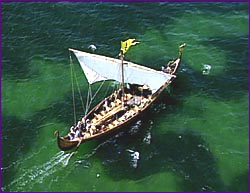
But the most innovative torture developed was reserved for a landowner, leader-priest and sea-farer known as Raud the Strong. Raud the Strong was known for his beautiful longship, a boat larger than any of the King’s, with a dragon’s head crafted into the bow.

When Raud the Strong refused to renounce Thor and Odin, King Olaf’s men inserted a poisonous snake into a long metal horn. The horn was then rammed down Raud’s throat and the end of it was heated with a flame, forcing the snake to wriggle down Raud’s esophagus.

http://www.destinyslobster.com/asatru/calendar.html

Longfellow waxes poetically on the scene. After Raud refuses King Olaf’s offer…

Then between his jaws distended
When his frantic struggles ended
Through King Olaf’s horn an adder,
Touched by fire, they forced to glide.

Sharp his tooth was as an arrow
As he gnawed through bone and marrow;
But without a groan or shudder,
Raud the Strong blaspheming died.

Then baptized they all that region,
Swarthy Lap and fair Norwegian,
Far as swims the salmon, leaping
Up the streams of Salten Fiord.

In their temples Thor and Odin
Lay in dust and ashes trodden,
As King Olaf, onward sweeping,
Preached the Gospel with his sword

After Raud’s death King Olaf seized Raud’s beautiful ship, and supposedly copied the design. According to legend this is how the famous Viking ships got their distinct shape.

How Asatru’s observe Raud the Strong Day, I don’t know. But it is not by shoving horns with snakes down Christians’ throats.

Epiphany, Day of the Kings

January 6

Every child knows that at one point Christmas had twelve days. The song says so. “On the twelfth day of Christmas, my true love gave to me…

But this begs two questions:

First, what kind of sicko sends their true love sends 23 birds, 50 assorted pipers, drummers, milk maids, ladies and leapin’ lords, five rings and a pear tree, and doesn’t include one vacuum?

And second, what happened to the other eleven days? What kind of cruel world advertises the twelve days of Christmas to its children and gives them only one? “Sorry kids, we just couldn’t afford the first 11 days this year. If only you’d been born last century.”

The truth is…

The Truth

Actually December 25th is the first day of Christmas, not the last.

In the modern world of Christmas so much energy is focused on preparing exclusively for the first day that by the time the 26th rolls around many people are simply Christmas’d out.

But for much of Christian history, the twelve days began on the night of December 25th and ended the day of January 6th. (…though the calendar varies for different Churches. Christmas in the Russian Orthodox Church, for example, doesn’t fall until January 7th.)

Today we tend to mark our holidays by calendar day–midnight to midnight–but these holidays were traditionally celebrated sunset to sunset. The famed “Twelfth Night” actually falls on the evening of January 5th, though calendars mark the Epiphany as January 6th.

The Epiphany

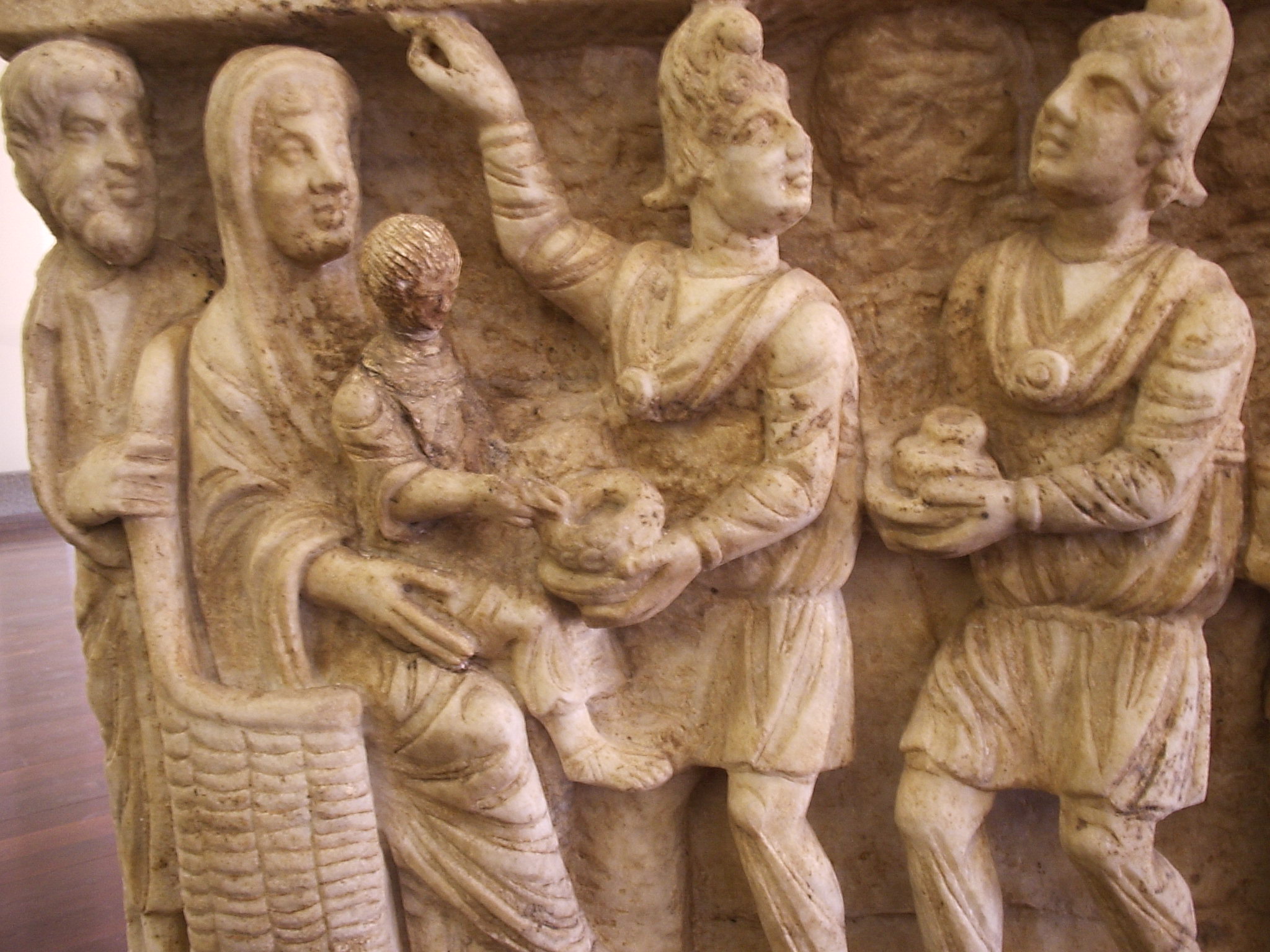
The Epiphany literally means ‘manifestation’ and marks the day the Three Wise Men, or Magi, encountered the Virgin Mary and the Baby Jesus.

There are different theories as to the details surrounding the Magi mentioned in the Gospels. In fact no number is specified in the Bible, but the number three may have originated due to the three gifts bestowed upon Christ: gold, myrrh and frankincense. Matthew does not give clues to their origin, nationality, religion, or ethnicity either except to say they came “from the East” to Jerusalem. Hence they are referred to as the Three Kings of the Orient, although their rank is also supposition

The three differing places of origin may have developed as a way of demonstrating the diversity of Christ’s influence.

The names attributed to the Magi vary from place to place. We can trace the names Gaspar (or Caspar), Melchior, and Balthasar to a 6th century Greek text]

One theory for their origin is that they were Zoroastrians. Zoroastrianism was one of the most common religions of Persia at the time, and its priests were astrologers, who were revered for their knowledge of the night sky.

The Magi bestowed three gifts that represent:

  • Gold – royalty, for kings
  • Frankincense – piety, for priests
  • Myrrh – suffering, or painful death

which led to the Virgin Mary’s famous quip: “So which one of you Wise Guys brought the Myrrh?”

Over the next two millennia many European traditions associated with the winter solstice merged with the twelve days of Christmas. For example, on Twelfth Night roles were often reversed, such as master and servant, a tradition stemming from the Roman Saturnalia.
So enjoy this the twelfth and last day of Christmas. And whatever you do, don’t give a baby myrrh. That’s just rude.

http://www.biblegateway.com/passage/?book_id=47&chapter=2&version=31

http://www.novareinna.com/festive/twelfth.html

http://en.bibleinfo.com/questions/question.html?id=761

http://www.spcm.org/Journal/spip.php?breve6085

http://en.wikipedia.org/wiki/Biblical_Magi

http://en.wikipedia.org/wiki/Twelve_Days_of_Christmas

http://www.turkishdailynews.com.tr/article.php?enewsid=92855

http://www.cnn.com/2004/WORLD/europe/02/10/uk.magi.reut/index.html

http://www.snopes.com/holidays/christmas/3wisemen.asp