10th of Tevet – the Siege of Jerusalem

January 5, 2012

December 17, 2010
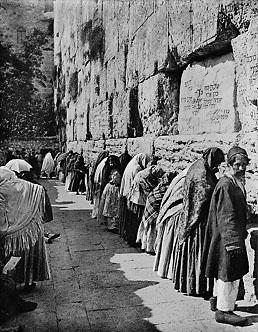
Wailing Wall, Jerusalem, early 20th century

The Big Guy of the three consecutive Jewish holy days is the last, the Tenth of Tevet. It is a day of fasting.

The Tenth of Tevet marks the first day of the siege of Jerusalem in 589 BC by the Babylonian king Nebuchadnezzar (630-562 BC). The city would fall thirty months later in 587. It was actually the third time in as many decades that Jerusalem had faced the Babylonians.

The first was in 606 BC by King Nabopolassar; the second around 597 BC by his son, the new king, Nebuchadnezzar, and finally eight years later by Nebuchadnezzar again. This time Nebuchadnezzar was feeling less charitable toward the city’s residents. After the city’s walls were breached, Solomon’s Temple was destroyed, Jerusalem was razed to the ground, and its remaining inhabitants were exiled.

This date is among the most tragic in all of Jewish history and yet, as Rabbi Yaakov Asher Sinclair points out, “on the tenth of Tevet itself, ostensibly, nothing really tragic happened. No wall was breached. No one died. Not a shot was fired. Only the siege was begun.” However the day marked the beginning of the end. The diaspora that would define the shape of Judaism for millennia.

The 10th of Tevet has also been chosen by some as a symbolic anniversary date of the millions who died in the Holocaust, whose dates of death may not be known.

In March of 2003, as the U.S. prepared for war, stories circulated about Saddam Hussein comparing himself to the ancient biblical king Nebuchadnezzar. And an evangelical minister stated in his sermon that Nebuchadnezzar was one of “the world’s greatest terrorists, maybe even higher than Bin Laden or Hitler…” Yet in Iraq he is considered a national hero. How is this dichotomy possible?

Nebuchadnezzar’s reign lasted 45 years, during which time Babylonia was at the peak of its power. He wrested his father’s territory from the Assyrians, halted Egyptian dominance, and defended the empire from Persian invaders. Under his rule Babylon grew to be the largest and most glorified city in the world with a defensive wall that stretched 56 miles. The metropolis boasted hundreds of towers, including the massive ziggurat we know as the “Tower of Babel” and the Great Temple of Marduk which held a 25 ton golden statue of Baal. His most innovative creation may have been the Hanging Gardens of Babylon. One of the Seven Wonders of the Ancient World, the Gardens were irrigated by a series of hydraulic pumps. According to legend the Gardens were built to cheer up Amytis, Nebuchadnezzar’s wife, who was homesick for her native land of Midea.

It would be like a single President ruling America from FDR through the Reagan years, taking the country from depression to superpower and defeating both Germany and the USSR in the process–not to mention overthrowing a few Central American republics along the way. So it is not difficult to see how he could be regarded as a national hero to one people, even though he brought about the near annihilation of his enemies.

The strange truth is, though Baghdad sits near what was once Babylon, the ancient civilization bears little resemblance to Iraq. To the Judeans Babylonia symbolized the boundless superpower. An ostentatious empire governed by decadence, arrogance and amorality.

Its leader was the son of the former leader Nabopolassar. Both father and son waged large military campaigns in the Middle East. And during their reign Babylonia won out over its enemies as the world’s single superpower.

So how can two societies with such conflicting memories of the same events ever find a common ground?

The answer may come in the shape of a figure who arrived on the scene an estimated 1500 years before Nebuchadnezzar: Abraham. Abraham (Ibrahim in Islam) is the father from which all three religions derive. He is the first monotheist. But his story is for another day…


Mother of All Sermons

Tenth of Tevet

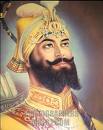
Gobind Singh: the Penultimate Guru

January 5

The Guru known as Gobind Singh was the second to last of the 11 Gurus of the Sikh religion. The Guru is the leader and the most revered figure in Sikhism. Most Sikh holidays revolve around the births, martyrdoms, and life events of the Gurus.

Guru Gobind Singh became the leader of the Sikhs at the age of 9 in 1775 when his father, the ninth Guru, was beheaded by Mughal ruler Aurangzeb for refusing to convert to Islam.

Guru Gobind Singh
Guru Gobind Singh

Gobind Singh’s three-decade reign determined the present shape of Sikhism today. Four of the religion’s holidays are directly related to Gobind Singh’s life:

1666: His birthday – on or around January 5

1675: The Martyrdom of his father Guru Tegh Bahadur – on or around November 24

1699: Vaisakhi – the Sikh New Year, on or around April 13, which honors the Guru’s establishment of the Khalsa, or “Community of the Pure”

1705: Maghi – remembers the “40 Immortals” who sacrificed their lives at the Battle of Muktsar

But perhaps the Guru’s most miraculous achievement was in choosing and preparing his successor, Guru Granth Sahib.

Guru Granth Sahib became the 11th Guru in 1708 and is still the Sikh Guru today. Talk about a record for longevity!

Shortly before Gobind Singh’s death in 1708, he declared that he would be succeeded not by a person, but by the Sikh holy book, Guru Granth Sahib, the writings of the ten Gurus of Sikhism. By taking the revolutionary step, Gobind Singh made the Guru immortal. Henceforth Sikhism could be guided by eternal principles instead of dependent on a mortal leader.

Sikhism is sometimes simplified as a cross between Hinduism and Islam, but is a unique philosophy. Sikhism rejects the Hindu caste system and idol worship. Unlike Islam, Sikhism does allow for images for adoration.

Sikhism has experienced conflicts with Islam ever since its inception in the mid-15th century. Sikhs have often sided with Hindus on political matters; Sikhism’s structure and culture has resulted in massive Sikh overrepresentation in the Indian armed forces. However in the late 20th century conflicts with Hindus increased as well.

Guru Gobind Singh died in October 1708, after a stab wound inflicted by a would-be assassin reopened while he was drawing a bow.

“The 12 months, the seasons, the dates, and all the days are blessed: each hour, minute, second, leads naturally to the True One.”

— Guru Granth Sahib

St. Genevieve

January 3

St. Genevieve of Paris

Today is St. Genevieve’s feast day. She’s honored as the Patron Saint of Paris.

St. Genevieve became a nun at the tender age of 15 and devoted the rest of her life—another 65 years—to Christ. The secret of her longevity may have been her diet. She didn’t eat much more than barley bread and beans, and according to her biography, only twice a week, Sundays and Thursdays. She loosened this restriction at the age of 50 at the request of some bishops.

When Huns Attack

During the Hun invasion of what’s now France in 451, St. Genevieve’s prayers were believed to have prevented the Huns from attacking Paris; they headed toward Orleans instead. (Notice Genevieve is not the patron saint of Orleans…)

St. Genevieve
St. Genevieve

The following decade, during the lengthy Childeric siege on the city, Genevieve sneaked through a blockade to bring back much-needed grain to Paris’s starving citizens.

Death did not stop Genevieve from performing miracles. Parisians held a procession of her relics during the deadly plague of 1129 which killed 14,000 people. Spread of the disease ceased almost immediately, and many who were sick were reported to have healed upon touching her relics.

St. Genevieve’s saint day is January 3, but for centuries Parisians celebrated the anniversary of that first procession–November 26, 1129–with another procession in her honor.

Why the Fuss of January First?

January 1

Today is the Granddaddy of all holidays. Celebrated around the world, New Year’s Day transcends culture, language and religion.

The strange thing is, how of all days did this arbitrary night–December 31 to January 1–come to represent the changing of the solar calendar? It is neither a solstice nor equinox, nor the anniversary of any momentous event.

  • Russia once celebrated the New Year on September 1.
  • The Chinese New Year falls in late January through early February.
  • The French chose September 22, the autumnal equinox, during the French Revolution.
  • Iran celebrated (celebrates?) on or around March 21, the spring equinox.
  • The Hebrew calendar celebrates in early Fall.
  • The Cambodian, Thai, and some Indian provinces in mid-April.

So what gives with January 1?

In fact the Roman calendar, on which ours in based, began with March. Which makes sense if you think about the names of the months:

  • September: 7th month
  • October: 8th month
  • November: 9th month…

I was told in elementary school another reason why the months were off: it was because July and August, the months named after Julius Caesar and Augustus, were inserted after June.

Good theory. Wrong, but good theory.

The months of July and August were not “added” to the calendar but replaced the already existing months Quintilis and Sextilis. (Quintilis meant 5th and Sextilis 6th.)

So even in the time of Julius Caesar (45 BC) were 6 of the months of the year out of whack?

Yep.

The original Roman calendar, supposedly created by Romulus, the founder of Rome, began in March and ended in December. March signified the beginning of the planting year and December marked the end of harvest. The remaining 60 or so days, when crops were neither sowed nor reaped, weren’t counted as months, but an amorphous winter period. As Cecil Adams puts it:

“…3,000 years ago not a helluva lot happened between December and March. The Romans at the time were an agricultural people, and the main purpose of the calendar was to govern the cycle of planting and harvesting.” – How Come February Has Only 28 Days?

This amorphous period allowed farmers to based their months on lunar cycles, not on the solar calendar. Hence the unoriginal names:

  • Quinctilis, 5th month, ie. 5th moon
  • Sextilis, 6th month, ie. 6th moon
  • September, 7th month, ie. 7th moon
  • October, 8th month, ie. 8th moon…

Farmer Ted (or Theodocus in ancient Roman) knew he had to plant such and such during the first or second moon and harvest such and such during the 8th or 9th moon.

They didn’t number the dates of the month like we do (1-31), but counted forward or backward based on the different stages of the moon each month:

The Kalends: first day of the month, or new moon
The Ides: middle of the month, or full moon
The Nones: the quartermoons

As in:

Beware the Ides of March. (Shakespeare) ie. Beware the full moon of March, ie. March 15th.

or

Damn, I’ve got to renew my driver’s license by the fourth day before the Kalends of Quinctilis. (Nestor the Chronicler) ie. four days before new moon of July, ie. June 27th. (The Romans included the day they were counting from as day 1.)

If you’re not confused yet, wait. It just gets better.

So sometime around 713 BC Roman King Numa Pompilius decided to name and fix this no-man’s land between December and March. He named January after the god Janus, and February after the Latin word Februum, meaning purification. It was the end of the year and marked a time of atonement. (Maybe that’s why it’s the shortest month!)

Years at this time were not numbered, but were referred to by the names of the two consuls elected that year. So this year might be Bush-Pelosi, except consuls were elected yearly.

In the third century BC the date officials took office was fixed on the Ides of March (March 15).

A law in 153 BC arbitrarily moved that date up two and a half months to January 1st.

The Cambridge Ancient History states that this was done to hasten the appointment of Quintus Fulvius Nobilior, so he could quell uprisings in Northern Spain. (Liv. Per. XLVII, Cassiod. Chron.) [More on this here.] My theory is that, as stated earlier, Romans had nothing better to do in January and February.

The date stuck and January 1st marked the beginning of the Roman legal calendar, though it was not yet considered to be the start of the new year by the general Roman populace.

Below: Caesar celebrating New Year

[Oops, wrong picture]

By the time Julius Caesar came to town a couple of problems were apparent with the Roman consular calendar.

The most important being that it was 355 days, roughly twelve lunar cycles. That worked fine for a few years but after enough years March would fall in the dead of Winter and September would mark the beginning of Summer, leading to very confused farmers, not to mention cows.

The Roman Head Honchos (Honchos Headus Romanus) tried to fix this problem by periodically inserting an extra month called Intercalaris after February. (Think Leap Month.) However, with the lack of DSL and decent cell phone service among ancient Romans, it took a while for an Intercalaris to make its way to the average farmer in the countryside, causing citizens to be in different months.

Also, the government could neglect to declare an Intercalaris for an extended time, as with the Punic Wars, leading to the “Years of Confusion” when the seasons went completely askew.

By the time Julius Caesar took power the calendar was off by approximately 100 days. He fixed this problem by extending the year 45 BC to 455 days. Then he changed the number of days in each month to create a 365-day solar calendar, rather than a lunar calendar. (Thank you Juli!)

Afterward, the calendar was also changed to refer to the year by the Emperor. So instead of being the year of Bush-Pelosi, for example, 2007 would be the 7th Year of the Reign of the Bush.

But wait there’s more!

Just when you thought it was safe to go back to the calendar, the Roman Church in the 6th century AD chose March 25, the date of the Annunciation, as the official start of its New Year.

The March 25th date also explains why December 25th, exactly nine months after the Annunciation, was chosen as the birth of Jesus.

However, the centuries-old Roman tradition of celebrating January 1 as the New Year could not be suppressed. January 1 was declared a Church holiday by Pope Boniface IX in 615 AD and called “Octave of the Lord.” The Pope’s mass was conducted at Rome’s Church of St. Mary. Hence the celebration became connected with the Virgin Mary and became known as “The Feast of St. Mary.”

The Gregorian calendar, proposed by Aloysius Lilius and approved by Pope Gregory in 1582, fixed the inaccuracies of the Julian calendar and set January as the 1st month yet again.

By this time many countries had already reverted back to the January 1st New Year:

  • 1544 Holy Roman Empire
  • 1556 Spain and Portugal
  • 1559 Prussia, Denmark/Norway, and Sweden
  • 1564 France
  • 1576 Southern Netherlands

Other governments followed suit:

  • 1583 Northern Netherlands
  • 1600 Scotland
  • 1700 Russia
  • 1721 Tuscany
  • 1752 Britain and colonies

It should be noted that the people of many of the above countries celebrated the Roman New Year’s Day on January 1st long before their governments recognized it. Britain for example considered March 25th as the beginning of the legal year, like a tax year, while the general populace celebrated on December 31st as the year’s end.

In essence, as late as the 1700’s the English-speaking world was continuing the 3,000 year-old Roman tradition–a year starting in March and ending in December.

Zartusht no-diso

[published Dec. 27, 2007]

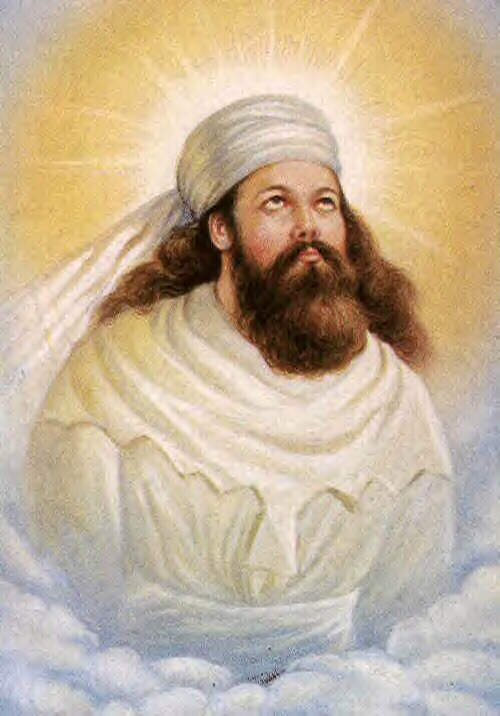
Zarathustra

Today former Prime Minister of Pakistan Benazir Bhutto was killed by a suicide attacker in Rawalpindi where she was attending a campaign rally. Bhutto was waving to the crowd from the sunroof of her vehicle after the rally when she was struck down by an attacker who fired shots and then set off an explosive devise. Over 20 spectators were killed.

As the government and press squabble over who was behind it and the cause of her death (by bullet, shrapnel, or by her hitting her head on the sun roof, as the government insists) and who was behind it, Zoroastrians remember the slaying of another leader.

Zarathustra, the founder of Zoroastrianism, once the dominant religion of Persia, was killed just three hundred miles to the northwest in Balkh, Afghanistan.
Zarathustra, or Zoroaster as he was known to the Greeks, lived in the region of Iran and Afghanistan around 1100 BC.

He spread the idea of monotheism long before Muhammad, Buddha, or Jesus walked the earth. He may have even predated Moses.

His philosophies regarding the continuing struggle of good versus evil, and the judgment of humans at the end of their life, is thought to have inspired numerous religions including Judaism, Christianity, Islam, and Buddhism.

It is a common misconception that the Zoroastrians worship fire. They see fire and light as symbols of God. Zoroaster believed God–Ahura Mazda–communicated with humans through three things: Good Thoughts, Good Words, and Good Deeds. But that God gave man free will to decide whether to follow these three, or to give in to evil

Once the predominant religion of what is now Iran, Zoroastrianism is now practiced by a scant 200,000 or less people, mostly in Iran and India. Zoroastrians do not accept converts. One must be born into the religion, which is one of the reasons their numbers are scarce.

One famous twentieth-century Zoroastrian was Freddie Mercury, the voice and genius behind the rock group Queen, who wrote the famous Bohemian Rhapsody:

“Goodbye everybody, I’ve got to go
Gotta leave you all behind and face the truth…”

The West is familiar with Zarathustra mainly from a scattering of cultural references.

Frederich Neitzsche wrote Thus Spoke Zarathustra using a fictionalized version of the prophet who bears little resemblance to the actual man.

Richard Strauss then composed a majestic orchestral piece of the same name. This piece was then used by Stanley Kubrick in what has been called “the greatest movie opening ever” in “2001: A Space Odyssey.”

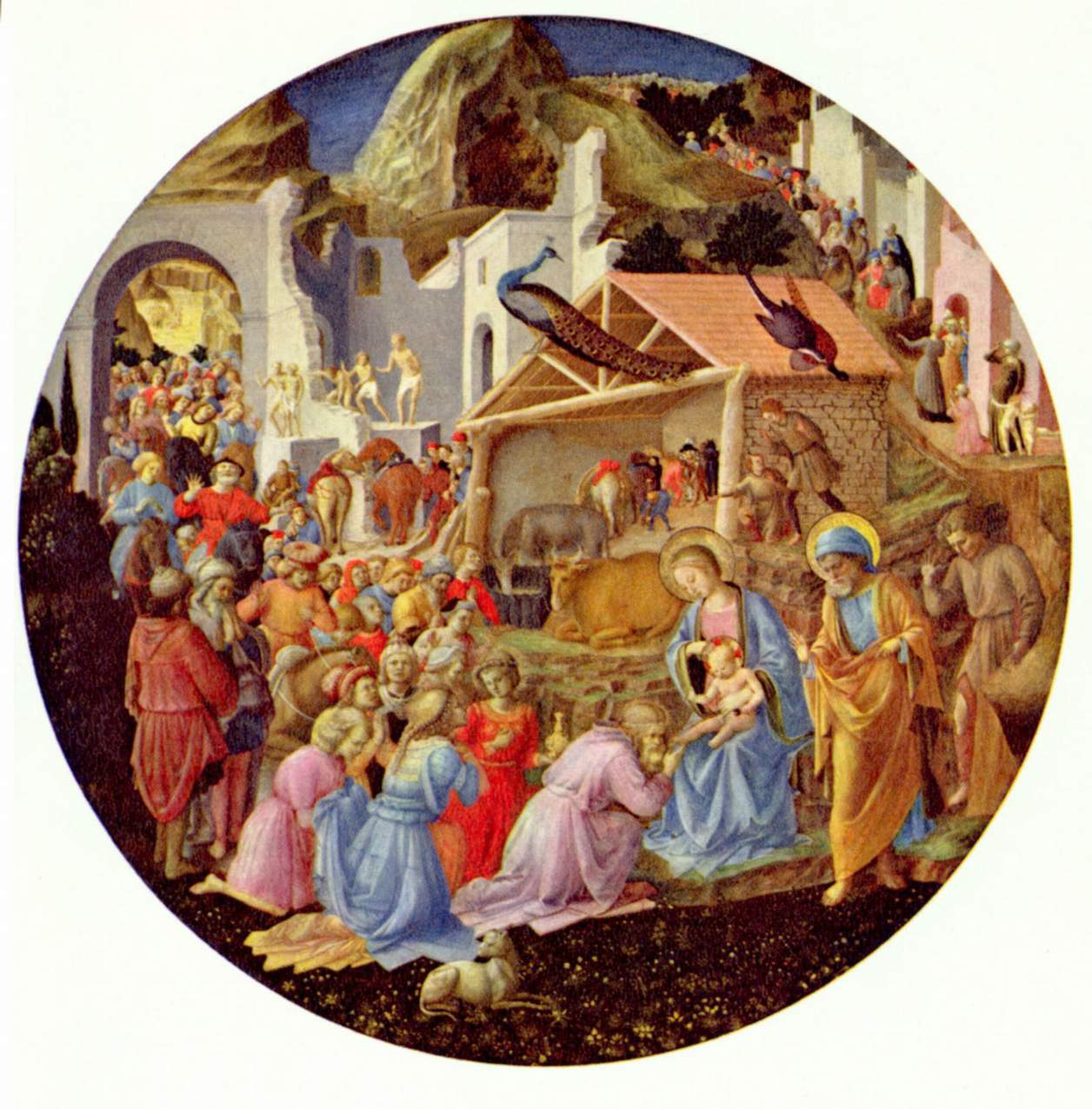
In the opening the moon, Earth, and sun align. The choice of music is appropriate as Zoroastrians were keen astronomers for their time, charting the movements of the sun, moon and stars. (Astrophysicist Grant Mathews believes the three wise men in the Bible who spotted the star of Bethlehem were actually Zoroastrians tracking an unusual alignment of the planets in 6BC.) However, the Zoroastrians do not believe in reincarnation, a theme suggested by the film’s end.

Similar to Benizar Bhutto, Zoroaster was struck down by an assassin while on the alter, according to the Shahnama–the massive 10th century national epic of Persia.

Jesus: Happy 2011th–2015th?–2019th?…

December 25

Behold! the angels said, ‘Oh Mary! God gives you glad tidings of a Word from Him. His name will be Christ Jesus, the son of Mary, held in honour in this world and the Hereafter, and in (the company of) those nearest to God.

— Qur’an 3:45

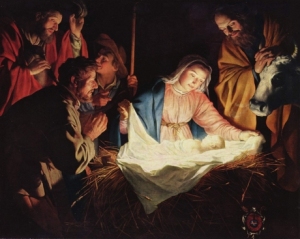
Nativity, Gerard von Honthorst (1590-1656)

Today we celebrate Jesus Christ’s 2011th birthday.

Actually, no.

We don’t know the year Jesus was born. But it’s believed he was born at least four years prior to the year we count as 1 A.D. because King Herod the Great, whom Matthew cites as king when Jesus was born, died in 3 or 4 BC.

One theory for this discrepancy is that Dionysius Exiguus–the sixth century monk who created the A.D. dating system (short for Anno Domini Nostri Jesu Christi or “in the year of our Lord Jesus Christ”)–forgot to calculate the four-year reign of Emperor Octavian when adding up the years since the birth of Christ. Thus, the year he deduced to be 525 AD should have been 529.

Another theory states that Jesus was born even earlier, since the census that Luke mentions as the time of Jesus’s birth [This was the first census that took place while Quirinius was governor of Syria – Luke 2:2] occurred every fourteen years. Working backward, historians figured the first census would have been conducted in 8 BC.

So you see, we’re already in the future: 2019 AD.

But whether we’re wishing Jesus a happy 2011th, 2015th or 2019th birthday, we’re almost certainly celebrating the wrong day.

There’s no hint in the Gospels as to the day or even the season of Christ’s birth. A fact which has led some Christian denominations to exclaim that, had God wanted us to celebrate the birthday of the Lord, He would have given us some indication of the date.

In 4000 Years of Christmas, Episcopalian minister and scholar Earl Count recounts that the Romans celebrated December 25 as the birthday of the Sun God Mithra, a tradition inherited from Persian Mithraism. Similarly, the Annunciation of Christ, observed 9 months earlier on March 25, coincided with the Spring Equinox, which was celebrated as the New Year in the Near East.

In fact, Dionysius himself never considered the first day of the Christian era to be Christ’s birth—theoretically December 25, 1 AD—but Christ’s conception—aka, the Annunciation—on March 25.

That led to some confusion. As late as 18th century the English still marked March 25 as the start of the calendar year. (i.e., March 24, 1699 was followed by March 25, 1700. Yes, these are the people that cursed us with the Imperial measurement system of feet and pounds.)

In the United States, Christmas–a holiday once banned by the Puritans–has far outstripped the popularity of the Annunciation, or any holiday for that matter, partially due to its potential for consumerism in the 19th and 20th centuries. Which has led the folks at The Good News to ask, not how can we put the Christ back into Christmas, but “How can we put Jesus back into the season when He was never part of it to begin with?

Well, regardless of how Christmas was created, it has become the de facto time to observe the principles taught by Jesus nearly 2000 years ago in a troublesome Roman backwater. Christmastime is the season of Faith, Hope, and Charity.

Some Christians say they wish Christmas could last all year. Others say that Christmas’s pagan roots mean we shouldn’t celebrate it at all. I’m inclined to agree with the former. If we don’t know which day of the 365 is the real Christmas, best to hedge our bets, and make every day a holy day.


‘Twas the Night Before Christmas…

December 24

‘Twas the night before Christmas
And all through the store
Not a register was empty
Nor an inch of the floor

For the men of the nation
Had converged on this spot
To buy all the presents
They should’ve already bought.

Today my co-workers complimented me on my resistance to all the goodies lying around the office. It wasn’t resistance; it’s just that at this point my body weight is 90% chocolate, and the remaining ten is sugar.

My boss let us out early today (4:30) which gave me an hour and a half to do all my Christmas shopping.

Single women, if you want to find a man, go to any mall in America after 5pm on Christmas Eve. The stores are chock full of them. Take your pick. You will know one of these shoppers is a male because he has the same expression as a parachuter who has just been dropped in Uzbekistan with a map of Disneyland and a purse.

Believe it or not, there was a time when Christmas Eve was not associated with frantic mobs scavenging through Toys R Us for the last Diaper-Me Elmo, or whatever the current craze is.

That time was 1866. The following year, Macy’s department store remained open Christmas Eve until midnight for last minute shoppers, thus setting in motion the downward spiral that has consumed our society.

You’ll notice with a lot of Saints’ Days, that the “Eves” before are still more important than the Days themselves. The same goes for many Jewish, Muslim and Hindu holidays. In many calendars, the day once began at sunset, a time much easier for farmers to deduce than 11:59 pm.

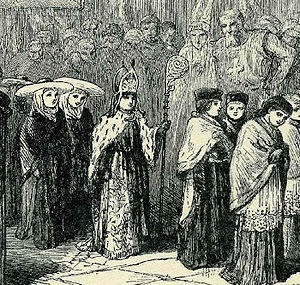
Some “Eves” were celebrated reverently with a mass at church. But many an Eve developed a reputation for merry-making. For example, Saint Nick’s Eve when townspeople would dress a boy up as a clergyman–a “Boy-Bishop” he was called–who would imitate a priest, much to the delight of onlookers. Sometimes mobs would sing bawdy songs while careening drunkenly through the streets in a haphazard procession, often harassing the social elite in the process.

Boy Bishop
Boy Bishop

This led to King Henry VIII’s infamous “party-pooper” decree:

Whereas heretofore divers and many superstitions and chyldysh observances have be used, and yet to this day are observed and and kept…as upon Saint Nicholas, Saint Catherine, Saint Clement, the Holy Innocents, and such like, children be strangelie decked and apparayled to counterfeit priests, bishoppes, and women, as so be ledde with songes and daunces from house to house, blessing the people and gatherying of money; and boyes do singe masse and preache in the pulpitt…

The Kynges Maiestie therefore, myndinge nothinge so moche as to advance the true glory of God without vaine superstition, wylleth and commandeth that from henceforth all such superstitious observations be left and clerely extinguished throwout his realmes and dominions, for asmuch as the same doth resemble rather the unlawfull superstition of gentilitie, than the pure and sincere religion of Christe.”

Of course, the King’s piety didn’t stop him from beheading his wives (or improve his spellyng). After the King’s death, his Roman-Catholic daughter Queen Mary rescinded the ban in 1554.

During Christmastime the ancient spirit of Saturnalia came out to play under the guise of Christianity, leading one 16th century Anglican bishop to pronounce, “Men dishonour Christ more in the twelve days of Christmas, than in all the twelve months besides.”

Oliver Cromwell banned the celebration of Christmas altogether between 1649 and 1660. And the Puritans in Massachusetts followed suit in 1659.

Rituals like those described above evolved into what we call “wassailing”. Members of the impoverished gentry would sing outside the residences of the social elite, asking, sometimes rather persuasively, for money, or at least booze—a cross between trick-or-treating and Christmas caroling, and the forerunner of both. (It was also a time for servants to impose upon their masters for tips, much like today’s Christmas bonuses.)

But according to Stephen Nissenbaum, author of The Battle for Christmas, it was a group of early 19th century aristocrats–disturbed by the uncouth December rituals of the gentry–who implemented many of the family-friendly traditions now associated with Christmas in North America. Jock Elliot in Inventing Christmas calls 1823 to 1848 the “Big Bang” of Christmas traditions. Chief among these: Saint Nicholas’s annual reindeer-powered sleigh jaunt on Christmas Eve, immortalized in Clement Clarke Moore’s “A Visit From Saint Nicholas” in 1822 and in Washington Irving’s short Christmas stories.

Santa Claus by Thomas Nast

Nissembaum theorizes that Santa Claus served as a “Judgment Day” primer for children. Be good and get presents. Be bad and get coal. A more tangible way for parents to introduce their kids to Christian doctrine before jumping straight into Eternal Damnation. [The unintended flipside being that children, after learning “the truth” about Santa, may grow to apply the same lesson to the Judge Himself.]

Nearly 200 years later, through the miracle of modern technology we can track Santa’s journey in real time as he darts across six continents at 100 times the speed of a bullet train, according to the North American Air Defense Command, aka NORAD.

NORAD’s been tracking Santa’s Christmas Eve trips since 1955. According to legend, that was the year…

…a Sears store, at the time known as Sears Roebuck and Company, placed Christmas advertising that included a phone number where children could reach Santa Claus. The only problem was that the phone number was printed incorrectly.

wisegeek.com Why Does NORAD track Santa

Yes, the kids reached NORAD. Bombarded with calls, Air Defense personnel checked the radar and informed the children of Santa’s whereabouts.

As for me, I’m off to the land where the sugar-plums dance. So Merry Christmas to all and to all a good night!

Festivus: a Holiday for the Rest of Us

December 23

On December 18, 1997 Frank Costanza (Jerry Stiller) introduced the TV-watching world to a new holiday tradition. In the Seinfeld episode “The Strike” George’s father explains to Cosmo Kramer how years earlier, fed up with the commercialization of Christmas, he conceived of the new holiday:

“Many Christmases ago, I went to buy a doll for my son. I reached for the last one they had, but so did another man. As I rained blows upon him, I realized there had to be another way.”

Frank summed up the holiday in a simple catch-phrase: “A Festivus…for the rest of us.”

Over a decade later Festivus has exploded into an international–well, okay, national–phenomenon. According to the Big Book of Girl Stuff:

“Festivus was intended to be a holiday that required no shopping. The only Festivus decoration is a bare metal pole, which can be stuck in a pot or hung from the ceiling.”

Festivus Poles

Another Festivus tradition is the “Airing of Grievances” during which family members announce how disappointed they have been in one another over the past year.

As far as cultural anthropologists have deduced, the holiday was invented by the father of Seinfeld screenwriter Dan O’Keefe in the 1960s, although the younger O’Keefe altered the holiday for the Seinfeld version. The original Festivus for example was held anytime from December to May. The modern incarnation is celebrated on December 23, halfway between Winter Solstice and Christmas.

But these days Festivus has competition for the December 23 spot. A holiday known as HumanLight is also celebrated on the 23rd. HumanLight is a non-denominational festival that makes no reference to the divine or supernatural. It was started by a Humanist organization in Verona, New Jersey in 2001. Its purpose: to provide a non-religious alternative to Christmas, Hanukkah, and other December celebrations.

It’s unlikely the December 23rd date was chosen to oust Festivus, but Festivus participants will gladly take on the challenge. You see, the final activity of Festivus is known as “Feats of Strength”: no Festivus party is declared over until someone can successfully pin the host’s head to the ground.

So have a great Festivus, and if you’re throwing a party, consider plush carpeting.