Día del Amigo has become a Christmas holiday without the gifts or family members. It has spread such that it no longer covers only friends, but anyone who walks by.
In Argentina and Uruguay July 20th is Día del Amigo, Friend Day. It’s not a public holiday, but more in the vein of Valentine’s Day—just a day for old friends to get together or strangers to get to know each other. It was promoted by Dr. Enrique Ernesto Febbraro, a professor of psychology, music history and dentistry, who was inspired by the feeling of global communion that swept the world as millions of folks all over the planet tuned in to watch or hear about the lunar moon landing on July 20, 1969.
Writes California blogger Disco Shawn upon visiting Argentina:
My first thought was to dismiss the whole thing as some sort of Hallmark holiday [but] …Apparently Febbraro’s efforts have paid off, as many Buenos Aires restaurants have been booked solid for a week or more. In 2005 part of the Argentinian cellular network crashed on Día del Amigo under the strain of so many people calling and texting their friends and loved ones.
This year is the 40th anniversary of the Lunar Moon Landing by Neil Armstrong, Buzz Aldrin, and that other guy. For that reason, scientists have also proclaimed July 20th Moon Day. Moon Day hasn’t made as deep an impact as Earth Day yet, but if South America keeps up Día del Amigo, July 20th may give April 22nd some competition.
“To see the Earth as it truly is, small and blue and beautiful in that eternal silence where it floats, is to see ourselves as riders on the Earth together, brothers on that bright loveliness in the eternal cold—brothers who know now that they are truly brothers.” — Archibald MacLeish
Día del Amigo is not to be confused with International Friendship Day, which was proclaimed in 1935 as the first Sunday in August, and which to the best of my knowledge nobody really celebrates.
El único momento de la vida en que me siento yo mismo es cuando estoy con mis amigos. — Gabriel García Márquez
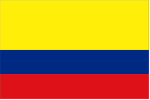
Colombia declared its independence from Spain on this day (July 20) in 1810. Back then the country had to wait nine years to see its dream come to fruition—Spain finally met defeat on August 7, 1819 at the Battle of Boyacá—but now Colombians need only wait two weeks after Independence Day for August 7th to roll around, so they can celebrate all over again.
Colombia is home to the second largest Spanish speaking population in the world after Mexico. Colombia produces 12% of all the world’s coffee, and 95% of the world’s emeralds. It’s the size of France, Spain and Portugal put together, and it’s the only South American nation with coasts on both the Atlantic and Pacific.
Despite being one of the three most bio-diverse countries on the planet, Colombia has had to work hard to combat its dangerous image on the nightly news.
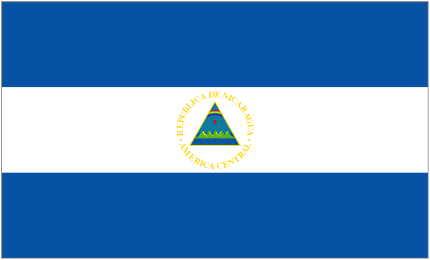
Nicaragua has been the focus of U.S. foreign policy more than most Americans realize.
In the 1850’s, the country was invaded and briefly ruled by a U.S. lawyer-doctor-journalist named William Walker.
At the turn of the 20th century, the country was the proposed site of the canal connecting the Atlantic to the Pacific, until Congress opted for Panama.
During the 1920’s and ’30’s, the U.S. Marines occupied Nicaragua making it “safe for democracy” (i.e., “business interests”).
But the United States’ most enduring impact on Nicaragua (outside of Mickey Mouse and Coca-Cola) may have been the support of the Somoza dynasty which ruled the country either directly or indirectly from the 1930’s through the 1970’s.
The final Somoza was President Anastasio Sonoza Debayle, whose mishandling of Nicaraguan finances in the 1970’s, and particularly after the 1972 earthquake, infuriated the Nicaraguan public. The socialist Sandinista Liberation Front (named for Augusto César Sandino) gained popularity as a militant opposition movement against Somoza’s government.
The revolution killed approximately 50,000 Nicaraguans and climaxed in 1979, by which time Somoza had lost U.S. support and the Sandinistas had gained control of most of the country outside of the capital Managua. Somoza fled to Miami on July 17, which is celebrated in Nicaragua as “Día de la Alegría”.
Two days later the Sandinistas took power.
On July 19, 2009 the country celebrates the 30th anniversary of that takeover, alternately known as Liberation Day and Sandinista Day.
Ironically, the celebrations come as the opposition accuses Sandinista leader Ortega – who lost power in 1990 but returned 17 years later – of promoting “a new family dictatorship” in Nicaragua, currently the second-poorest country in Latin America…
For writer Sergio Ramirez… “[Ortega] wasted the opportunity that history put in his hands, to use his leadership to transform Nicaragua socially and to provide it with better democratic institutions… What there is now is a populist government with a conduct that is confusing in many aspects, that has a demagogic left-wing discourse and a right-wing behaviour in economic policy…”
“We were idealistic people. We were in love with the revolution… But we don’t see now that it was worth it. … The cost in human life, in destruction of property, was a lot higher than the benefit.”
But for the most part, Nicaraguans celebrate Liberation Day with parades, fireworks, and official ceremonies. Many still remember—or were victims themselves—of the violence, censorship and corruption that characterized much of the 20th century.
“We must accept the fact that in our country we cannot win one single victory of political freedom without overcoming a desperate resistance on the part of the Government, and that victory will not come of itself but only as a result of a bitter struggle by the oppressed people for the overthrow of racial discrimination…
The theory that we can sit with folded arms and wait for a future parliament to legislate for the ‘essential dignity of every human being irrespective of race, colour, or creed’ is crass perversion of elementary principles of political struggle.”
Mandela’s story is legendary, not only for the 27 years he spent in prison, but for the reasons he arrived there and for his singular journey since.
Mandela was arrested on Sunday, August 5, 1962 for speaking against the government in public and leaving the country illegally, for which he was sentenced for five years.
“While serving this sentence, he was tried again for more serious charged connected with his leadership of the armed resistance group, Umkhonto we Sizwe. He and his colleagues were convicted of terrorism, narrowly escaping execution, receiving life sentences instead.”
Terrorism? Yes, in a post-9-11 world, heads of state downplay that for nearly three decades Nobel Peace Prize Laureate Nelson Mandela had been deemed a terrorist by the apartheid “justice” system.
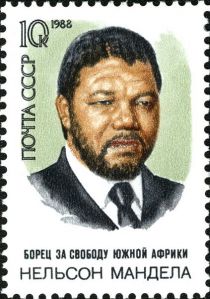
Nelson Mandela stamp, Soviet Union, 1988
During his imprisonment the island on which Mandela was held—Robben Island—became known as “Mandela University.” The political prisoner educated other inmates who then continued the struggle against racism outside the prison walls.
“Did they imagine we might forget him and his companions if they banished him to this island? And did they imagine we could forget the misery of our lives?”
The famous cry “Free Nelson Mandela” really meant “Free South Africa”. On February 11, 1990, the first half of that long sought prize came to pass. Since 1966, not so much as a photograph had been taken of Mandela. His release was broadcast around the world.
After the country’s first truly-democratic elections in 1994, Mandela became South Africa’s first black President.
Freedom, however, is not a moment but a journey. As late as 2008, due to red tape and lack of oversight, Mandela and other members of the African National Congress were still on the U.S. terrorist watch list.
“In the 1970s and ’80s, the ANC was officially designated a terrorist group by [South Africa’s] ruling white minority. Other countries, including the United States, followed suit.” — USA Today 4/30/08
“It is frankly a rather embarrassing matter that I still have to waive in…the great leader, Nelson Mandela.” — Secretary of State, Condoleezza Rice
Mandela and the ANC were removed from the list by a special bill signed by President Bush in July 2008, just prior to Mandela’s 90th birthday.
In South Africa, celebrants “thank Madiba” (Mandela’s honorary title) on July 18th with acts of charity and good deeds, from cleaning cemeteries to painting hospitals.
Meanwhile, in the country of Ghana…
President John Evans Atta Mills on Friday called on Ghanaians to observe Saturday, July 18, 2009 as Nelson Mandela International Day to commemorate his leading role in Africa’s liberation struggle… “The day is Mr. Nelson Mandela’s birthday and those observing this day are required to contribute 67 minutes of their time to the service of their communities in recognition of the 67 years Nelson Mandela has spent in serving humanity.”
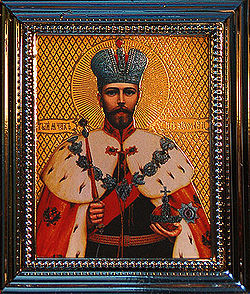
It’s not an official holiday yet, but with the Russian Orthodox Church’s beatification of the last Russian Tsar and his family in 2000, the Romanovs do have their own saint day—July 17—the anniversary of the day they were executed in 1918.
Nicholas II, the last Russian Tsar, is a touchy subject in the former Soviet Union. He and his family met a horrifying end at the hands of revolutionaries who banned all religion in Russia except worship of the state. But Russians also recall that Nicholas’s decisions wrought unrecoverable damage to one of the strongest empires on earth.
Nicholas’ reign was troubled from the get-go. Four days after his coronation in 1896, a panic during his banquet festivities in Moscow resulted in the trampling-to-death of nearly 1,400 celebrants. Though not the Tsar’s fault, Nicholas’ decision to attend a ball at the French Embassy that night anyway did not win kudos from the Russian people.
The following decade saw the tragic massacre known as Bloody Sunday, where striking workers and their families hoping to bring a petition to Nicholas II in St. Petersburg were instead gunned down by police. Public reaction to Bloody Sunday led the Tsar to allocate power to the political body known as the Duma.
But the end of his reign must be attributed to his refusal to pull out of World War I, even when his country was on the verge of total political and economic collapse. Mass mutinies led Nicholas to suspend the Duma, but members of the Duma and the Soviet, as well as leading generals, demanded Nicholas’s abdication. By 1917, the Tsar’s most loyal troops were lying under the sod of western battlefields; he abdicated in March.
Russia’s short-lived democratic government shielded the Romanovs in St. Petersburg, but during the October Revolution, that government was ousted by the Bolsheviks. The Bolsheviks wanted to leave no chance that Russia would return to the old aristocratic system. On July 17, 1918, the Bolsheviks gunned down Nicholas and the entire royal family in a cellar in St. Petersberg, including his wife Alexandra, their four daughters, and their 14 year-old son Alexei.
The Romanov Royal Family
On July 17, 1998, eighty years to the day after their deaths, the royal family was interred in St. Peter and Paul Cathedral in St. Petersburg. They’re considered saints after the 2000 beatification, but not martyrs. To be a martyr of the Church, one’s death must be a direct result of one’s Christian faith. The Romanovs are honored instead as “Passion bearers”—those who met death in a Christ-like way.
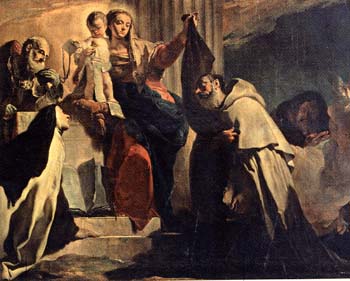
Our Lady of Mt. Carmel gives Scapular to St. Simon Stock
Now therefore send, and gather to me all Israel unto mount Carmel, and the prophets of Baal four hundred and fifty, and the prophets of the Asherah four hundred, that eat at Jezebel’s table.
1 Kings 18:19
What are Carmelites? Was Clint Eastwood their mayor? Are they responsible for my favorite Frappuccino toppings?
No, the Carmelites are named for Mount Carmel in Israel, a peak considered sacred to Jews, Muslims, Christians, and Bahais.
Mt. Carmel is mentioned prominently in the Old Testament, including the Book of Kings, wherein Elijah challenges the prophets of Baal and Asherah to light a fire atop the mountain.
Nearly two-thousand years later, according to hagiographers, a French Crusader by the name of Berthold founded a monastic order on Mount Carmel—on the site of Elijah’s Cave—after receiving a vision from Christ. St. Berthold remained in charge of the monastery until his death in 1195.
The most famed leader of the Order of the Brothers of Our Lady of Mount Carmel, or the Carmelites, may have been an English hermit named Simon Stock. During Stock’s tenure as prior, the Carmelite Order was in danger of being suppressed.
Oppressed by the Saracens, the monks slowly emigrated to Europe. During the night preceding the sixteenth of July, 1225, the Blessed Virgin is said to have commanded Pope Honorius III to approve the foundation.
The legend goes that on July 16th, 1251, St. Simon Stock had a vision of the Virgin Mary who presented him with a sacred scapular and a promise of protection for those who wore it.
“Take, beloved son, this scapular of thine order as a badge of my confraternity and for thee and all Carmelites a special sign of grace; whoever dies in this garment, will not suffer everlasting fire. It is the sign of salvation, a safeguard in dangers, a pledge of peace and of the covenant.”
The Order was not suppressed, and in fact grew in prominence over the next several hundred years, even splitting off into different branches.
Today the special scapular is a defining vestige of the Carmelites, and they celebrate the anniversary of the apparition of the Virigin Mary—Our Lady of Mount Carmel—on July 16th every year.
In observation of the 750th anniversary, to be celebrated on July 16, Pope John Paul II has written a special letter to the Carmelites, saying: “I also carry the scapular on my heart… for the love that it nutures toward the common Heavenly mother, whose protection is continually springing forth.”
July or August
July 13-15 (Gregorian calendar)
15th day of 7th month (lunar calendar)
“In the time of Shaka; one of his fellows Mokuren saw the image of his dead mother suffering in hell. Mokuren was desperate to relieve her pain and asked Shaka for help. Shaka answered, “On 15th of July, provide a big feast for the past seven generations of dead.”‘— Japan 101
OK, Buddha may not have actually said “15th of July”, since he lived 300 years before Julius Caesar. But he did say “15th day of the seventh month.” Whether that’s according to the lunar or solar calendar depends on who you ask.
In the lunar calendar the Festival of Obon—the Japanese festival of the dead—tends to fall in August. But in Tokyo and the east of Japan, many temples observe Obon according to the solar calendar—on July 13th through the 15th. The result is that anywhere you look between mid-July and August there’s bound to be Obon festivities happening somewhere.
Obon is one of the most important holidays in the Japanese calendar, second only to New Year’s Day in most communities. Japanese usually return home to be with their families during the Obon season to carry on a tradition that has been celebrated for over 500 years in Japan.
Families enjoy time together, partake in Obon rituals and tidy up the graves of their ancestors.
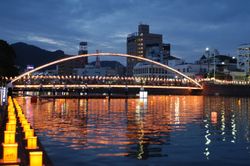
Lantern floating ritual, 2004
One tradition is to release floating paper lanterns on the water on the last night of Obon, in order to guide the departed spirits to the after world.
Another is the age-old Bon Odori, or Bon Dance, which emulates the dance of joy and gratitude that Mokuren did when his mother was released from hell.
Obon is a shortened form of the word urabon’e, which means “hanging upside-down and suffering.” The purpose of Obon is relieve the suffering of the Urabon’e.
As a child, I asked my father, “When was the French Revolution?”
He said, “It began in 1789.”
I asked, “When did it end?”
He said, “It’s still going on.”
* * *
Known as “Bastille Day” in English, Fete de la Federation (Holiday of the Federation) is one of the world’s most famous national holidays, but it’s more commonly known as le Quatorze Juillet (July 14).
The Fete de la Federation commemorates the storming of the Bastille on July 14, 1789. Located in the heart of Paris, the fortress was built during the Hundred Years War as the Bastion de Saint-Antoine. After the war, kings used the Bastion to hold the “evildoers”, such as con-men, embezzlers, political prisoners and Protestants.
Over the centuries the large, imposing Bastille prison became the very symbol of the tyrannical monarchy.
The Bastille
By 1789 France was in deep financial doodoo, in part from supporting the American War of Independence. King Louis XVI took the desperate step of calling together a body known as the Estates-General–a gathering of members of the clergy, nobles, and “everybody else”–to help solve the crisis. The Third Estate (the “everybody else” contingent) represented 97% of France’s population (Nobles and Clergy made up the other 3%) but could easily be outvoted by the other two Estates, as had happened the last time the Estates-General convened, in 1614.
“Since 1614, the economic power of the Third Estate had increased dramatically; in 1788, the popular call was to double the number of the representatives from the Third Estate so that they’d have equal voting power in comparison with the other two estates…TheParlement of Paris conceded the doubling question…but then declared that all voting would be done by individual Estates, that is, each Estate would get one vote.”
“Revolution & Tragedies in France”
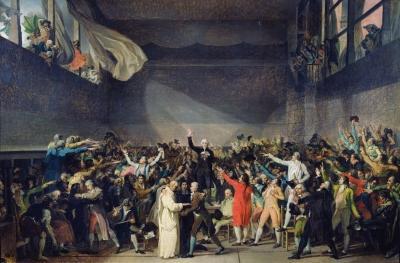
Needless to say, this didn’t enthuse the Third Estate, which walked out of the meeting en masse and formed the National Assembly, joined by sympathetic clergymen and nobles. On June 19, 1789, the king locked and forbade entry to the meeting place of the newly-formed National Assembly, the Salle de Etats. Not easily dissuaded, the Assembly met on a nearby Tennis Court to take what became known as the Tennis Court Oath. Fearing that King Louis XVI would shut them out of the their new meeting place, members of the National Assembly vowed that they would not disband until they had created a Constitution for a new France, based on the principle that the government serve the people.
The Tennis Court Oath
Tensions in Paris grew as King Louis filled the capital with Swiss and German soldiers, who were less sympathetic to the French populace than native-born soldiers. The final straw was not a shot or a massacre, but the king’s dismissal of his Finance Minister Jacques Necker. Necker had been instrumental in calling together the Estates-General, in doubling the membership of the Third Estate, and in involving the public in the financial affairs of the nation. The already discontented public saw his dismissal as an attack on their cause, and they feared King Louis XVI’s next step would be the dissolution of the National Assembly.
On July 12, thousands of Parisians marched onto the Palais Royal where a journalist and lawyer by the name of Camille Desmoulins jumped up on a table outside a cafe by the garden and was said to have yelled,
“Citizens, there is no time to lose; the dismissal of Necker is the knell of Saint Bartholomew for patriots! This very night all the Swiss and German battalions will leave the Champ de Mars to massacre us all; one resource is left; to take arms!”
In recent years, the debate about whether the besiegers of the Bastille sought to free political prisoners, or to take the weapons stored there, has favored the latter. There were only seven prisoners in the Bastille at the time of the siege. After a violent clash between the angry armed crowds outside the Bastille and the forces that guarded it, the crowds stormed the fortress, freed the prisoners, took the munitions, and reportedly decapitated the Bastille’s governor and placed his head on a spike.
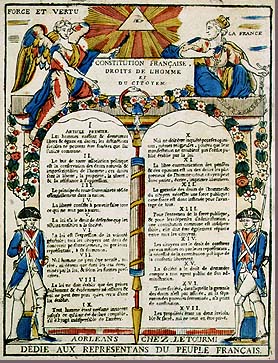
The 500 year-old symbol of French royal tyranny had come to an end; the following month the National Constituent Assembly gave birth to the Declaration of the Rights of Man and Citizen. A document which declared equality not only for all French citizens, but for all men, for all time.
Exactly one year after the storming of the Bastille, Paris hosted the first Fete de la Federation in memory of the event. Hundreds of thousands or spectators gathered around the Champ de Mars to watch soldiers and national guardsmen of France’s 83 departments march, after which King Louis gave an oath to uphold the new Constitution. He would lose his head two and a half years later.