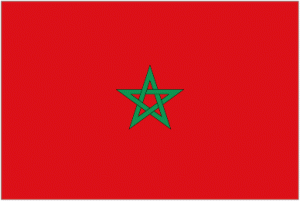
Green March – Morocco

November 6

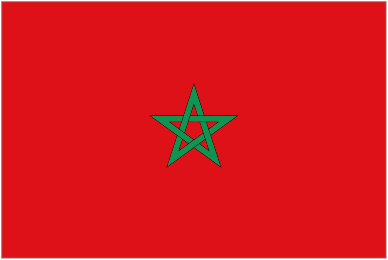
flag_morocco

Nope, this has little to do with the environmental movement. Green here signifies the religion of Islam, and the March in question was led by Moroccans protesting Spain’s continued occupation of the Western Sahara (then Spanish Sahara) well into the 1970s.

The Green March was orchestrated by Morocco’s King Hasan II who emphasized Western Sahara’s long-standing ties with his country.

In 1975, faced with growing international opposition and fighting within the territory, Spain announced the possibility of creating an independent state out of Spanish Sahara.

However, both Morocco and Mauritania (to the southeast) had claims to the territory. Hasan took the case to the International Court of Justice. The Court determined that there were ties between the Saharan territory and Morocco, but that the ties were not substantial at the time of Spain’s colonization of the territory; thus the Court recommended a Saharan referendum on self-determination.

In a televised announcement, Hasan emphasized the first part of the Court’s recommendation—the territory’s ties to Morocco—and called on Moroccans to liberate Spanish Sahara by means of a massive peaceful march.

On November 6, 1975, around 350,000 unarmed Moroccans assembled on their southern border and crossed over into then-Spanish territory calling for the return of Moroccan Sahara. The Spanish commanders refused to fire on the unarmed civilians as Hasan had predicted. The Green March went off peacefully and triumphantly. Later that month Spain agreed to temporary joint administration of the territory with Morocco and Mauritania, after which Western Sahara would be split between the two African nations.

Mauritania withdrew from Western Sahara in 1979 after a guerrilla war movement in favor of Saharan independence. The anniversary of Green March is a triumphant holiday in Morocco, although the call for independence is still hotly debated in Western Sahara.

Morocco Since 1830: A History, by C.R. Pennell

Why Green?

There’s little evidence in the Qur’an for green’s emergence as the color most symbolic of Islam, but numerous Muslim countries include green on their flags. In fact Libya’s flag is entirely green, the only single-color banner in the world.

One Surah (76:21) does notes that in paradise, denizens will be clad in green robes of fine silk.

Other sources claim that the Prophet Muhammad wore green and used green in his armies’ banners.

Still other theologians point to green as the color of nature and of life. So in a sense the Green March may have been related  to the environmental movement after all…
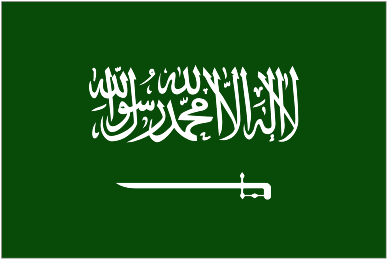
Hajj: the fifth pillar of Islam

November 4-7, 2011

Today begins the Hajj to Mecca in which millions of Muslims around the world will leave their homes to embark on the journey that every financially and physically able Muslim must take once in their lifetime.

Destination: Makkah (Mecca), Saudi Arabia.

The Hajj to Mecca has been called the most diverse gathering of human beings ever assembled. Participants come from all countries, all races, and all walks of life.

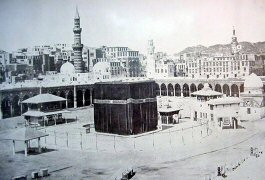
Mecca is the city toward which, the rest of the year, Muslims pray five times a day. During Hajj millions converge on the Masjid al Haram, the holiest mosque in all Islam. The Holy Mosque’s open court can accommodate hundreds of thousands of worshipers, who circumambulate (I don’t get to use that word very often) around the centerpiece of the court: the Kaaba. The Kaaba is a stoic black cube which holds a sacred stone believed to have fallen from heavens in the days of Adam.

Kaaba in the middle of the Holy Mosque, circa 1880

It was here, thousands of years ago that Abraham and his son Ishmael introduced the world to monotheism, by building a small temple in the middle of the desert, as commanded by God. Abraham shouted out to the empty desert a welcome to anyone who would join him in prayer at the Kaaba. Each year during Hajj, millions answer his call.

Though the people of the Arabian peninsula have revered the site long before the days of Mohammad, it was the Prophet who set the stone in its final place. Muslims don’t worship the stone itself–Islam allows no idols of any kind. Rather, the place is revered for its connection to the Prophet Muhammad and to God.

This holy meteor has never been carbon-dated, but it was stolen once. According to www.lancashiremosques.com:

In 317/930 the Qarmatians raided Mecca; they captured the stone, and carried it off to al-Hasa or Bahrayn, where it was kept. Ransom was offered for it, which was ignored. Then in 340/951 it was thrown, the historian Juwayni relates, into the Friday Mosque of Kufah with a note: “By command we took it, and by command we have brought it back.”


During Hajj, pilgrims enter a state of Ihram. During Ihram one may not intentionally harm any living creature, and men must wear two pieces of unstitched cloth, one around their waist and one over their shoulders. As Kamran Pasha, author of Mother of Mother of the Believers: A Novel of the Birth of Islam, explains:

In this way, all pilgrims are dressed exactly the same, eliminating differences of race, culture and economic status. Whether we are kings or paupers, whether we wear suits and ties or dashikis in the world we left behind, we are all the same now – human beings standing equally before our Creator, devoid of manmade distinctions.

Hajj is a spiritual journey, but it is also one of visas and vaccinations. passports and paperwork. The more one prepares, the better. Saudi Arabia does its best to accommodate over a million foreigners crossing its borders for the pilgrimage, but travel prices can be jacked up four-fold during, and sadly, “A number of pilgrims have reported being unable to reach Mecca due to fraudulent travel agencies eager to cash in on the world’s largest religious pilgrimage.”

Circling the Kabah seven times is the most important part of Hajj, but not all of it. Pilgrims also follow the footsteps of Hagar and her son Ishmael as they searched for water in the desert millennia ago. It is said Ishmael struck his foot on the ground and water sprang forth from the sand.

One couple’s unforgettable first Haj

A Journey of Hajj: Recreating Genesis at the House of God

Millions of Muslims Prepare For Hajj 2009

Russian Unity Day

November 4

flag_russia

Russia’s current incarnation of Unity Day dates all the way back to the early 21st century. Yep, it’s fairly new in that respect, but the reason for the celebration goes back to 1612.

In the early 17th century Russia faced full-scale invasion from its Polish-Lithuanian neighbors to the West. These days it’s hard to think of Russia as threatened by Poland and Lithuania, but in 1569 the latter two formed a mighty union known as the Polish-Lithuanian Commonwealth.

The Polish army got as far east as Moscow, and surprisingly 5000 Polish cavalry defeated a force of 35,000 Russian soldiers outside the city, a devastating loss to the Russian army and public morale.

This was known as the Time of Troubles in Russia, referring to the period when Russia lacked a Tsar. Tsar Feodor Ivanovich died in 1598 without heir. The Romonov dynasty would not emerge as the clear leader of the country and reestablish the Tsardom until 1613.

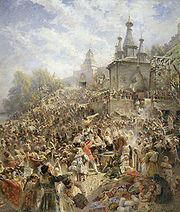
In 1612 a local merchant named Kuzma Minin gathered a ragtag volunteer “national militia” to fight against the Poles. Led by Knyaz Dmitry Pozharsky, the group laid siege to the city and finally ousted the the Poles from Moscow in October (Old Calendar) that year.

The Russians began celebrating the anniversary of the ouster on October 22 (Oct. 22 O.S./Nov. 4 New) in the generations thereafter.

After the formation of the Soviet Union the celebration lost popularity in favor of the anniversary of the 1917 October Revolution.

In 2005 Russia re-established November 4 (October 22 Old School) as Russia’s Unity Day.

Today the main square of the Kremlin is named for Minin and Pozharsky, though Pozharsky gets the short end of the deal, as it’s known colloquially as Minin Square.

"Appeal of Minin", Makovsky, 1896

Bunka no Hi – Culture Day – Japan

November 3

flag_Japan

In Japan, November 3 is Culture Day, or “Bunka no Hi“. The present incarnation dates only to 1948, but Bunka no Hi follows a much older tradition. November 3 was the birthday of the Meiji Emperor (1852-1912) which was celebrated by the whole nation during the Emperor’s reign. The Meiji Emperor is credited for, among other things, ushering Japan into the modern era.

November 3 is also the anniversary of the creation of the post-war Constitution in 1946.

On Bunka no Hi the government awards the Bunka Kunsho—Order of Culture Awards. These are the highest academic and cultural achievement awards in the nation.

Each region has its own ways of celebrating the holiday, but throughout Japan, many communities host parades on November 3. Participants wear the uniforms and dress of olden days and remember the traditions of a bygone era.

“Empty-handed I entered the world
Barefoot I leave it.
My coming, my going —
Two simple happenings
That got entangled.”

— Kozan Ichikyo

Photos and article of Bunka no Hi

All Souls Day

November 2

…For it’s the turn of the year and All Souls’ night,
When the dead can hear and the dead have sight…

Edith Wharton, All Souls

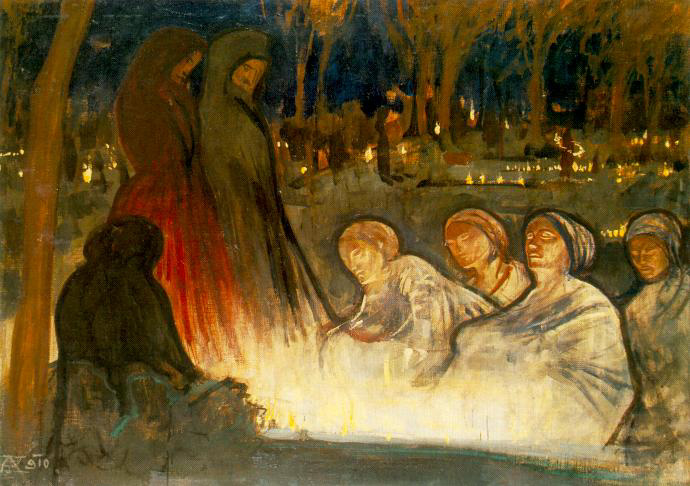
All Souls Day - Aladar Korosfoi-Kriesch

Whereas All Saints Day recognizes the departed whose souls have found refuge in Heaven, All Souls Day remembers those restless spirits still lingering in Purgatory.

All Souls Day originated not in Rome but France.

Around 820 Amalarius of Metz (northwest of Strasbourg) wrote “After the offices of the saints, I have inserted an office for the dead. For many pass over from this present age who are not immediately united with the saints.” (ie. “don’t go directly to heaven.”)

In the early 11th century, St. Odilo, fifth abbot of the Cluny monastery, officiated the feast of All Souls on November 2. Over the century, the tradition was adopted by dioceses across Western Europe.

On All Souls Day, families visit the graves of their loved ones and light candles in their memory.

Fear not the shudder that seems to pass:
It is only the tread of the their feet on the grass…
…For the year’s on the turn and it’s All Souls’ night,
When the dead can yearn and the dead can smite…

…Let them see us and hear us, and say: “Ah, thus
In the prime of the year it went with us!”

All Souls Day is celebrated on November 2, unless the 2nd falls on a Sunday, in which case it’s observed on Monday, November 3 as was the case in 2008.

Halloween

October 31

Pagan: “a follower of a rustic or provincial religion”
from the Latin pagus, meaning a rural district.

The word “pagan” goes all the way back to the Greek root pagos meaning “that which is fixed”. “Fixed” as in “staying in position”, not like, your dog.

After crossing the Adriatic, the Romans used the word pagus to refer to a rural district. Pagan came to mean “country-dweller”.

Under Constantine, Christianity was not only tolerated, the religion replaced paganism throughout the Empire, with a top-down implementation. [For a more scholarly discussion, see the deleted “Storm” scene from X-Men 1.]

Long after Europe had converted to Christianity, some country-dwellers continued to worship their local and regional deities and observe the seasonal rituals of their ancestors to ensure prosperous harvests. Eventually the name for country-dweller became synonymous for followers of the old religions.

+ + +

What makes Halloween so special among American holidays is that it appears to harken back to its pagan roots without the veneer of a Christian holiday, like Easter and Christmas. While Celtic and Germanic traditions such as Walpurgis Night (Witches Night) and Beltane (May Day) have all but died out, Halloween is among the most widely celebrated holidays in the U.S.

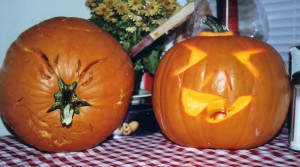
And while several national holidays (such as Memorial Day, St. Patrick’s Day, and Labor Day) are celebrated with parades, sports events, or barbecues, Halloween has several holiday-specific traditions that are celebrated at no other time of the year. This puts it in a small class of holidays that include Christmas, Easter, Thanksgiving, New Year’s, and Independence Day. Yet unlike the above holidays, Halloween is not recognized by the U.S. government. Nobody gets the day off. And still Halloween captivates the country at large and is becoming increasingly popular in Europe. This may be why Halloween has been singled out as contrary to the teachings of Christianity by some sects.

In truth, the holiday owes as much to traditions picked up during the celebrations of the ‘All Saint’s Day’ as to its pagan past. An observer of the Celtic holiday Samhain would hardly recognize the holiday today. Samhain was a cross-quarter day (directly between the equinox and solstice) when the Celts would practice acts of divination—predicting the future.

Some historians believe it was also a day to commemorate the dead, which is why the Pope moved All Saints’ Day–originally May 13–to November 1 to compete with the age-old local pagan traditions.

German and Irish immigrants brought their harvest traditions with them to America in the 19th century, such as the good old pagan bonfire on All Hallow’s Eve.

Hallowe’en masquerade parties were fashionable in Victorian America at the end of the 19th century. By the 20th century, the holiday belonged to the kids.

Which came first, the trick or the treat?

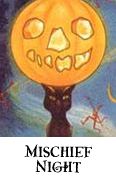
The British tradition of playing pranks on one’s neighbors on the night before Guy Fawkes Day (instituted 1606) traversed the Atlantic, taking hold on All Hallow’s Eve. On the nights leading up to All Soul’s Day, youths would take gates off their hinges, soap up neighbors’ windows, and create all-around havoc and mischief. (Now October 30 is known as Mischief Night). Today kids are much less prone to pull pranks on Halloween, but are more than happy to receive their sugar-coated pay-off.

Halloween is at once a caricature of traditions of rustic peoples, as seen through the eyes of their former enemies, and a wholly unique celebration, that has picked up its own imagery and rituals throughout the centuries.

On Paganism and Etymology

Halloween: Customs, Spells and Recipes

Mischief Night

October 30

At twenty minutes before eight, central time, Professor Farrell of the Mount Jennings Observatory, Chicago, Illinois, reports observing several explosions of incandescent gas, occurring at regular intervals on the planet Mars. The spectroscope indicates the gas to be hydrogen and moving towards the earth with enormous velocity.

We now return you to the music of Rámon Raquello, playing for you in the Meridian Room of the Park Plaza Hotel, situated in downtown New York.

In England Mischief Night originally referred to April 30 (May-Eve or Witches Night), the evening before May Day. Exactly six months apart, May Day and Samhain (November 1) were two of the four cross-quarter dates that Celtics and Druids celebrated during the year. The term Mischief Night was later applied to November 4, the evening before Guy Fawkes Day, when youths would play pranks on unsuspecting neighbors, like soaping up windows and prying gates off their hinges.

When and how Mischief Night got transferred to the evening before Halloween isn’t clear. In the United States, where Guy Fawkes Day isn’t observed, youths in the 1930s took it upon themselves to cause mayhem on the nights leading up to Halloween. What began as minor vandalism–egging cars and toilet papering houses–moved on to arson and destruction of property. In the 1980s and early 1990s, cities such as Camden, New Jersey, and Detroit–where October 30 is called “Devil’s Night”–reported over 100 fires in a single evening. Since that time however, serious Mischief Night crime has significantly declined.

It’s ironic that originally November 1 was the big holiday, and All Hallow’s Eve, was its prologue. Now Halloween has become the major holiday in itself, and Mischief Night fulfills some of the purpose Hallow’s Eve used to serve.

War of the Worlds

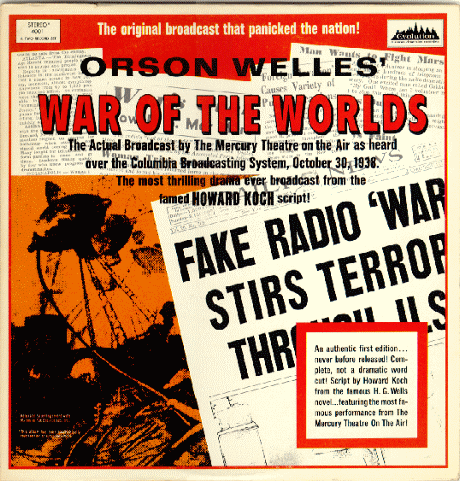
The greatest Mischief Night prank ever pulled happened seventy years ago today. A 23 year-old stage and radio actor named Orson Welles and his Mercury Theatre Players broadcast a radio rendition of H.G. Wells’ The War of the Worlds. Rather than creating a static stage reading or radio-play, Welles took the extraordinary step of reciting the events of the novel as if it were a real news broadcast.

After the initial introduction, in which Welles explained this was a radio play of War of the Worlds, a fake announcer took the listener to the Park Plaza Hotel to hear to music of “Ramon Raquello and his orchestra.” The music was periodically interrupted to inform the listener of live events going on elsewhere, from reports of a gas explosion seen on Mars, to the crash landing of an alien craft in Grover’s Mill, New Jersey.

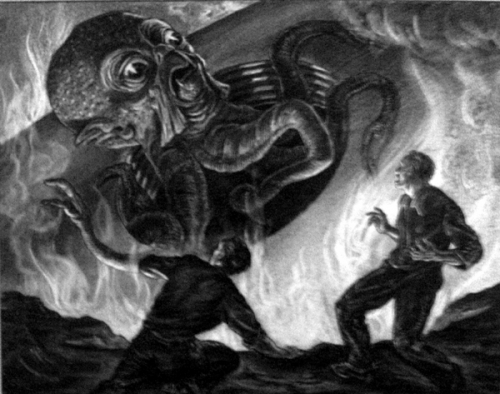
REPORTER: More state police have arrived. They’re drawing up a cordon in front of the pit…Wait a minute! Something’s happening… (Hissing sound) A humped shape is rising out of the pit. I can make out a small beam of light against a mirror. What’s that? There’s a jet of flame springing from that mirror, and it leaps right at the advancing men. It strikes them head on! Good Lord, they’re turning into flame! (Unearthly shrieks) Now the whole field’s caught fire. (Explosion) The woods..the barns…the gas tanks of automobiles…it’s spreading everywhere. It’s coming this way. About twenty yards to my right… (Abrupt dead silence)

ANCHOR: Ladies and gentlemen, due to circumstances beyond our control, we are unable to continue the broadcast from Grover’s Mill…We continue now with our piano interlude…

It was so realistic that listeners who tuned in after the introduction had no idea they were listening to the Mercury Theatre drama-hour…

ANCHOR: Ladies and gentlemen, I have a grave announcement to make. Incredible as it may seem, both the observations of science and the evidence of our eyes lead to the inescapable assumption that those strange beings who landed in the Jersey farmlands tonight are the vanguard of an invading army from the planet Mars.

The battle which took place tonight at Grovers Mill has ended in one of the most starling defeats ever suffered by an army in modern times; 7000 men armed with rifles and machine guns pitted against a single fighting machine of the invaders from Mars. 120 known survivors…

The monster is now in control of the middle section of New Jersey and has effectively cut the state through its center. Communication lines are down from Pennsylvania to the Atlantic Ocean. Martial law prevails throughout New Jersey and eastern Pennsylvania.

Tragically, New Jersey was in tact. However, the broadcast reached an estimated 6 million listeners and led to widespread hysteria across the tri-state area.

At the end of the broadcast, Orson Welles assured his listeners that the prank was simply:

…the Mercury Theatre’s own radio version of dressing up in a sheet and jumping out of a bush and saying Boo!…we couldn’t soap all your windows and steal all your garden gates by tomorrow night…so we did the next best thing…So goodbye everybody, and remember please…That grinning, glowing, globular invader of your living room is an inhabitant of the pumpkin patch, and if your doorbell rings and nobody’s there, that was no Martian…it’s Halloween.

Orson Welles, October 30, 1938

Republic Day – Turkey

October 29

If the earth were a single state, Constantinople would be its capital.

–Napoleon Bonaparte

In the 17th century, the Ottoman Empire stretched from Transylvania to Ethiopia, from Algiers to the Caspian Sea.

By the end of the 19th century, France had chipped away at much of North Africa, the Ottoman Empire’s ‘ally’ Britain had assumed protective control of Egypt, Balkin republics were declaring their independence in Europe, while Arab groups to the East were fighting for the same. In addition, the Empire was crippled by a mountain of debt to European creditors brought on by the Crimean War and the numerous wars that followed.

During World War I, the Ottoman Empire sided with the Central Powers (Austro-Hungary) against the Allied Powers (Britain, France, and Russia). The Empire met with initial successes, but weakened during the War’s progress, partially by internal conflicts such as the Great Arab Revolt and independence movements encouraged by the Allies.

A young military commander by the name of Ataturk, who rose to fame at the Battle of Gallipoli, was enraged at the Allied partitioning of the Ottoman Empire and the occupation of Constantinople. Between 1919 and 1923 he led the resistance in the Turkish War of Independence, fought mainly against Greece, France, and Armenia.

In 1923, after 8 months of negotiations, representatives of the warring states signed the Treaty of Lausanne. The treaty negated Ottoman claims in Iraq, Syria, and Cyprus, and acknowledged the Republic of Turkey as the successor to the Ottoman Empire. The Republic was officially proclaimed on October 29, 1923, and Mustafa Kemal Ataturk became its first president.

Ataturk and the Republic of Turkey