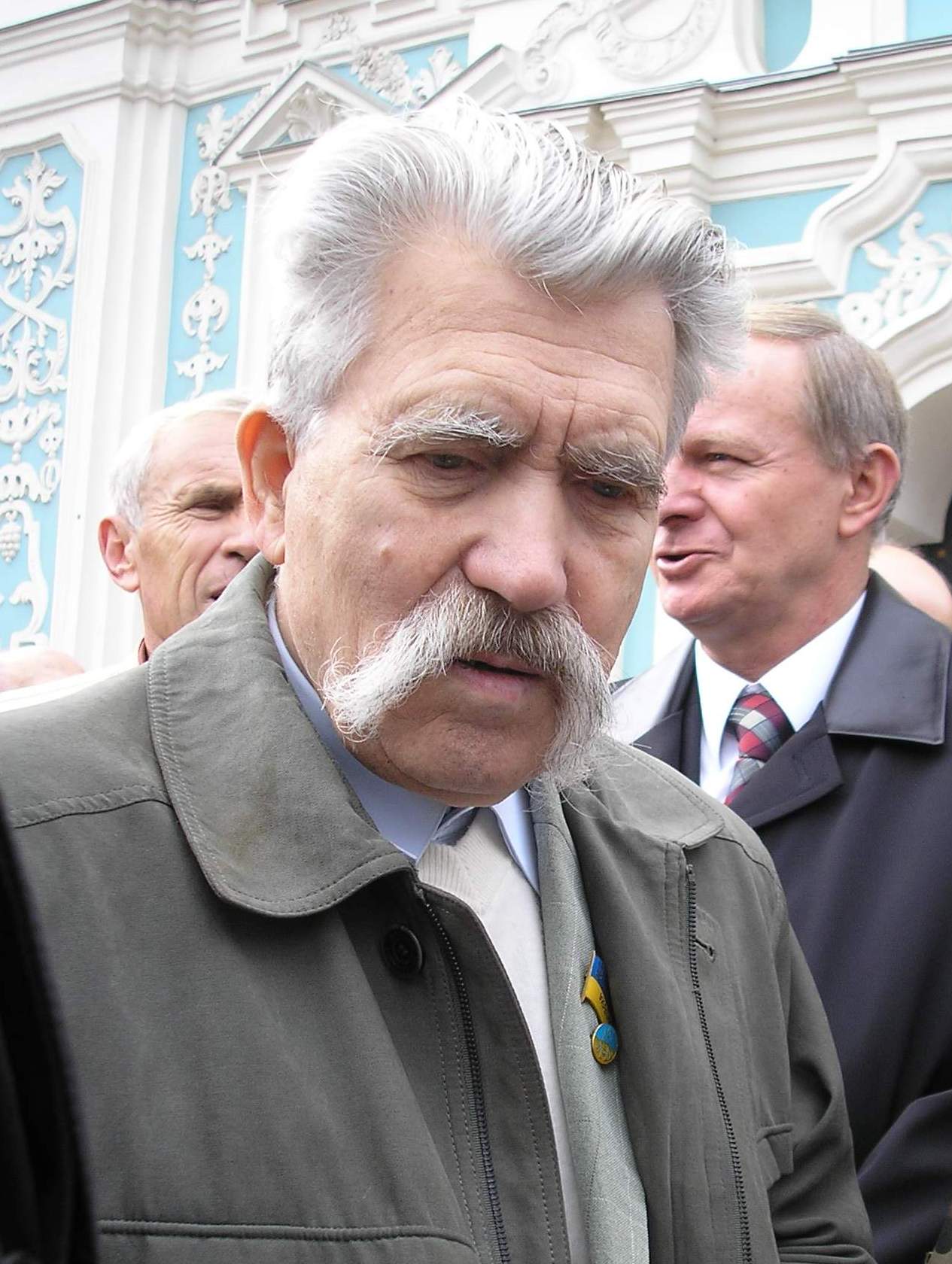
Today is the sixtieth birthday of Ukrainian activist, writer, agitator and politician Levko Lukyanenko. But Ukrainians aren’t celebrating the man, they’re celebrating the document he wrote on this day in 1991, Ukraine’s Declaration of Indpendence:
In view of the mortal danger surrounding Ukraine in connection with the state coup in the USSR on August 19, 1991,
Continuing the thousand-year tradition of state development in Ukraine,
Proceeding from the right of a nation to self-determination in accordance with the Charter of the United Nations and other international legal documents, and
Implementing the Declaration of State Sovereignty of Ukraine,
the Verkhovna Rada of the Ukrainian Soviet Socialist Republic solemnly declares Independence of Ukraine…
Levko Lukyanenko
Back in 1959 Lukyanenko had helped to form the underground organization “Ukrainian Workers and Peasants Society”, for which he wrote the party program. For his involvement, he was sentenced to execution, a sentence that was later mitigated to fifteen years hard labor in the Gulag. His time didn’t dim his revolutionary fervor, but cemented it. After his release, he helped found the Ukrainian Helsinki Human Rights Group.
“All in all, Levko Lukyanenko spent twenty five years in prison and concentration camps and five years in exile, his crime being not murder or armed assault, or robbery but something the soviet regime considered to be the most grievous offence–having views and ideas inconsistent with the soviet ideology.”
Lukyanenko was released during the Soviet prestroika reforms of the 1980s. In 1990 the former enemy of the state was elected to the Ukrainian parliament.
Oh, and it’s Ukraine, not The Ukraine. It means “Borderland”.
Ukraine also gave us St. Nestor the Chronicler (c. 1056 – c. 1114), the monk who spent twenty years writing the great Russian and Ukrainian history “The Tale of Bygone Years”, or “The Chronicle”.
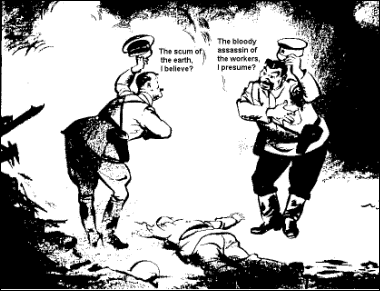
The two most bitter enemies in Europe, Adolf Hitler and Joseph Stalin, had signed a non-aggression pact.
What did it mean? The end of peace and the beginning of the most devastating war in history.
In spite of concern over Nazi Germany’s buildup of military power, the Britain and France had been wary of signing any alliance treaty with the Soviet Union, whom they considered merely the lesser of two evils (and the further of the two, geographically).
Russia had no choice but to oppose Germany, or so the Britain and France believed. Hatred of communism was a founding principle of Hitler’s Nazi movement, and the feeling in Russia toward Nazism was mutual.
Hitler used the West’s alienation of the Soviet Union to his advantage. On August 23, 1939 Hitler and Stalin signed the Nazi-Soviet Non-Aggression Pact. It stated, simply, that the two countries would not attack each other. In other words, it cleared the path for Hitler to attack Poland, knowing Russia wouldn’t attack from the East, should Britain and France attack from the West.
With the two-front war threat out of the way, German tanks rolled into Poland, claiming to do so in retaliation for outbreaks of violence on the German-Polish border.
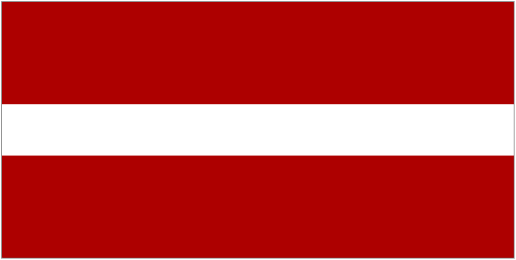
Weeks later the world got a hint of the other part of the Non-Aggression Pact. It was actually a co-aggression pact. Hitler would attack Poland from the West; Stalin would attack from the East. The USSR would get Estonia and Latvia, Germany would get Lithuania, and the two would “split” Poland down the middle.
Germany’s blitzkrieg against Poland was so swift that Stalin was forced to attack Poland sooner than he’d expected. The Poles, who had managed to hold off Germany for two weeks, fought on for another month as their country was hopelessly devoured from both ends by two of the strongest military powers in the world.
The Pact was meant to last 10 years. Hitler broke it in less than two, invading the Soviet Union in 1941.
Though Germany was defeated in 1945, Poland, Lithuania, Latvia, and Estonia remained in Soviet possession. The West was not anxious to spill more blood in central Europe after 6 years of war. Poland was recognized as an independent country in 1952 but remained under Soviet control. However, the Baltic States would wait until the 1990s to regain independence.
In 1986, protesters gathered in 21 cities across the world on the anniversary of the infamous pact, to protest specifically the secret provision signed by Hitler and Stalin that still determined the map of the Baltic. A provision that the Soviet Union still officially denied existed. Three years later, on the 50th anniversary of the pact, two million Estonians, Latvians and Lithuanians joined hands to form the “Baltic Way”. A human chain that stretched 600 kilometers across the three republics.
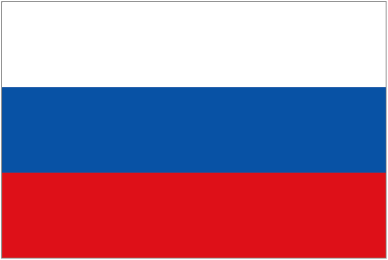
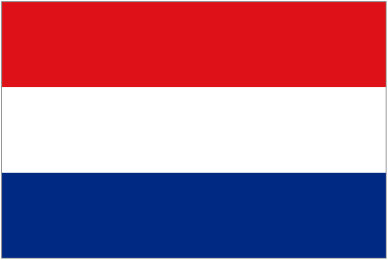
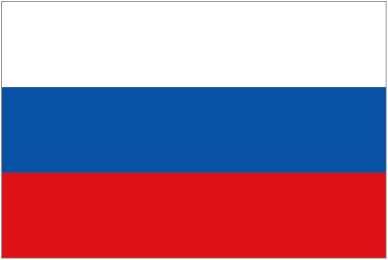
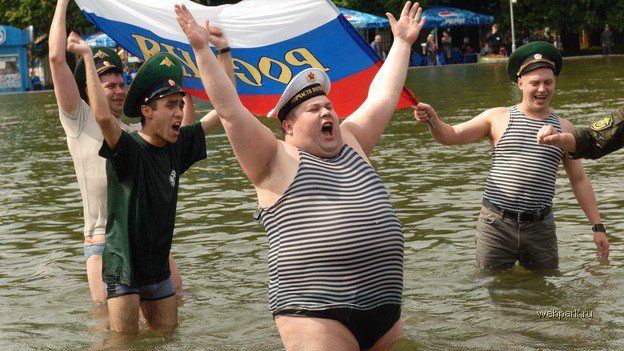
They’re waving the red, white and blue over in Russia today, though not necessarily in that order. The white-blue-red Russian tri-color flag dates back to the 1660s when Czar Alexei Mikhailovich ordered ships to fly a similar banner for identification. Historians speculate it may have been inspired by the Dutch flag, the oldest remaining tri-color national flag.
Dutch flag
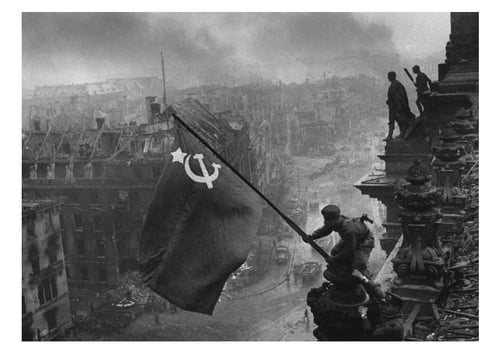
In the 1880s Czar Alexander III declared the tri-color flag the official flag of Russia. After the October Revolution of 1917, the tri-color was replaced by the red Soviet hammer-and-sickle flag.
The Soviet flag flies over the Berlin Reichstag at the end of WWII
Flag Day marks the anniversary of the end of the failed 1991 “August Putsch”, a coup which attempted to stem Soviet president Mikhail Gorbachev’s reformist policies of the 1980s, but which led to the disintegration of the Soviet Union instead.
Subject 110 and The Gang of Eight
In early to mid-1991, Gorbachev–one of the two most powerful men in the world–was placed under surveillance, not by a foreign power, but by his own KGB.
The head of the KGB, Vladimir Kryuchkov, was fearful of the liberal Russian president’s attempts to modernize the country through the decentralization of power. Gorby was working with leaders of the separate Soviet republics on a treaty that would increase the sovereignty of the republics, a move he deemed necessary to sustain the unity of the whole. Hard-liners opposed the treaty.
In July, Khryuchkov overheard a conversation between Subject #110 (Gorbachev) and Russian President Boris Yeltsin in which it was suggested that they replace old school party members like Kryuchnov and his cronies with more liberal ones.
Kryuchkov was not down with this. Nor were his seven cronies, henceforth know as the “Gang of Eight.”
On August 18, some of the Gang of Eight paid Gorbachev a friendly visit while he vacationed at his dacha in the Crimea, during which the concerned visitors ensured the Soviet leader’s rest and privacy by cutting off all channels of communication and placing him under house arrest. The following day they attempted to assume control of the country, due to Gorbachev’s “illness”.
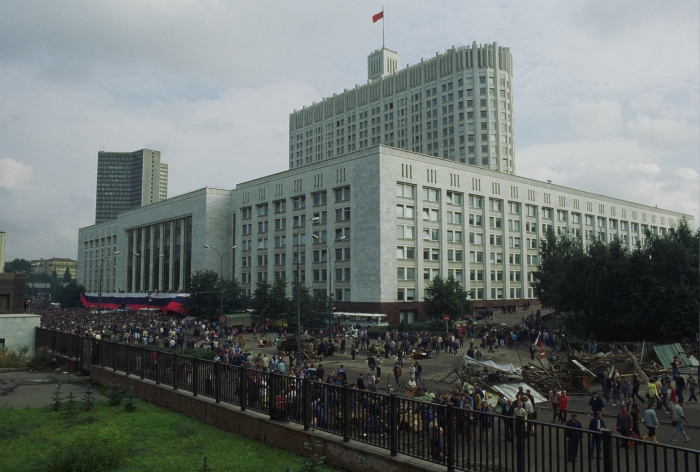
A quarter million handcuffs and arrest forms had been ordered. Prisons were emptied to make room for agitators. Independent newspapers were shut down, and tanks prepared to roll into the capital to seize control of the Russia’s parliament building, the “White House”.
The Russian "White House" (note the barricades)
Boris Yeltsin and other leaders urged the military not to support the coup. They called for a general strike and demanded that Gorbachev be allowed to address the nation. Citizens surrounded the White House and barricaded it with whatever they could — trolleys, street sweepers, homemade barriers — to prevent the military from attacking.
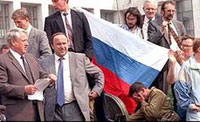
Boris Yeltsin (left) during the coup
On August 21, at 1 AM, tanks and army vehicles moved in. A pivotal moment was when Spetsgruppa A (Alfa Group), the military unit entrusted with entering the White House and killing Boris Yeltsin and company, analyzed the number of civilian deaths such an action would require, and refused to carry out their mission.
The hard-liners knew they were in deep. They attempted to strike a deal with Gorbachev. He refused to meet with them. That evening communications were restored at the dacha; Gorbachev denounced the actions of the Gang of Eight, ordered their dismissals, and resumed control of the country.
The following day, August 22, the Russian legislature chose to fly Russia’s historic tri-color flag rather than the hammer-and-sickle flag of the Soviet Union.
It was only a piece of cloth, but the symbolic gesture of raising the pre-Soviet flag was tantamount to Russia declaring its own independence from the Soviet Union. And without Russia, there could be no Soviet Union.
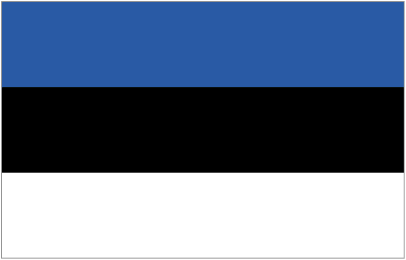
Between August 20 and August 30, Estonia, Kyrgyztan, Belarus, Moldova, Azerbaijan declared independence. In September, Uzbekistan, Latvia, Tajikstan, and Armenia did the same.
Ten years later…
“A poll released in July said only 10 percent regarded [August 1991] as a democratic revolution that ended Communist power. Twenty-five percent look back at August 1991 as a tragic event whose aftermath was disastrous for the country.” — NewsHour, August 22, 2001
Twenty-seven years ago today a shot rang out in a Manila airport.
Returning to the Philippines after three years in exile, Benigno Aquino, leader of the Liberal Party and the most vocal opponent of President Ferdinand Marcos, was struck dead by an assassin’s bullet.
Twelve years to the day prior to his death, Aquino had escaped another attack. He was not present at a Liberal Party rally where two fragmentation grenades were thrown on stage, killing 9 and injuring almost 100 Liberal Party members and supporters. In response to the bombing, President Marcos suspended habeas corpus and arrested scores of Maoists.
The following year he declared martial law, and had Aquino, his #1 opponent, arrested. Although no evidence connected Aquino to the crime, a military tribunal found Aquino guilty and sentenced him to death by firing squad. The sentence was later mitigated, but Aqunio remained in prison for seven years. In jail Aquino suffered a heart attack and was granted leave to receive surgery in the United States.
Aquino and his wife Corazon did not return to the Philippines for 3 years. In that time both were active speakers against the Marcos government, which had amended the Constitution in the 1970s and 80s to extend martial law, increase the scope of Marcos’s power and the length of his term.
Benigno Aquino returned to Manila on August 21, 1983, knowing full well the many dangers that awaited him. Below is the beginning of the address he was set to give upon his return.
“I have returned on my free will to join the ranks of those struggling to resolve our rights and freedoms through non-violence. I seek no confrontation. I only pray and will strive for a genuine national reconciliation founded on justice. I am prepared for the worst, and have decided against the advice of my mother, my spiritual adviser, many of my tested friends, and a few of my most valued political mentors.
“A death sentence awaits me. Two more subversion charges, both calling for death penalties, have been filed since I left three years ago and are pending with the courts. I could have opted to seek political asylum in America, but I feel it is my duty, as it is the duty of every Filipino, to suffer with his people especially in time of crisis.
“I never sought nor have I been given any assurances or promise of leniency by the regime. I return voluntarily, armed only with a clear conscience and fortified in the faith that in the end, justice will emerge triumphant.”
Aquino never had a chance to deliver the speech. He was assassinated “by a lone gunman” according to the government, the moment he stepped off the airplane.
Ninoy Aquino
He was reportedly called “The Greatest President we never had,” by Liberal Party leader Jovito Salonga.
There was never proved any direct evidence linking Marcos to the assassination, but it sparked widespread discontent with the Marcos administration. In November 1985 Marcos announced Presidential elections to take place in February. Benigno Aquino’s widow Corazon ran against Marcos. The Marcos government claimed to have won the election, but accusations of extreme voter fraud and massive public demonstrations against his rule combined with military opposition and U.S. pressure forced Marcos to resign on February 25, 1986.
Beningo Aquino’s widow Corazon Aquino became the first female President of the Philippines. She passed away on August 1, 2009.
Though worshipped differently across many Hindu sects, Krishna is one of the holiest figures–if not the holiest–in the Hindu religion. He was born at midnight on this, the eighth day after the full moon of Bhadrapada/Shravan, in the year–well, before you were born.
In 2010 Sri Krishna Jayanti, or Krishna Janmashtami, falls on September 1 or 2, depending on location.
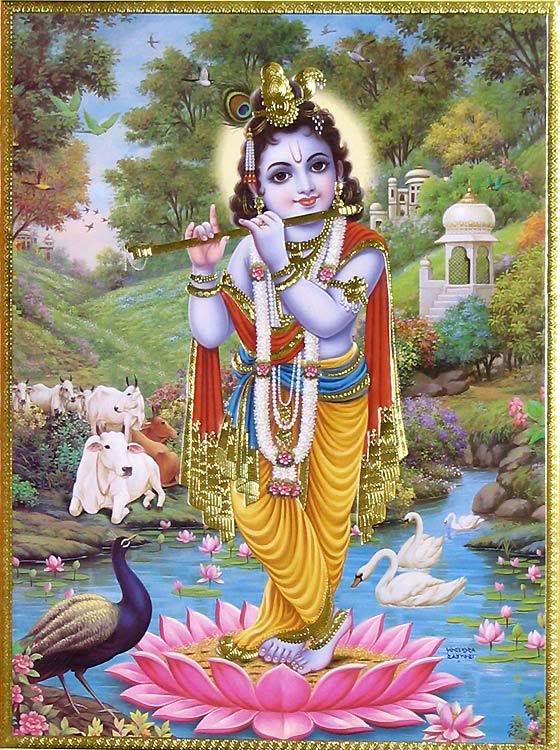
Krishna is considered the eighth and greatest incarnation of the god Vishnu. In art, he’s commonly pictured as a baby or as a youngster playing the flute. Krishna means “black”, but he’s more often depicted as blue.
Before Krishna was born, a prophecy was told to the King Kamsa. That he–the king–would be killed by his cousin’s son. Kamsa placed his cousin Devaki and her husband Vasudeva in prison. Every son that Devaki bore, Kamsa had killed. Six children in all. The seventh boy, Balarama, was magically transfered to the womb of another woman. The eighth child Vasudeva managed to sneak out of the prison. The boy was Krishna. Vasudeva encountered a cow-herding couple who had just given birth to a daughter. They switched babies and Vasudeva returned to the prison, showing Kamsa that the child was a girl, not a boy.
Krishna grew up with the humble cow-herding family. He was a mischievous kid, known for playing pranks and for seducing women with the romantic music of his flute.
When the King heard of Krishna’s existence he invited Krishna to a wrestling match, set up to trap and kill Krishna and his elder brother Balarama. The brothers foiled King Kamsa’s plans, defeating first a mighty demon elephant and the King’s best wrestlers.
When the King drew his sword, Krishna grabbed him by the hair and crushed him to death, fulfilling the prophecy.
The holiday comes to a climax at midnight tonight, when Krishna was said to have been born. Krishna is worshipped through the chanting of Vedic hymns, and mantapam structures built in his honor are decorated with thindis snacks and fruits…
After midnight, it’s all gonna be peaches and cream.
Today Hungarians honor the founder of their nation. Over a thousand years ago King Stephen (that’s Saint Stephen to you) was crowned King of Hungary. Though a saint, King Stephen was not someone you’d want on your bad side. He once killed an opponent by having his eyes gouged out and pouring molten led into his ears. And that was his cousin.
King Stephen. No, it's not a fro.
The whole molten-ear thing aside, he was considered a pious king, who imbued his dominion with Christian principles and established a Hungarian state very similar to the one still in existence. Even then Hungary was a multicultural nation, which the king encouraged:
“Foreigners coming from different countries and places to settle here bring with them a variety of languages, customs, instructive matters, and arms, which all contribute to adorn and glorify the royal court…A country speaking but one language, and where uniform customs prevail, is weak and fragile.”
King Stephen’s words have survived to this day. He once wrote to his son Emeric:
“Thou hast been brought up amidst delights and treasures, and knowest nothing of the arduous labors of war and the perils of hostile invasions by foreign nation, in the midst of which nearly my whole life has been passed.
The time has arrived to leave behind thee those pillows of luxuriousness which are apt to render thee weak and frivolous, to make thee waste thy virtues, and to nourish in thee thy sins…
…Rule over [thy subjects] peaceably, humbly, and gently, without anger, pride, and envy, bearing in mind that all men are equal, that nothing exalts more than humility, nor is there any thing more degrading than pride and envy.”
He forgot, however, to pass on the most valuable wisdom a parent can offer a child: “Ease off the boar hunting.”
Emeric was killed in a boar hunt accident in 1031–according to legend, on the same day he was set to inherit the kingdom. King Stephen never fully recovered from the loss.
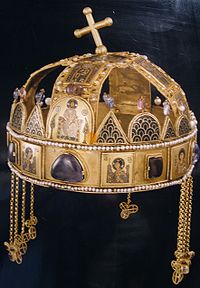
Holy Crown of Istvan (Stephen)
For a man so blessed in other arenas, Stephen had poor fortune when it came to progeny. The father of the nation had no children of his own to take over the crown.
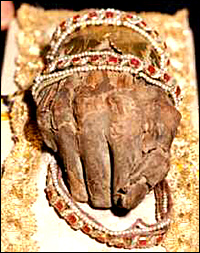
He died on August 15, 1038. His saint day is the following day in the Roman Catholic church: August 16. However, the Hungarians honor him on August 20–the anniversary of the date his remains were brought to Buda. It turns out that not only were Stephen’s words, his Christian piety and his principles preserved, so was his hand.
His right hand. And each year on St. Stephen’s Day Hungarians line the streets as the king’s surprisingly well-preserved 1000 year-old right hand is paraded through the capital.
Before you grab your towel and get undressed, no, this has nothing to do saunas or back rubs, so put your pants back on. This is a family blog.
No. Spas in Russian means “savior”. The ‘Spases‘ are three folk holidays celebrated in August, that bring the Russian summer season to a close with style. And food.
August 14 (Gregorian) is mokryi Spas, or “Wet Savior”, but is more commonly referred to as Honey Spas (medovyi Spas), so named because it coincides with the late-summer gathering of honey.
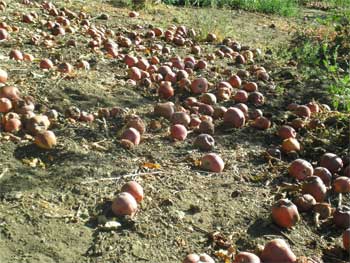
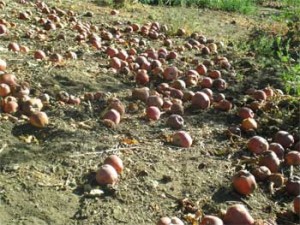
The second, and most important of the three takes place today. Spas na gore/iablochnyi Spas, aka, “Savior on the Hill”/”Apple Spas”.
Apple Spas falls during the Feast of the Transfiguration in the Eastern Orthodox Calendar (August 19, Gregorian; August 6, Julian). Fruits and veggies from orchards and gardens are blessed today, and it’s considered bad luck to eat apples until now. More specifically, children in heaven are said to receive apples to eat this day, only if their living parents have not done so before Apple Spas.
The third Spas is orekhovyi Spas–Nut Savior–which once coincided with–you guessed it–the gathering of nuts at month’s end (August 29, Gregorian; August 16, Julian).
The Spas developed out of agrarian festivals during which the first spoils of the harvest were consecrated in honor of nature deities, in the hopes of a bountiful harvest and mild winter. Over the centuries the folk festivals became inextricably intertwined with Christian traditions.
The Apples Spas coincidentally falls on the anniversary of the start of the 1991 coup in which Soviet leader Mikhail Gorbachev was kidnapped by hard-liners who disagreed with his reformist policies. The coup failed, and within days, five Soviet republics had declared their independence. By the year’s end, the 75 year-old Soviet Union had ceased to exist.
There sang a mother to her babe–
A mother young and fair–
“No flower like thee adorns the vale,
O sweet Virginia Dare…
Whatever Became of Virginia Dare?
On this day in 1587 the first child of English parents was born in America. Virginia Dare was the daughter of Ellinor and Ananias Dare, and granddaughter of John White, governor of the colony known as Roanoke in what is now North Carolina.
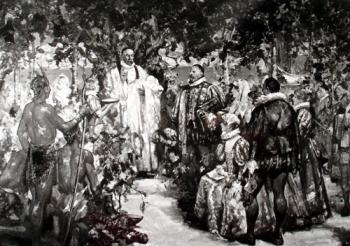
Baptism of Virginia Dare
History texts record Ananias as both a former bricklayer from London and as an “aristocratic young man.” He was one of the Governor’s Assistants, in addition to being his son-in-law.
We only know about Viriginia Dare’s existence because shortly after her birth and baptism, her grandfather John White left the colony for England to seek materials and support. The journey took six months, during which time he encountered pirates, bad weather, and a near shipwreck, before finally landing–not in England, but Ireland.
When he finally returned to the colony in 1591, all trace of the colony, including his daughter and granddaughter, had disappeared.
To this day, whatever became of the “Lost Colony” of Roanoke remains a mystery. Virginia Dare has been the subject of historians and novelists, and the inspiration of poets and other artists in America for 400 years. From the poetry of Lydia Howard Sigourney to TV’s Buffy the Vampire Slayer. Today, inhabitants of Roanoke Island celebrate the 423nd birthday of Virginia Dare and ponder the fate of America’s first colony.
He calls–he shouts–the cherished names,
But Echo makes reply.
“Where art thou, Ellinor! my child!
And sweet Virginia Dare…”