And of all the annual celebrations on earth there is none older and more universal than the celebration of the Winter Solstice.
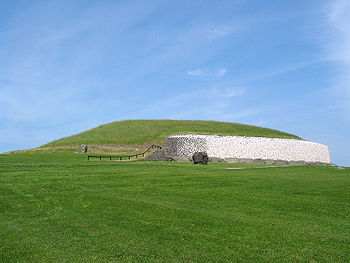
Many of the world’s oldest monuments, which for years baffled anthropologists and archeologists, are now believed to have functioned as massive calendars that predicted the winter and summer solstices with astonishing accuracy. From Newgrange in Ireland and Stonehenge in England, both of which predate the Druids, to the Chankillo towers in Peru built 1700 years before the Incas, to the 365-day calendar used by the ancient Egyptians. All of these calendars were used to make sense of and to find meaning and patterns in an otherwise mysterious and unpredictable world.
Newgrange, Ireland
The word “Yule” used in Germanic and Norse countries comes from “yula” meaning wheel, referring to the cycling of the seasons and the wheel of time. The term predates Christianity, but today yule-tide greetings are synonymous with the Christmas season.
The word Solstice comes from the Latin words “sol”, or “sun,” and “sistere”, meaning “to stand still.” The Solstice is the moment at which the sun stands still. Winter Solstice marks the longest night and shortest day of the year, and it usually falls on December 21 or 22. From that night on forward the ancients knew–or prayed–that the days would grow longer and warmer, providing for sufficient harvest and plenitude the following year.
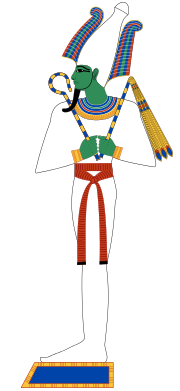
As early as 2400 BC the ancient Egyptians worshipped Osiris, the god of death, life and fertility Osiris during the solstice. It was the day on which he was said to have been entombed and reborn. This tradition was echoed in later Greek ceremonies paying homage to Dionysus.
Osiris
The ancient Romans celebrated the solstice with a week-long festival called Saturnalia, honoring Saturn, the god of agriculture. The symbols they used included holly and wreaths, and it was a time of exchanging gifts.
The Druids called this time Alban Arthan, the Light of Winter. Although it has also gained the interpretation Light of Arthur by the poets, harkening to the legendary king who was associated with the sun and believed to have been born on the Winter Solstice.
In the Norse lands on Yule’s Eve a boar was sacrificed and its meat used for the holy feast. Those who could not afford to do so, broke a boar-shaped loaf of bread in its place.
December 20, 2011 December 8, 2012 November 27, 2013
Hanukkah, or “Chanukkah” as those in the know call it, is one of the most misunderstood Jewish holidays. In fact, we don’t even know what “Hanukkah” means. Many believe it means “dedication”; others say it’s an acronym for “They rested on the 25th”. (Hanukkah starts on the 25th of Kislev.)
Hanukkah is a minor holiday in Judaism–in theory if not in practice–and isn’t mentioned anywhere in the Hebrew Bible.
That’s not to say Talmudic scholars haven’t argued about Hanukkah’s customs for ages (Whether, for example, celebrants should light one extra candle per night, or light eight on the first night and take one away each night). But the absence of holiday regulations in the Jewish Scriptures may have contributed to Hanukkah’s ability to adapt to various cultures of the Jewish diaspora.
Hanukkah History
After the death of Alexander the Great in 323 BC, the land around Jerusalem came under the power of the Seleucid Empire.
By the 2nd century BC, the Jews of and around Jerusalem were in the midst an identity crisis: whether to maintain their own religious traditions or to assimilate into Hellenistic culture. Many Jews in the cities were willing to adopt Greek ways. According to 1 Maccabees:
In those days there appeared in Israel men who were breakers of the law, and they seduced many people, saying “Let us go and make an alliance with the Gentiles all around us…Thereupon they built a gymnasium in Jerusalem according to the Gentile custom. They covered over the mark of their circumcision and abandoned the holy covenant…
Now back then the gym wasn’t Bally’s. It was the center of Greek social life, where men discussed topics of the day in the nude, a practice which went against Jewish law, and a place where Jewish men could not easily hide the 8th-day snip.
The Seleucid Emperor Antiochus set forth increasingly harsher restrictions on Jewish rituals, including the killing of newly-circumsized babies. He replaced the Jewish High Priest with his own puppet priest, turned Jewish temples into pagan ones, and eventually forbade the practice of Judaism altogether.
One religious leader known as Mattathias refused to make a sacrifice to a pagan god in the temple. When a Hellenized Jew attempted to make the sacrifice in his name, Mattathias killed the Jew as well as one of the king’s messengers. Mattathias then fled to the countryside with his 5 sons, and recruited traditionalist Jews to join his cause.
After Mattathias’ death, his son Judas “the Hammer” Maccabee (Maccabee means hammer) led a revolt against the Greek establishment. According to 1 Maccabees, despite being greatly outnumbered, Maccabee’s rag-tag crew defeated the opposing forces and re-consecrated the temple.
What’s up with the candles?
The miracle of the “Festival of Lights” was that the Jews only had enough oil to keep the temple’s sacred flame alight for one night. However, the flame stayed alight for eight days. For this reason, Jews continue to light an eight-candle “menorah” every year. The great Jewish philosopher Hillel won out on the menorah debate: Jews light one candle on the first night, and one more candle every night thereafter.
[One Jewish-Persian custom is to light eight candles the first night of Hanukah and eight more candles each additional night for a total of 64 on the eighth night, although we suspect this tradition was started by the Jewish-Persian candle-makers union.]
Hanukkah Ironica
Hanukkah originally represented a victory of Jewish culture over assimilation into Greek culture. However, much of the importance that Hanukkah has today is the direct result of assimilation.
The observance of Chanukkah grew in importance during the 19th and 20th centuries in predominantly Christian nations such as the United States, as Jewish culture sought to adapt to the growing influence of of Christmas. Modern Hanukkah traditions such as gift-giving are borrowed straight from Christmas, which is of course celebrated around the same time of year, and which owes many of its own traditions to solstice festivals of the Greco-Romans. So in a sense, over 2000 years later, Greek influence is still going strong.
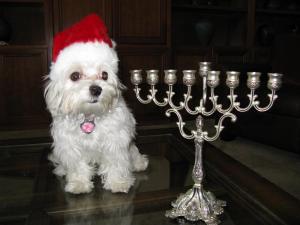
Ilse, the spiritually-confused Maltese
Hanukkah is a modern example of how holidays continuously change by synthesizing attributes of merging cultures. It’s the type of transition that took place countless times in ancient and medieval history, though detailed records of such transitions have all too often been lost to time or intentionally obscured.
Ashura (aka Ashoura) means 10th. Ashura falls on the 10th day of Muharram, the first month of the New Year. Fasting, though not obligatory during Muharram, is highly encouraged on this date.
Ashura is observed by both Shi’a and Sunni Muslims throughout the world, although for varying reasons. These differences give insight to the both commonalities and the conflicts between the two branches of Islam.
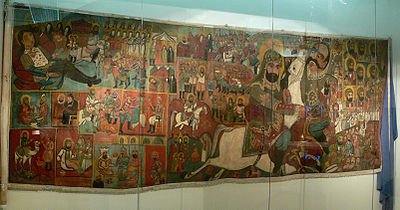
Ashura is one of the most sacred days of the year for Shi’a Muslims, who commemorate the martyrdom of Hussein ibn Ali in the Battle of Karbala. The battle took place on Muharram 10, 61 AH, or October 10th 680 CE in what is now Iraq.
Hussein was the son of Ali ibn Abi Talib and the grandson of the prophet Muhammad. Hussein and over a hundred of his followers, many of whom were family of Muhammad, were slain in the Battle of Karbala.
Hussein is the third Imam of Islam for the Shi’a Muslims.
In the immediate wake of the passing of Muhammad, disagreement arose as to the true successor of Muhammad, and two groups solidified.
The larger group elected the Abu Bakr, Muhammad’s father-in-law and close companion, citing among other things, Muhammad’s asking of Abu Bakr to lead prayers at mosque shortly before his death. These followers became the Sunni. They felt that election was the accepted way of deciding leadership at that time, and that Muhammad would have agreed to this, or would have left no doubt as to his successor.
But the election took place without the participation of key members of Muhammad’s family, including his daughter Fatima and son-in-law Ali, who were preparing Muhammad’s body for burial. This smaller group believed Muhammad chose Ali as successor, citing as partial evidence a speech Muhammad made at Ghadir Khumm:
“Of whomsoever I am the mawla, Ali is his mawla.”
Mawla means “friend,” but it can also mean “master” or “protector.”
Also, the Shi’a believed that since the prophet Muhammad was appointed by God and God alone, his legacy was passed on by blood, not by the elections and factions of men.
In the 24 years between Muhammad’s death (632 CE) and Hussein’s ascension to Caliph, three Caliphs ruled the Islamic empire: Abu Bakr, Umar, and Uthman.
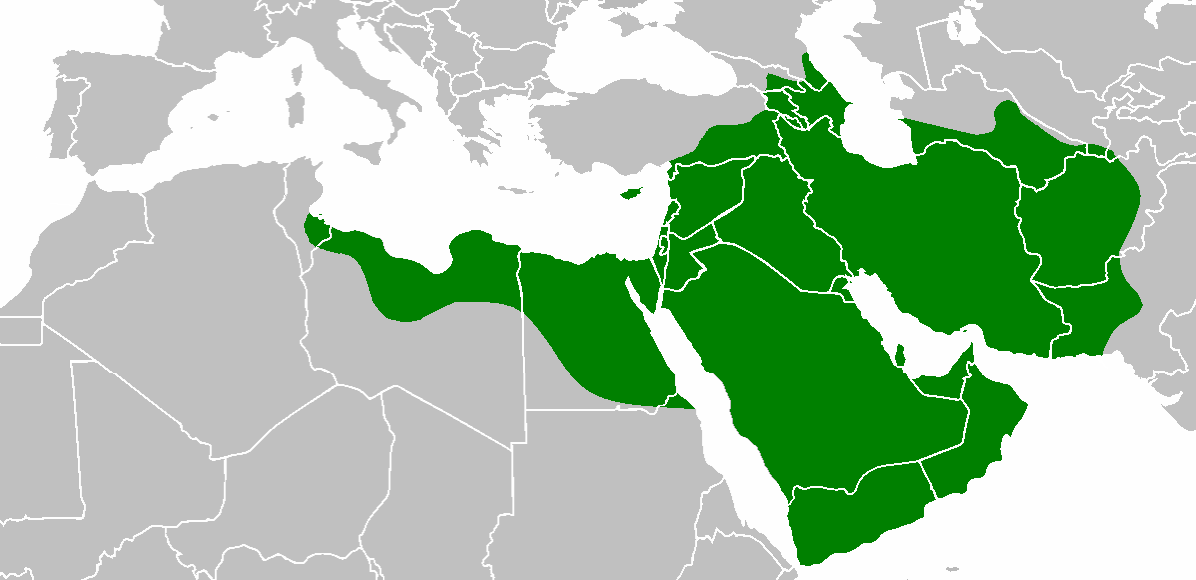
Under their reigns the Empire spread from Arabia to what is now Pakistan and Afghanistan in the East, to Turkey and Georgia in the North, and to southern Spain and northern Morocco in the West.
(Islamic Empire under Caliph Uthman, 656 CE)
Uthman’s reign was the longest, lasting just over a decade. In 656 CE Muslim rebels laid siege to his palace and killed the Caliph. What follows is one of the most hotly debated aspects of all Islam.
Uthman was succeeded by the son-in-law of Muhammad, Ali ibn Abi Talib. Initially Ali is reported to have initially refused the Caliphate, but he eventually accepted.
Aisha, a wife of Muhammad and daughter of the first Caliph Abu Bakr, believed Ali let Uthman’s killers off the hook too easily and raised an army to overthrow Ali. This did not succeed, but increased tensions between the two factions.
Around this time Muawiyah I, governor of Syria appointed by Umar, refused to acknowledge Ali as the new Caliph. Muawiyah had been the son of a powerful family controlling Mecca in the days of Muhammad. Ali doubted his piety, for Muawiyah had converted to Islam only when it was politically advantageous to do so. Muawiyah rebelled against Ali in what is known as the first Fitna, or Muslim Civil War. A truce was reached, but when Ali appointed one of Uthman’s suspected killers to be governor of Egypt, Muawiyah invaded Egypt and assumed authority.
In 661 CE the first Imam Ali was killed by the poisoned sword of a Kharijite. By this time Muawiyah, as ruler of Syria and Egypt, was the most power man in the Empire. He forced Ali’s oldest son, Hasan, to step down as the new Caliph.
When Muawiyah died in 680 CE (60 AH) he appointed his son Yazid as Caliph. This was the first time the Caliphate had been passed from father to son.
Which brings us to Hussein ibn Ali. Hasan’s younger brother. Hussein refused to acknowledge Yazid as ruler and mounted a campaign against him.
Meanwhile rebellion broke out against Yazid in Kufa. Yazid’s forces squashed the rebellion.
Hussein, unaware of this, set out for Kufa with a band of followers numbering between 108 and 136. He expected to be greeted with support in Kufa, but encountered Yazid’s troops, led by Umar ibn Sa’ad near the city of Karbala.
It was on the tenth day of Muharram that Hussein ibn Ali and all his supporters were killed by overwhelming forces.
In the aftermath of the battle the news of Hussein’s death solidified the Shi’a people against the Umayyad dynasty.
“Many westerners do not understand why it is that Shia Muslims mourn the martyred Imam Hussein as though the event did not occur a thousand years ago but as if it happened as recently as yesterday.”
Today Shi’a Muslims around the world are united in their view of Yazid as a force of evil.
Many Sunni join them in this depiction. However, Sunni are divided. And in addition to remembering the death of Muhammad’s grandson Hussein, Sunni observe Ashura for additional reasons. According to tradition, the 10th of Muharram is the anniversary of the date:
God created the earth
Adam and Eve were banished from Heaven, or the Garden,
Noah, or Nuh, stepped off the ark onto Mt. Judi
God saved Moses, or Musa from the Egyptian Pharaoh
Abraham, Moses, and Jesus were born
The origin of the establishment of Ashura for all these dates is unlcear. In his journeys Muhammad observed the Jews celebrating the tenth of Muharram as a day of Atonement (Yom Kippur).
Today, both Sunni and Shi’a mourn the tragedy of the death of the grandson of Muhammad, and Ashura is commemorated in different ways by the one-billion-plus followers of Islam.
“I had long been deeply impressed by the religious fervor of hundreds of thousands of Iranians whom newsreels in the 1980s showed marching in the streets, flagellating themselves with heavy-duty, Hydra-headed whips, drawing blood to commemorate the martyrdom of Iman Hossein in 683 CE. When I found myself in Shiraz on the memorial day Arbaeen, which marks the 40th day after the martyr’s death, I heard that self-flagellations were about to take place down the road, and I rushed there with my camera and notebook. What I found was a well-stylized dance. Young men were eagerly stepping in a circle to the tune of pleasant, if repetitive, music, gently waving slight whips, with which they symbolically touched their well-covered backsides. They did not even work up a sweat, much less draw blood.
His Highness the Aga Khan has been the Imam of the Shia Ismaili for over fifty years. The Ismaili are the second largest group of Shia in the world. At age 20 he was chosen by his grandfather to succeed him rather than his father or uncle. Wrote his grandfather, Sultan Muhammed Shah Aga Khan:
“In view of the fundamentally altered conditions in the world in very recent years due to the great changes that have taken place, including the discoveries of atomic science, I am convinced that it is in the best interests of the Shia Muslim Ismaili community that I should be succeeded by a young man who has been brought up and developed during recent years and in the midst of the new age, and who brings a new outlook on life to his office.”
Five years before 9/11 the Aga Khan gave a foretelling speech to a group of young people, mostly Americans, about to enter “the real world.” Excerpts are below.
“Today in the occident, the Muslim world is deeply misunderstood by most.
“The Muslim world is noted in the West, North America and Europe, more for the violence of certain minorities than for the peacefulness of its faith and the vast majority of its people…And the Muslim world has, consequently, become something that the West may not want to think about, does not understand, and will associate with only when it is inevitable…
“…the historical process of secularisation which occurred in the West, never took place in Muslim societies. What we are witnessing today, in certain Islamic countries, is exactly the opposite evolution…
“The news-capturing power of this trend contributes to the Western tendency to perceive all Muslims or their societies as a homogeneous mass of people living in some undefined theocratic space, a single “other” evolving elsewhere. And yet with a Muslim majority in some 44 countries and nearly a quarter of the globe’s population, it should be evident that our world cannot be made up of identical people, sharing identical goals, motivations, or interpretations of the faith…
“…Concepts such as meritocracy, free-world economics, or multi-party democracy, honed and tested in the West may generally have proven their worth. But valid though they may be, responsible leadership in the Islamic world must ask if they can be adapted to their cultures which may not have the traditions or infra-structure to assimilate them: There is a real risk that political pluralism could harden latent ethnic or religious divisions into existing or new political structures…
“Although the modern page of human history was written in the West, you should not expect or desire for that page to be photocopied by the Muslim world.”
I was in the large church room when the Aga Khan delivered this address. Like others of my young age I did not understand the importance of his words, every one of which came true in the years that followed.
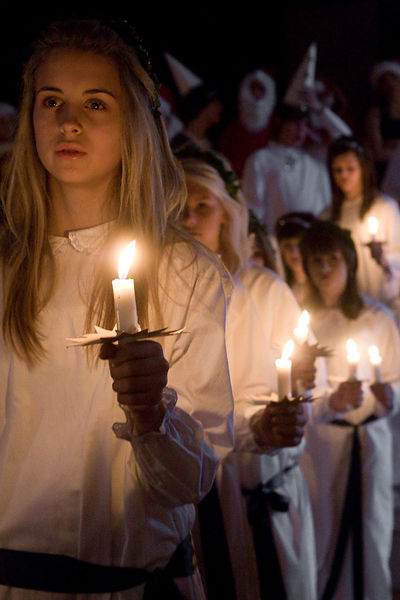
In Sweden and in Swedish communities in North America, thousands of girls will don the traditional white dress and red sash to take part in Lucia Day. Atop the heads of many girls will burn candles in a special crown worn for the holiday–although in Sweden most candles used these days are the battery-powered kind, due to–as the Swedes have discovered–the highly flammable nature of girls’ hair.
The crown of candles shines a light of hope during the darkest nights of the year, which in Sweden can be about 23 hours long.
(c) 2007 Fredrik Magnusson
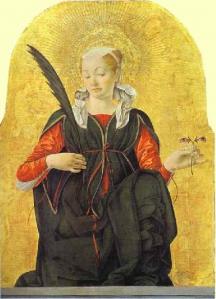
Saint Lucia was a young Christian who lived in Syracuse, Italy during the time of Diocletian–the infamous persecutor of early Christians–in the late 3rd century. When her mother became ill, Lucia prayed for her. Upon her mother’s recovery Lucia took a vow of chastity and gave her dowry to the poor, thus earning the rancor of a particularly vindictive suitor.
Some stories say the angry suitor outed her as a Christian in court, which then ordered her execution. Other stories say the suitor tried to kill her himself. Either way, they tried to kill her by fire, but she would not burn. Her eyes were poked out (some say she poked out her own eyes and gave them to the suitor) but new eyes grew back in their place. Men and oxen tried to drag her from the town, but she could not be budged.
Finally, on December 13, 304 A.D., the angry suitor stabbed Lucia with a sword in the neck and killed her. She was 20 years old.
Another legend tells of St. Lucia helping the ancient Christians in the catacombs, where torches were needed to navigate the dark tunnels. To keep her hands free to bring more food and drink, Lucia attached candles to a wreath she wore on her head.
Saint Lucy (Those ain't flowers)
So how did this Catholic saint from Italy become the heroine of a Protestant country in Scandinavia?
It may have to do with the date. Back when Sweden was Catholic and used the Julian calendar, Lucia’s feast day, December 13, was the longest night of the year. In pagan times the winter solstice was considered an ominous night to be out, when trolls and supernatural spirits wandered the earth. Lucia, whose name means light, became a symbol of the victory of light over darkness. Today, Swedish towns hold pageants to pick the “Lucia Bride”. Rituals similar to Luciatagen have taken place in Sweden in one form or another for over a thousand years, but it wasn’t until the 1927 Lucia procession in Stockholm, organized by a local newspaper, that the tradition as we know it spread throughout Sweden and Swedish-speaking Finland.
Lussekatter, or saffron buns, are a staple of the holiday. Made with one of the world’s most expensive spices, saffron dough is filled with cinnamon, sugar, raisins and chopped nuts. The oldest (or youngest) girl in the family serves these goodies.
A more recent Lucia Day tradition is to wake up unsuspecting Nobel Prize winners sleeping at the Grand Hotel in Stockholm. The Nobel Prize is awarded three days earlier on December 10.
“…one may no longer consider himself a Christian, but you cannot truly be considered a Mexican unless you believe in the Virgin of Guadalupe.”
— Carlos Fuentes
It’s been said that Mexico came into being not in 1821–the year Spain recognized its independence–but nearly 300 years earlier, in 1531, when a recently widowed peasant-farmer named Juan Diego Cuauhtlatoatzin, beheld the most spectacular vision in Mexican history.
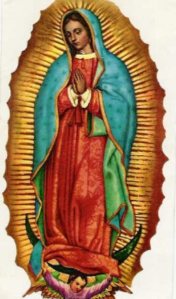
Guadalupe
On December 9, he was out walking near the ruins of Tepeyac Hill, where Aztecs once worshipped the mother goddess Tonatzin, when a young incarnation of the Virgin Mary appeared before him encompassed in a halo of light. She spoke to Juan Diego in his native tongue of Nahuatl, and asked him to deliver a message to the Mexican bishop: to build a church on the ground where she stood.
Upon hearing Juan Diego’s story, the bishop had his doubts. So the next time Juan Diego saw the Virgin, he confessed to her his failure to convince the bishop. She told him to pick some flowers at the top of the hill–even though it was December and no flowers should have been blooming. There he found Castilian roses, native to the bishop’s hometown in Spain. The Virgin arranged them in his tilma (apron), but when Juan Diego opened his tilma to the bishop, it held not flowers but the lifelike image of the Virgin of Guadalupe upon it.
Word spread of the miraculous vision and the image on the cloth. What the event suggested to the descendants of the Aztecs, many of whom had been made to feel unworthy by the strange pushers of this new faith due to the color of their skin, was that the Virgin revealed herself not to a Spanish bishop, but to a common, dark-skinned peasant. And Guadalupe herself was not the pale icon that had been forced upon the people by Europeans, but a mestizo, a mixture of races that would come to represent Mexico.
Old Basilica of the Virgin of Guadalupe, Mexico City
During the Mexican War of Independence in the 1810’s, the Lady of Guadalupe became the symbol of the new-born nation and the country’s patron saint.
In 2002, Pope John Paul II canonized Juan Diego as well. His feast day is December 9, the anniversary of the day he first saw Our Lady of Guadalupe. The Feast of Our Lady of Guadalupe is December 12, the last day she appeared to him.
Today Mexico is still overwhelmingly Catholic, but as Gustavo Arellano points out:
You don’t have to be Mexican or even Catholic to celebrate Guadalupe. Heck, you don’t even have to believe in God. All you need is a belief in the equality of people that’s in the core of Guadalupe’s message and you will surely feel her redeeming love.
On December 12, Mexicans and Mexican-Americans gather in churches and communities throughout North America and celebrate the symbol of the people of Mexico and patron saint of the Americas.
Today, December 8, the Roman Catholic Church celebrates the Feast of the Immaculate Conception.
I know what you expectant mothers are thinking. The Immaculate Conception is December 8. Jesus was born on December 25. A 17-day pregnancy? How do I get in on that!?!
Well, you can’t. Contrary to popular belief, in the Roman Catholic Church the Immaculate Conception refers not to the conception of Jesus, but to that of Mother Mary.
The Feast of the Immaculate Conception falls exactly nine months before the Nativity of the Virgin Mary on September 8th. The Annunciation meanwhile is observed on March 25, nine months before Christmas.
So immaculate or not, gestation takes 9 months.
The Feast of the Conception of the Blessed Virgin Mary has been celebrated at least since the seventh century. But it wasn’t until 1854 that Pope Pius IX officially defined Immaculate Conception:
“The Blessed Virgin Mary, in the first instant of her conception, by a singular grace and privilege of Almighty God, and in view of the foreseen merits of Jesus Christ, the savior of the human race, was preserved free from all stain of original sin.”
This doesn’t mean that Mary’s was a virgin birth, like Jesus’. The word Immaculate comes from the Latin in (not) and maculatus (stained). Mary’s conception, according to Roman Catholic dogma, was a normal one, but she was blessed by God and sanctified from the very moment of her own conception.
Although it’s not explicitly mentioned in the Bible, the Roman Catholic Church cites Mary’s description—being “full of grace”—as evidence for her Immaculate Conception, a blessed state that shielded Jesus from exposure to Original Sin. Protestants disagree on this, and in fact, Mary’s conception has been a major point of contention between the two.
The Feast of the Immaculate Conception is celebrated throughout the Catholic world. In Spain, Portugal, and parts of Latin America December 8 is celebrated as Mother’s Day. In Panama today, Mother’s Day is one of the most important holidays of the year. Writes one mother:
“I just came back from mother’s day celebration in Bocatorito a little village close to us…For the first time in my life I felt the core essence of what this day is all about. A day when you feel loved and special, but not with expensive gifts and going for dinner in fancy restaurants. Here, surrounded by humble people I understood and felt the joy of being celebrated as a mother.”
About this time of year parents deliberately wait in long lines in overcrowded shopping malls so their kids can sit on the lap of a fat red stranger.
Some cultures might call this odd. We call it Christmas.
Though the Christmas season begins commercially on Black Friday, and religiously on Advent, tonight kicks off the season for children in Europe, including the Netherlands, Germany, Belgium, the Czech Republic, and Austria.
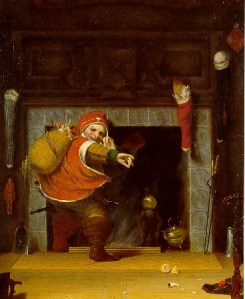
Saint Nicholas, 1838 - by Robert Weir
It’s St. Nicholas’ Eve, and though the date and the figure go by many names, the themes remain the same: kids and candy.
The jolly bearded guy known as Santa Claus in the United States is actually is an amalgamation of numerous folk figures.
The United States imported “Santa Claus” mainly from the Dutch Sinterklaas. Long before that, the Dutch learned of the saint, Saint Nicholas, from Spanish sailors, who believed Saint Nicholas had the power to save sailors by stemming storms at sea. Even today Sinterklaas arrives in Holland on or around November 17 each year, not on a sleigh from the North Pole, but on a ship from Spain.
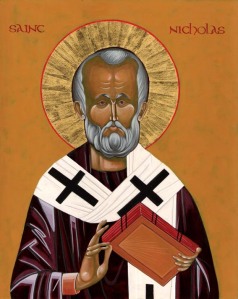
No one would be more surprised at the role Santa plays in modern society than Saint Nicholas himself, who was actually a bishop in the ancient town of Myra, Turkey (then Asia Minor) around 300 AD.
Saint Nick, old skool
Saint Nicholas was imprisoned for 5 years for refusing to recognize the Roman Emperor Diocletian as a god. He was released after the Christian Emperor Constantine took the throne and removed Christianity from the Roman “terrorist watchlist.”
Today Saint Nicholas is remembered less for his role in destroying pagan temples than for his acts of kindness toward children. Like secretly giving poor families of young girls money for a dowry, so they could marry rather than become prostitutes.
Legends of Saint Nicholas’s devotion to the poor spread throughout the centuries. As his posthumous fame grew, children would leave their boots outside on St. Nicholas Eve in the hopes that St. Nick would fill them with goodies.
In Protestant Germany, Martin Luther replaced the Catholic gift-giving Saint Nicholas with the Christkindl, or “Christ Child.” Over time Christkindl’s name morphed to Krist Kindel. You may know him however as Kris Kringle.
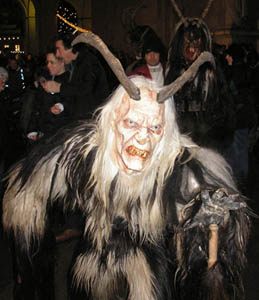
In North America Santa Claus travels by reindeer-guided sleigh, while in Europe the gift-giver is accompanied by figures such as Zwarte Piet (Black Piet) or Krampus (The Claw), the latter being a goat-headed demonish entity who whips bad children with a switch. The Bad Cop to Santa’s Good Cop.
Whether you call him Santa, Kris Kindl, or Father Christmas, you better watch out, you better not cry, you better not pout, I’m telling you why: Christmas is still 20 days out and believe me, you don’t want to end up on Krampus’s naughty list!