Nelson Mandela’s Birthday

July 18 (not an official holiday in South Africa)

“We must accept the fact that in our country we cannot win one single victory of political freedom without overcoming a desperate resistance on the part of the Government, and that victory will not come of itself but only as a result of a bitter struggle by the oppressed people for the overthrow of racial discrimination…

The theory that we can sit with folded arms and wait for a future parliament to legislate for the ‘essential dignity of every human being irrespective of race, colour, or creed’ is crass perversion of elementary principles of political struggle.”

The Shifting Sands of Illusion, Nelson Mandela, June 1953

Mandela’s story is legendary, not only for the 27 years he spent in prison, but for the reasons he arrived there and for his singular journey since.

Mandela was arrested on Sunday, August 5, 1962 for speaking against the government in public and leaving the country illegally, for which he was sentenced for five years.

“While serving this sentence, he was tried again for more serious charged connected with his leadership of the armed resistance group, Umkhonto we Sizwe. He and his colleagues were convicted of terrorism, narrowly escaping execution, receiving life sentences instead.”

Nelson Mandela: the Early Life of Rolihlahla Madiba, by Jean Guiloineau and Joseph Rowe

Terrorism? Yes, in a post-9-11 world, heads of state downplay that for nearly three decades Nobel Peace Prize Laureate Nelson Mandela had been deemed a terrorist by the apartheid “justice” system.
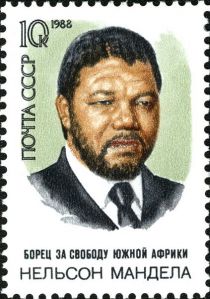
Nelson Mandela stamp, Soviet Union, 1988

During his imprisonment the island on which Mandela was held—Robben Island—became known as “Mandela University.” The political prisoner educated other inmates who then continued the struggle against racism outside the prison walls.

“Did they imagine we might forget him and his companions if they banished him to this island? And did they imagine we could forget the misery of our lives?”

A Pilgrimage to the Isle of Makana, from Call Me Not a Man, by Mtutuzeli Matshoba

The famous cry “Free Nelson Mandela” really meant “Free South Africa”. On February 11, 1990, the first half of that long sought prize came to pass. Since 1966, not so much as a photograph had been taken of Mandela. His release was broadcast around the world.

After the country’s first truly-democratic elections in 1994, Mandela became South Africa’s first black President.

Youtube: Free Nelson Mandela

Freedom, however, is not a moment but a journey. As late as 2008, due to red tape and lack of oversight, Mandela and other members of the African National Congress were still on the U.S. terrorist watch list.

“In the 1970s and ’80s, the ANC was officially designated a terrorist group by [South Africa’s] ruling white minority. Other countries, including the United States, followed suit.” — USA Today 4/30/08

“It is frankly a rather embarrassing matter that I still have to waive in…the great leader, Nelson Mandela.” — Secretary of State, Condoleezza Rice

Mandela and the ANC were removed from the list by a special bill signed by President Bush in July 2008, just prior to Mandela’s 90th birthday.

In South Africa, celebrants “thank Madiba” (Mandela’s honorary title) on July 18th with acts of charity and good deeds, from cleaning cemeteries to painting hospitals.

Meanwhile, in the country of Ghana…

President John Evans Atta Mills on Friday called on Ghanaians to observe Saturday, July 18, 2009 as Nelson Mandela International Day to commemorate his leading role in Africa’s liberation struggle… “The day is Mr. Nelson Mandela’s birthday and those observing this day are required to contribute 67 minutes of their time to the service of their communities in recognition of the 67 years Nelson Mandela has spent in serving humanity.”

Ghana News Agency, July 17, 2009

1961 Nelson Mandela Interview

Obon – Japan

July or August
July 13-15 (Gregorian calendar)
15th day of 7th month (lunar calendar)

“In the time of Shaka; one of his fellows Mokuren saw the image of his dead mother suffering in hell. Mokuren was desperate to relieve her pain and asked Shaka for help. Shaka answered, “On 15th of July, provide a big feast for the past seven generations of dead.”‘— Japan 101

OK, Buddha may not have actually said “15th of July”, since he lived 300 years before Julius Caesar. But he did say “15th day of the seventh month.” Whether that’s according to the lunar or solar calendar depends on who you ask.

In the lunar calendar the Festival of Obon—the Japanese festival of the dead—tends to fall in August. But in Tokyo and the east of Japan, many temples observe Obon according to the solar calendar—on July 13th through the 15th. The result is that anywhere you look between mid-July and August there’s bound to be Obon festivities happening somewhere.

Obon is one of the most important holidays in the Japanese calendar, second only to New Year’s Day in most communities. Japanese usually return home to be with their families during the Obon season to carry on a tradition that has been celebrated for over 500 years in Japan.

Families enjoy time together, partake in Obon rituals and tidy up the graves of their ancestors.

obon_albuquerqe_bridge
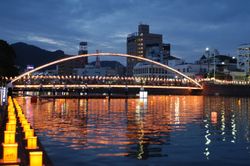
Lantern floating ritual, 2004

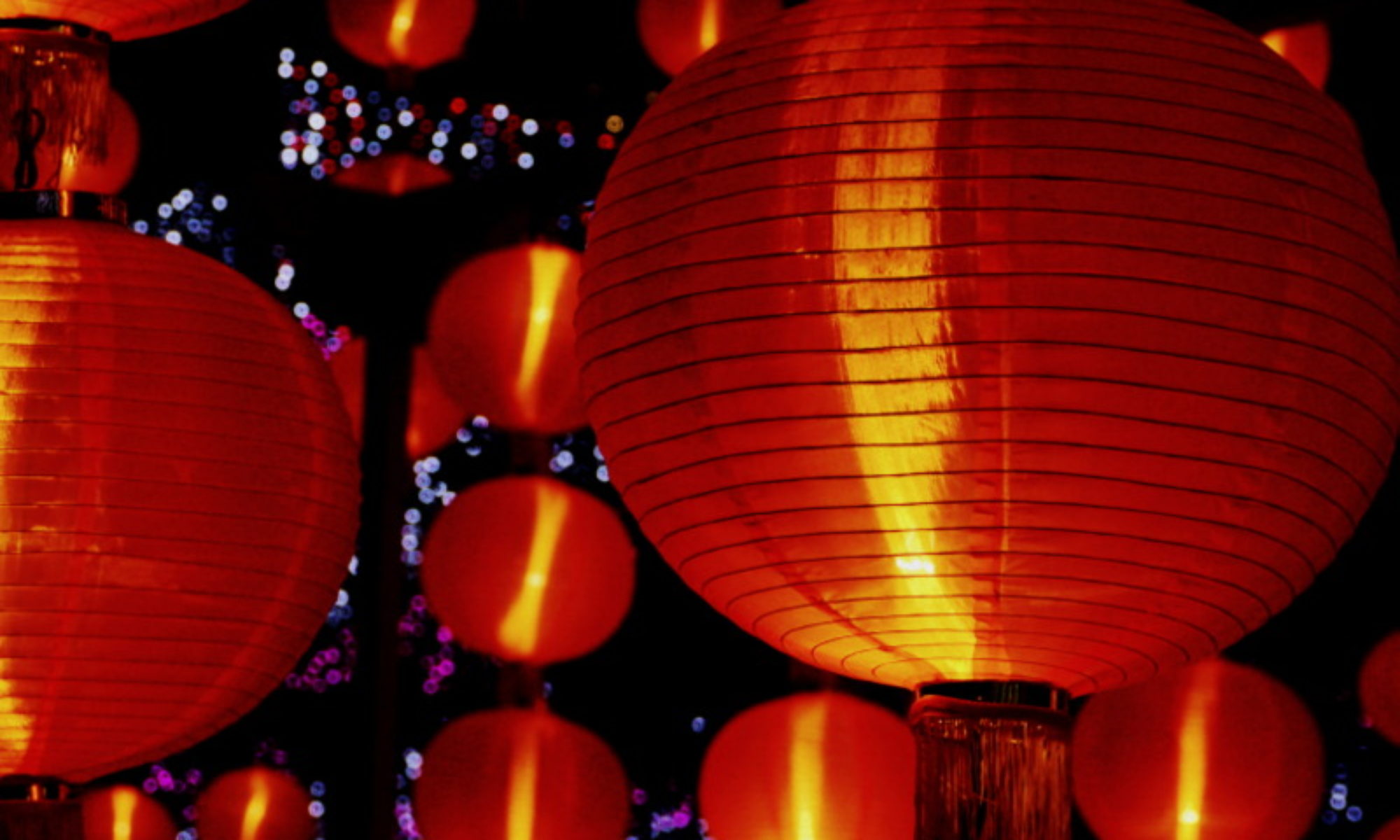
One tradition is to release floating paper lanterns on the water on the last night of Obon, in order to guide the departed spirits to the after world.

Another is the age-old Bon Odori, or Bon Dance, which emulates the dance of joy and gratitude that Mokuren did when his mother was released from hell.

Obon is a shortened form of the word urabon’e, which means “hanging upside-down and suffering.” The purpose of Obon is relieve the suffering of the Urabon’e.

Battle of the Boyne

July 12

…there is nothing now that we so earnestly desire as to establish our government on such a foundation as may make our subjects happy, and unite them to us by inclination as well as duty; which we think can be done by no means so effectually as by granting to them the free exercise of their religion…

Such were the words that got James II booted off the English throne.

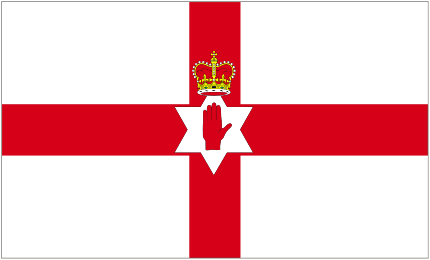
On the Glorious Twelfth (not to be confused with August’s Glorious Twelfth) Northern Ireland recalls a battle of two Kings. The Battle of the Boyne marked the first major victory of William of Orange against mostly-Catholic forces supporting the deposed King James II. The “Twelfth” refers to the date in 1690 on which the battle took place: July 1st. “Uhh…” Yeah, we’ll get to that.

The war is called the “Jacobite War” after King James. (Okay, somebody has to talk to these people about naming things.)

King James’ Catholic leanings, his push for religious freedom, and his tendency to bypass Parliament when issuing such decrees, landed him on the top of Parliament’s naughty list. Finally King James did the unforgivable: he reproduced.

The birth of his son by his Catholic wife ensured what Parliament had been fearing most: the continuation of a Catholic line on the English throne. Parliament deposed the King in favor of his daughter Mary and her husband William of Orange, the stadtholder (head honcho) of the Dutch lowlands. (Orange refers to a principality, not a fruit or color.)

France was at odds with William and the Dutch at the time, so James hightailed it to Paris to garner troops from the French King. James then set his sites on Ireland, where he had support from both Catholics and Protestant loyalists.

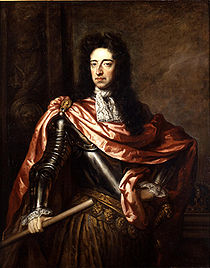
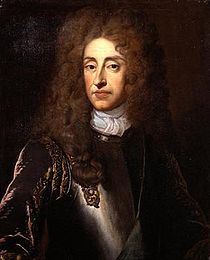
King William III King_James_II
Kings William III and James II (separated at birth?)

The two armies collided at Boyne–William with 36,000 men and 24,000 under James. Surprisingly the death toll was only around 2,000, but it was a definitive Williamite victory, and the beginning of the end for James.

The following year King William sealed the deal at the Battle of Aughrim. Fought on the real July 12, Aughrim was one of the bloodiest battles ever waged on Irish soil–7000 men killed in a day. Thus, the Irish have a definite ax to grind regarding what England sometimes refers to as its “Bloodless Revolution.”

For many years the inhabitants of Belfast celebrated Aughrim as the primary motivation behind Glorious Twelfth. When the UK switched to the Gregorian calendar, named after Pope Gregory, many in Northern Ireland saw it as declaring allegiance to the Papacy, and continued celebrating on Julian calendar dates. The anniversary of the Battle of the Boyne–fought July 1 in the Julian Calendar–falls on July 12 in the Gregorian. The two battle commemorations were combined, and over the centuries the Boyne has become more celebrated of the two. Celebrating Boyne over Aughrim has helped to appease Irish Catholics, who didn’t appreciate the wholesale slaughter of their ancestors at Aughrim being celebrated as a holiday.

Tensions remain high between Irish Catholics and the mostly-Protestant population of Northern Ireland. The celebrations have often led to violence, destruction, and poor taste in hat wear.

Belfast, Northern Ireland

Three Manly Games – Naadam in Mongolia

July 11

This week thousands of Mongolians gather to celebrate Revolution Day, July 11, and to compete in Mongolia’s biggest festival: Eriin Gurvan Naadam, or the Three Games of Men.

The “Three Manly Sports” as they’re called, are: Archery, Wrestling, and Horseback-riding. (Sorry guys, for whatever reason Ultimate Frisbee didn’t make the cut.)

“For 2,000 years, these three sports were not just entertainment, but a vital part of military training for the nomadic tribes of the steppes between Siberia and China.”  — Christian Roy, Traditional Festivals

Naadam ceremony 2006, photo by Vidor
Naadam 2006

Around a thousand years ago the three activities merged into the Naadam Festival. The historic games were a rite of strength and courage among the region’s nomadic warriors. In the 13th century Genghis Khan and grandson Kublai incorporated Naadam into the political ceremony of the newly unified nation.

The festival began to be celebrated every third year under the religious leader Zanabazar in 1641. In the 20th century the government moved the annual celebration to July 11 to commemorate the Mongolian Revolution of 1921.

Naadam means “to play.” Day One of the three-day festival begins with the Mongolian President’s inaugural speech and the impressive opening ceremonies, followed by archery and wrestling in Ulaanbaatar Stadium. The wrestling bouts are a sight to behold. According to journalist Ron Gluckman,

“The field is empty when the national anthem is chanted by the crowd. Then, without warning, hundreds of men suddenly toss aside robes, and scream madly as they bound down into the arena, stripped down to little more than leather boxing shorts.” — The Alternative Olympics

A wrestler is out the moment his elbow or knee hits the ground. Two full days of intensive bouts whittles the playing field down from 512 wrestlers to just two. There’s no division by size—the smallest wrestler can prove himself against the largest. Legend has it that a woman won one year, which is why the men now wear revealing tops. Wrestling is the only one of the three ‘manly’ sports in which women aren’t allowed to compete.

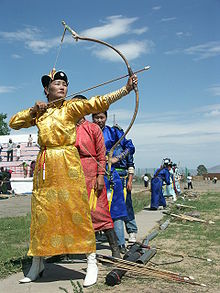
Women's archery, Naadam, 2005

The archery competition involves Mongolia’s weapon of choice since the 12th century. The arrows are made of willow, vulture feathers, and bone, and bows are strung with bull tendons. Mongolians are proud to point out that their ancestors perfected the bow as a weapon, and that even back in 1224 AD, according to the ancient Stone of Genghis Khan, a Mongolian archer named Yesunke hit a target 536 meters away in a competition organized by Genghis himself.

Mongolians learn to ride horses before they can walk. According to the UB Post, back in the day the Naadam races included up to 45,000 jockeys. The races take place out on the open steppes. Children as young as 6 compete, as well as women, who often do so in stiletto heels. (Mongolian women love their stiletto heels. Even the policewomen wear them.) Finishing first in the race is no small honor. The winner gets to bow before the President of Mongolia.

After hundreds of years, Naadam is still a vital part of Mongolia’s national heritage. For three days, beginning on Mongolia’s national day, Mongolians celebrate mastery of the three skills that allowed a group of horsemen to conquer much of two continents.

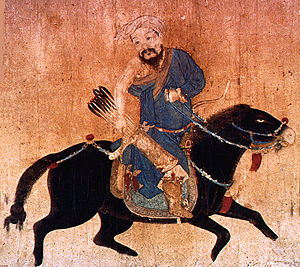
Mongol Archer
Mongol Archer

Clerihew Day

July 10

7/11 might be a more appropriate day to extol the virtues of poetry, but as it is, we’ll celebrate on 7/10, the birthday of poet, journalist, and author Edmund Clerihew Bentley, who created the most venerated form of poetry in all the English language: the Clerihew.

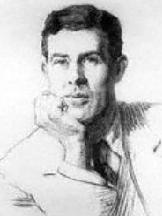
Edmund Clerihew Bentley

The Clerihew is a four-line verse where the end of the first line, or more often the full first line, is the subject’s name. Clerihews have an AABB rhyme scheme and meter is of secondary (or no) importance:

Even Steven
Will be leavin’
To get mugged in Chicago
After watching Dr. Zhivago

— the author, age 11

According to Steven Gale’s Encyclopedia of British Humorists, Clerihew composed the first such poem as a 16 year-old student in science class, in honor of a British chemist.

Sir Humphry Davy
Was not fond of gravy.
He lived in the odium
Of having discovered sodium.

Evidently the poem was a big hit with his fellow students, for he never stopped writing them. He published his first collection in his 1905 classic, Biography for Beginners. Other favorite clerihews include:

Sir Christopher Wren
Said, “I am going to dine with some men.
If anyone calls,
Say I am designing St Paul’s.

And from the Boston Globe’s Clerihew contest:

Edmund C. Bentley
Wrote intently,
But would now be anonymous
Were it not for the verse form for which his middle name is eponymous.

Clerihew was also a mystery author. He wrote one of the great detective stories of the early 20th century, Trent’s Last Case.

“Cupples, I have absolutely nothing left to say, except this: you have beaten me. I drink your health in a spirit of self- abasement. And you shall pay for the dinner.” — Trent’s Last Case, 1913

It wasn’t Trent’s Last Case. Bentley wrote two sequels, Trent Intervenes and Trent’s Own Case.

So before you go off and celebrate Clerihew Day with the reverence it deserves, remember,

Edmund Bentley
Evidently
Was born in the U.K.
On Clerihew Day

anti-Valentine’s Day in Russia?

July 8

From Q++ Worldwide Public Holidays

“Russia’s First Lady, Svetlana Medvedeva, is chairing a comittee to celebrate July 8th as a Russian “anti-Valentine’s Day”, with emphasis on family, mariage and long-term faithfulness, rather than what she (and many in Russia) considers the shallowness of Saint-Valentine’s celebration of short-term infatuation.

“If this year’s first July 8 celebration of SS. Piotr and Fevronia (two 13th century Russian Orthodox Saints who were married and buried in the same coffin) is a success, Mrs. Medvedev has promised to make it an official public holiday in Russia.”

http://qppstudio-public-holidays-news.blogspot.com/2008/06/russias-first-lady-wants-july-8-public.html

Here lies (and cheats) Soapy Smith

July 8

Every July 8th, citizens of Skagway, Alaska, hold a wake for a citizen who died on this day in 1898: Jefferson Randolph ‘Soapy’ Smith, the “king of the frontier confidence men.”

Soapy Smith, 1860-1898

Smith got his nickname Soapy from an old scam he played selling soap to miners in Colorado.

It’s hard to believe someone so concerned about the hygiene of his fellow men could get such a bad rep. But you see, Smith wrapped bars of soap in $20 to $50 bills in front of the miners, then double wrapped those in brown paper, claiming that one in ten bars had been wrapped in money. Miners would pay $5 for a nickel’s worth of soap to try their luck.

Miraculously, no one ever won the big bills. Soapy was a master at sleight-of-hand, a skill he picked up in his teens playing the “shell game” with peas and thimbles in back in Texas.

But it was in Denver that Soapy made his real mark. With his “earnings” he opened a gambling establishment known as the Tivoli Club, and organized a gang of pickpockets, muggers, disbarred lawyers, and bribed politicians.

Soapy was as good with words and he was with his hands. Once when Denver authorities brought him to trial, he explained that the Tivoli Club performed a public service, curing gamblers of their addiction, by ensuring they lost. And the court acquitted him.

When the Klondike Gold Rush began, Soapy made his way up north to Alaska, but he let others do the digging.

Smith opened his own parlor and within a few months the 38 year-old was running the town, with a supporting cast of the unusual suspects.

A typical scam: Smith had a monopoly on the local telegraph and charged $5 to send messages. Only the telegraph wasn’t connected to anything but the wall. (Skagway didn’t get a real telegraph office until 1901.)

His last swindle involved a prospector named John Stewart, who made the mistake of walking into Smith’s Parlor with a bag of $2700 (in 1898 dollars) in gold. When Stewart’s money was stolen by men in Smith’s parlor, Stewart took his cause to anyone who would listen. A group known as the Committee of 101, which had been after Smith for years, held a meeting to stop him for good. Smith tried breaking into the meeting with a Winchester, but was stopped by the city surveyor Frank Reid. A gun battle ensued, and Smith died on the spot, bullet through the heart. Reid died 12 days later.

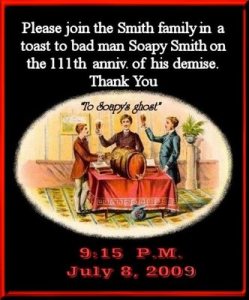
Though not an official holiday, the traditional toast to Soapy Smith is held by the residents of Skagway—and for some reason at Hollywood’s Magic Castle—at 9:15 pm each July 8th, the approximate time of Smith’s death.

Soapy’s wakes may lack the reverence of others, but as wakes go, it’s supposed to be one hell of a party.


Soapy Smith: Con Man’s Empire – historynet.com

Soapy Smith’s Soap Box – soapysmiths.blogspot.com

Alias Soapy Smith – www.soapysmith.net

Running of the Bulls – Encierro

July 7 (St. Fermin’s Day)

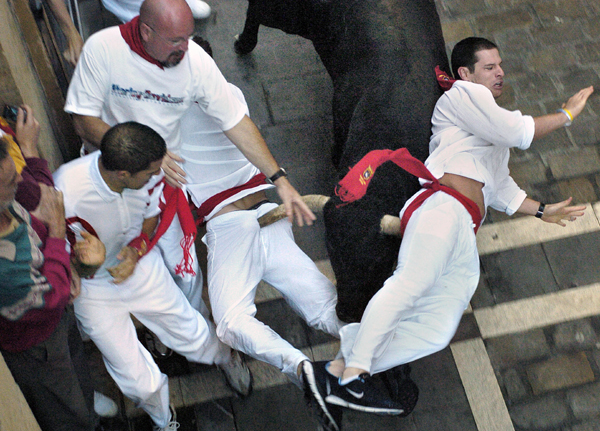
14 people have been killed in the San Fermin Running of the Bulls since 1924, when they began counting. To give you an idea of the scope of the mayhem, that’s almost equal to the number of people killed by vending machines in the U.S. since 2001.

Running with the Bulls (aka the Encierro) has been a Pamplona tradition for centuries. Local organizers remind tourists to take safety precautions and warn them of the potential for serious injury. The warnings are often shrugged off, but last year two California brothers got the point in the end.Protesters aren’t so concerned with injuries to humans, but with cruelty to animals. 40,000 bulls are killed by the bullfighting industry each year in Europe. These and other facts about bullfighting are ‘exposed’ during PETA’s Running of the Nudes, which coincides with the festival each year.

Who knows which Run the good Saint Fermin would prefer?

(http://luduran.wordpress.com/2007/07/07/7-de-juliosan-fermin/)

Q: So who is this Saint Fermin anyway, and what does he have to do with bulls?

A: St. Fermin was the son of a Roman senator in Pamplona. He converted to Christianity, was named a Bishop in Amiens, returned to Pamplona to lead his flock, and was martyred back in Amiens in 303 AD. He was actually beheaded, not slaughtered by bulls. And in September, not July.

It was his predecessor Bishop Saturninus of Toulouse who had the honor of being tied to a bull by his legs and dragged to his death. The two saints’ martyrdoms are sometimes confused because of Fermin’s association with the Encierro.

The tradition of honoring St. Fermin in Pamplona dates back to 1186, though the liturgical festival was originally in October. It was moved to July 7 in 1591 to coincide with the summer market fairs and bull ceremonies.

The Martyrdom of Saturninus of Toulouse

So if you’re running with the bulls this week, stretch beforehand, wear good shoes, and be careful where you slip.

[Also on July 7: the Japanese celebrate Tanabata, the reunion of the lovers Orihime and Hikoboshi—stars in the heavens who are permitted to visit each other one day of the year—the seventh day of the seventh month. People create beautiful origami in their honor and write wishes on tanzuku to send up to the two briefly reunited lovers.]