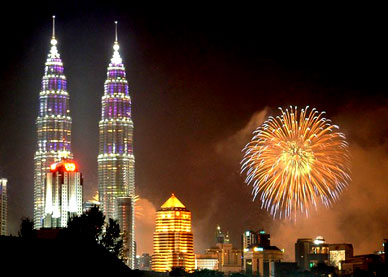
Until just a few years ago, it was home to the two tallest buildings in the world, the Twin Towers.
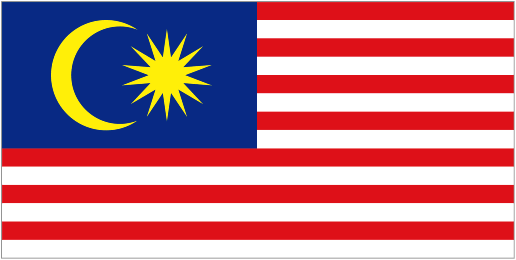
Its flag boasts over a dozen horizontal red and white stripes and a blue rectangle in the upper left corner displaying certain celestial objects.
It won its Independence from Great Britain.
(Got it yet? Okay, one more…)
Its head of state is the Yang di-Pertuan Agong, and its official religion is Islam.
That’s right! Malaysia!
Petronas Twin Towers, Kuala Lumpur
The Petronas Twin Towers were completed in Kuala Lumpur in 1998 and were opened on this day in 1999. At almost 1,500 feet, they’re taller than the Sears Tower by 33 feet, and were they were the tallest buildings in the world up until 2004 when they were surpassed by “Taipei 101”. (They’re still there, they’re just not the tallest buildings in the world anymore.)
The Malaysian flag contains 14 red and white stripes which symbolize the equal standing of the country’s 13 states and its federal government. The 14-point “Federal Star” represents Malaysia and its monarchy, while the yellow crescent moon represents Islam.
Though the official religion is Islam, Malaysia has significant populations of Buddhists and Hindus as well as a smaller Christian population.
And today is the biggest civic holiday of the year. Malaysians celebrate Hari Merdeka, (Independence Day), which marks Malaysia’s formation as a unified modern state and its independence from Great Britain over half a century ago, on August 31, 1957.
Last Wednesday in August
August 31, 2011
August 29, 2012
364 days out of the year, Buñol is a quiet, ordinary Spanish town country nestled in the foothills of the Valencia mountains about 40 kilometers from the Mediterranean coast; its population is just shy of 10,000.
But if you happen to visit Buñol on the last Wednesday of August, don’t wear your finest. You will notice that the population has tripled in size, the bulk of these tens of thousands have amassed along a few narrow streets, and they’re all engaged in a peculiar activity: throwing tomatoes.
Lots of tomatoes.
Over a hundredTONS of tomatoes.
La Tomatina is essentially the world’s largest food fight. (Although the Great Kettering Elementary School Food Fight of 1986 comes close.)
We wish we could say La Tomatina originates from an ancient pagan fertility rite, but it’s only 60 or so years old. Stories of the festival’s origin vary. Combining them would sound like this:
During a Gigantes y Cabezudos festival (the kind with the really big heads as featured in Borat) some rowdy spectators attempted to become participants, knocking over a big-head-carrying procession member in the process. A scuffled ensued among the hot-tempered youths.
Now, the people of Buñol had always enjoyed throwing things at each other. And fortunately for posterity, a truck or cartload of tomatoes had overturned just prior this auspicious occasion, providing the feuding parties with the perfect ammunition.
The following year authorities hoped to stem a repeat of the disaster, but the veterans of the previous year had some unfinished business to attend to.
The activity was first sanctioned by Town Hall in 1950. It was permitted and prohibited intermittently over the next few years. It got out of hand in 1956, townspeople got hurt, and it was canceled the following year. Some folks held a Tomatina Funeral instead. The festival was brought back by popular demand in 1959–but with regulations*–and they’ve been throwing tomatoes ever since.
Yes, La Tomatina started out as a Buñol style gang war. Perhaps in the States, if we armed our inner-city youths with tomatoes (in LA, avocados) we would attract tourists instead of violence.
As it is, in Buñol tens of thousands of tourists flock to La Tomatina each year. The festivities begin with the scaling of the “soap pole”. A ham is stuck atop a tall greased pole, and the tomato throwing can’t begin until a brave crowd member retrieves it.
*If you go, it’s considered proper Tomatina etiquette to squish your tomato before hurling it. Don’t bring bottles or anything that could cause injury, and be careful not to rip other people’s clothes. And it doesn’t matter if you’re wearing red or not. You will be.
“Our red tornado became an inexorable hurricane. It was becoming difficult to stand upright in so much slush and with so many wet missiles impacting from every possible direction. We blotted out the sun and sky…I had become one vast squelching mound of pulped tomato…
Today (August 30) Turkey celebrates Victory Day. The day honors those who have served in Turkey’s military and who fought heroically in the nation’s battles. Throughout the past two millennia, some of history’s greatest battles have been fought on what is now Turkish soil, but of all these, the Battle of Dumlipinar, fought in August 1922, was singled out to serve as the country’s Victory Day.
The Battle of Dumlipinar was the last major battle of the Greek campaign of the Turkish War for Independence (1919-1923).
After World War I, the Ottoman Empire found itself, along with Germany and the Austro-Hungarian Empire, at the losing end of an Armistice. The Treaty of Mudros didn’t reflect the reality of a war that in many ways was a stalemate. Western powers seized Ottoman towns and territory in the coming years…
“Greece, in a wild imperial venture supported by Britain, had invaded western Anatolia, hoping to make itself an Aegean ‘great power’ and to construct a ‘greater Greece’ out of the ruins of the Ottoman Empire. But the invasion ended not simply in Greece’s defeat at the battle of Dumlupinar in 1922, but in a calamitous rout and slaughter which drove not only the Greek armies but much of the Greek civilian population of Anatolia into the sea.”
As part of the treaty following the Greco-Turkish War, Turks and Greeks engaged in a population exchange, whereby Greek Muslims moved to Turkey and Turkish Christians moved to Greece. (Population Exchange Commission, 1923)
During these same years, Turkish revolutionaries under Mustafa Kemal simultaneously defeated the French and the Armenians in separate campaigns, forcing the Allies to revisit earlier treaties. The Turks dissolved the Sultanate of the Ottoman Empire, and a new Turkish Republic was established, with Mustafa Kemal as its leader.
The Turkish Nation consists of the valiant descendants of a people that has lived independently and has considered independence the sole condition of existence. This nation has never lived without freedom, cannot and never will.
The word “carnival” comes from the Latin carne vale meaning “farewell to the flesh”. It originally referred to festivals that fell just before Lent, when eating meat was forbidden. Famous pre-lenten carnivals include Rio de Janeiro, New Orleans, Nice, and Trinidad.
Inspired by the world-famous Trinidad Carnival, Notting Hill takes place in August, because you’d have to be nuts to wear a thong in England in February.
The ‘Mother of Notting Hill Carnival’ is Claudia Jones, a native of Trinidad who spent almost her entire life on three vastly different islands: Trinidad, Manhattan, and England.
Born in Trinidad in 1915, Jones immigrated to Harlem, New York with her family at age 7. As a teen, she took part in a protest against the trial and prosecution of the Scottsboro Nine, and she spent much of the next 20 years fighting the inequalities of the U.S. justice system. She became a vocal supporter of the Communist League and a prominent writer for the Daily Worker.
Claudia Jones
As a reward for her outspokenness, Jones was arrested in 1948 on immigration charges and nearly deported, despite having lived in the U.S. for 26 years. She was arrested a few years later, along with other Communist Party leaders, for supposedly violating of the Smith Act during the height of the McCarthy era frenzy. While in prison the 40 year-old Jones suffered a heart attack. This and a bout of tuberculosis she contracted in her youth would plague her health for her remaining years.
In October 1955 she was deported from the U.S., and was granted asylum in what would be her final island: England.
As temperatures rose in Notting Hill in August 1958, the city erupted in race riots, in which hundreds of whites attacked the neighborhood’s West Indian residents. In addition to speaking out against the riots, Jones decided to create an event that would promote racial harmony while celebrating the music and talent of England’s West Indian heritage. This forerunner of the Carnival was held indoors in its first years, starting in 1959.
Unfortunately Jones wouldn’t live to see the first official Notting Hill Carnival and street festival in 1965. She died on Christmas Eve, 1964.
Today the Notting Hill Carnival is London’s largest annual public event, and at over a million people, it’s one of the largest street festivals in the world.
Jones would probably be delighted to know that an estimated 1.5 million people of all faiths and races attended the 2000 Notting Hill Carnival—more than the entire population of her homeland of Trinidad.
Today, the State (and former Republic) of Texas celebrates Lyndon Johnson Day, in honor of the 36th President of the United States.
Johnson’s five-year presidency was one of the most controversial and emotionally charged periods in American history—from the assassination of predecessor John F. Kennedy to the escalation of the Vietnam War to the Civil Rights movement. But what you may not know about the 36th President is that before entering politics, Johnson was a teacher.
Johnson graduated from Southwest Texas State Teacher’s College. He found he preferred high school to grade school, teaching debate at the former:
“I felt about my students very much like I feel about my staff. I associated with them a lot socially. I would go into their homes and I would be with their family and would take them into my home, particularly the leading debaters and the ones that were on the teams. If they would take one side of a question I would take the other… I developed several better speakers—much better—than I was.”
LBJ worked in the Texas legislature during the 1930’s, and was elected to the U.S. House of Representatives during a special election in 1937. He won his Senate seat in 1948 and was elected as John F. Kennedy’s Vice-President in the 1960 election.
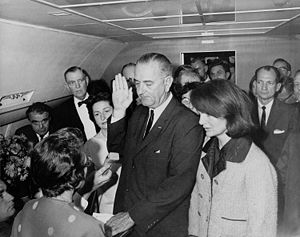
Three years later LBJ became the first and only President ever sworn in on Texas soil when Kennedy was assassinated in Dallas.
LBJ sworn in as 36th President on Air Force One, beside Kennedy's widow, Jacqueline.
Johnson led the United States through one of the country’s most turbulent decades.
During his Presidency, Johnson strived to create a “Great Society” through such legislation as the Civil Rights Act of 1964 and the Voting Rights Act. He appointed the first African-American Supreme Court Justice, Thurgood Marshall. A social democrat, he pushed for a “War on Poverty”, but it was the War in Vietnam that would be his legacy.
In the Democratic New Hampshire primary in 1968, Johnson’s anti-War opponent won 42% of the vote, only slightly less than Johnson himself. Later that month, Johnson announced he would not run for another term.
Johnson returned to his ranch in Johnson City, Texas, where he died on January 22, 1973 just miles from where he was born, outside Stonewall, Texas.
The people of Texas celebrate the life of President Johnson every year on his birthday, August 27th.
2008 marked his 100th birthday.
“When I leave this job, I want to go back to right where I started in some college classroom and walk in at five minutes of eight and wait for the students to march in and sit down, and then start challenging them and provoking them and stimulating them and getting the best out of them for an hour. And then I am going to be sorry when the bell rings.”
But not just any hand. The hand above symbolizes the concept of Ahimsa, the central component of the Jain religion. It means the practice of non-violence, but far beyond our common perception of it. Ahimsa is the absence of harm toward any living being, human or animal. For this reason vegetarianism is a essential part of Jainism. In fact, during special festivals, such as Paryushana, some Jains restrict themselves to eating those parts of plants that do not endanger the plant itself. (However, “fruitarian” diets are not necessarily practiced throughout the year.)
Ahimsa also means practicing the self-discipline not to cause harm to one’s own soul. And that means no sin. States the Puruṣārthasiddhyupāya 4.42:
All sins like falsehood, theft, attachment and immorality are forms of violence which destroy the purity of the soul. They have been separately enumerated only to facilitate their understanding.
The circle in the palm of the Jain hand represents the cycle of reincarnation, and the 24 spokes are the 24 Tirthankars, great prophets of Jain, the last of whom, Mahavira, lived over 2500 years ago.
The name of this week’s festivities, Paryushana, literally means to close in, to remain near to one’s self and soul. Paryushana stems from the tradition of monks to stay in one place, in the towns, during the rainy season. The rainy season could last four months, but the minimum duration for Paryushana was 70 days.
The period of Paryushana commences by Bhadrapada Shukla panchami, the fifth day (panchami) of the bright/full moon (Shukla) of the month of Bhadrapada (August/September).
During this time people replenish their faith through meditation, self-control, and through the wisdom of the Dharma.
There are two sects of Jainism. Digambara and Svwetambara (pardon my pronunciation.)
The Digambaras observe a 10-day festival starting on today (although the date can vary slightly by sect and location). Digambara Jains use this time to focus upon the Dashalakshana vrata—the 10 components of the Dharma:
Forbearance – Kshama
Gentleness – Mardava
Uprightness – Arjava
Purity – Shaucha
Truth – Satya
Restraint – Sanyam
Austerity – Tapa
Renunciation – Tyaga
Lack of possession – Akinchanya
and Chastity – Brahmcharya
The Svwetambara Jains celebrate an 8-day festival which ends today. During this time the Kalpa Sutra is recited. The Kalpa Sutra recalls the birth, life, and journey toward Nirvana of Mahariva.
The holy festival closes with participants seeking forgiveness for their sins of the last year.
I grant forgiveness to all living beings
May all living beings grant me forgiveness
My friendship is with all living beings
My enmity is totally non-existent
Let there be peace, harmony, and prosperity for all
“Susan B. Anthony is not on trial; the United States is on trial.”
— Matilda Joslyn Gage
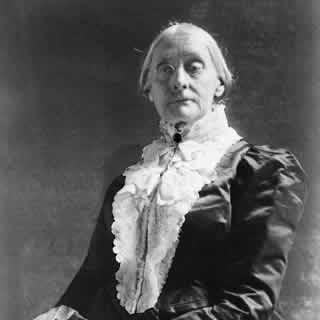
Susan B. Anthony
Women’s Equality Day celebrates the anniversary of the passage of the 19th Amendment on August 26, 1920. The amendment gave American women the long-fought-for right to vote. One of the most vocal and influential activists for women’s suffrage was Susan B. Anthony. In fact, in Massachusetts it’s Susan B. Anthony Day today, in honor of the famed activist, human rights defender, and convicted felon.
That’s right. Susan B. Anthony was arrested on November 18, 1872 for voting in the November 5 presidential election, “without having a lawful right to vote and in violation of section 19 of an act of Congress.”
In order to prevent damage to her reputation, Commissioner Storrs sent word to Anthony, requesting that she come down to his office. Anthony responded saying she “had no social acquaintance with him and didn’t wish to call on him.” The Commissioner was forced to send a deputy marshal to Anthony’s residence in Rochester, New York. She later recalled:
“He sat down. He said it was pleasant weather. He hemmed and hawed and finally said Mr. Storrs wanted to see me… ‘what for?’ I asked. ‘To arrest you.’ said he. ‘Is that the way you arrest men?’ ‘No.’ Then I demanded that I should be arrested properly.”
Anthony refused to pay bail. The case made national headlines, and letters flooded in. To her dismay, Anthony’s lawyer did pay her bail without her knowledge, explaining “I could not see a lady I respected put in jail.” (This however, later ruined her chance of bringing the case to the Supreme Court.)
Anthony’s lawyer argued—as Anthony had done herself outside of court—that the wording of the 14th Amendment gave all citizens of the United States the right to vote. After a lengthy trial, covered daily in the national press, and at which Anthony herself was not allowed to testify, the judge announced: “The Fourteenth Amendment gives no right to a woman to vote, and the voting by Miss Anthony was in violation of the law…Upon this evidence I supposed there is no question for the jury and the jury should be directed to find a verdict of guilty.”
The judge pronounced her guilty without ever calling on the jury to deliberate.
Before sentencing, the judge asked Anthony: “Has the prisoner anything to say why sentence shall not be pronounced?”
Not one to make waves, Anthony told the judge:
“Yes, your honor, I have many things to say; for in your ordered verdict of guilty, you have trampled under foot every vital principle of our government…May it please the Court to remember that since the day of my arrest last November, this is the first time that either myself or any person of my disfranchised class has been allowed a word of defense before judge or jury…All of my prosecutors, from the eighth ward corner grocery politician who entered the complaint, to the United States Marshal, Commissioner, District Attorney, District Judge, your honor on the bench, not one is my peer, but each and all are my political sovereigns; and had your honor submitted my case to the jury, as was clearly your duty, even then I should have had just cause of protest, for not one of those men was peer; but, native or foreign born, white or black, rich or poor, educated or ignorant, awake or asleep, sober or drunk, each and every man of them was my political superior; hence in no sense, my peer.”
Anthony continued for some time, ignoring the judge’s orders for silence. Finally the judge ordered Anthony to pay $100 and the costs of prosecution. Anthony simply said:
May it please your honor, I shall never pay a dollar of your unjust penalty. All the stock in trade I possess is a $10,000 debt, incurred by publishing my paper–The Revolution–four years ago, the sole object of which was to educate all women to do precisely as I have done, rebel against your manmade, unjust, unconstitutional forms of law, that tax, fine, imprison and hang women, while they deny them the right of representation in the government…And I shall earnestly and persistently continue to urge all women to the practical recognition of the old revolutionary maxim, that ‘Resistance to tyranny is obedience to God.’
She never paid the fine.
Oh, and in case you were wondering, she voted Republican.
The above line was supposedly uttered by Adolf Hitler to his chief of staff Alfred Jodl, referring to his order to General Dietrich von Choltitz, military governor of Paris during the German occupation, not to let majestic city of Paris fall back into Allied hands, except as complete rubble.
In August 1944, General Eisenhower originally refused to divert troops to help the liberate Paris on the Allies’ way to Berlin; however, Charles de Gaulle threatened to take his own Free French forces anyway, alone if need be.
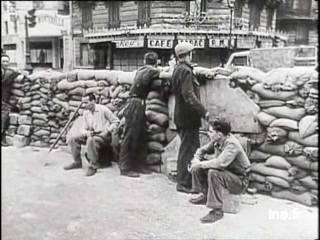
As Free French forces neared, the Parisians launched a massive strike and mobilized for an all-out war with the German occupying forces. The French Resistance and Free French battled the German occupying force for nearly a week in late August 1944, until Choltitz surrendered on August 25, 1944.
August 20, 1944
Choltitz is one of the most controversial figures of the Vichy France. He is seen as a hero to some for refusing to obey HItler’s orders to destroy one of the greatest cities in the world. However, in addition to having served Hitler and the Nazis faithfully during the war, he ordered the executions of numerous French Resistance fighters and destroyed Paris’s Grand Palais in the final days before the Liberation. His motivations may never be fully known, but fortunately for us, centuries-old Parisian landmarks survived the war and the battle for liberation with minimal physical damage.
Free French forces on the Champs Elysees, August 25
On this day in 1944, Charles de Gaulle, leader of the Free French, addressed his newly liberated countrymen from the Hotel de Ville:
We will not hide this deep and sacred emotion. These are minutes which go beyond each of our poor lives. Paris! Outraged Paris! Broken Paris! Martyred Paris! But liberated Paris! Liberated by itself, liberated by its people with the help of the French armies, with the support and the help of the whole France, of the fighting France, of the only France, of the real France, of the eternal France…
We, who have lived the greatest hours of our History, we have nothing else to wish than to show ourselves, up to the end, worthy of France.
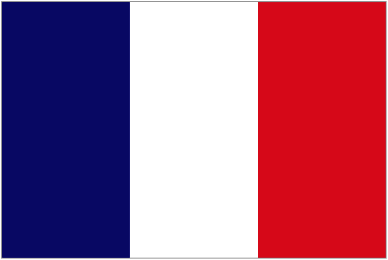
Vive la France!
Liberation Day is not a national holiday in France. Rather, the French celebrate Victory Day 1945 on May 8, the anniversary of the official end of hostilities in Europe the day after the surrender of German forces in Rheims, France.