Love in the Time of V.D. (Valentine’s Day)

February 14

Between Lincoln’s and Washington’s Birthdays in February comes another birthday, one that has been celebrated far longer than either President, but for a man whose life is all but unknown.

wedding
The awakening of spring has always been associated with the blossoming of love. In the Roman calendar February was the last month of the year, a time of purification before the new agrarian planting season.

Lupercalia commemorated the She-wolf that suckled the babies Romulus (founder of Rome) and his brother Remus in a cave on the site of the future capital. On February 15 each year a group of priests known as the Brotherhood of the Wolf, or Luperci, would strip to their birthday suits and sacrifice a dog and goat at the cave. Then they’d put on loincloths of the goat’s skin and go about the streets of Rome smacking women on their backsides with an animal skin lash, known as a februa (from the Latin februare, meaning “to purify”) in a ritual intended to promote fertility and ease the pangs of childbirth.
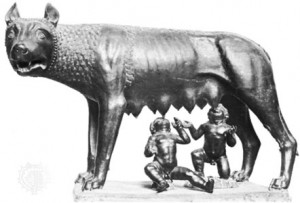
Romulus, Remus, & Ma Wolf
Romulus, Remus, & Mama Wolf

The Romans celebrated another festival in mid-February: Juno Februata. On the 14th of February eligible young men and women would participate in Roman Spin-the-Bottle. Boys would draw the names of eligible girls and ‘couple up’ during the festivities, sometimes for the entire year.

Around 496 AD Pope Gelasius banned the old pagan rituals and introduced the Festival of the Purification of the Virgin on February 14, which was later moved to February 2. The Church tried to replace to earlier rituals by having boys and girls draw the names of a saint and emulate the life of that saint. For whatever reason, that zany tradition never caught on with the same vigor as the Roman one.

Some scholars say that St. Valentine’s Day was a minor feast with no connection to romance or couples up until the 14th century. It was then that writers such as Chaucer and his contemporaries began referring to it as the day that birds chose their mates.
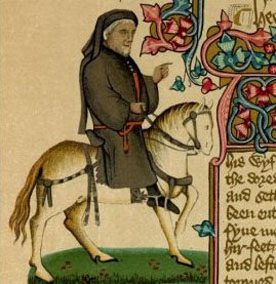
Geoffrey Chaucer
Geoffrey Chaucer

Chaucer wrote “The Parliament of Fowls”—referring to birds, not the English governing body—in tribute to Richard II’s engagement to Anne of Bohemia in 1381.

”[it] was on seynt Volantynys day
When euery byrd comyth there to chese his make.”
(It was sent on Saint Valentine’s Day,
When every bird comes there to choose his mate…)

It was a common writing device for poets to link certain events with the saint whose feast was observed that day. However the Valentine Chaucer referred to was the one whose feast was celebrated on May 3, for May 3 was the date of the King’s engagement. Chaucer describes conditions common to late Spring. (Chaucer and the Cult of Saint Valentine.)

The marriage of the royal 16 year-olds Anne and Richard was one based in love rather than politics. It ended with Anne’s death from plague 12 years later. Richard was never the same after her death, and was deposed and killed in 1400…on February 14.

Nearly a dozen ‘Valentines’ were canonized in the first centuries of the Christian Church, and to this day no one really knows which one we celebrate on February 14. (Would the Real Saint Valentine Please Stand Up)

Saint Valentine
St. Valentine

[Others say Valentine’s origin is a case of semantics. That Valentine comes from the Norman-French term galantin, meaning something like “woman-lover” in a chivalrous sense. It’s where we get the words “gallant” and “gallantry”.]
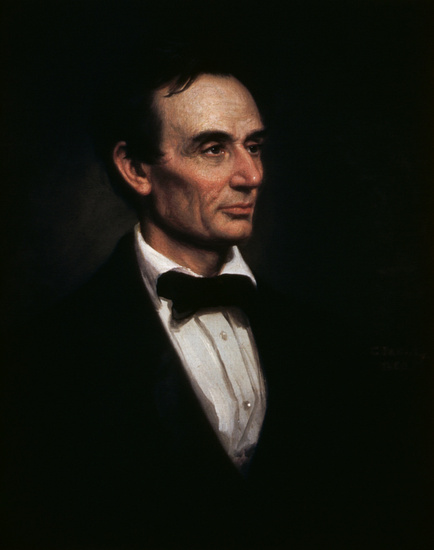
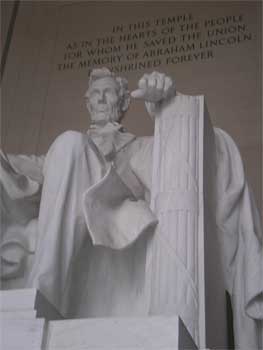
Lincoln’s Birthday

February 12

If I were two-faced, would I be wearing this one?

Abraham Lincoln

Young Abe Lincoln

There are only two Americans remembered with a federal holiday: George Washington and Martin Luther King Jr.

That’s right, Abe Lincoln, considered by many to be America’s greatest President, didn’t make the cut.

It’s true that many states celebrate ‘Presidents Day’ in honor of both Washington and Lincoln, while others celebrate Lincoln’s Birthday separately.

But on the national level ‘Presidents Day’ was never officially adopted. There were movements in Congress to create a new holiday on Lincoln’s birthday, or, since it was only 10 days before Washington’s birthday, celebrating the two on a single ‘Presidents’ Day. However the change never took effect. Though the date was changed, and the holiday is commonly called ‘Presidents Day,’ by the media and public, the Monday federal holiday is still officially “Washington’s Birthday.”

Here we have one of the earliest writing samples of Abraham Lincoln, when he was a young child:

Abraham Lincoln is my nam
And with my pen I wrote the same
I wrote in both hast and speed
and left it here for fools to read

Abraham Lincoln his hand and pen
he will be good but god knows When

My favorite Lincoln story stems from his Illinois lawyer days when he was defending a client by the name of Melissa Goings in the town of Metamora.

The 70 year-old Goings was accused of killing her husband, a well-to-do farmer, though she claimed she acted in self-defense. Her husband was known to be abusive and drink heavily. In her statement Mrs. Goings said she had wrested loose as he choked her, and struck him in the head with a stick of firewood, fracturing his skull. He died three days later. His last words were, “I expect she has killed me. If I get over it, I will have revenge.”

Even though Mrs. Goings’ story was consistent, awareness of domestic violence was not as broad as it is now, and Lincoln knew there was a good chance of her conviction.

Melissa posted her own $1000 bail. However, on the day of her trial she had a short conference with Lincoln, her lawyer, after which she walked out of the courthouse and was never seen again.

The court bailiff was angry with Lincoln. Unable to locate Mrs. Going, he accused Lincoln of “running off” the defendant. Lincoln denied the charge. “I did not run her off,” Lincoln insisted, “She wanted to know where she could get a good drink of water, and I told her there was mighty good water in Tennessee.” (Carl Sandburg, Abraham Lincoln: The Prairie Years)

lincoln_memorial1-01

Links:
http://www.factmonster.com/spot/washington1.html

Lincoln & Darwin: 200

[published Feb. 12, 2009]

Susannah Wedgwood and Nancy Hanks had little in common. They grew up on separate continents. Susannah was the first of seven children in a well-to-do English family and married a wealthy doctor named Robert Darwin. Nancy was the bastard daughter of Lucy Hanks and an unknown father, born in a cabin in rural West Virginia. She married a struggling Kentucky drifter by the name of Thomas Lincoln.

What Susannah and Nancy did have in common was that two hundred years ago today, on February 12, 1809, just hours apart, each of them gave birth to a son who in very different ways changed the course of human history.

Charles Darwin remembered almost nothing about his mother, though a childhood friend later recalled the boy bringing a flower to school, saying: “that his mother had taught him how by looking at the inside of the blossom the name of the plant could be discovered.” Even at that age Darwin did not take accepted knowledge of the natural world for granted. He allowed his observations to form his philosophy rather than relying on a predetermined philosophy to filter those observations. (Elegy for an Age)

Susannah Darwin died in 1817, when Charles was 8 years old.

Little is known about Lincoln’s mother, or what wisdom she imparted to him in the few years they had together. She died in 1818 when Abraham was 9.

Perhaps when Nancy read to young Abe from the family Bible, she interjected her abolitionist leanings. Perhaps her unknown roots, in a world where genealogy was everything, caused Lincoln to rethink the standards and social mores of his day. What we do know is that at nine years old, Abe Lincoln whittled the wooden pegs for his mother’s coffin.

He later said, according to his law partner William Herndon, “God bless my mother; all that I am or ever hope to be I owe to her.”

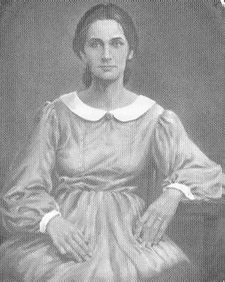
Nancy Hanks
Nancy Hanks

Nancy Hanks Eulogy

Oldest Country in the World

February 11

flag_japan

It’s hard to say what’s the oldest country in the world is, but the winner might be Japan twice over.

First, with an average lifespan of over 80 years Japan has one of, if not the, world’s oldest population. 25% of the population is over 60 (as opposed to 17% in the U.S.).  So, along with Andorra, Japan is one of the top two “oldest” countries in the world in that respect.

In terms of the oldest sovereign nation without major border changes, many people cite the tiny country of San Marino, which declared itself a constitutional republic in 301 AD. Founded by a Christian stonemason (Marinus of Rab) fleeing persecution, San Marino lies entirely within Italy.

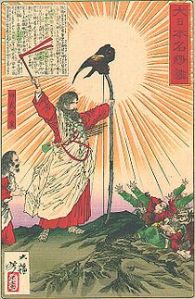
Emperor Jimmu

But a thousand years before Marinus the Mason drew his first breath, Emperor Jinmu (also Jimmu) founded the nation of Japan, making it the oldest nation in the world by many accounts.

How much of Jinmu’s story is true and how much is legend will never be known. His name means “divine warrior” and for millennia the Japanese believe Jinmu descended from the Sun Goddess through her “Heavenly Grandchild”. The Sun Goddess dispatched her Grandson to Earth with the imperative:

“This Reed-plain-1500-autumns-fair-rice-ear Land is the region which my descendants shall be lords of. Do thou, my August Grandchild, proceed thither and govern it. Go! and may prosperity attend thy dynasty, and may it, like Heaven and Earth, endure forever.”

Japanese schoolchildren learned the above declaration by heart right up through World War II.

During Japan’s modernization in the 1870’s, the Meija government (Meija means “enlightened rule”) switched the country over to the solar calendar, and calculated the date of the founding as February 11, 660 BC. Kenkoku Kinen no hi (National Foundation Day) celebrated the country’s unification 2500 years earlier and the divinity of the Emperor.

During the American Occupation, celebration of Kenkoku Kinen no hi was banned because of its glorification of the Emperor. However the ceremonies were brought back by popular demand in 1966 and carry on strong today.

Though the Japanese may no longer believe the Emperor’s blood descends from the Sun, even to this day the red sun shines front and center as the proud symbol of the Japanese flag.

Japanese Naval Ensign

Foundations of Japanese Civilization

Japanese Historians and National Myths

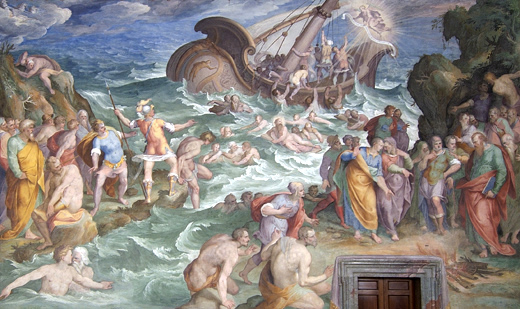
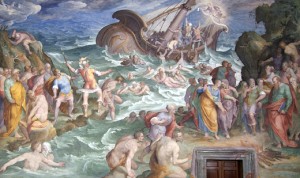
Shipwreck of St. Paul

February 10

Shipwreck of St. Paul, the Vatican

Just sit right back and you’ll hear a tale
A tale of a fateful trip
That started from Judean port
Aboard a Roman Ship.

The weather started getting rough,
The Roman ship was tossed.
Because of the sermons of the fearless Paul
Not a single life was lost.

They splashed about for 14 days,
No sight of sun nor star.
Until they crashed upon the reef
Of Malta’s rocky shore…
Of Malta’s rocky shore.

Reminded this was nothing to
His Savior’s sacrifice
Paul introduced the pagans there
To eternal life with Christ.

Here, on St. Paul’s shore!

St. Paul (the artist formerly known as Saul of Tarsus) was one of the worst persecutors of Christians before his miraculous conversion on the road to Damascus. The former Bad Boy of Tarsus is the only Apostle never to have toured with the living Jesus; yet he has more New Testament works attributed to him than any other author. At least 7 NT books are attributed to Paul, and he’s credited with having written or inspired another 8, making him responsible for up to half of the New Testament’s 27 books.

In the late 50s AD, the Apostle Paul was nearly stoned to death by his fellow Jews for bringing Gentile into a Jewish Temple. He demanded his right to be tried before a Roman court, hence his journey across the Mediterranean around 60 CE.

Because of the shipwreck, Paul was a few years late for his court date. He continued proselytizing in the Mediterranean before being tried in Rome. He lost his head during the reign of Nero, around 64 or 67 AD.

St. Paul is the patron saint of Malta, and the bay where he is believed to have crashed still bears his name.

February 10th is celebrated in the Roman Catholic Church as the feast day of the Shipwreck of Saint Paul, and it’s a national holiday in Malta. On this day each year the statue of St. Paul is carried in a procession through the streets of Valletta.

June 29, 2008 to June 28, 2009 was declared the “Year of St. Paul” by Pope Benedict XVI.

Tu B’Shevat – New Year for Trees

February 7-8, 2012
January 25-26, 2013
15th day of the month Shevat

The evolution of this holiday is a bit unusual. In ancient times Tu B’Shevat wasn’t really a “holy day” at all, but more of a tax day. Fruit-bearing trees were taxed differently depending on their age. And fruit could not be taken until after the tree’s third year. The fifteenth day of the month of Shevat was chosen as the “birthday” for all trees in the land of Israel, regardless of when they were planted.

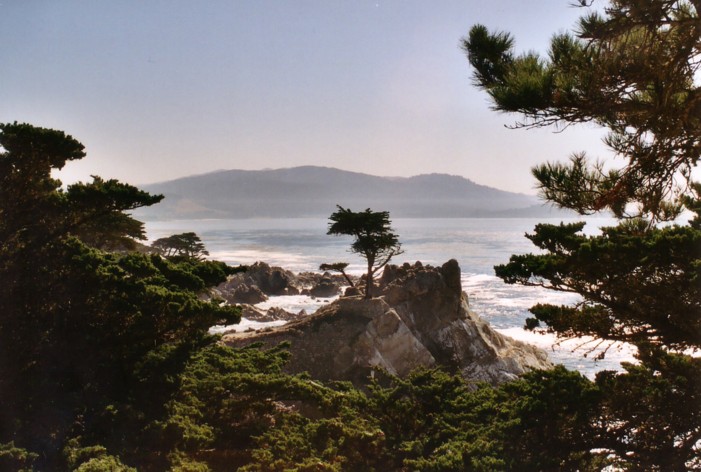
Lone Pine, Monterey
Lone Pine, Monterey, California

Today it is celebrated as more of an Arbor Day for the Jewish people.

The is no one way to celebrate Tu B’Shevat.

In Italy Rabbi Barbara Aiello and her congregation bring green plants to the residents of a local retirement home, to bright up the rooms.
In Modiin, Israel a kindergarten class plants trees.

Many Jewish families around globe have a special “sedar” or meal on Tu B’Shevat. Four types–or colors really–of wine are consumed during the sedar, as well as different types of fruit.

In the Kabbalah tradition the fruits symbolize different levels of the world:

  • 1. assiyah, the level of “action,” is symbolized by fruits with an inedible shell, such as nuts. The inside represents holiness, protected by the outer shell.
  • 2. yezirah, the level of “formation.” This level is represented by fruits with edible outsides and pits on the inside.
  • 3. beriah, the level of “creation,” is symbolized totally edible fruits, such as apples, grapes, figs, and raspberries.
  • 4. atzilut, the purest level is known as “emanation,” and is not symbolized by fruit or anything for that matter, as it cannot be represented by anything concrete.

In modern times Tu B’Shevat has been adopted by the environmental movement, and a sort of Earth Day culture has developed around it. The modern tradition of planting trees goes back to 1884 when settlers in Galilee planted 1500 trees. Today it is common for schoolchildren in Israel to do the same.
Another reason Judaica may have latched onto the holiday tighter in diaspora than originally in Israel, was the representation of the tree and tree’s roots as symbols for the roots of the Jewish people back in the Holy Land, and fruit symbolic of the Jewish family and future yet to be realized. The theme of genealogy and family grew to be of fundamental importance during the eras of exile. Tu B’Shevat’s imagery of trees and land tapped into the scattered people’s longing for a faraway homeland.
Branches

The blessing for the fruit is:

Baruch Atah Adonai, Elohaynu Melech Haolam, borei pri ha’eitz.

“Blessed are You Adonai, our God, ruler of the universe, who brings forth the fruit of the tree.”

Tu B’Shevat begins, as all Jewish holidays, at sun-down and continues the next day.

Chinese Lantern Festival

15 days after Chinese New Year
February 6, 2012
February 24, 2013

Experience is a comb nature gives us when we’re bald.

— Chinese Proverb

chinese_lantern-01

If you thought Chinese New Year was big this year, guess what:

It ain’t over.

Chinese New Year celebrations last for 15 days, right up until the first full moon of the year. The fifteenth night of the first lunar month, and culmination of the party, is the Lantern Festival.

There are many stories about the festival’s origin. According to one legend, a coastal village came under attack by ship. The villagers ran up to the mountains to hide. When the attackers moved on, a villager remaining in town lit up a sky lantern to signal to the villagers in the mountains that it was safe to come down.

Another legend says that the Jade Emperor in Heaven planned to unleash a fire of vengeance upon a town that had killed his favorite Goose. A fairy, hearing of the plan, warned the townspeople to light a bevy of lanterns on that day. From Heaven it appeared the town had already been set ablaze, and the Jade Emperor did not destroy it.

Moral of the story: do not mess with a Jade Emperor’s Goose!

Jade Emperor
Jade Emperor

People across China and Taiwan greet the first full moon of the year by creating their own short-lived Milky Way. Thousands of Sky Lanterns are released into the sky, in one of the most spectacular sights of the new year.

Before sending one’s sky lantern up into the heavens, it’s good luck to write a wish or prayer on the lantern or on a piece of paper inside it. The higher the wish and lantern ascend the more good luck they are believed to bring.

The Taiwanese word for Sky Lantern–Tian Ding–means “having a baby boy.”

The festival is called Yuan Xiao in Chinese. Yuan Xiao is also the name of the little glutenous rice-flour dumplings consumed in mass quantities on this day.

Waitangi Day – New Zealand

February 6

flag_newzealand

New Zealand’s national holiday celebrates the signing of the Treaty of Waitangi on this day (February 6) in 1840.

The word ‘celebrate’ is disputed though. The treaty was the original agreement between representatives of the British Crown and the Maori chieftains, and its signing is considered the birth of New Zealand. However, to many Maori—the indigenous descendants who make up about a sixth of New Zealand’s population—the Treaty represents the country’s ‘original sin’.

The problem with the Treaty of Waitangi stems from discrepancies between the English and Maori translations (translated by a well-meaning but less-than-fluent English missionary in a single night) so the chieftains and the British never precisely agreed on the same stipulations. The New Zealand government solved this dilemma by, when in doubt, not honoring the Maori version. This didn’t sit well with the Maori, whose protests against the loss of their lands fell on deaf ears for over a century.

Once heralded as a symbol of victory for indigenous rights, the Treaty has become the cornerstone of a growing awareness of social injustices committed against the Maori, who protest each Waitangi Day.

But as Tariana Turia, co-leader of the Maori Party, said:

“It’s critically important that people understand that the Treaty is not about settlement, it’s not about grievance. The Treaty was a document of unity, and all of us should understand it.” – New Zealand Herald

Marae, Waitangi, © 2009 Alison MacCallum

And if there’s one thing that unifies the New Zealand people, it’s that nobody outside New Zealand understands them. Here are some “Kiwi-isms” to help you better communicate with these fun-loving but linguistically-challenged people:

A into G: arse into gear (to get going)

Box of birds: cheerful, very good

Carked it: kicked the bucket

Cellotape: scotch tape

Cotton buds: Q-tips

Dag: an amusing character

Dunny: toilet

Eketahuna: the NZ “Timbuktu”

Fanny: you don’t need to know, just never say “fanny pack”. It’s called a”bum-bag.”

Guts for garters: in big trouble

Ice block: popsicle

Judder bar: speed bump

Kia ora: “hello” in Maori

Money for jam: easy money

Off yer face: intoxicated

Pavlova: tasty dessert named for a Russian ballerina who visited NZ (though Australians try to claim it)

Rattle your dags: hurry up

Throw a wobbly: become angry

Your shout: your turn to buy drinks

More at the official NZ-to-English Dictionary

Oh, and Waitangi is the name of the river that was the site of the Treaty’s signing. It means “noisy” or “weeping river”.