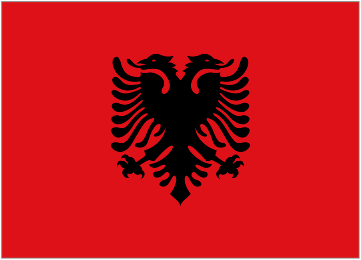
Gettin’ Zany with Albania

November 28

Albania, Albania,
You border on the Adriatic
Your land is mostly mountainous
And your chief export is chrome

Albanian National Anthem

Ok, the above lyrics are not from the Albanian national anthem. They’re from that episode of Cheers where Coach demonstrates how it’s easier to learn factoids when they’re set to music. (Sung to the tune of “When the Saints Go Marching In“.)

Albania is one of the most overlooked countries of Europe, yet one of the most beautiful. And Albanians are fiercely proud of this fact. On no day is Albanian pride more evident than on November 28, Albania’s Flag Day, Independence Day, and just about everything else all wrapped up into one.
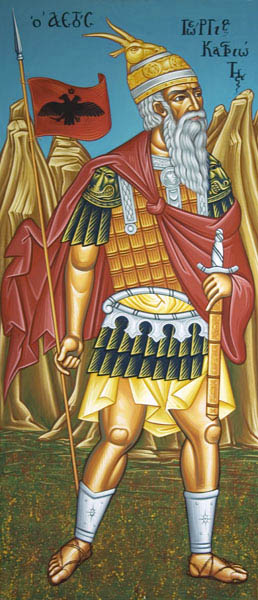
Giorgios Kastriotis, Skanderbeg

Back in 1443 an Albanian by the name of Giorgios Kastrioti, aka Skanderbeg (Lord Skander) was fighting on behalf of the Ottoman Empire against the Hungarians. Years before, the Sultan had usurped the Kastrioti family’s lands. The family had submitted to his rule, converted to Islam, and young Giorgios and his brothers were conscripted. Giorgios was granted the title “Beg”, or Lord. He even became a general in the Ottoman army, winning several battles against the Greeks, the Serbs and the Hungarians.

On November 28, 1443, during a battle against the Hungarians, Skanderbeg and 300 Albanians fighting for the Ottoman Empire suddenly switched sides. Skanderbeg first raised the double-headed eagle banner that is now the flag of Albania.

Skanderbeg soon united the Albanian princes against the Sultan. Through strategy, trickery, wits and will, his greatly outnumbered forces held the Ottoman Empire at bay for over two decades, even after the fall of Constantinople in 1453. The Ottoman army finally subdued Albania in 1479, ten years after Skanderbeg’s death by malaria.
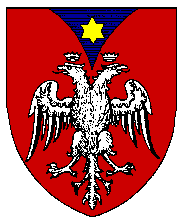
skanderbeg_coat_of_arms

The Ottoman Empire ruled Albania until the early 20th century. In 1908 Albanian fighters sided with the Young Turks, a group fighting to restore constitutional government across the Empire. After the Sultan conceded, the Young Turks loosened restrictions that had banned Albanian language and culture. However, when Albanian nationalism resurfaced, the Young Turk government cracked down harder than before, crushing the Albanian rebellion and enforcing “Ottomanization’.

The tightening of power only inflamed the independence movement. In 1911 Albanian fighters defeated a group of Turkish troops and raised the double-headed eagle flag for the first time since the days of Skanderbeg.

On November 28, 1912, during the height of the First Balkan War, the National Assembly announced that “delegates from all parts of Albania, without distinction of religion, who have today met in the town of Valona, have proclaimed the political independence of Albania…” (Albanian Declaration of Independence)

In 1939 Albania met a new enemy, this time in the West. Italian dictator Mussolini, envious of the ease with which Hitler annexed neighboring countries, tried his own hand as Conqueror. He chose as his victim the mighty kingdom of Albania. King Zog was forced to flee, and Albania experienced 5 years under the Axis. Communist-led nationalist forces liberated the country (Albanians are quick to point out they were liberated not by the USSR but by themselves) on November 29, 1944.

Albania became a communist country, but wasn’t dominated by Moscow. In fact they broke ties with the Soviet Union during the latter’s de-Stalinization. Post-Stalin USSR just wasn’t communist enough for Albania.

On November 28, 1998, Albania voted for a new parliamentary constitution–555 years to the day after Skanderbeg first raised the Albanian flag.

For all these reasons, today, November 28, is Albania’s National Day.

+  +  +

In American cinema, Albania enjoys a unique status as the country we’re most likely to scapegoat for arbitrary reasons. In Wag the Dog, Robert Dinero and Dustin Hoffman cook up a fake war against Albania to take the attention off the President’s affair…

“Why Albania?”

“Why not?”

“What have they ever done to us?”

“What have they ever done for us?”

In Tune in Tomorrow, radio serial writer Peter Falk so offends the Albanian-American population with his random Albanian jokes, that he is forced to pick a new arbitrary target: Norwegians.

Late Medieval Balkans – by John Van Antwerp

Happy New Year! The Advent-ure Begins

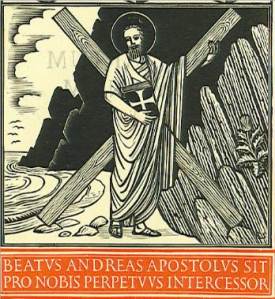
St. Andrew

The fourth Sunday before Christmas marks the beginning of the liturgical calendar in much of the Western Church. Advent Sunday corresponds to the Sunday nearest Saint Andrew’s Day (November 30).

Advent comes from the Latin Adventus,meaning ‘arrival’. During Advent Christians prepare for both the anniversary the birth of Christ, as celebrated on December 25, and the anticipation of the Second Coming.

The first records of what we now call Advent date from 5th and 6th century France.

Advent originally lasted six weeks (43 days), from St. Martin’s Day (November 11) to Christmas, during which adherents would fast three times a week. For many Germans and Austrians, St. Martin’s Day still kicks off the Christmas season.

Beginning in the 9th century the length of Advent was reduced to four weeks instead of six. Over the centuries the fasting element of this “second Lent” was replaced by abstinence, which was then replaced by little calendars with chocolates in them.

Some of the most visible symbols of the holiday are the Advent wreaths and the royal purple and royal blue banners and vestments in Catholic and Protestant churches.

Advent Wreath

The circular wreath was an ancient Germanic and Celtic symbol, representing the ever-turning “wheel of the year”. Today the wreath–with no beginning and no end–symbolizes the eternity of God and the immortality of the soul, as do the evergreens from which the wreath is made. Laurel leaves represent Christ’s persecution; cedar represents the healing power of Christ; and pine and holly represent immortality. Pine cones are sometimes used to signify new life and resurrection.

During each Sunday of Advent families and churches light one of the four wreath candles. In that respect the wreath is the original Advent Calendar.

In the Catholic tradition three candles are purple. The fourth, a rose candle, is lit on Gaudete Sunday.

The History of Advent

The History of the Advent Wreath

Al-Hijra 1433

~ November 26, 2011
~ November 14, 2012
~ November 3, 2013

Happy New Year!

What’s that? No party hats? No noise makers, or funny glasses with “1432” on them?

Nope, the Islamic New Year is a time of reflection and reverence, not outward celebration. The name Muharram itself–the first month of the Hijra calendar–means “holy” or “forbidden”. Muharram is one of the four “sacred” months (not including Ramadan), during which certain acts are forbidden.

“…the one that keeps a fast in the month of Muharram will receive the reward of thirty fasts for each fast.”

Details of the Hijra calendar are laid out in the Qur’an which states: “The number of the months according to Allah is twelve.” The number of days in each month is determined by the lunar cycle. The Qur’an condemns luni-solar calendars which insert an intercalary or leap period “one year and forbid it another year so that they may make up the number of the months which Allah has allowed in order to permit what Allah has forbidden.

In other words, the days and months of the year are set down by God, as are rules about when to abstain from certain activities ranging from fighting to eating to intercourse. So even if man tries to shift the months of the year for his convenience, this doesn’t change the natural timetable by which prescribed activities are allowed and forbidden.

Islam and the Moon

Islam’s use of the moon and the lunar cycle as the sole determinant of the year stands in stark contrast to luni-solar calendars that originated from earlier cultures, many of which worshipped a “sun-god”, be it Ra, Helios, or Mithra.

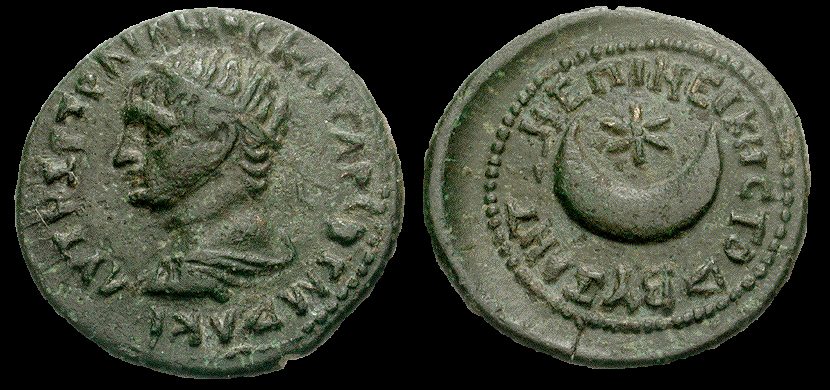
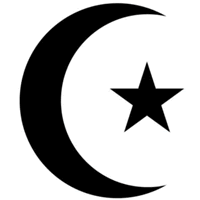
Today the crescent moon is the most widely recognized symbol of Islam, yet early Muslims used icon-free banners of various colors. The moon and star, symbols of Byzantium since the 4th century BC, spread across the Islamic world during the expansion of the Ottoman Empire.

Moon & Star Byzantine coin, ca. 100 AD

The Qur’an forbids worship of the moon or any other object. During the Prophet Abraham’s quest for God, Abraham first worships a “shining planet”, but when the star fades he says, “I love not those that disappear.” When the moon rises he says “This is my Lord.” But he is disillusioned when the moon sets as well. Finally, when sun rises, he says, “This is my Lord; this is the greatest of all” But like the moon and star, even the sun sets. Abraham at last proclaims, “I have devoted myself absolutely to the One who initiated the heavens and the earth. I will never be an idol worshipper.” [Qur’an 6:76-79]

Al-Hijra

The birthnight of Islam may have been Muhammad’s first revelation of the Quran by the Angel Gabriel in 610 CE. But the Year known as 1 in the Muslim calendar came over a decade later..

The Prophet Muhammad was living in Makkah, teaching Islam and monotheism to his followers, and thus angering the city’s governance. Even then Makkah was a pilgrimage destination, but for a very different reason. The Kaaba–the birthplace of monotheism in Islam–held idols of pagan gods worshipped by the many cults and clans around Makkah. Much of the power of city leaders rested on their perceived connection with pagan gods and idols.

Muhammad found support in the people of Medinah, who would travel the 200 miles distance to Makkah to meet with him and learn the ways of Islam. Muhammad refused to stop teaching Islam, despite offers of riches and power from government leaders if he did, and threats to his life if he didn’t. In September of 622 he cut his ties with the leaders of Makkah and led his followers north to Medinah to establish the world’s first city-state governed by the laws of the Qur’an.

Though today Makkah is the direction toward which Muslims pray and the destination of the Hajj, it was Muhammad’s departure of the city that set in motion the Islamic calendar. We’re beginning the 1430th year of Al-Hijra, or “the Migration.”

Months of the al-Hijra calendar

Muharram: Forbidden, holy
Safar: Whistling of the Wind
Rabi al-Awwal: First month of spring
Rabi al-Thani: Second month of spring
Jumada al-Awwal: First month of dryness (summer)
Jumada al-Thani: Second month of dryness
Rajab: To respect. One of the four sacred months, Rajab is also called Rajab al Fard (alone), because the other three sacred months are consecutive.
Shaban: Continual Increase
Ramadan: Intense heat
Shawwal: Uplift or breakage
Zul Qu’dah: To sit
Zul Hijjah: Pilgrimage (month of the Hajj)

The names derive from pre-Islamic times when the months coincided with the seasons.

[from Dec. 28 – 2008 – For the first time in over three decades Muslims will celebrate two ‘New Years’ in a single Gregorian calendar year. First, Al-Hijra 1429 on January 9/10 2008 CE and now 1430 AH on December 28/29. The next time this will happen will be in 2041 CE, so better make this one count!]

Muharram

~ November 26, 2011
~ November 14, 2012
~ November 3, 2013

Muharram is the first month of the Islamic calendar.

But you won’t find fireworks displays or any celebrations akin to both Western and Eastern New Year traditions. On the first day of the year Muslims reflect upon the Hijra–the Prophet Muhammad’s flight from Mecca to Medina in 622 CE.

Muharram procession. (Chan'ad Bahraini)

The Hijra is considered the beginning of the Islamic calendar; hence, years are referred to as AH (After Hijra).

During the month of Muharram, Muslims focus on the Islamic principles of sacrifice, selflessness, patience, and knowledge of Allah Ta’ala. It is also one of the four sacred months. Fasting during Muharram is not obligatory, but is encouraged during the first ten days, especially the tenth day, Ashura.

The Islamic calendar is approximately 355 days with twelve months of 29 to 30 days. For this reason the Islamic calendar does not usually coincide with the solar calendar, but falls about 10 days earlier each year.

The dates of Muslim holidays vary depending on the visibility of the lunar crescent. Unlike other lunar calendars which begin on the new moon, in the Islamic calendar a month begins when the crescent of the moon is first visible.

Though lunar cycles can be predicted, lunar sightings cannot, due to inclement skies and other atmospheric conditions. For this reason pre-printed calendars are not considered accurate, although they are necessary for planning. Saudi Arabia has adapted a standard calendar based on the lunar cycle as it would be viewed on a clear night from Mecca.

Islamic Star and Crescent

Observing the Islamic calendar, or Hijra calendar, is a sacred duty to all Muslims.

Prior to the Hijra in 622 CE much of the Arab world used a lunar calendar that was offset by an “Intercalculation,” or extra month, inserted every three or so years. The Intercalculation month was inserted by government astronomers to keep the lunar calendar in line with the solar calendar. But by arbitrarily manipulating the lunar cycle the dates of the four sacred months became corrupted. As the Qur’an explains in 9:36:

“The number of the months with Allah is twelve months by Allah’s ordinance in the day that He created the heavens and the earth. Four of them are sacred.”

During the sacred months sacred activities are observed and fighting is forbidden; thus it was/is vital that all Muslims be on the same calendar and that the sacred months not vary from state to state:

“Postponement (of a sacred month) is only an excess of disbelief whereby those who disbelieve are misled. They allow it one year and forbid it another year so that they may make up the number of the months which Allah has allowed in order to permit what Allah has forbidden.”[Qur’an 9:37]

Black Friday

Day after Thanksgiving

Before long, every entrance to the Exchange became so blocked by the still-gathering legions, that strength and patience were required by him who desired or found it necessary to work his way through the press of people…

What had happened to values? What did it mean? Tampering with gold…had precipitated an alarmingly unsettled condition, which might reach disastrously from one end of the land to the other…

Frederic Stewart Isham, Black Friday, 1904

Greetings, children. Buy Nothing Day is the day after Thanksgiving. The Devil calls it Black Friday.

Reverend Billy Talen, What Would Jesus Buy?

Black is the color ascribed to those terrifying autumnal days when the Stock Market takes a nose dive. Black Monday (October 19, 1987), Black Thursday (October 24, 1929) and the original Black Friday (September 24, 1869), when the price of gold fell dramatically after Jim Fisk and Jay Gould attempted to corner the market.

In the 21st century, Black Friday is day after Thanksgiving and the start of the Christmas shopping season, when stores hope to get their balance sheets back ‘in the black’ (positive, as opposed to ‘in the red’) after one of the busiest shopping days of the year.

The term Black Friday supposedly originated not with accountants but with Philadelphia bus drivers and police officers, who lamented the traffic congestion that inevitably gridlocked the city on the day after Thanksgiving.

In 2008, consumers got a reminder of the crowd-control meaning behind Black Friday’s name. A Wal-Mart employee was trampled to death by a mob of shoppers storming into the Long Island store to buy whatever holiday item is so important that one must kill one’s neighbor to purchase it. A pregnant woman in the same melee was hospitalized and reportedly suffered a miscarriage.

On the other side of the country, an argument in the electronics department of a Palm Desert Toys ‘R’ Us ended with two men shooting each other.

A brief aberration? Or a sign of things to come? According to Reverend Billy Talen, the Shopocalypse is upon us…

Guard against every kind of greed. Life is not measured by how much you own.

Luke 12:15

Thanksgiving!

4th Thursday in November

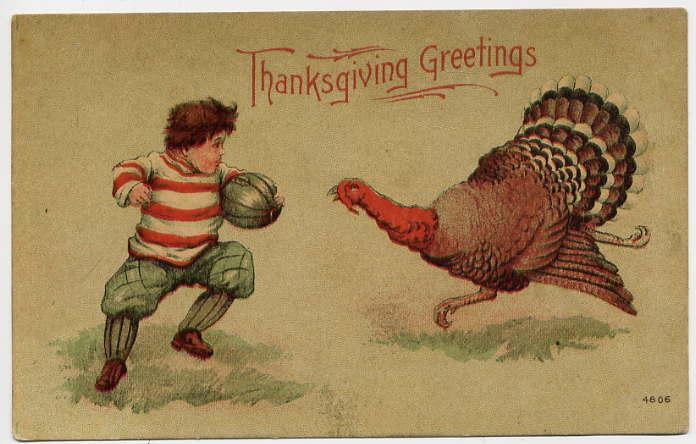
Oops, wrong picture!

Today Americans join with friends and family to declare thanks for the past year’s blessings.

Though scholars argue over the first true Thanksgiving in North America, popular tradition attributes the holiday to the three-day feast of the Plymouth Rock Pilgrims and the Wampanoag Indians who showed them the ropes in 1621.

The celebrants feasted on deer and corn as well as turkey, and did so in early Autumn rather than in November. The Pilgrims had chosen to migrate to New England during the height (or depth) of the Little Ice Age, meaning Massachusetts was even colder in November than it is now. (Yes, hard to imagine.)

And the Pilgrims didn’t consider it a “Day of Thanksgiving” either.

To the Pilgrims, “Days of Thanksgiving” were solemn occasions of prayer, not feasts, during which labor and recreation were both discouraged. The Pilgrims’ first official Thanksgiving was a day of prayer in July 1623, after a drought. In the 19th century the memory of this event merged in the public eye with the autumn 1621 feast, perhaps given a boost by the rediscovery of the Plymouth Governor William Bradford’s journal by an English bishop in the 1850’s.

Though the British don’t celebrate Thanksgiving, the American tradition hails from England. Queen Elizabeth I had proclaimed a Day of Thanksgiving in 1588 after the destruction of the Spanish Armada. The first annual Day of Thanksgiving in Britain was declared in November 1605 after London authorities thwarted a terrorist plot to blow up Parliament, an event celebrated today as Guy Fawkes Day.

Autumnal harvest festivals were nothing new, but Days of Thanksgiving were also proclaimed after victories in times of war. In 1676, for example, descendants of the Pilgrims declared a Day of Thanksgiving for their victory over their former friends, the Wampanoag.

101 years later in the midst of the Revolutionary War, the Continental Congress declared December 18, 1777 a day of “solemn thanksgiving and praise,” and a day to support the troops through prayer.

George Washington declared Thursday, November 26, 1789 a day of Thanksgiving during his first year as President, a tradition continued by John Adams. But a national Thanksgiving fell by the wayside until Congress and President Madison declared a Thanksgiving Day in 1814, following the end of the War of 1812.

The biggest Thanksgiving bump occurred in 1863, when the nation was at war with its most formidable enemy: itself. Three months after the Battle of Gettysburg, President Lincoln sought to unify the country through prayer, by asking all Americans to “set apart and observe the last Thursday of November next, as a day of Thanksgiving and Praise to our beneficent Father who dwelleth in the Heavens.

It was the first Thanksgiving following the enactment of the Emancipation Proclamation.

Thanksgiving’s association with the first Pilgrims solidified throughout the 19th century as the reunified country sought to fortify its own unique national traditions.

Lincoln’s “last Thursday in November” became the official Thanksgiving rule until 1933.

That year, Franklin D. Roosevelt’s first year in office, November had five Thursdays, and Thanksgiving was to fall on the last day of the month. As one merchant organization wrote:

“It is an established fact that Christmas buying begins vigorously every year in the retail stores the day following Thanksgiving and that the Thanksgiving to Christmas period is the busiest retail period of the whole year. The Downtown Association of Los Angeles feels that Abraham Lincoln’s Proclamation of 1864 setting aside a day for Thanksgiving to be the 4th or last Thursday in November of each year can be carried out to the letter by designating in your Thanksgiving Proclamation this year, November 23rd, the fourth Thursday in November as the day of Thanksgiving.”

FDR moved Thanksgiving to the 4th Thursday in November, and did so again in 1939, despite letters of protest from calendar makers who had printed their calendars, universities that had planned their football season and vacations, traditionalists who believed that centuries-old holidays shouldn’t revolve around department stores, and one tongue-in-cheek West Virginian who wrote:

“I see by the paper this morning where you want to change Thanksgiving Day to November 23 of which I heartily approve. Thanks.

Now, there are some things that I would like done and would appreciate your approval:

1. Have Sunday changed to Wednesday;

2. Have Monday’s to be Christmas;

3. Have it strictly against the Will of God to work on Tuesday;

4. Have Thursday to be Pay Day with time and one-half for overtime;

5. Require everyone to take Friday and Saturday off for a fishing trip down the Potomac.”

Shelby O. Bennett, August 15, 1939

FDR’s tradition stuck. Today Thanksgiving falls on the 4th Thursday of November.

Americans are a grateful people, ever mindful of the many ways we have been blessed. On Thanksgiving Day, we lift our hearts in gratitude for the freedoms we enjoy, the people we love, and the gifts of our prosperous land…

Since the first National Day of Thanksgiving was proclaimed by President George Washington, Americans have come together to offer thanks for our many blessings. We recall the great privilege it is to live in a land where freedom is the right of every person and where all can pursue their dreams.

President George W. Bush, Thanksgiving Proclamation; November 15, 2007

First Thanksgivings: Original Sources

Presidential Thanksgiving Proclamations 1789-1815

Lincoln’s Proclamation, 1863

FDR’s letters re: Thanksgiving 1933 & 1939

1564: The First Forgotten French Pilgrims – NY Times 2008

All Souls Day

November 2

…For it’s the turn of the year and All Souls’ night,
When the dead can hear and the dead have sight…

Edith Wharton, All Souls

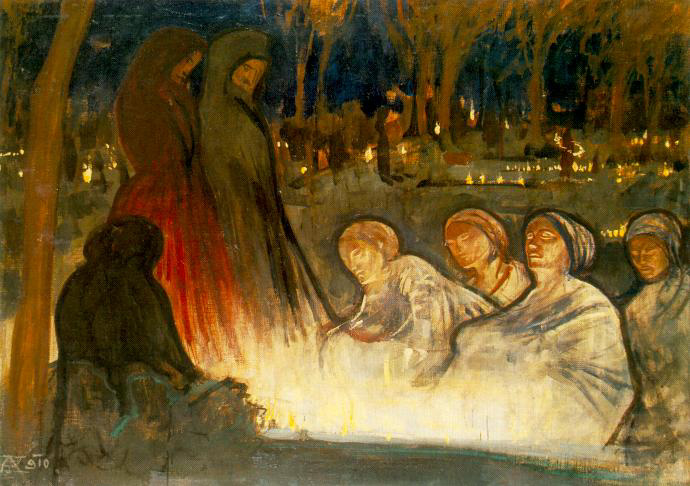
All Souls Day - Aladar Korosfoi-Kriesch

Whereas All Saints Day recognizes the departed whose souls have found refuge in Heaven, All Souls Day remembers those restless spirits still lingering in Purgatory.

All Souls Day originated not in Rome but France.

Around 820 Amalarius of Metz (northwest of Strasbourg) wrote “After the offices of the saints, I have inserted an office for the dead. For many pass over from this present age who are not immediately united with the saints.” (ie. “don’t go directly to heaven.”)

In the early 11th century, St. Odilo, fifth abbot of the Cluny monastery, officiated the feast of All Souls on November 2. Over the century, the tradition was adopted by dioceses across Western Europe.

On All Souls Day, families visit the graves of their loved ones and light candles in their memory.

Fear not the shudder that seems to pass:
It is only the tread of the their feet on the grass…
…For the year’s on the turn and it’s All Souls’ night,
When the dead can yearn and the dead can smite…

…Let them see us and hear us, and say: “Ah, thus
In the prime of the year it went with us!”

All Souls Day is celebrated on November 2, unless the 2nd falls on a Sunday, in which case it’s observed on Monday, November 3 as was the case in 2008.

All Saints Day

November 1

Every day of the Catholic calendar honors at least one Saint.

But for all those Saints who just weren’t saintly enough to get their own day, there’s All Saints Day.

Okay, not exactly.

Medieval liturgists traced All Saints Day in the Catholic Church to the consecration of the Pantheon, originally a pagan temple built by Emperor Hadrian around 125 AD. The Pantheon honored the Roman, well, Pantheon (literally, “All Gods”.)

On May 13, 609 or 610, the Pantheon was consecrated by Pope Boniface IV in the name of the Virgin Mary and All Martyrs. The date, May 13, may harken back to the old festival Lemuralia, during which Romans remembered the dead and cast out restless spirits.

In the 730s Pope Gregory III dedicated a chapel at St. Peters Basilica on November 1 and declared it an annual holy day. The chapel housed the relics “of the holy apostles and of all saints, martyrs and confessors, of all the just made perfect who are at rest throughout the world.

St. Peters Basilica is believed to be the burial place of Saint Peter himself. This, the most famous place of worship in Christendom was built beside the “Circus” of Caligula, where the Emperor Nero organized mass executions of Christians beginning in 65 AD.

St. Peter was crucified there (upside-down) at the site in 67 AD. Today the Vatican City’s Colonnade surrounds what was once the notorious Circus, its center marked by an enormous Obelisk brought to Rome after the conquest of Egypt.

Some historians attribute the November 1 date to the church’s desire to supplant regional harvest festival holidays devoted to the dead, such as the Celtic Samhain.

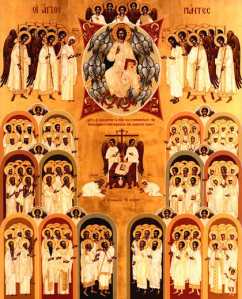
Today All Saints Day glorifies the memory of those souls, known and unknown, who have found a place in heaven.

For all those stuck in Purgatory, there’s All Souls Day