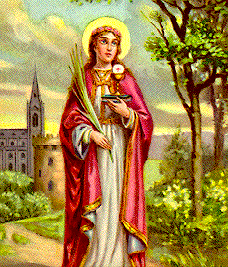
Kids, if you thought your folks are hard on you, be glad you didn’t have Saint Barbara’s dad.
Barbara’s claim to fame was being kept in isolation in a tower by her father Dioscorus, a prominent pagan in Asia Minor, around 300 AD.
Saint Barbara
Dioscorus grew upset at his daughter’s refusal of several marriage proposals by eligible suitor-princes. Before leaving on a business trip, Dioscorus ordered his workers to construct a bathhouse for Barbara. The bathhouse had two windows. But in her father’s absence, Barbara asked the workmen to put in a third window. When Dioscorus returned he was infuriated by the deviation from his plan. Barbara confessed she did it in honor of the Holy Trinity, and that she was a Christian, having been secretly tutored by a priest.
As any concerned father would do, Dioscorus took her to the Roman prefect, Marcian, who ordered Barbara to be tortured until she renounced her faith. Young Barbara withstood heinous tortures, but did not renounce Christ. When Marcian ordered her execution, Dioscorus offered to do it himself. Barbara was beheaded by her own father around 303 AD. Dioscorus was then struck by a bolt of lightning and died.
Because of the method of her father’s demise, Barbara became the patron saint of those threatened by thunderstorms and fire. And later became the patron saint of miners and artillerymen.
Rome had the last laugh on Barbara though. In 1969, after over a thousand years, the Catholic Church officially removed her Feast Day–like Saint Brigid–for lack of any evidence that she ever existed.
Barbara’s legend is still strong in Germany and northern Europe, where Barbara is celebrated on December 4, the assumed date of her martyrdom. It’s customary to place a twig from a cherry branch (Barbarazweig) in water on this day, to bloom by Christmas. While imprisoned Barbara had found a cherry branch in her cell and moistened it with her drinking water. Before her death, it bloomed, and brought her joy.
The U.S. Field Artillery has two military orders in her name, the Ancient Order of Saint Barbara and the Honorable Order of Saint Barbara.
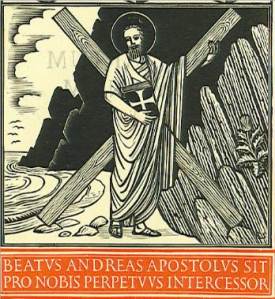
The fourth Sunday before Christmas marks the beginning of the liturgical calendar in much of the Western Church. Advent Sunday corresponds to the Sunday nearest Saint Andrew’s Day (November 30).
Advent comes from the Latin Adventus,meaning ‘arrival’. During Advent Christians prepare for both the anniversary the birth of Christ, as celebrated on December 25, and the anticipation of the Second Coming.
The first records of what we now call Advent date from 5th and 6th century France.
Advent originally lasted six weeks (43 days), from St. Martin’s Day (November 11) to Christmas, during which adherents would fast three times a week. For many Germans and Austrians, St. Martin’s Day still kicks off the Christmas season.
Beginning in the 9th century the length of Advent was reduced to four weeks instead of six. Over the centuries the fasting element of this “second Lent” was replaced by abstinence, which was then replaced by little calendars with chocolates in them.
Some of the most visible symbols of the holiday are the Advent wreaths and the royal purple and royal blue banners and vestments in Catholic and Protestant churches.
Advent Wreath
The circular wreath was an ancient Germanic and Celtic symbol, representing the ever-turning “wheel of the year”. Today the wreath–with no beginning and no end–symbolizes the eternity of God and the immortality of the soul, as do the evergreens from which the wreath is made. Laurel leaves represent Christ’s persecution; cedar represents the healing power of Christ; and pine and holly represent immortality. Pine cones are sometimes used to signify new life and resurrection.
During each Sunday of Advent families and churches light one of the four wreath candles. In that respect the wreath is the original Advent Calendar.
In the Catholic tradition three candles are purple. The fourth, a rose candle, is lit on Gaudete Sunday.
~ November 26, 2011 ~ November 14, 2012 ~ November 3, 2013
Happy New Year!
What’s that? No party hats? No noise makers, or funny glasses with “1432” on them?
Nope, the Islamic New Year is a time of reflection and reverence, not outward celebration. The name Muharram itself–the first month of the Hijra calendar–means “holy” or “forbidden”. Muharram is one of the four “sacred” months (not including Ramadan), during which certain acts are forbidden.
“…the one that keeps a fast in the month of Muharram will receive the reward of thirty fasts for each fast.”
Details of the Hijra calendar are laid out in the Qur’an which states: “The number of the months according to Allah is twelve.” The number of days in each month is determined by the lunar cycle. The Qur’an condemns luni-solar calendars which insert an intercalary or leap period “one year and forbid it another year so that they may make up the number of the months which Allah has allowed in order to permit what Allah has forbidden.”
In other words, the days and months of the year are set down by God, as are rules about when to abstain from certain activities ranging from fighting to eating to intercourse. So even if man tries to shift the months of the year for his convenience, this doesn’t change the natural timetable by which prescribed activities are allowed and forbidden.
Islam and the Moon
Islam’s use of the moon and the lunar cycle as the sole determinant of the year stands in stark contrast to luni-solar calendars that originated from earlier cultures, many of which worshipped a “sun-god”, be it Ra, Helios, or Mithra.
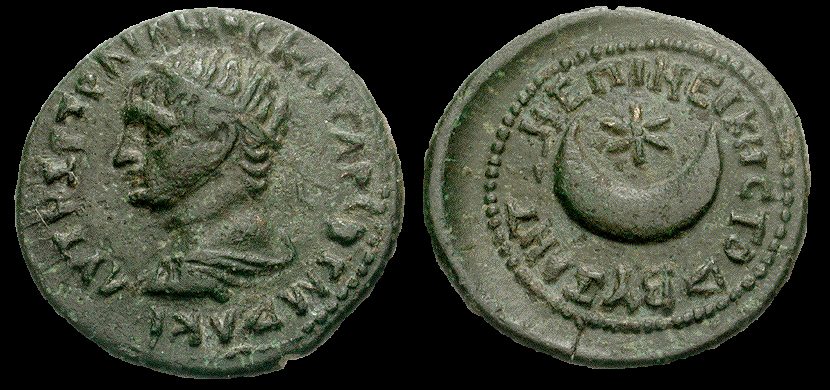
Today the crescent moon is the most widely recognized symbol of Islam, yet early Muslims used icon-free banners of various colors. The moon and star, symbols of Byzantium since the 4th century BC, spread across the Islamic world during the expansion of the Ottoman Empire.
Moon & Star Byzantine coin, ca. 100 AD
The Qur’an forbids worship of the moon or any other object. During the Prophet Abraham’s quest for God, Abraham first worships a “shining planet”, but when the star fades he says, “I love not those that disappear.” When the moon rises he says “This is my Lord.” But he is disillusioned when the moon sets as well. Finally, when sun rises, he says, “This is my Lord; this is the greatest of all” But like the moon and star, even the sun sets. Abraham at last proclaims, “I have devoted myself absolutely to the One who initiated the heavens and the earth. I will never be an idol worshipper.” [Qur’an 6:76-79]
Al-Hijra
The birthnight of Islam may have been Muhammad’s first revelation of the Quran by the Angel Gabriel in 610 CE. But the Year known as 1 in the Muslim calendar came over a decade later..
The Prophet Muhammad was living in Makkah, teaching Islam and monotheism to his followers, and thus angering the city’s governance. Even then Makkah was a pilgrimage destination, but for a very different reason. The Kaaba–the birthplace of monotheism in Islam–held idols of pagan gods worshipped by the many cults and clans around Makkah. Much of the power of city leaders rested on their perceived connection with pagan gods and idols.
Muhammad found support in the people of Medinah, who would travel the 200 miles distance to Makkah to meet with him and learn the ways of Islam. Muhammad refused to stop teaching Islam, despite offers of riches and power from government leaders if he did, and threats to his life if he didn’t. In September of 622 he cut his ties with the leaders of Makkah and led his followers north to Medinah to establish the world’s first city-state governed by the laws of the Qur’an.
Though today Makkah is the direction toward which Muslims pray and the destination of the Hajj, it was Muhammad’s departure of the city that set in motion the Islamic calendar. We’re beginning the 1430th year of Al-Hijra, or “the Migration.”
Months of the al-Hijra calendar
Muharram: Forbidden, holy Safar: Whistling of the Wind Rabi al-Awwal: First month of spring Rabi al-Thani: Second month of spring Jumada al-Awwal: First month of dryness (summer) Jumada al-Thani: Second month of dryness Rajab: To respect. One of the four sacred months, Rajab is also called Rajab al Fard (alone), because the other three sacred months are consecutive. Shaban: Continual Increase Ramadan: Intense heat Shawwal: Uplift or breakage Zul Qu’dah: To sit Zul Hijjah: Pilgrimage (month of the Hajj)
The names derive from pre-Islamic times when the months coincided with the seasons.
[from Dec. 28 – 2008 – For the first time in over three decades Muslims will celebrate two ‘New Years’ in a single Gregorian calendar year. First, Al-Hijra 1429 on January 9/10 2008 CE and now 1430 AH on December 28/29. The next time this will happen will be in 2041 CE, so better make this one count!]
~ November 26, 2011 ~ November 14, 2012 ~ November 3, 2013
Muharram is the first month of the Islamic calendar.
But you won’t find fireworks displays or any celebrations akin to both Western and Eastern New Year traditions. On the first day of the year Muslims reflect upon the Hijra–the Prophet Muhammad’s flight from Mecca to Medina in 622 CE.
Muharram procession. (Chan'ad Bahraini)
The Hijra is considered the beginning of the Islamic calendar; hence, years are referred to as AH (After Hijra).
During the month of Muharram, Muslims focus on the Islamic principles of sacrifice, selflessness, patience, and knowledge of Allah Ta’ala. It is also one of the four sacred months. Fasting during Muharram is not obligatory, but is encouraged during the first ten days, especially the tenth day, Ashura.
The Islamic calendar is approximately 355 days with twelve months of 29 to 30 days. For this reason the Islamic calendar does not usually coincide with the solar calendar, but falls about 10 days earlier each year.
The dates of Muslim holidays vary depending on the visibility of the lunar crescent. Unlike other lunar calendars which begin on the new moon, in the Islamic calendar a month begins when the crescent of the moon is first visible.
Though lunar cycles can be predicted, lunar sightings cannot, due to inclement skies and other atmospheric conditions. For this reason pre-printed calendars are not considered accurate, although they are necessary for planning. Saudi Arabia has adapted a standard calendar based on the lunar cycle as it would be viewed on a clear night from Mecca.
Observing the Islamic calendar, or Hijra calendar, is a sacred duty to all Muslims.
Prior to the Hijra in 622 CE much of the Arab world used a lunar calendar that was offset by an “Intercalculation,” or extra month, inserted every three or so years. The Intercalculation month was inserted by government astronomers to keep the lunar calendar in line with the solar calendar. But by arbitrarily manipulating the lunar cycle the dates of the four sacred months became corrupted. As the Qur’an explains in 9:36:
“The number of the months with Allah is twelve months by Allah’s ordinance in the day that He created the heavens and the earth. Four of them are sacred.”
During the sacred months sacred activities are observed and fighting is forbidden; thus it was/is vital that all Muslims be on the same calendar and that the sacred months not vary from state to state:
“Postponement (of a sacred month) is only an excess of disbelief whereby those who disbelieve are misled. They allow it one year and forbid it another year so that they may make up the number of the months which Allah has allowed in order to permit what Allah has forbidden.”[Qur’an 9:37]
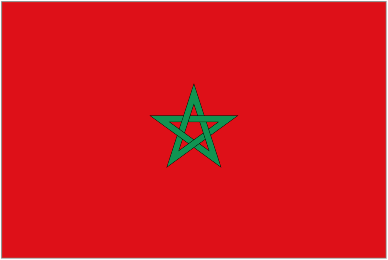
Nope, this has little to do with the environmental movement. Green here signifies the religion of Islam, and the March in question was led by Moroccans protesting Spain’s continued occupation of the Western Sahara (then Spanish Sahara) well into the 1970s.
The Green March was orchestrated by Morocco’s King Hasan II who emphasized Western Sahara’s long-standing ties with his country.
In 1975, faced with growing international opposition and fighting within the territory, Spain announced the possibility of creating an independent state out of Spanish Sahara.
However, both Morocco and Mauritania (to the southeast) had claims to the territory. Hasan took the case to the International Court of Justice. The Court determined that there were ties between the Saharan territory and Morocco, but that the ties were not substantial at the time of Spain’s colonization of the territory; thus the Court recommended a Saharan referendum on self-determination.
In a televised announcement, Hasan emphasized the first part of the Court’s recommendation—the territory’s ties to Morocco—and called on Moroccans to liberate Spanish Sahara by means of a massive peaceful march.
On November 6, 1975, around 350,000 unarmed Moroccans assembled on their southern border and crossed over into then-Spanish territory calling for the return of Moroccan Sahara. The Spanish commanders refused to fire on the unarmed civilians as Hasan had predicted. The Green March went off peacefully and triumphantly. Later that month Spain agreed to temporary joint administration of the territory with Morocco and Mauritania, after which Western Sahara would be split between the two African nations.
Mauritania withdrew from Western Sahara in 1979 after a guerrilla war movement in favor of Saharan independence. The anniversary of Green March is a triumphant holiday in Morocco, although the call for independence is still hotly debated in Western Sahara.
There’s little evidence in the Qur’an for green’s emergence as the color most symbolic of Islam, but numerous Muslim countries include green on their flags. In fact Libya’s flag is entirely green, the only single-color banner in the world.
One Surah (76:21) does notes that in paradise, denizens will be clad in green robes of fine silk.
Other sources claim that the Prophet Muhammad wore green and used green in his armies’ banners.
Still other theologians point to green as the color of nature and of life. So in a sense the Green March may have been related to the environmental movement after all…
“There is no deed more precious in the sight of Allah, nor greater in reward, than a good deed done during the ten days of Sacrifice.”
Prophet Mohammad reported by Ibn Abbas
[Published Dec. 9, 2008] It brings me great joy to write about Eid al-Adha today. Not just because it’s one of the holiest days of Islam, and one of only two Eids (Festivals).
It’s also because Eid al-Adha is the first holiday I wrote about for Every Day’s a Holiday, which means we’ve come almost full circle. Since the Islamic calendar is 11 days shorter than the Gregorian calendar, it hasn’t quite been a solar year, but we’re getting there.
I have learned so much about the Islamic calendar over the past year, my head hurts. I used to think, Why does the Islamic calendar have to be different from every other calendar in the world? Not all calendars are 365 days long, but at least they make some effort to correct themselves every few years. A leap day, leap week, leap month. Leap something! The Islamic calendar says, uh-uh. Pay no heed to seasons. A month observed in the summer 15 years ago is observed in the winter now, and vice-versa.
It struck me as counterintuitive. Or some kind of weird trick to play on kids. But now, after following the calendar through a full cycle, I see two reasons.
The first is that as all other calendars shift in relation to the Islamic calendar, Muslims get to share and contrast their celebrations and holy days with all other cultures.
The holiest third of the month of Ramadan just touched the ten days of atonement of the Jewish calendar, observed between the High Holy Days. Precisely as Muslims broke the fast with Eid al-Fitr, the Jews began the fast of Rosh Hashanah.
And Eid al-Adha this week coincides with the Catholic Festival of the Immaculate Conception (December 8), both of which speak to the bond between parent and child, and the bond between humanity and God.
Eid al-Adha, the Festival of the Sacrifice, commemorates the moment when Abraham nearly sacrificed his son at Allah’s request. And the moment the Lord stopped Abraham in time to offer him a ram to take Ishmael’s place.
It is this moment between Abraham and his son Ishmael, that the Prophet Mohammad set forth as the defining event of Islam, which means literally, “submission”. For this reason, the structure known as the Kaaba–where Abraham first introduced monotheism to the world–was sanctified by Mohammad as holiest site on Earth.
During Eid al-Adha Muslims strive to experience the oneness of God, beginning with a special prayer:
In the name of God
And God is the greatest
O God, indeed this is from you and for you
O God, accept from me
And just as when we make a sacrifice for a friend or a loved one, we find that the sacrifice was not from us, but for us.
Today begins the Hajj to Mecca in which millions of Muslims around the world will leave their homes to embark on the journey that every financially and physically able Muslim must take once in their lifetime.
Destination: Makkah (Mecca), Saudi Arabia.
The Hajj to Mecca has been called the most diverse gathering of human beings ever assembled. Participants come from all countries, all races, and all walks of life.
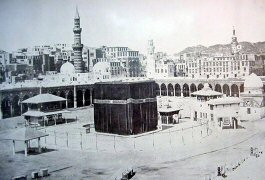
Mecca is the city toward which, the rest of the year, Muslims pray five times a day. During Hajj millions converge on the Masjid al Haram, the holiest mosque in all Islam. The Holy Mosque’s open court can accommodate hundreds of thousands of worshipers, who circumambulate (I don’t get to use that word very often) around the centerpiece of the court: the Kaaba. The Kaaba is a stoic black cube which holds a sacred stone believed to have fallen from heavens in the days of Adam.
Kaaba in the middle of the Holy Mosque, circa 1880
It was here, thousands of years ago that Abraham and his son Ishmael introduced the world to monotheism, by building a small temple in the middle of the desert, as commanded by God. Abraham shouted out to the empty desert a welcome to anyone who would join him in prayer at the Kaaba. Each year during Hajj, millions answer his call.
Though the people of the Arabian peninsula have revered the site long before the days of Mohammad, it was the Prophet who set the stone in its final place. Muslims don’t worship the stone itself–Islam allows no idols of any kind. Rather, the place is revered for its connection to the Prophet Muhammad and to God.
This holy meteor has never been carbon-dated, but it was stolen once. According to www.lancashiremosques.com:
In 317/930 the Qarmatians raided Mecca; they captured the stone, and carried it off to al-Hasa or Bahrayn, where it was kept. Ransom was offered for it, which was ignored. Then in 340/951 it was thrown, the historian Juwayni relates, into the Friday Mosque of Kufah with a note: “By command we took it, and by command we have brought it back.”
During Hajj, pilgrims enter a state of Ihram. During Ihram one may not intentionally harm any living creature, and men must wear two pieces of unstitched cloth, one around their waist and one over their shoulders. As Kamran Pasha, author of Mother of Mother of the Believers: A Novel of the Birth of Islam, explains:
In this way, all pilgrims are dressed exactly the same, eliminating differences of race, culture and economic status. Whether we are kings or paupers, whether we wear suits and ties or dashikis in the world we left behind, we are all the same now – human beings standing equally before our Creator, devoid of manmade distinctions.
Hajj is a spiritual journey, but it is also one of visas and vaccinations. passports and paperwork. The more one prepares, the better. Saudi Arabia does its best to accommodate over a million foreigners crossing its borders for the pilgrimage, but travel prices can be jacked up four-fold during, and sadly, “A number of pilgrims have reported being unable to reach Mecca due to fraudulent travel agencies eager to cash in on the world’s largest religious pilgrimage.”
Circling the Kabah seven times is the most important part of Hajj, but not all of it. Pilgrims also follow the footsteps of Hagar and her son Ishmael as they searched for water in the desert millennia ago. It is said Ishmael struck his foot on the ground and water sprang forth from the sand.
…For it’s the turn of the year and All Souls’ night,
When the dead can hear and the dead have sight…
Edith Wharton, All Souls
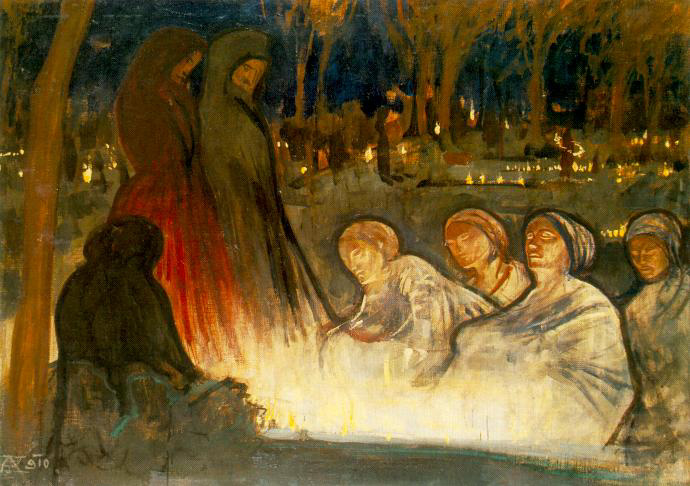
All Souls Day - Aladar Korosfoi-Kriesch
Whereas All Saints Day recognizes the departed whose souls have found refuge in Heaven, All Souls Day remembers those restless spirits still lingering in Purgatory.
All Souls Day originated not in Rome but France.
Around 820 Amalarius of Metz (northwest of Strasbourg) wrote “After the offices of the saints, I have inserted an office for the dead. For many pass over from this present age who are not immediately united with the saints.” (ie. “don’t go directly to heaven.”)
In the early 11th century, St. Odilo, fifth abbot of the Cluny monastery, officiated the feast of All Souls on November 2. Over the century, the tradition was adopted by dioceses across Western Europe.
On All Souls Day, families visit the graves of their loved ones and light candles in their memory.
Fear not the shudder that seems to pass:
It is only the tread of the their feet on the grass…
…For the year’s on the turn and it’s All Souls’ night,
When the dead can yearn and the dead can smite…
…Let them see us and hear us, and say: “Ah, thus
In the prime of the year it went with us!”
All Souls Day is celebrated on November 2, unless the 2nd falls on a Sunday, in which case it’s observed on Monday, November 3 as was the case in 2008.



.jpg "Muharram_procession_2,_Manama,_Bahrain_(Feb_2005)")